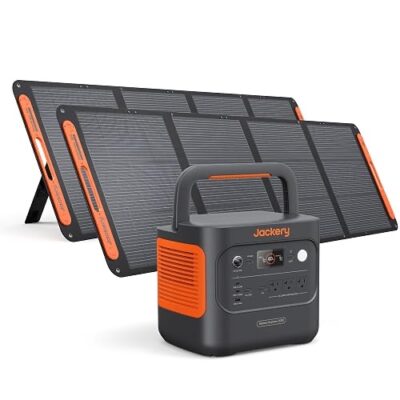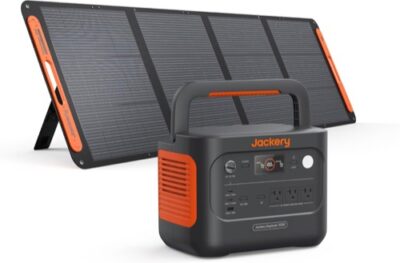
Jackery HomePower 3600 Plus Kit Review: 400W Solar and Backup Limits
At a Glance
KEY FEATURES
- Exact offer: JHP-3600A HomePower 3600 Plus with two SolarSaga 200W panels, ASIN B0FMXCPWBN.
- 3,584Wh LFP storage and 3,600W rated battery AC output; 7,200W listed surge.
- 400W solar included versus a 1,000W receiver maximum; matched dual-input voltage required.
- 10ms listed backup transfer; grid bypass is limited to 1,440W / 12A.
- About 77.2lb, with wheels and telescoping handle; one station supplies 120V, not native 240V.
PROS
- 3,584Wh LFP capacity supports a substantial essentials plan.
- 3,600W output and 7,200W surge give useful appliance headroom.
- Wheels and an extendable handle make 77.2 lb more manageable.
- Fast AC charging provides a realistic poor-weather recovery path.
CONS
- Two 200W panels are undersized for rapid recovery of a 3,584Wh battery.
- Whole-house and 240V expectations require a separate circuit and transfer audit.
- Panels, cables, and the station consume meaningful storage and deployment space.
- Large multi-box deliveries demand immediate inventory and commissioning.
Best for staged home backup
Exact-kit documentation plus 41 usable qualitative owner records; solar recovery is rated lower because the included 400W array is small relative to 3,584Wh storage. No first-party test or population-rate claim.
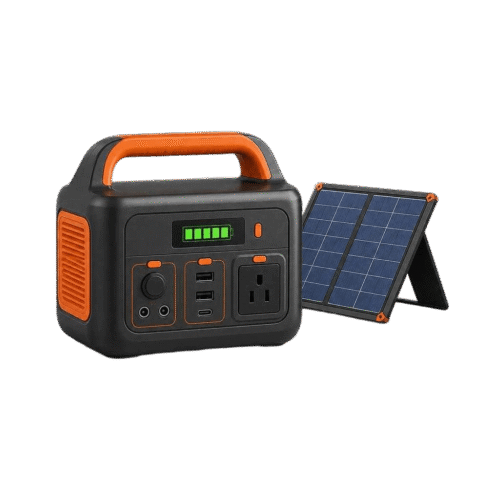
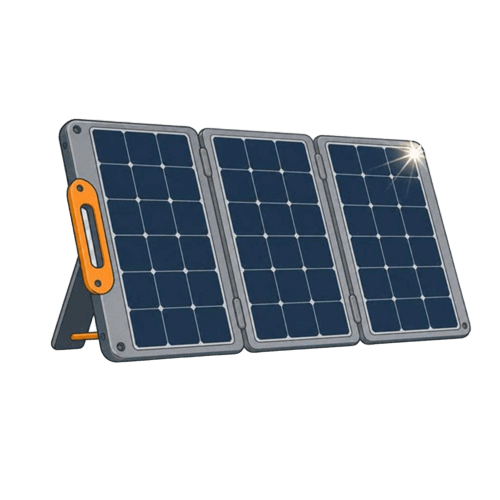
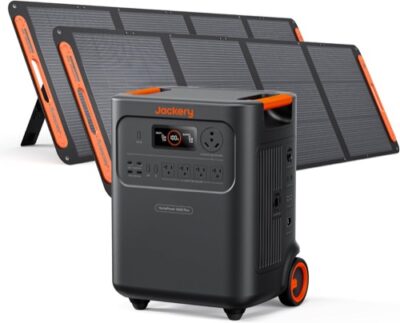
The Jackery HomePower 3600 Plus kit pairs a substantial 3,584Wh battery with two 200W SolarSaga panels. That is 400W of included solar against a station capable of accepting up to 1,000W. The mismatch is not automatically a bad purchase: it makes sense when sunlight extends an outage reserve and AC power provides the main recovery route. It is much less convincing as a complete solar-only plan.
This review concerns the US JHP-3600A two-panel offer, ASIN B0FMXCPWBN. It draws on Jackery’s documentation and genuine customer accounts, not independent hands-on testing. “3600” in the product name should not be read as 3,600Wh of stored energy.
Start with the outlets—and the lower bypass limit
The battery inverter supplies up to 3,600W continuously, with a listed 7,200W surge. That gives useful headroom for compatible 120V appliances, but it does not mean every outlet or operating mode supports the same load.
| Connection or mode | Manual limit | What changes your plan |
|---|---|---|
| Four ordinary AC outlets | 120V; 2,400W per port, within the 3,600W combined battery-output limit. | Individual and combined limits both apply. |
| TT-30 outlet | 120V, 30A, up to 3,600W. | A direct 30A connection does not create unlimited energy or 240V service. |
| Grid bypass / UPS operation | 120V, 12A, 1,440W. | A load acceptable on battery may exceed the wall-powered bypass allowance. |
| USB charging | Two USB-C ports up to 100W each and two USB-A ports up to 18W each. | The documented station outputs do not include a 12V car socket; vehicle charging is an input function. |
The HomePower 3600 Plus manual lists a transfer within 10ms, not zero interruption. It recommends testing compatibility and cautions about multiple devices in UPS use. Keep its 1,440W bypass limit separate from the larger outage-output headline.
What the two panels can put back
The most useful calculation is energy replaced during your available sun, not a guaranteed time to reach 100%. Dividing 3,584Wh by 400W gives 8.96 hours at full nameplate output before losses. That is arithmetic, not a measured recharge result, and not 8.96 ordinary daylight hours.
One owner described roughly 100W per panel in winter conditions. That is useful context for seasonal planning, not a typical-output benchmark. Other accounts describe successful household backup, but the evidence does not establish a dependable full daily refill from this exact pair of panels.
Use the load-and-runtime planning method to separate running watts from daily energy. A high-power cooking appliance may fit the inverter while quickly consuming the reserve intended for refrigeration overnight.
Solar expansion requires a matched arrangement
The two DC8020 inputs accept solar in the 16–60V range, up to 12A per input and 1,000W combined. Jackery also requires the input voltages at both ports to match and recommends the same panel model and panel count on each side. The manual permits at most two panels per port in its documented arrangement. A matching plug alone is not compatibility approval.
- Identify the delivered panel revision. Match its electrical label and manual rather than borrowing figures from another SolarSaga 200W generation.
- Check the complete array. Voltage, current, cold-weather limits, adapters and connector arrangement all need to satisfy the station instructions.
- Keep charging methods distinct. The manual prohibits using vehicle and solar input together, and specifies a 12V—not 24V—vehicle charging source.
- Budget the deployment. Added panels need usable sun, support, protected cable routes and storage, not just a higher wattage total on a shopping list.
For a household with occasional outages and reliable utility recovery, keeping the included pair may be entirely reasonable. For a cabin or extended outage where sunlight must replace most daily use, design the compatible array and fallback source before buying extra batteries.
Owner experiences point to distribution and handling
An owner described running a kitchen refrigerator, garage freezer, Wi-Fi and security equipment through a seven-hour interruption. That supports a practical use case, not a universal seven-hour energy budget.
Another buyer emphasized that only equipment actually connected to the station receives power. Outlet placement and approved distribution can decide usefulness before battery capacity does.
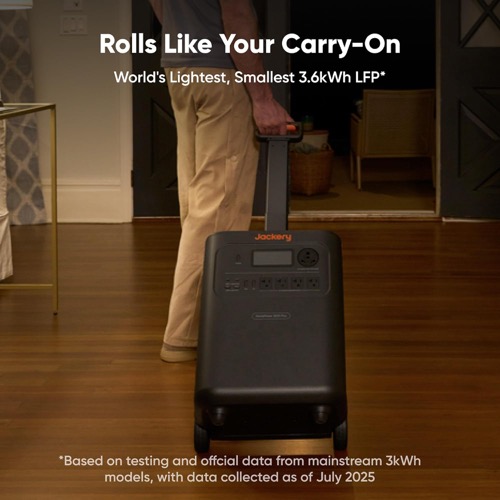
Other feedback describes the difficulty of moving the approximately 77.2lb station into a vehicle and handling the separate panels. Wheels and a telescoping handle help on a suitable floor; they do not remove the lifting problem at stairs, a trunk or a high threshold.
The station itself is not waterproof or dustproof according to its manual. Keep it in the specified protected environment even when the panels are outside. A panel weather rating cannot be transferred to the battery, plugs or household distribution arrangement.
Check the delivered kit before the return window closes
Customer accounts include missing or faulty panel concerns and differing refund or replacement experiences. They do not support a failure percentage or a promise that support will resolve a problem promptly. A multi-box kit deserves an early inventory and a charging check while the delivery details are still easy to document.
- Match the purchase. Photograph model labels, serials, both panels and included leads; reconcile every box with the exact seller offer.
- Check both charging paths. Following the manuals, confirm AC charging and the supplied solar arrangement. Record conditions and stable input rather than one fleeting display peak.
- Prove the actual essentials routine. Include appliance starts, cycling, overnight reserve and the intended recovery period. Review the energy-saving setting for small or intermittent loads.
- Document any fault. Keep the code, configuration and photos for a written support case. Do not improvise wiring or repeat resets when the manual calls for service.
A household circuit connection needs appropriate transfer equipment and a qualified installer. Do not backfeed a wall outlet, and do not turn an owner’s grounding-adapter anecdote into a DIY instruction. For sensitive equipment, distinguish backup transfer behavior from uninterrupted power; this kit is not a blanket recommendation for medical or other life-critical loads.
The 400W bundle works best when solar is the helper
Choose this exact kit for a measured group of 120V essentials when you value the larger energy reserve, the TT-30 outlet and rolling movement, and can recharge from AC when weather disappoints. The included panels are a useful starting point if their daily contribution matches your expectations.
Short interruptions, planned loads and dependable non-solar recovery can justify starting with two panels. Check the lower bypass limit if the station will remain between the wall and an appliance.
Solar-only daily recovery, upstairs portability and 240V household service are different projects. Price the array, lifting route or additional system hardware before treating this kit as their solution.
The purchase turns on recovery and installation, not whether 3,600W sounds sufficient. A compatible appliance can still exhaust the battery faster than 400W of panels can refill it. That is the central trade-off to settle before checkout.
Pros & Cons Analysis
Based on documented specifications and owner feedback
Pros
- Serious energy reserve — The battery can support refrigeration, communications, security, lighting, and scheduled high-draw tasks when their real watt-hours are measured.
- Useful inverter margin — Rated battery output is 3,600W, but bypass is limited to 1,440W. Confirm the mode and individual outlet limits as well as appliance startup demand.
- Large-station mobility — Integrated wheels and a telescoping handle make one-floor movement far easier than lifting a conventional 77-pound box.
- Flexible recovery strategy — Fast AC input lets solar act as an extender rather than the only route back to full during cloudy outages.
- Room to improve solar — A 1,000W station ceiling gives a qualified designer space to build beyond the included 400W array.
Cons
- The bundle is solar-light — The 3,584Wh battery divided by 400W gives 8.96 full-output hours before losses, not a guaranteed number of daylight hours.
- Home integration is not automatic — Selected circuits, 240V appliances, neutral and grounding behavior, and transfer equipment must match the exact system and local code.
- Portability has limits — Wheels do not solve stairs, vehicle lifting, soft ground, or safe restraint in transit.
- Portable panels add labor — Two modules require setup space, wind management, clean connectors, cable routing, and repeated angle adjustments.
- Service readiness matters — Photos, serials, input/output logs, and early delivery checks improve any missing-part or panel-remedy case.
Buy the Reserve Only After Checking How You Will Refill It
This two-panel kit is most convincing for measured 120V essentials when solar supplements a dependable AC recovery route. The larger battery, TT-30 outlet and rolling design are useful, but none makes the included 400W array a guaranteed daily refill.
For solar-only operation, 240V service or frequent lifting, price the additional system requirements first. If you intend to leave an appliance connected through the station, its 1,440W bypass ceiling—not the 3,600W battery headline—is the first check.
Frequently Asked Questions
Is the HomePower 3600 Plus battery 3,600Wh?
No. The JHP-3600A manual specifies 3,584Wh. Its rated battery AC output is 3,600W; watts describe power, while watt-hours describe stored energy.
Can the included two panels recharge it every day?
That is not established. Dividing 3,584Wh by the 400W panel rating gives 8.96 full-output hours before losses. Weather, season, shading, charging losses and concurrent loads affect net daily recovery. Use measured daily harvest and consumption rather than a fixed refill promise.
Why does the UPS mode have a lower power limit?
In grid bypass, the manual specifies 120V / 12A / 1,440W. The 3,600W figure applies to rated battery inverter output. A load that fits battery operation can therefore exceed the bypass allowance. The manual lists a transfer within 10ms and requires device-compatibility checks.
Can I add different panels to the unused solar capacity?
Only an arrangement approved for the exact station and panels should be used. The manual specifies 16–60V and 12A per solar input, 1,000W combined, matching input voltages, and recommends the same panel model and count on both ports. Connector fit alone does not prove compatibility.
Does this kit have 240V or a 12V car output?
One station supplies 120V AC and the documented USB outputs, not native 240V or a car-output socket. A 240V parallel system requires a second compatible station and prescribed hardware. Vehicle charging is a separate 12V input function.
Can I leave the station outside beside the panels?
The manual states that the station is not waterproof or dustproof. Keep it in the specified protected environment, with safe cable routing. A solar panel’s weather rating does not apply to the station or the whole installation.
Technical Specifications
| Brand | Jackery |
|---|---|
| Kit model / SKU / ASIN | HomePower 3600 Plus + 2 × SolarSaga 200W bundle (ASIN B0FMXCPWBN; US) |
| Power-station model | Jackery HomePower 3600 Plus, model JHP-3600A |
| Included solar-panel model and quantity | 2 × Jackery SolarSaga 200W bifacial portable panels |
| Battery capacity | 3,584Wh |
| Battery chemistry | LiFePO4 (LFP) |
| Cycle-life rating | 6,000 cycles to at least 70% capacity |
| Expandable capacity | Up to 21.5kWh per station with five Battery Pack 3600 units |
| Continuous AC output | 3,600W |
| Surge / peak output | 7,200W surge from one station; two-station hardware is required for 240V |
| AC voltage, frequency, and waveform | 120V, 60Hz, pure sine wave |
| AC outlets and high-current / RV / 240V outputs | 4 × ordinary 120V outlets: 2,400W per port; 1 × TT-30: 3,600W. Battery AC total: 3,600W. Grid bypass: 1,440W / 12A. Native 240V requires a second station and prescribed parallel hardware. |
| USB and DC outputs | 2 × USB-C up to 100W and 2 × USB-A up to 18W; no 12V car-output socket in the documented output inventory |
| Maximum station solar input | 1,000W across two DC inputs |
| PV input voltage/current range and connector | Dual DC8020: 16–60V / 12A per port, 24A / 1,000W total. Manual requires matching input voltages and recommends identical panel models/counts on both ports. |
| Included panel rated power | 400W total (2 × 200W) |
| Panel Voc / Vmp / Isc / Imp | Verify the electrical label and matching manual for the delivered SolarSaga 200W revision; do not transfer figures between generations |
| Panel construction and cell type | Two foldable bifacial monocrystalline panels |
| Panel weather rating | IP68 panels |
| Panel dimensions and weight, folded / deployed | Confirm the delivered panel revision before planning storage and deployment; two separate folding panels are included |
| Solar recharge estimate with included panel | 3,584Wh ÷ 400W = 8.96 nameplate hours before losses; this is arithmetic, not a guaranteed recharge time or ordinary daylight duration |
| Maximum AC input and AC recharge time | Manual: 100–120V, 60Hz, 15A maximum AC input. Recharge duration depends on mode, starting charge and conditions; bypass output remains limited to 1,440W. |
| Car, alternator, and other charging methods | 12V vehicle source only; DC input 12–16V, 8A total. Car cable sold separately. Do not combine vehicle and solar input. |
| UPS / EPS support and transfer time | Within 10ms according to JHP-3600A manual; not zero-transfer. Bypass: 120V / 12A / 1,440W. Test device compatibility. |
| App and connectivity | Jackery app over Wi-Fi and Bluetooth |
| Station dimensions, weight, operating limits, and weather rating | 15.2 × 12.2 × 19.3in; about 77.16lb / 35kg; charge/discharge -20–45°C. Manual states not waterproof or dustproof; use the specified protected environment. |
| Station and panel warranties | Station manual: 3 years plus 2 with eligible registration. Confirm seller eligibility and separate panel coverage for the delivered offer. |
| Included in the box | HomePower 3600 Plus, AC cable, 2 × SolarSaga 200W panels, solar charging leads, documentation; transfer switch and batteries sold separately |