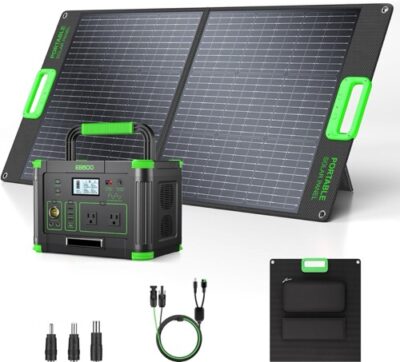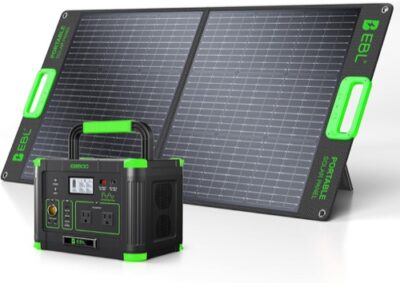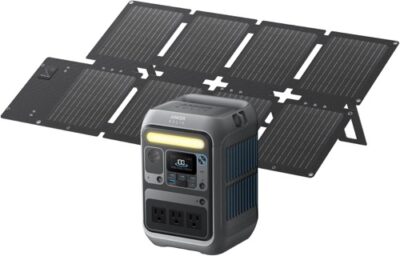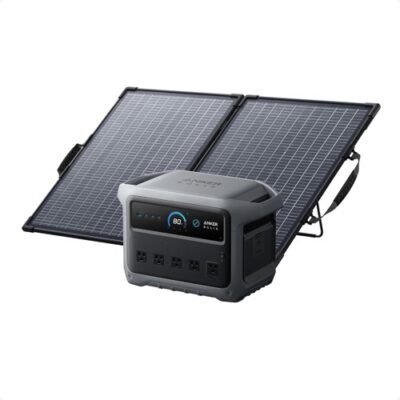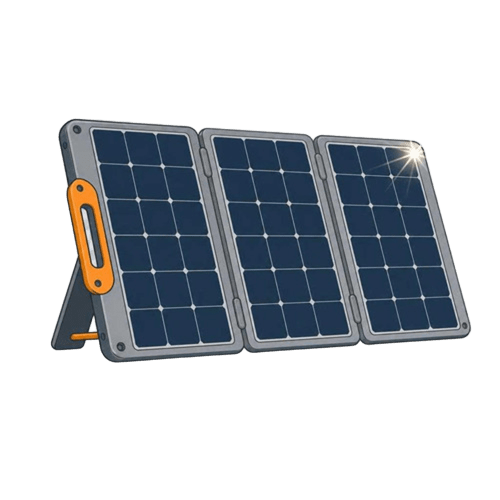
OUPES 2000W Solar Generator Review: A 1024Wh Station That Charges in 36 Minutes and Grows to 5120Wh
At a Glance
KEY FEATURES
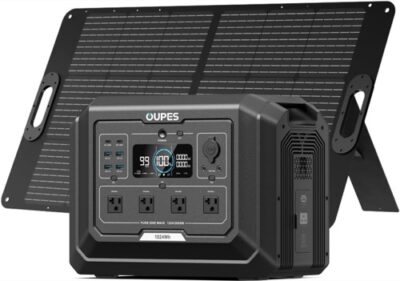
- Exact kit: OUPES Mega 1 with one OUPES 100W portable panel.
- Station: 1,024Wh LFP, 2,000W continuous output, and expansion to 5,120Wh.
- Solar mismatch: 100W included versus an 800W station ceiling.
- Recovery: Very fast AC input contrasts with slow starter-panel recharge.
- Best fit: Staged home/camping backup where battery and array upgrades follow measured loads.
PROS
- 2,000W output supports many household and travel appliances.
- 1,024Wh LFP base can expand to 5,120Wh.
- Fast AC charging is useful during short grid or generator windows.
- 800W solar ceiling leaves room for a serious array upgrade.
CONS
- Included 100W panel uses only one-eighth of the station solar ceiling.
- Missing-panel fulfillment appears in the supplied owner narratives.
- App, bypass, and restoration behavior require commissioning.
- Expansion batteries worsen recovery time unless charging grows too.
Best staged system, weak starter solar
Exact documentation plus 64 usable qualitative owner records. Station capability scores well; solar score reflects the 100W-to-800W mismatch and fulfillment evidence. No first-party test.
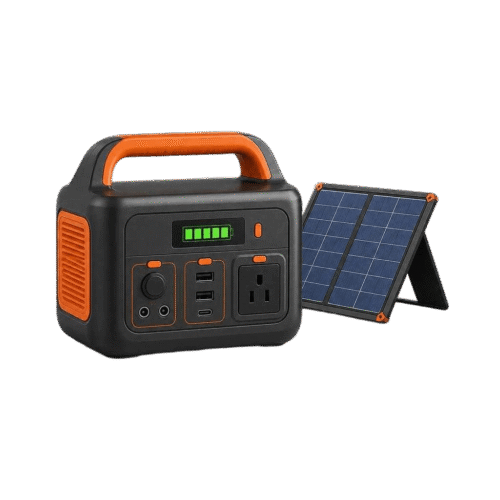
The OUPES Mega 1 bundle is easiest to understand as a staged system. Stage one is the station: 1,024Wh, 2,000W continuous output, expansion support, app connectivity, and fast AC input. Stage two is the included 100W panel, which proves the solar path and offsets small daytime loads. Stage three is the compatible array or expansion battery a buyer may add after measuring real energy use. Confusion occurs when stage two is advertised as if it already completes stage three.
Sixty-four usable owner records support freezer, refrigerator, outage, camping, and expansion interest, along with fast wall recovery. They also include missing-panel fulfillment reports, solar-input and grid-bypass questions, app behavior, and mixed support outcomes. These narratives make acceptance and commissioning central. They do not establish a missing-item rate or typical failure frequency.
A 100W module is one-eighth of the 800W receiver ceiling. Empty-to-full planning lands around 12–14 peak-sun hours before poor weather or concurrent load. That can preserve a freezer or router reserve but is unlikely to replace a deeply cycled battery in one ordinary day. A larger compatible array changes the recovery curve far more than optimistic positioning of the starter panel.
| Upgrade problem | Better first upgrade | Reason |
|---|---|---|
| Battery ends each day low despite sun | More compatible PV | The 100W panel underuses an 800W receiver |
| Battery reaches full but overnight reserve is insufficient | Compatible expansion battery | Harvest exists; stored energy is the constraint |
| Motor overloads at startup | Different inverter/system | More battery or solar does not raise every output limit |
| Panel is missing or mismatched | Fulfillment remedy first | Do not redesign around an incomplete order |
For freezer backup, log watt-hours over a complete hot-day duty cycle and test compressor starts separately. Expansion to 5,120Wh can extend runtime, but it does not make a 100W panel adequate for refilling the expanded bank. Every added watt-hour creates a larger recovery obligation. Build the battery and array together.
Bypass and app behavior deserve a four-state commissioning sequence: grid present, grid lost, low-battery condition, and grid restored. Save settings and firmware version. Sensitive computing may still require a dedicated UPS. If the station or seller promises a particular transfer function, verify it on the exact load rather than inferring from an under-20ms headline.
The 100W Starter-Panel Acceptance Gate
| Spec | Value |
|---|---|
| Battery Capacity | 1024 Wh LiFePO4 (to 5120Wh) |
| Continuous AC Output | 2000 W (pure sine wave) |
| Surge / Peak | 4500 W |
| Bundled Solar | 100 W panel (station accepts up to 800 W) |
| Wall Recharge | 0-80% in 36 min (owner: ~45 min to full) |
| Ports | 4 AC, 2 USB-C (100W), 4 USB-A, 2 DC5521, 1 car |
| Weight | 27.8 lb |
| Cycle Life | 3,500+ cycles |
| Best For | Camping, road trips, home outage backup |
Mega 1 Station Verdict Versus Bundle Verdict
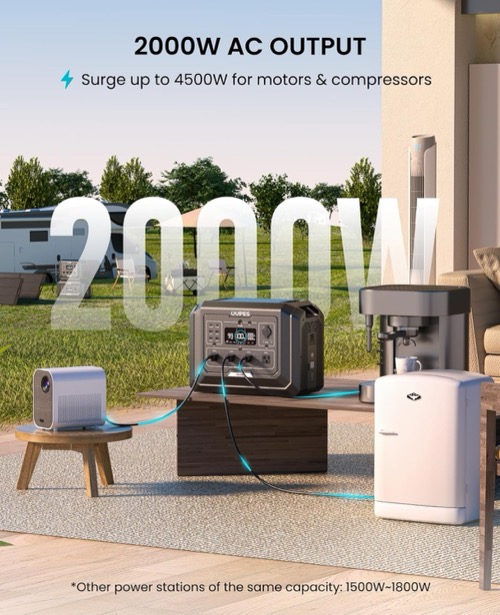
If you want a fast-charging, expandable station and you’re realistic about the panel, this OUPES 2000W solar generator review lands on a conditional yes for the right buyer. The station is the standout: 27.8 pounds, a 2000W inverter with a 4500W surge, 13 ports, an under-20ms UPS, and a wall charge one owner clocked at about 45 minutes. The 1024Wh LiFePO4 pack runs low-draw gear like fans and camper loads for hours and starts heavy appliances cleanly. The catch is the bundled 100W panel — undersized for 1024Wh, and slow enough that one owner barely moved off 67% after five sunny hours. Buy it for the station and the expandability, not the solar in the box.
A 1,024Wh Base With a 5,120Wh Expansion Question
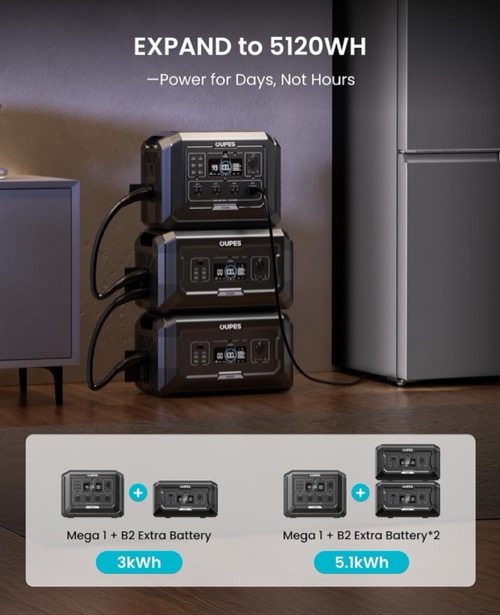
The first thing worth understanding is that 1024Wh is a starting point, not a ceiling. Add two B2 extra batteries and the pack climbs to 5120Wh — five times the storage — which is what separates a weekend camping unit from an extended off-grid or multi-day outage setup. You scale the same station instead of rebuying, and that changes how you should think about the purchase: this is a platform, not a fixed box.
Owners describe a sturdy, compact build that stays a realistic one-person carry at 27.8 pounds. One buyer’s older aunt in Jamaica carried it around herself to keep phones charged and lights on through power problems — a small detail that says more about real-world portability than any spec sheet. The LiFePO4 pack is rated for 3,500+ cycles with strong thermal stability, so it reads as long-term standby gear rather than a disposable gadget.
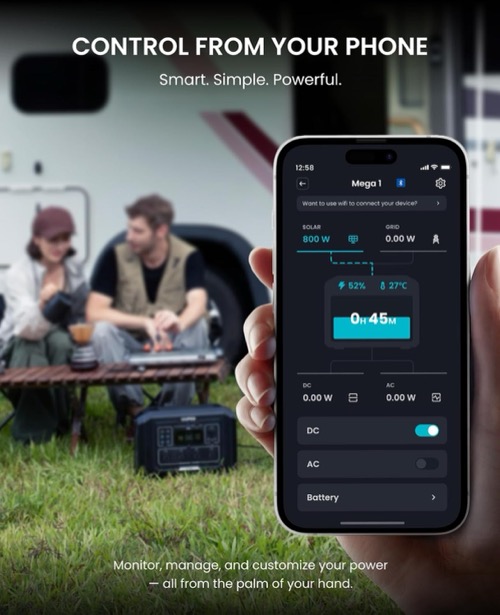
The control side is modern. A Bluetooth/Wi-Fi app lets you monitor input, output, and battery level remotely — one owner singled it out as a genuine bonus — and an LCD screen on the unit shows the same real-time stats at a glance. You don’t need the app to run the basics, but it’s handy for checking charge without walking over.
Start the Hardest Appliance Before Building the Load Group
The 2000W pure sine wave inverter covers far more than phones and laptops, and the 4500W surge is what lets motor-and-compressor loads start cleanly. Owners have run two fans through an entire hot event day, powered a small swamp cooler “no problem,” and cooked with a skillet and coffee maker during an outage. The marketing calls out microwaves, power tools, and mini-fridges, and the field reports line up: this station starts the heavy-startup gear it claims to.
The honest limit is capacity, not power. A 1024Wh pack behind a 2000W inverter empties quickly under continuous high-draw loads. A space heater or microwave runs in useful bursts, not for hours. That’s not a flaw so much as the nature of a 1kWh pack — and it’s exactly why the expansion batteries exist.
Callout — The 4500W surge decides *what* you can plug in; the 1024Wh pack decides *how long* it runs. Owners started swamp coolers, skillets, and fans without tripping the inverter — the surge handles the spike, and the capacity sets the clock. For all-day appliance backup, the B2 batteries are the answer, not a bigger inverter.
Freezer Duty Cycle as the Energy Benchmark
Start with the honest usable number. After inverter and conversion losses, a 1024Wh LiFePO4 pack delivers roughly 870 watt-hours to your AC devices — call it 1024 × 0.85. That figure, not the nameplate, is what your runtime math should use.
From there it splits into two stories. High-wattage appliances are capacity-limited, so they run for a useful but short time. Low-draw gear — especially anything that cycles, like a fridge or fans — runs much longer. That’s the exact pattern owners report: two fans lasting a full hot event day and a truck-bed camper running “at least 8 hours,” but heaters and microwaves measured in bursts.
| Device (typical draw) | Estimated Runtime | Owner-Grounded Note |
|---|---|---|
| Space heater (~1500 W) | ~0.5 hr | Capacity-limited; useful bursts only |
| Microwave (~1000 W) | Minutes of cook time | Short bursts, not continuous hours |
| Small swamp cooler (~180 W) | ~4-5 hr | Owner ran one “no problem” |
| Two box fans (~100 W total) | ~8-9 hr | Owner ran two fans all event day |
| Truck-bed camper (~100 W avg) | ~8+ hr | Owner reported “at least 8 hours” |
| Portable 12V fridge (~40 W avg) | ~1.5-2 days | Cycling keeps average draw low |
| Laptop (~60 W) | ~14 hr | Plus 50+ phone charges from USB |
These OUPES runtimes are scenarios, not forecasts. Recalculate with the Mega 1’s actual starting reserve, full appliance duty cycle, compressor starts, temperature, expansion state, and energy entering from AC or the array.
Thirty-Six-Minute AC Versus Twelve-to-Fourteen-Hour Starter Solar
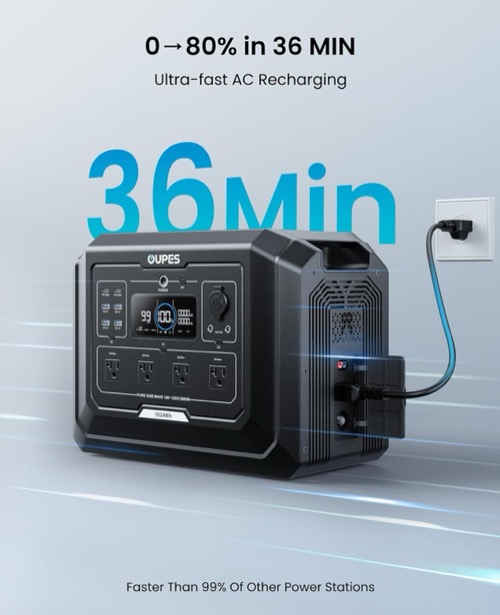
Here’s where the two halves of the kit diverge hardest, so it’s worth being blunt. The wall charger is the star: OUPES rates 0-80% in 36 minutes, and one owner measured a full charge from the outlet in about 45 minutes. Charge with AC and solar together and the rated 0-80% drops to roughly 26 minutes. For turning a dead pack around before a trip or between outages, this is genuinely fast and dependable.
The bundled 100W panel is the opposite. For a 1024Wh station, 100W is a trickle, and owners say so. One left the panel out on a sunny day for about five hours and the charge barely moved from 67%; another reported roughly two days to fill the pack on solar alone. A single glowing “charges even on cloudy days” review exists, but the more measured accounts should set your expectations: the bundled panel is an emergency top-up, not a recharge.
| Recharge Method | Time / Result | What It Means |
|---|---|---|
| Wall (AC) | 0-80% in ~36 min | The reliable fast path — owner saw ~45 min to full |
| AC + solar (dual) | 0-80% in ~26 min | Fastest turnaround if the sun is out |
| Bundled 100W panel | ~2 days on solar alone | A trickle for 1024Wh; top-up only |
| ~3x240W panels (added) | 0-80% in ~1.3 hr | Uses the station’s 800W ceiling — buy separately |
The important nuance: the station itself accepts up to 800W of solar and can reach 0-80% in about 1.3 hours — but only with roughly three 240W panels you buy separately. If off-grid solar is central to how you’ll use this, budget for real panels beyond the 100W in the box.
Callout — The smartest way to think about this kit’s charging: the wall is your sprinter, the bundled panel is a slow trickle, and the station’s real solar potential is locked behind panels you have to add. If you’re near an outlet, you’ll almost never need solar. If you’re truly off-grid, plan to spend on panels to reach the 800W ceiling.
Commission Bypass, App, and Restoration as One System
As outage insurance, the station does well within honest limits. The under-20ms UPS switchover is designed to keep computers, routers, and medical devices alive through a blackout, and owners lean on it exactly that way — one kept an apartment’s essentials running through severe weather, and another was ready for a sudden storm thanks to fast shipping. The 13-port layout means lights, electronics, and a small appliance or two all have a home at once.
The limit, again, is capacity. At 1024Wh, this bridges an outage for electronics and short appliance runs — not a whole house for a full day. That’s where expandability earns its place: add the B2 batteries toward 5120Wh and the same unit covers longer blackouts and whole-day fridge duty.
One cautionary note belongs here. Most owners praise the build and fast support, but one detailed 1-star report describes a unit that never recharged in a greenhouse setup, followed by a frustrating support process before a refund. It’s a single account against a 4.2-star average, but it’s the reason to test your unit thoroughly soon after it arrives, while returns are easy.
Callout — For backup, buy the capacity you’ll actually need. If your outages are short and you mainly want to keep phones, a router, and a few lights alive, 1024Wh is plenty. If you want to run a fridge overnight or bridge a multi-day storm, plan on the B2 batteries from the start rather than discovering the ceiling mid-outage.
Three-Stage OUPES Upgrade Map
| Use Case | Fit | Why |
|---|---|---|
| Camping / road trips | Strong fit | Portable, runs fans and camper loads for hours |
| Apartment / short outage backup | Strong fit | Under-20ms UPS, 13 ports, fast recharge |
| Fast turnaround charging | Strong fit | 0-80% in 36 min from the wall |
| Tailgating / picnics | Strong fit | 27.8 lb one-person carry, AC + USB-C |
| Expandable off-grid setup | Strong fit | Scales 1024Wh to 5120Wh with B2 batteries |
| Solar-first, bundled-panel only | Not ideal | 100W is a trickle for 1024Wh |
| Whole-home / long high-draw backup | Borderline | 1024Wh drains fast; add batteries |
| Serious off-grid solar | Verify first | Needs ~3x240W panels bought separately |
Buy it when you want:
- A fast-charging station that hits 0-80% in about 36 minutes from the wall
- An expandable platform that grows from 1024Wh to 5120Wh
- Portable, port-rich power for camping, road trips, and short outages
- A 2000W / 4500W-surge inverter that starts real appliances
Look elsewhere if you need:
- Effortless solar recharge straight out of the box — the 100W panel is a trickle
- Hours of runtime on a heater, microwave, or window AC at 1024Wh
- A whole-home backup without buying the expansion batteries
- Guaranteed hands-off support if a unit fails — plan to test yours early
Mega 1 100W Bundle: Buy, Upgrade, or Skip
For campers, road-trippers, and anyone building a short-outage kit, this OUPES 2000W solar generator review comes down clearly in favor — with one condition. The station is the easy part to recommend: portable, fast-charging, port-rich, backed by a LiFePO4 pack rated for 3,500+ cycles, and expandable from 1024Wh to a serious 5120Wh. The 36-minute wall charge is the standout owners actually verify, and the 2000W inverter with a 4500W surge starts the fans, coolers, and cooktops people rely on.
The trade-offs are honest. The bundled 100W panel is undersized for a 1024Wh pack and behaves like a trickle in real sun; high-draw loads drain 1024Wh quickly; and one owner’s failed unit is a reminder to test yours early. So the if/then is simple: if you want a fast-charging, expandable station and you’ll either stay near an outlet or add real panels later, the OUPES 2000W is an easy yes. If you’re counting on the 100W panel alone to keep it full off-grid, temper that expectation — or budget for the panels that unlock its 800W solar ceiling — before you buy.
Pros & Cons Analysis
Based on documented specifications and owner feedback
Pros
- Strong base inverter — The 2,000W platform covers refrigeration, cooking tasks, tools, and mixed electronics after startup verification.
- Expansion can add real endurance — Compatible batteries can turn the base station into a longer-duration system for measured essentials.
- AC recovery is a strength — High input can restore energy quickly when utility or a suitable generator is available.
- Solar receiver is not the bottleneck — An 800W ceiling gives the buyer room to build a much faster compatible array.
- Owner use is mission-relevant — Supplied records include freezer, refrigerator, outage, camping, and backup roles that translate into acceptance tests.
Cons
- The bundle undersizes solar dramatically — A 100W panel is useful for demonstration and light offset, not rapid recovery of 1,024Wh or an expanded bank.
- Fulfillment is part of product quality — A missing panel or cable leaves the advertised kit incomplete even if the station works.
- System behavior is configuration-dependent — App settings, bypass mode, reserve, firmware, and restoration need documented testing.
- More battery can create an energy trap — Expansion without more charging capacity produces longer outages between full states.
- Support outcomes are mixed — Preserve serials, invoice, package labels, fault data, and written communication for any remedy.
A Strong Expandable Station With a Demonstration-Size Solar Panel
The OUPES Mega 1 is capable and expandable, but its included 100W panel is only the first step toward solar recovery. Buy the bundle when the price justifies the starter panel and you are prepared to verify delivery, commission software behavior, and size later upgrades together.
Frequently Asked Questions
How long will the 100W panel take to charge the Mega 1?
Planning is roughly 12–14 peak-sun hours from empty under favorable conditions and longer with shade, heat, cloud, cable loss, taper, or active loads.
Can the Mega 1 use more solar?
Yes, the receiver ceiling is much higher than the included panel. Design the array within exact voltage, current, connector, polarity, and cold-Voc limits.
Can it run a freezer?
Often, but measure a complete duty cycle and test compressor startup. Runtime depends on ambient temperature, insulation, cycling, reserve, and other active loads.
Does adding a battery increase inverter output?
Expansion primarily adds stored energy. It does not automatically raise every continuous, surge, port, or voltage limit; verify the exact system documentation.
What if the panel ships separately?
Track all packages, photograph labels, and confirm the exact panel and cables promptly. Use the seller/Amazon remedy path before the return period expires if the order remains incomplete.
Can I use it as a UPS?
Only after testing the exact load through utility loss, low battery, and restoration. Use a dedicated UPS where zero interruption, conditioning, or managed shutdown is required.
Technical Specifications
| Brand | OUPES |
|---|---|
| Kit model / SKU / ASIN | Mega 1 + 100W panel bundle (ASIN B0FS71NRSZ; US) |
| Power-station model | OUPES Mega 1 |
| Included solar-panel model and quantity | 1 × OUPES 100W portable solar panel |
| Battery capacity | 1,024Wh |
| Battery chemistry | LiFePO4 (LFP) |
| Cycle-life rating | More than 3,500 cycles to 80% capacity |
| Expandable capacity | Up to 5,120Wh with two OUPES B2 expansion batteries |
| Continuous AC output | 2,000W |
| Surge / peak output | 4,500W |
| AC voltage, frequency, and waveform | 120V, 60Hz, pure sine wave |
| AC outlets and high-current / RV / 240V outputs | 4 × NEMA 5-20R AC; no 30A RV or 240V output |
| USB and DC outputs | 4 × USB-A 18W, 2 × USB-C 100W, 2 × DC5521 12V/10A, 1 × 12V/10A car socket |
| Maximum station solar input | 800W |
| PV input voltage/current range and connector | 12–78V DC; MPPT operating range 18–75V, 14A maximum; Anderson input through MC4 adapter |
| Included panel rated power | 100W |
| Panel Voc / Vmp / Isc / Imp | Voc 24.4V / Vmp 20.5V / Isc 5.27A / Imp 4.88A |
| Panel construction and cell type | Foldable ETFE monocrystalline panel; at least 23% published cell efficiency |
| Panel weather rating | IP65 panel |
| Panel dimensions and weight, folded / deployed | Folded 21.8 × 23.2 × 1.9 in; deployed 43.7 × 23.2 × 1.4 in; 12.48 lb |
| Solar recharge estimate with included panel | Calculated about 12–14 peak-sun hours from empty with the included 100W panel |
| Maximum AC input and AC recharge time | 1,400W Fast mode; about 58 minutes to full, or 1.9 hours in 700W Slow mode |
| Car, alternator, and other charging methods | 12–15V vehicle input at 8A; optional OUPES alternator charger and smart generator supported |
| UPS / EPS support and transfer time | UPS supported; under 20ms transfer |
| App and connectivity | OUPES app over Wi-Fi and Bluetooth |
| Station dimensions, weight, operating limits, and weather rating | 15.1 × 9.1 × 11.6 in; 27.8 lb; 32–104°F operation; IP21 station |
| Station and panel warranties | Station 5 years plus 1 year with registration; panel 12 months |
| Included in the box | Mega 1, AC cable, car-to-Anderson cable, MC4-to-Anderson cable, manual and warranty card; 100W panel and output lead |