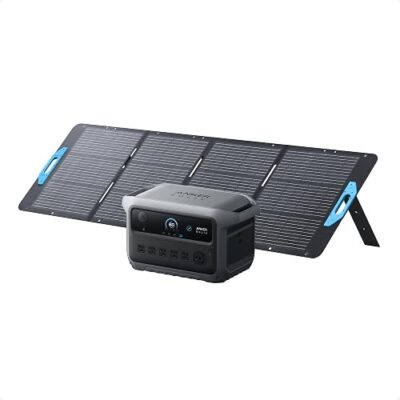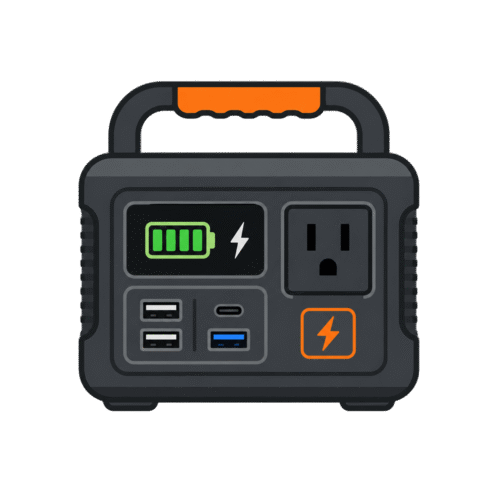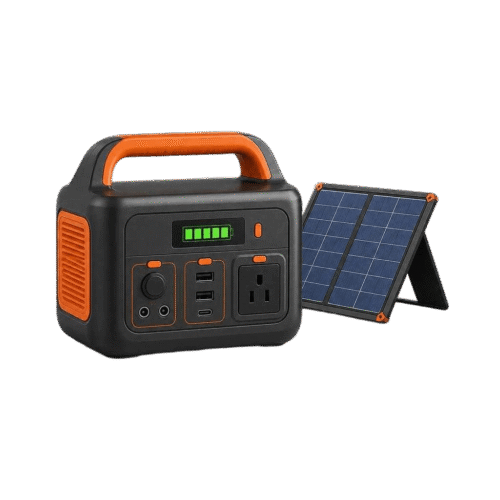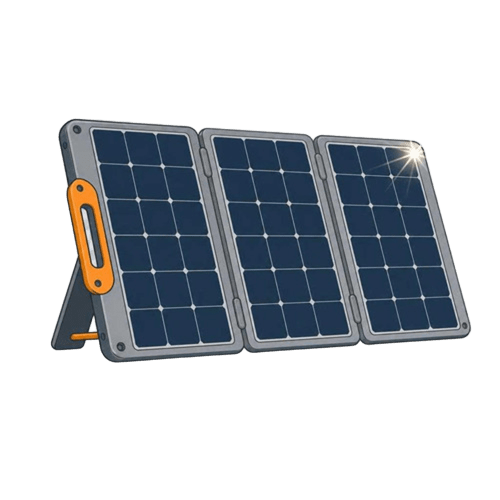
Anker SOLIX C300 Review: A Pocket-Sized 288Wh Kit With Its Own 60W Panel
At a Glance
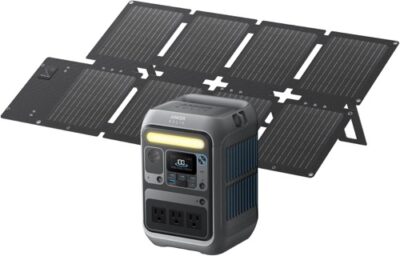
KEY FEATURES
- Exact kit: Anker SOLIX C300 AC A1722 with PS60 Compact A2438.
- Small-load platform: 288Wh LFP, 300W continuous AC, and 600W surge.
- USB-C strength: Two 140W two-way USB-C ports plus additional device outputs.
- Solar: 60W included; station accepts up to 100W.
- Best fit: Carry-sensitive trips and device backup where 288Wh is enough.
PROS
- Nine-pound station is genuinely easy to move and pack.
- High-power USB-C paths reduce dependence on the AC inverter.
- 60W panel is compact and can deliver useful good-sun input.
- Multiple recharge routes improve travel flexibility.
CONS
- 288Wh cannot sustain broad appliance or heating loads.
- 300W AC boundary excludes many kitchen and comfort devices.
- Panel stand geometry and wind stability require attention.
- A 100W-panel sale bundle may offer better recovery value.
Best compact USB-C solar kit
Exact documentation plus 92 usable qualitative owner records. Ratings emphasize system portability and exact small-load evidence while keeping solar and medical runtime conditional. No first-party test.
The Anker SOLIX C300 AC kit earns its place by reducing friction. The station is light, has multiple high-power USB-C paths, and can recharge from AC, vehicle, USB-C, or its included PS60 Compact panel. The panel is only 60W, but that choice is coherent with a 288Wh travel battery: the full kit remains easy to pack and deploy. Buyers who want maximum solar speed can use up to the station’s documented 100W ceiling, but a larger panel changes the size advantage.
Ninety-two usable owner records provide a strong qualitative record for camping, CPAP, air-mattress pumps, laptops, phones, lights, and other small-load use. Several exact-kit reports place stable panel input around roughly 52W under favorable sun. Repeated cautions concern the panel’s support geometry, wind stability, cable management, and the question of whether a sale bundle with a 100W panel offers better value. Those observations do not establish average output or failure frequency.
Choose this 60W kit
You prioritize low carry weight, USB-C devices, short trips, and an array that fits easily in a vehicle.
Choose a larger solar setup
You regularly drain most of 288Wh, camp in short winter days, or need to run a load while replacing energy.
Use a USB-C-first plan. A compatible laptop, phone, camera, or power bank can avoid AC inverter and wall-brick overhead. Reserve AC for devices that require it, and confirm the combined shared-port limits in the exact manual. One port’s headline rating is not a promise that every connector supplies its maximum simultaneously.
| Carry-kit item | Commissioning check | Reason |
|---|---|---|
| C300 AC station | Every output family, display, app, and low-battery behavior | Small systems often depend on one exact port |
| PS60 Compact | Surface, stand, angle, connector, and stable good-sun input | Support geometry controls whether the panel stays aimed |
| Solar/extension leads | Labels, polarity, strain relief, and dry connection | Plug fit alone does not prove electrical compatibility |
| Overnight load | Exact settings and total watt-hours | 288Wh leaves little room for assumption |
For CPAP or another medical device, use only an approved connection and complete an overnight test with the same pressure, humidifier, heated hose, and reserve planned for the trip. For an air mattress pump, prove the short startup event but account for little total energy. For a fan, router, or light, multiply measured watts by the full number of hours. A device can be low power and still dominate the battery when it runs all night.
288Wh × conservative usable factor ÷ measured average watts = planning hours. Protect a reserve for the morning and keep solar harvest as a separate daily line.
Solar should be judged in watt-hours over the day. A 52W observation during strong sun is encouraging for a 60W panel, but shade, heat, cloud, angle, cable loss, and battery taper change the result. The published full-charge estimate of about 5.5 hours is an ideal condition, not an arrival time. Reposition the panel, stabilize it against wind, and compare the day’s harvest with the previous night’s consumption.
The Nine-Pound Kit Inventory
| Spec | Value |
|---|---|
| Battery Capacity | 288 Wh LiFePO4 (LFP) |
| Continuous AC Output | 300 W (pure sine wave) |
| Surge / Peak | 600 W |
| Solar Input | 60 W (bundled foldable panel) |
| Wall Recharge | 80% in ~50 min |
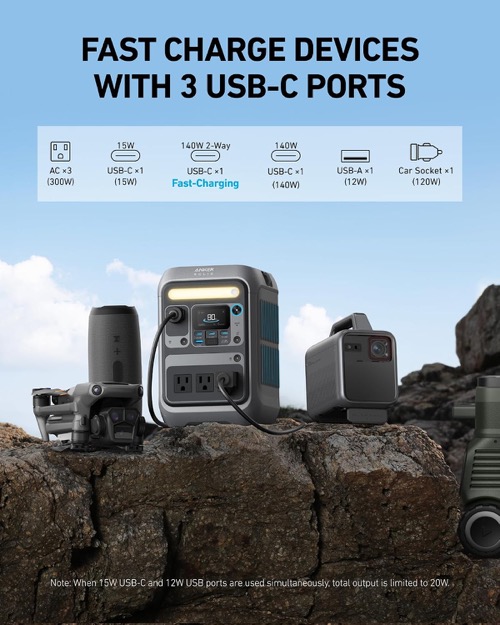
| Ports | 3 AC, 2 USB-C (140W), 1 USB-C (15W), 1 USB-A, 1 car |
| Extras | Anker app, built-in light, a low published acoustic figure under specified conditions quiet |
| Warranty / Cycles | 5 years / 3,000 cycles |
| Best For | Travel, camping, remote work, small backup |
Mission Gate: Portability Before Capacity
If you want quiet, compact power for gadgets and a laptop, this Anker SOLIX C300 review lands on a evidence-qualified yes for the right buyer. The station is a standout: light enough to toss in a backpack, quiet at a low published acoustic figure under specified conditions, backed by a polished app, and quick to refill — 80% at the wall in about 50 minutes. The 288Wh LiFePO4 pack runs a laptop for roughly five hours, keeps a phone and smartwatch topped overnight, and drives small AC gear like a cooking pan. The 60W panel is a real, well-built bonus for keeping it fed off-grid — just plan around roughly 40W of actual input and a slower fill. For travel, camping, and light emergency use, it’s one of the more livable compact kits out there.
compact Power: Build and Ports
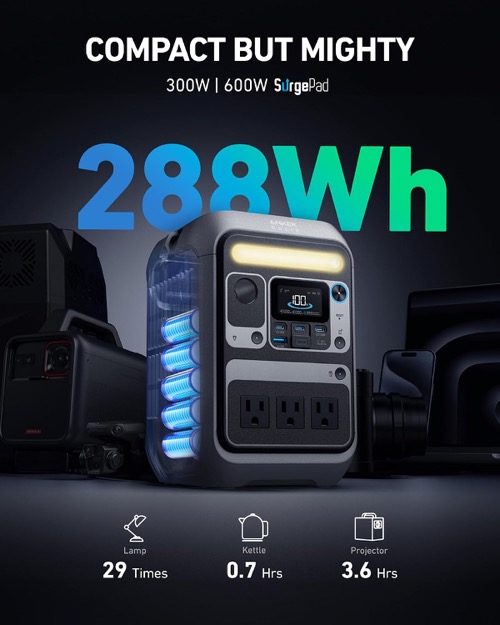
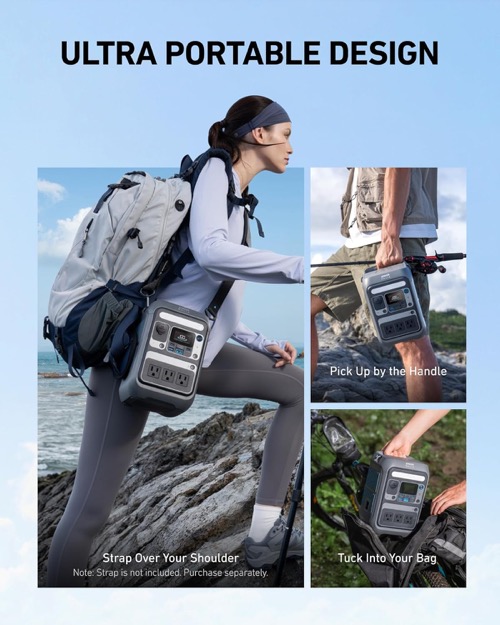
The first thing owners notice is how little there is to carry. One who swapped in from a similar-capacity Bluetti found the Anker clearly lighter, with a molded-in grip that made a separate handle unnecessary, and Anker rates the design about 15% smaller than similar units. Buyers describe it as stylish and premium, with the kind of quality control that makes it feel nice in hand — and at a low published acoustic figure under specified conditions it’s quiet enough to sleep beside in a tent.
Port selection punches well above the size. You get three AC outlets sharing the 300W output, a 120W car socket, two 140W USB-C ports for genuinely fast two-way charging, a 15W USB-C, and a 12W USB-A — eight in all, with a sliding cover that reveals the input for solar or wall charging. Owners routinely run several things at once: phones and a smartwatch on USB while a laptop pulls from AC.
Two nice touches earn repeat mentions. The Anker app connects over Wi-Fi or Bluetooth, wakes the unit quickly, and shows battery temperature plus watts in and out — one owner even connected from around 100 feet away across a campsite. And the built-in light bar is soft and diffused, ideal for lighting a tent without glaring into your eyes, controllable from the app or a button.
Callout — The kit is complete for most travelers, but two things aren’t in the box the way you might expect: the carry strap is sold separately (the station only has the mounting points), and a couple of owners reported their car-charging cable missing on arrival. If a strap or car charging matters to you, confirm both before your first trip.
An Overnight Energy Envelope for Small Loads
Start with the honest usable number. After inverter and conversion losses, a 288Wh LiFePO4 pack delivers roughly 245 watt-hours to your devices — call it 288 × 0.85. That figure, not the nameplate, is what your runtime math should use.
From there it’s a device-and-laptop story. This isn’t a unit for heaters or microwaves — the 300W ceiling rules those out — but it’s a strong companion for the gear people actually travel with. One owner ran a 240W-rated laptop that draws 20-80W in normal use for about five hours on a charge, and used it to keep a phone and smartwatch at 100% overnight while sipping only about 10% of the battery.
| Device (typical draw) | Estimated Runtime | Owner-Grounded Note |
|---|---|---|
| Laptop (~45 W avg) | ~5 hr | Owner saw ~5 hr; gaming drains far faster |
| Phone (~15 Wh/charge) | ~15 charges | Overnight top-ups use little of the pack |
| Phone + smartwatch overnight | Holds both at 100% | Owner used ~10% of capacity |
| Small cooking pan (~200 W) | ~1 hr | Camp cooking in short sessions |
| CPAP (~35 W, no humidifier) | ~6-7 hr | Roughly one overnight |
| Mini fridge / cooler (~50 W avg) | ~5+ hr | Longer with daytime solar top-ups |
These are estimates. Your real numbers shift with the device’s actual draw, the starting charge, and temperature — and whether solar is feeding in while you run loads. A good rule from owners: run a watt-hour check on your gear before you rely on it.
Four Recharge Paths, One 288Wh Battery
If solar is the patient option, the wall charger is the sprinter. Anker rates the C300 at 80% in about 50 minutes plugged in, with a full charge shortly after — enough to turn a low battery around before you head out the door. The two 140W USB-C ports also charge the unit quickly via a PD 3.1 source, and there’s a 12V car socket for topping up on the road.
Passthrough charging is the quiet feature that makes it flexible. You can run a device off the outputs while the panel, wall, or USB-C refills the pack. One owner ran a laptop while the 60W panel fed in around 50W: in normal 20-80W use the battery held its ground, and only slipped when the laptop briefly spiked above the panel’s input. On wall or USB-C power, passthrough easily outpaces a laptop.
The takeaway: for a fast, dependable refill, lean on the wall or USB-C. Solar is best treated as a runtime extender rather than your primary way to fill 288Wh in a hurry.
Why Good Sun Often Means Watts in the Low Fifties
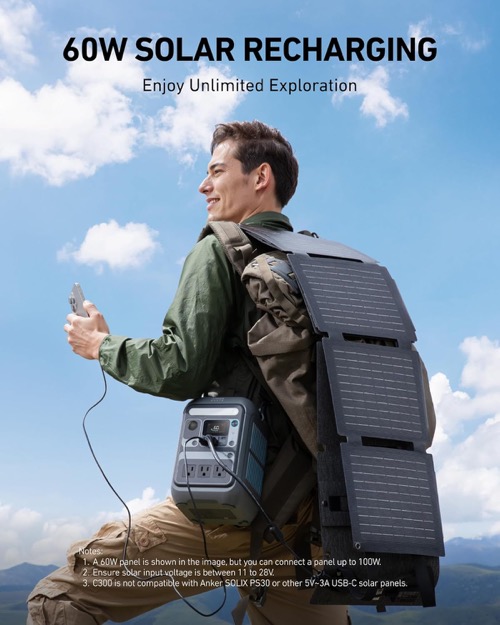
Here’s where expectations need setting, and the good news is that owners are pleasantly surprised rather than disappointed. The bundled 60W panel is light, folds compact enough for a backpack, wipes clean, and shrugged off light rain in the field — owners cite an IP68 rating. Compared with a heavy 100W panel, it’s far easier to tote and aim.
Real output is honest and modest. In full sun, one buyer measured around 40W and recharged the station from 63% to full by about noon, and the panel even picks up a few watts before sunrise. On heavily overcast days it still gathers roughly 5 to 15 watts — a trickle, not nothing. The recurring advice from owners who want more speed: step up to a compatible 100W panel, especially if you plan to run a higher-draw laptop while charging.
One important compatibility note: the C300 is not compatible with Anker’s SOLIX PS30, PS200, or PS400 panels, or with other 5V/3A USB-C panels. If you upgrade, confirm the replacement works with the C300’s DC solar input first.
Callout — The smartest way owners use the panel is as a daytime top-up. Lay it out while you’re at camp or working outside, let it feed the station through passthrough, and you’ll noticeably stretch how long you can go between wall charges — even if it never replaces a quick wall refill on its own.
The 300W Red Line by Use Case
| Use Case | Fit | Why |
|---|---|---|
| Travel / remote work | Strong fit | Light, quiet, runs a laptop ~5 hr |
| Camping (devices, lights) | Strong fit | Compact, built-in light, a low published acoustic figure under specified conditions quiet |
| Phone / gadget backup | Strong fit | ~15 phone charges, overnight top-ups |
| Emergency go-bag | Strong fit | LiFePO4 longevity, 5-yr warranty |
| Fast turnaround charging | Strong fit | 80% at the wall in ~50 min |
| Solar-first, unattended | Borderline | Real ~40W input fills slowly |
| High-draw or 300W+ loads | Not ideal | Won’t start heaters or microwaves |
| Whole-home / long backup | Not ideal | 288Wh is a gadget bridge, not a house battery |
Buy it when you want:
- A genuinely compact station for phones, laptops, and small gear
- A fast wall charge and a polished app with a built-in light
- Quiet, light, durable power for travel, camping, and remote work
- A solar panel already in the box to extend runtime off-grid
Look elsewhere if you need:
- To run heaters, microwaves, or anything over 300W
- Hours of runtime on heavy AC loads or a whole-home bridge
- Effortless, fast solar that hits its full rated watts
- A strap and case included without buying extras
C300 AC Verdict: Portability Earns the Premium
For travelers, remote workers, campers, and anyone building a light emergency kit, this Anker SOLIX C300 review comes down clearly in favor. The station is the easy part to recommend: compact, quiet, stylish, quick to charge, and backed by a LiFePO4 pack rated for 3,000 cycles and a 5-year warranty. The 288Wh capacity keeps a laptop running for hours and gadgets topped for days of light use, and the eight-port layout and excellent app make it a pleasure to live with. The bundled 60W panel makes it a true solar kit out of the box rather than a battery you have to accessorize.
The trade-offs are honest and small. It’s a 288Wh, 300W unit, so heavy or over-300W loads are off the table; the 60W panel refills slowly and rewards a step up to 100W; and the carry strap costs extra. So the if/then is simple: if you want a light, quiet, fast-charging companion for phones, laptops, and small gear — with solar to stretch it off-grid — the Anker SOLIX C300 is an easy yes. If you’re hoping to power big appliances or refill it fast from the sun alone, this compact kit isn’t the tool for that job.
Pros & Cons Analysis
Based on documented specifications and owner feedback
Pros
- Portability is system-wide — Both the station and 60W panel remain small enough for regular vehicle and campsite deployment.
- USB-C is unusually capable — Two-way high-power ports suit laptops and modern electronics while avoiding unnecessary AC conversion.
- Exact owner use is broad — Identity-explicit records cover camping, CPAP, air mattresses, fans, lights, and device charging.
- Panel output can be credible — Several supplied observations around the low-50W range show useful harvest in favorable placement.
- Recharge options reduce dependence — AC, solar, car, and high-power USB-C inputs give a small battery several practical recovery routes.
Cons
- Capacity demands discipline — A few continuous overnight loads can spend most of 288Wh after conversion loss and reserve.
- Panel support is a field task — Angle, stand tension, ground surface, wind, and cable strain affect whether the panel stays productive.
- Good-sun output is not guaranteed — Low-50W observations depend on irradiance, heat, angle, shade, battery state, and cable path.
- Medical use needs exact validation — Device-approved connection and a full comfort-setting overnight trial are essential before relying on CPAP backup.
- Value varies by bundle — Compare the 60W package with current 100W-panel offers rather than assuming the smallest kit is cheapest per recovered watt-hour.
A Portable USB-C Power Kit With Honest 288Wh Limits
The C300 AC and PS60 Compact are well matched for small-load travel. Strong USB-C, low weight, and credible solar input make it easy to use, but the buyer must respect the 300W inverter, 288Wh energy budget, and panel-deployment details.
Frequently Asked Questions
How long will the 60W panel take to charge the C300 AC?
Anker publishes about 5.5 hours under stated conditions. Real time depends on peak sun, angle, shade, temperature, cable loss, battery state, and concurrent loads.
Can the C300 AC run a CPAP?
Potentially, but use a device-approved power path and complete an overnight test with the exact pressure, humidifier, heated-hose, and reserve settings.
Can I use a 100W panel instead?
The station accepts up to its documented solar limit. Verify exact voltage, current, connector, polarity, and model compatibility before substituting a panel.
Why are owner reports near 52W instead of 60W?
Panel ratings use controlled conditions. Field output varies with sun, temperature, angle, shade, cable loss, and battery acceptance; 52W is an observation, not a universal expectation.
Can it power a coffee maker?
Most coffee makers exceed or heavily consume a 300W/288Wh system. Check the exact appliance; a larger station is usually the better match.
Does it work without the app?
Core local controls remain available, but the app provides useful monitoring and configuration. Record important settings and verify the essential functions without a phone.
Technical Specifications
| Brand | Anker |
|---|---|
| Kit model / SKU / ASIN | SOLIX C300 AC + PS60 Compact bundle (ASIN B0DBLJRRPW; US) |
| Power-station model | Anker SOLIX C300 AC, model A1722 |
| Included solar-panel model and quantity | 1 × Anker SOLIX PS60 Compact 60W panel, model A2438 |
| Battery capacity | 288Wh |
| Battery chemistry | LiFePO4 (LFP) |
| Cycle-life rating | 3,000 cycles; retained-capacity threshold is not published on the exact bundle page |
| Expandable capacity | No expansion-battery port |
| Continuous AC output | 300W |
| Surge / peak output | 600W |
| AC voltage, frequency, and waveform | 120V, 60Hz, pure sine wave |
| AC outlets and high-current / RV / 240V outputs | 3 × 120V AC; no high-current RV or 240V output |
| USB and DC outputs | 3 × USB-C (2 × 140W two-way, 1 × 15W), 1 × USB-A 12W, 1 × 12V/10A car socket |
| Maximum station solar input | 100W |
| PV input voltage/current range and connector | 11–28V DC, 8.2A maximum; XT60 input through the bundled MC4 adapter path |
| Included panel rated power | 60W |
| Panel Voc / Vmp / Isc / Imp | Published operating point: 16V / 3.75A; Voc and Isc are not published for the exact PS60 Compact |
| Panel construction and cell type | Foldable monocrystalline panel with integrated stand |
| Panel weather rating | IP68 panel |
| Panel dimensions and weight, folded / deployed | Folded 9.1 × 10.5 × 2.5 in; deployed 21.7 × 40.7 × 0.7 in; 4.0 lb |
| Solar recharge estimate with included panel | About 5.5 hours to full under the manufacturer's stated solar conditions |
| Maximum AC input and AC recharge time | 330W maximum; about 50 minutes to 80% and 68 minutes to full |
| Car, alternator, and other charging methods | Up to 140W USB-C input; up to 100W vehicle input; car cable included |
| UPS / EPS support and transfer time | Pass-through charging supported; no transfer-time rating is published for the exact C300 AC bundle |
| App and connectivity | Anker app over Wi-Fi and Bluetooth |
| Station dimensions, weight, operating limits, and weather rating | 6.5 × 6.3 × 9.4 in; 9.0 lb; charge 32–104°F, discharge -4–104°F; station has no published IP rating |
| Station and panel warranties | Station 5 years; confirm the current US PS60 Compact term at purchase |
| Included in the box | C300 AC, AC cable, car cable, safety documents; PS60 Compact, MC4-to-XT60 cable, two extension leads, warranty information |