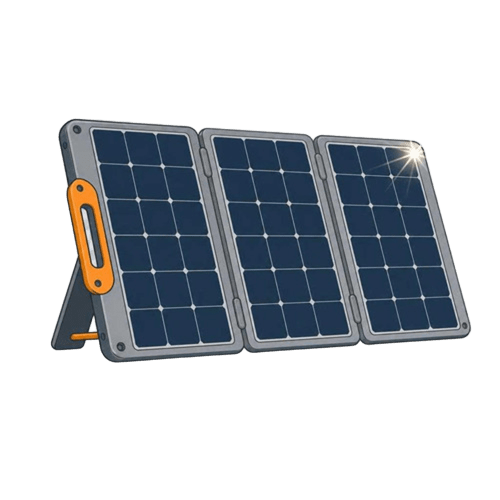
GRECELL 500W Solar Generator Review: A Budget 519Wh Kit With Its Own 100W Panel
At a Glance
KEY FEATURES
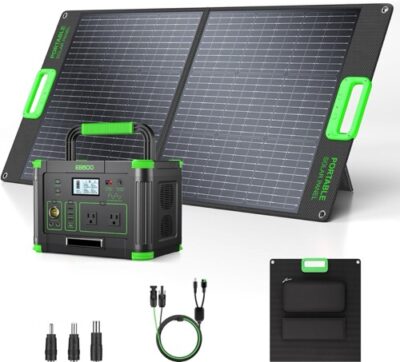
- Exact kit: GRECELL T-500 with GRECELL 100W 20V foldable panel.
- Battery/output: 519.48Wh NCM, 500W continuous AC, 1,000W surge.
- Solar match: 100W included against a 105W receiver ceiling.
- Evidence caution: Pooled reviews include unrelated brands and sibling products.
- Best fit: Budget small-appliance and camping use for buyers willing to commission carefully.
PROS
- 100W panel is well matched to the 105W station input ceiling.
- 519.48Wh capacity supports meaningful small-load runtime.
- 500W pure-sine output and diverse ports suit camping and emergency electronics.
- Compact station provides strong hardware value when discounted.
CONS
- Marketplace owner evidence is materially contaminated by other products.
- NCM battery and unpublished exact-kit cycle life trail many newer LFP competitors.
- 500W limit excludes many heating, cooking, and motor loads.
- Warranty and seller channel require explicit documentation at purchase.
Budget kit with identity caution
Exact primary documentation plus strictly identity-filtered owner material. The score is capped because the pooled marketplace record contains unrelated products and cannot support broad reliability inference.
Pooled-review warning: the supplied marketplace set contains unrelated EBL panels, carrying bags, and sibling power stations. Only reviews that explicitly match the GRECELL T-500 and GRECELL 100W 20V panel may support exact-kit conclusions. The existence of many nearby reviews does not create high confidence.
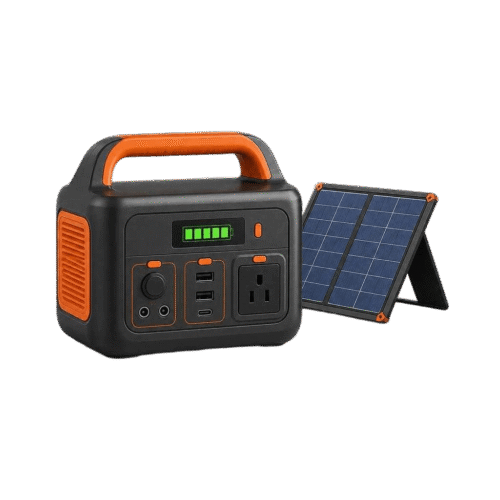
The exact T-500 kit is a 519.48Wh NCM station with 500W continuous pure-sine output, a 1,000W surge rating, a 105W maximum input path, and one GRECELL 100W foldable panel. On paper, those pieces are sensibly matched: the panel sits close to the station’s input ceiling, unlike starter bundles that include only a fraction of what the receiver accepts. The trade-off is ownership confidence. Identity contamination and limited exact documentation make delivery verification unusually important.
Use 500W as a hard continuous boundary, not a target for routine operation. A refrigerator, pump, or power tool can have a startup event far above its running draw. Disconnect other loads and test repeated starts. Heating appliances that fit under 500W may still consume 519Wh quickly. For a cooler, CPAP, router, light, or laptop, record watt-hours across the complete duty cycle.
| Evidence item | Accept | Reject or escalate |
|---|---|---|
| Station label | Exact T-500 and 519.48Wh identity | Sibling capacity, missing label, or mismatched manual |
| Panel label | GRECELL 100W 20V exact module | EBL or another pooled-brand panel |
| Solar path | Correct MC4-to-DC7909 connection and stable input | Forced plug, hot connector, or unexplained intermittent input |
| Seller/warranty | Documented invoice and current remedy contact | Ambiguous seller or no serial-based support path |
A 100W panel and 105W receiver are a logical pair. Manufacturer estimates of six to nine hours remain conditional on strong sun and low concurrent load. Calculate daily energy balance rather than expecting a universal full-charge time. Inspect the foldable panel for cell or fabric damage, stabilize it against wind, and log output with weather, angle, and battery state.
Evidence Identity Comes Before the GRECELL Verdict
| Spec | Value |
|---|---|
| Battery Capacity | 519.48 Wh (lithium-ion) |
| Continuous AC Output | 500 W (pure sine wave) |
| Surge / Peak | 1000 W |
| Solar Input | Up to 100 W (bundled panel) |
| Ports | 2 AC, 1 USB-C (60W), 3 USB-A (18W), 12V car, 2 DC, wireless pad |
| Wall Recharge | Not specified by listing |
| Solar Recharge | ~a full sunny day from the 100W panel |
| Weight | Light (exact figure not published) |
| Best For | Camping, travel, small-device backup |
Exact T-500 Decision in One Page
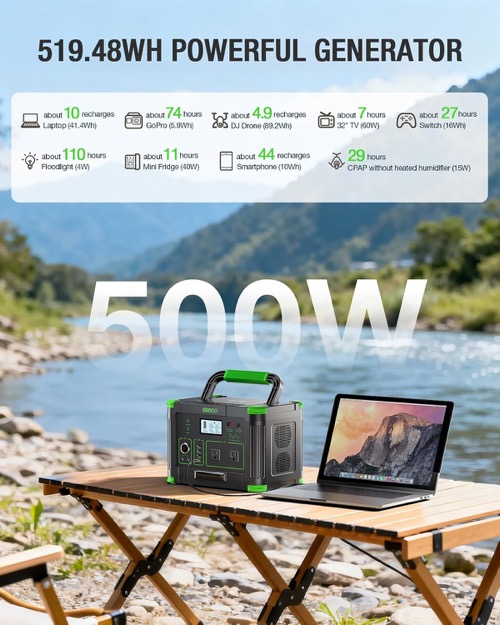
If you want an affordable, panel-included kit for weekends and small emergencies, this GRECELL 500W solar generator review lands on a evidence-qualified yes. The station is light, compact, and easy to carry, the pure sine output is clean, and the port count — ten, including a 60W USB-C and a wireless charging pad — is generous for the price. Owners ran phones, fans, and headlamps across five days of dry camping without complaint. Just buy it for what it is: a 519Wh, 500W unit for small devices, not a whole-home backup, and a lithium-ion pack that trades some longevity for a lower price.
Allocate 519.48Wh Across a Half-Day Mission
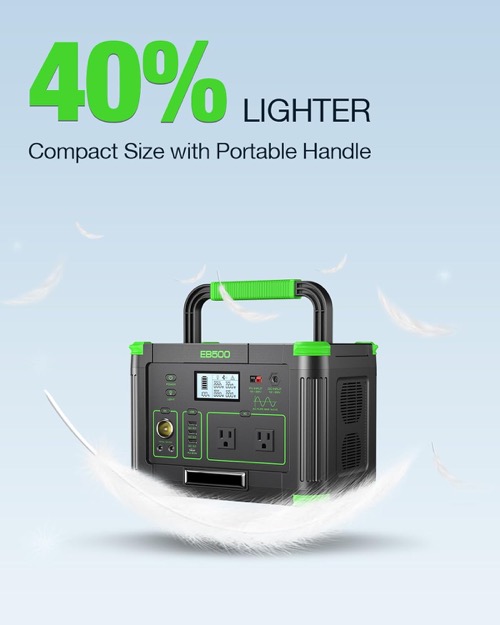
The first thing owners notice is how manageable it is. Buyers call the size “perfect,” describe it as lightweight and easy to move, and one points out it’s small enough to tuck inside a camper cupboard. The listing doesn’t publish an exact weight, but a 519Wh lithium-ion station in this class is a comfortable one-handed carry — a big reason campers reach for it on trips.
Inside is a 519.48Wh lithium-ion pack, and the chemistry matters. The listing describes a “lithium battery” with a built-in smart BMS but never claims LiFePO4, so this is standard lithium-ion. That keeps the unit light and cheap, but it means fewer charge cycles and a shorter calendar life than the LFP packs in higher-priced stations. The smart BMS covers the essentials — temperature control, overvoltage, overcurrent, and short-circuit protection — which is what you want in anything you’ll leave charging unattended.
A small but appreciated touch: the information window. One owner specifically liked being able to read charge level and load at a glance, which makes it easy to keep tabs on the pack while you’re off-grid.
The 500W Boundary and the Loads Below It
Start with the honest usable number. After inverter losses, the 519.48Wh pack delivers roughly 440 watt-hours to your AC devices — call it 519 × 0.85. That figure, not the nameplate, is what your runtime math should use.
From there the story splits by wattage. The 500W pure sine inverter happily runs phones, laptops, fans, a CPAP, a mini-fridge, lights, and small TVs — the gear owners actually plugged in on multi-day trips. What it can’t do is run anything past 500W for long: microwaves, space heaters, hair dryers, and window AC units are out, and the 1000W surge only covers a brief start-up spike.
| Device (typical draw) | Estimated Runtime | Owner-Grounded Note |
|---|---|---|
| Phone (~12 Wh) | ~30 charges | Core camping use |
| Laptop (~60 W) | ~7 hr | Plus USB-C at 60W PD |
| Portable fan (~15 W) | ~25-29 hr | Ran fans on a 5-day trip |
| Mini fridge (~45 W avg) | ~9-10+ hr | Cycling keeps average draw low |
| 32″ LED TV (~40 W) | ~9-10 hr | Comfortable for a campsite |
| CPAP, no humidifier (~30-40 W) | ~10-12 hr (math) | One owner saw only ~3 hr — test yours |
| Microwave / heater (>500 W) | Won’t run | Above the 500W ceiling |
Callout — The 500W inverter decides *what* you can plug in; the 519Wh pack decides *how long* it runs. The one number to respect is that 500W ceiling: it’s why a CPAP, a fan, and a laptop are fine, and why a microwave or a hair dryer simply won’t start. Match your loads to it and the runtimes above hold up.
These are estimates. Your real numbers shift with the device’s actual draw, the starting charge, and temperature — the CPAP owner’s disappointing three hours is a reminder to test any medical device against this unit before you rely on it.
A 105W Receiver Sets Every Recharge Clock
You’ve got three ways to refill it, and the listing is frustratingly quiet on times. The wall charger is the fastest path, but the listing doesn’t publish a from-empty figure, so confirm it with the seller if speed matters to you. The 12V car port works for topping up on the road, though DC car charging is always the slow option.
Solar is the headline of the kit, and it’s a full-day proposition. The bundled 100W panel realistically delivers 60-70W in good sun, and the station caps solar input at 100W, so refilling the 519Wh pack from empty takes most of a sunny day — roughly seven to nine hours of solid light. Aim the panel squarely at the sun and re-angle it as the day moves to hold your best numbers; on partly cloudy days, expect a partial fill.
The practical move owners already use is pass-through: run low-draw gear off the outputs while the panel trickles the station back up during daylight. It won’t outrun a heavier load, but it noticeably extends how long you can go between wall charges on a camping trip.
Verify GRECELL Panel Identity Before Measuring Harvest
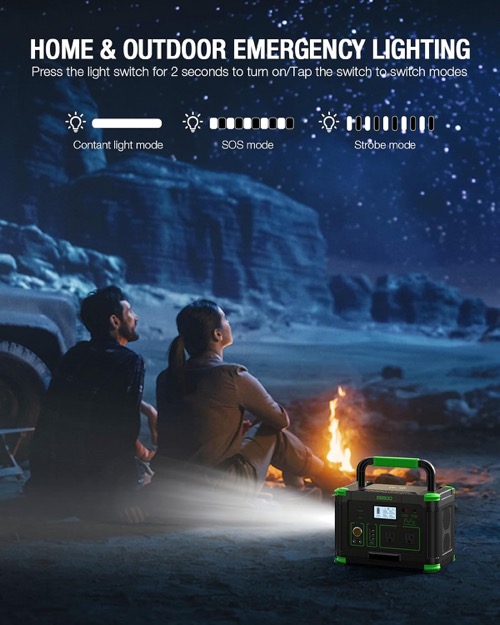
The panel is a real one, not a prop. It uses advanced monocrystalline cells rated up to 23.5% conversion efficiency, outputs around 18V, and carries a smart chip that identifies connected devices to optimize charging speed while guarding against overcharge and overload. GRECELL says it works with most portable power stations on the market, and it ships with multiple adapters and connectors — so it’s useful beyond just this station.
The honest catch is the gap between nameplate and reality. A 100W panel rarely delivers 100W in the field; sun angle, heat, and haze pull real output down toward 60-70W. That’s normal for any solar panel, not a GRECELL flaw, but it’s why the solar recharge is a full-day affair rather than a couple of hours. Treat the 100W figure as a lab ceiling and 60-70W as your working number.
For a budget kit, having a genuine monocrystalline panel with adapters in the box — instead of forcing you to buy one separately — is a real part of the value here.
Budget Value After the Contamination Discount
This is where the kit makes its case. Buying a pure sine wave station and a real 100W panel together, at a price one owner flatly called “better than some other brands,” undercuts assembling the same pair from a premium maker. For a camper who needs phones, fans, lights, and a laptop kept alive for a weekend, that’s a genuine sweet spot.
The compromise is just as real, and it’s the lithium-ion chemistry. LFP rivals cost more but last markedly longer — more cycles, better calendar life, and steadier long-term capacity. If you’ll cycle a station hard for years, that premium pays off. If you want an affordable kit for occasional trips and short outages, lithium-ion is a fair trade, and the 519Wh capacity plus 500W ceiling keep this firmly in light-duty territory.
Callout — Think of this as a communications-and-comfort kit, not a backup generator. It’ll keep phones, a router, lights, and a fan going through an evening outage and power a campsite of small devices for days — but it won’t carry a fridge and household loads through a long blackout. Price it against that job, and it’s a strong value; price it against a whole-home unit, and it isn’t playing the same game.
T-500 Delivery and Support Risk Matrix
| Use Case | Fit | Why |
|---|---|---|
| Weekend / dry camping | Strong fit | Ran phones, fans, headlamps for 5 days |
| Road trips / travel | Strong fit | Light, compact, easy one-hand carry |
| Phone / laptop / camera charging | Strong fit | 60W USB-C, 3× USB-A, wireless pad |
| Short outage (comms + lights) | Solid fit | 519Wh keeps essentials alive an evening |
| CPAP (no humidifier) | Verify first | One owner saw only ~3 hr — test yours |
| Mini-fridge on a trip | Solid fit | ~9-10 hr of cycling runtime |
| Solar-first, hands-off charging | Borderline | Real ~60-70W input needs a full sunny day |
| Long, high-draw appliances | Not ideal | 500W ceiling blocks microwaves, heaters, AC |
| Whole-home / multi-day backup | Not recommended | 519Wh is a bridge, not a house battery |
| Maximum battery lifespan | Consider LFP | Lithium-ion trails LiFePO4 on cycles |
Buy it when you want:
- An affordable kit — a pure sine station and a 100W panel in one box
- Light, compact power for camping, travel, and grab-and-go backup
- Ten ports, including a 60W USB-C and a wireless pad, for small gear
- Multi-day runtime on low-draw devices like phones, fans, and lights
Look elsewhere if you need:
- To run a microwave, heater, hair dryer, or AC — that’s past 500W
- A whole-home or long-blackout backup — this is a 519Wh bridge
- LiFePO4 longevity for years of hard, daily cycling
- Guaranteed CPAP runtime you can’t test before you depend on it
GRECELL T-500 Kit: Conditional Budget Verdict
For campers, road-trippers, and anyone building a small emergency kit on a budget, this GRECELL 500W solar generator review comes down as a clear yes — with the lane clearly marked. The station is easy to like: light, compact, clean pure sine output, ten well-chosen ports, and a smart BMS, all bundled with a genuine 100W monocrystalline panel. Owners leaned on it happily through five-day off-grid trips, running phones, fans, and headlamps without drama, and the informative display makes it simple to manage.
The trade-offs are honest and worth respecting. The 500W ceiling rules out high-wattage appliances, the 519Wh pack drains fast on anything near that limit, real solar input runs well under 100W, and the lithium-ion chemistry won’t age like LiFePO4. One CPAP owner’s short runtime is a fair warning to test medical gear first. So the if/then is simple: if you want an affordable, panel-included kit for small devices on trips and short outages, the GRECELL 500W is an easy recommendation. If you’re expecting a whole-home backup or years of heavy daily cycling, spend more on a larger LFP station instead.
Pros & Cons Analysis
Based on documented specifications and owner feedback
Pros
- System sizing is coherent — Unlike token-panel bundles, the 100W panel sits close to the receiver's 105W maximum input.
- Capacity is useful for the class — About 519Wh can support electronics, cooling, lighting, communications, and short appliance tasks when measured.
- Port coverage is broad — USB, USB-C, DC, car socket, AC, and wireless charging address varied small-load use.
- Pure-sine AC broadens compatibility — Sensitive electronics are better served than by a modified-sine platform, within the 500W boundary.
- Price can compensate for simplicity — The value case can work when the exact kit is discounted and the buyer does not need expansion or app control.
Cons
- Evidence identity is the largest weakness — Nearby EBL, bag, and sibling-model reviews cannot be counted as T-500 kit experience.
- Battery platform is older-style — NCM chemistry and missing exact cycle-life data reduce confidence relative to well-documented LFP competitors.
- Recharge remains all-day — A 100W panel cannot refill 519Wh instantly; six-to-nine-hour estimates need favorable sun and little concurrent use.
- Startup margin is limited — Pumps, compressors, and tools can exceed the 1,000W short surge even when their running watts look acceptable.
- Remedy preparation matters — Seller identity, invoice, serial photos, readings, and prompt testing are unusually important with a sparse exact record.
A Sensibly Matched Budget Kit With an Evidence-Identity Tax
The T-500's 519Wh/500W platform and nearly full-rate 100W solar bundle make practical sense. Buy only after confirming the exact product, seller, panel, cables, and remedy path; pooled marketplace reviews are too contaminated for broad confidence.
Frequently Asked Questions
How do I know a review applies to the GRECELL T-500 kit?
Look for the exact T-500 model, 519.48Wh rating, GRECELL 100W panel, and matching ports/connectors. Exclude EBL, carrying-bag, and sibling-capacity reviews.
How long does the 100W panel take to charge it?
Manufacturer guidance is roughly six to nine hours under suitable conditions. Actual time varies with sun, angle, temperature, shade, cable loss, battery state, and active loads.
Can it run a refrigerator?
Possibly, but prove compressor startup under the 1,000W surge limit and measure duty-cycle energy. Do not infer compatibility from running watts alone.
Is the battery LiFePO4?
No. Exact documentation identifies an NCM lithium-ion battery for this T-500 bundle.
Can I use another solar panel?
Only if its voltage, current, polarity, connector path, and total input remain inside the exact 12–26V and receiver limits.
What should I document at delivery?
Photograph station and panel labels, ASIN, serial, packaging, cables, seller, and initial AC/solar/output tests before the return period ends.
Technical Specifications
| Brand | GRECELL |
|---|---|
| Kit model / SKU / ASIN | T-500 + 100W 20V panel bundle (SKU DYCNX0001AEB-GNUS + DYZDB0001AEB-GN; ASIN B0GYP8PS1L) |
| Power-station model | GRECELL T-500 |
| Included solar-panel model and quantity | 1 × GRECELL 100W 20V foldable panel |
| Battery capacity | 519.48Wh |
| Battery chemistry | NCM lithium-ion |
| Cycle-life rating | Not published for this exact bundle |
| Expandable capacity | No expansion-battery port |
| Continuous AC output | 500W |
| Surge / peak output | 1,000W |
| AC voltage, frequency, and waveform | 110–120V, 60Hz, pure sine wave |
| AC outlets and high-current / RV / 240V outputs | 2 × AC; no high-current RV or 240V output |
| USB and DC outputs | 3 × USB-A QC 18W, 1 × USB-C 60W, 2 × DC5525, 1 × car socket, 10W wireless pad |
| Maximum station solar input | 105W maximum input power |
| PV input voltage/current range and connector | 12–26V DC, 6–8.5A PV input; MC4-to-DC7909 path |
| Included panel rated power | 100W |
| Panel Voc / Vmp / Isc / Imp | Voc 23.85V / Vmp 20V / Isc 5.25A / Imp 5A |
| Panel construction and cell type | Foldable ETFE monocrystalline panel; 23.5% published cell efficiency |
| Panel weather rating | Not published for the exact 100W panel in the bundle documentation |
| Panel dimensions and weight, folded / deployed | Folded 25.2 × 21.1 × 2.5 in; deployed 50.5 × 21.1 × 0.2 in; 10.3 lb |
| Solar recharge estimate with included panel | 6–9 hours under the manufacturer's stated solar conditions |
| Maximum AC input and AC recharge time | 105W maximum input; exact wall-charge time is not published |
| Car, alternator, and other charging methods | 12–15V vehicle input; car cable included |
| UPS / EPS support and transfer time | No documented UPS/EPS transfer-time rating |
| App and connectivity | No app or wireless connectivity |
| Station dimensions, weight, operating limits, and weather rating | 11.57 × 7.95 × 7.95 in; 14.1 lb; charge 32–104°F, discharge 14–104°F; no published IP rating |
| Station and panel warranties | 24-month bundle warranty and lifetime customer support |
| Included in the box | T-500, 100W panel, AC and car cables, Anderson/DC adapter cable, DC7909 cable, adapter set, cable bag, manual |