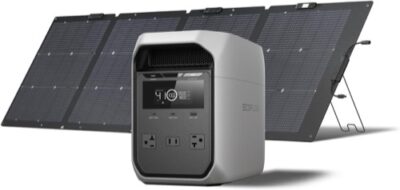
EcoFlow DELTA Pro 3 + 400W Solar Generator Review
At a Glance
KEY FEATURES
- Station: 4,096Wh LFP with 4,000W continuous 120/240V output
- Solar boundary: 2,600W receiver paired with one 400W portable panel
- Connections: TT-30R and L14-30R support RV and approved selected-circuit plans
- Mobility: 113.5 lb chassis with integrated wheels and handle
- Best fit: Expandable home or RV backup with staged solar growth
PROS
- Native 120/240V output supports more circuit types.
- 4,096Wh storage and expansion suit measured backup plans.
- Two PV inputs leave substantial array-growth room.
- App visibility and wheels improve day-to-day ownership.
CONS
- One 400W panel uses only about 15% of the PV ceiling.
- 113.5 lb remains difficult to lift or move over stairs.
- Fixed wiring and transfer equipment require qualified review.
- Large multi-box delivery and cables need immediate inspection.
Best for Expandable 120/240V Backup
Based on exact manufacturer limits and 61 usable exact-bundle owner records; no first-party testing performed.
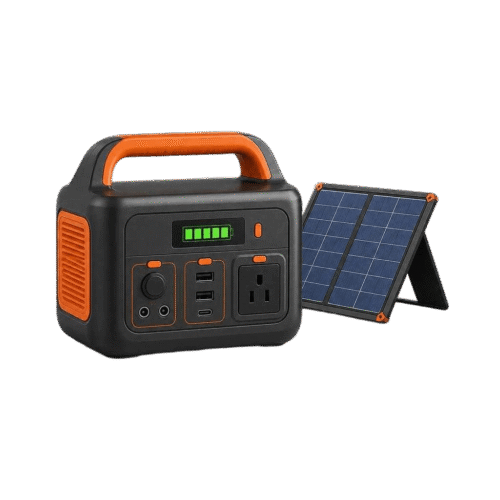
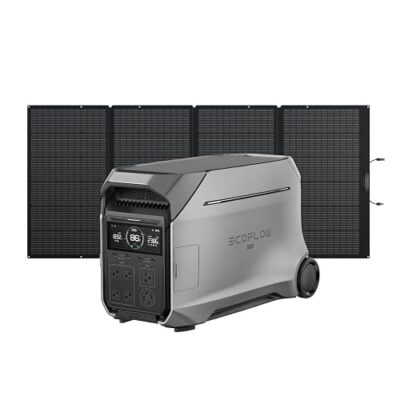
The EcoFlow DELTA Pro 3 with one 400W portable panel combines a genuinely capable 120/240V station with a deliberately modest starter array. The station can accept 2,600W of solar across separate high- and low-voltage inputs, yet this box supplies 400W. That is not a hidden defect: it is the central sizing fact. Buyers who judge the kit by its 4,000W inverter headline can miss that recovery, not output, becomes the limiting resource during a long outage.
The evidence base is unusually rich for a marketplace bundle. Sixty-one usable supplied owner accounts discuss transfer-switch use, RV power, refrigeration, air conditioning, off-grid sheds, app control, mobility, solar deployment, missing cables, battery calibration, and both successful and frustrating support cases. These reports identify commissioning risks; they do not establish a failure rate. Electrical limits below come from EcoFlow’s exact DELTA Pro 3 documentation and current 400W-panel material.
Map the Circuits Before You Count the Watts
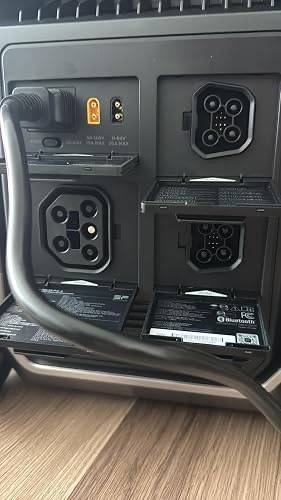
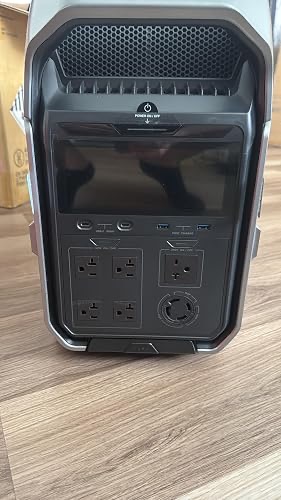
Native 120/240V output makes this station materially different from a large 120V-only battery. It can present 240V through the documented outlet and 120/240V through the locking connection, while a TT-30R serves a 120V RV-style load. But “240V capable” is not the same as “connect it to anything.” The inlet, transfer equipment, neutral and grounding behavior, branch protection, conductor sizing, and appliance startup all have to match the final installation.
Begin with a circuit inventory, not a whole-house label. Mark each desired circuit as 120V or 240V, record measured running watts, capture motor startup where relevant, and estimate daily watt-hours. A well pump, central air conditioner, or compressor may fit the voltage and still fail the startup or energy test. A qualified electrician should review fixed wiring and transfer equipment; never improvise a backfeed connection.
| Circuit question | Evidence to collect | Decision consequence |
|---|---|---|
| Voltage | 120V or 240V nameplate and circuit type | Determines which DELTA Pro 3 output path can be considered |
| Startup | Measured inrush or documented motor requirement | Can reject a load even when average watts look modest |
| Daily energy | Watt-hours across a realistic operating cycle | Sets runtime and solar-recovery demand |
| Transfer method | Listed inlet, switch, and exact wiring plan | Separates safe selected-circuit use from unsafe improvisation |
The 400W Panel Uses Only a Small Slice of the Receiver
EcoFlow publishes a 2,600W total solar ceiling: 1,600W on the high-voltage port and 1,000W on the low-voltage port. The included portable panel is rated at 400W, so its nameplate power equals roughly 15% of the station’s maximum solar acceptance. In favorable sun it can offset a refrigerator, communications gear, lights, and other modest daytime loads. It cannot be treated as a rapid empty-to-full charger for a 4,096Wh battery.
The arithmetic is revealing. Dividing 4,096Wh by 400W gives 10.24 nameplate hours before any loss. EcoFlow’s current bundle page describes about 13 hours under its test assumptions. Real deployment can take longer because panel temperature, imperfect angle, clouds, shade, cable loss, receiver taper, and simultaneous loads reduce net charge. Several supplied owners found the panel useful, while others reported weak or failed solar behavior, cable omissions, or disappointing results. Test the exact delivered panel early rather than converting either group into a universal prediction.
Build a Recovery Calendar, Not a Single Charge-Time Number
Plan recovery in energy bands. In a favorable four-hour peak-sun day, a 400W nameplate panel might deliver a planning band around 1.1–1.4kWh after ordinary losses; poor weather can produce far less. Compare that range with the previous night’s measured consumption. If the load group consumes 2.5kWh and the panel restores 1.2kWh, the deficit is 1.3kWh per day. The battery is large, but the trend still ends at zero.
A practical outage calendar includes three paths: solar for routine daytime harvest, fast AC for short utility-restoration windows, and a compatible alternate source for extended bad weather. EcoFlow also supports other charging routes, but every source needs its own current documentation and cable path. Do not assume that a generator with a receptacle automatically provides waveform, grounding behavior, or sustained power suitable for the station.
Morning state of charge + net solar harvest + other verified charging − essential load energy − optional load energy = evening reserve.
When evening reserve declines for two days, reduce consumption or add a verified recovery source before the reserve becomes an emergency.
Commission the Transfer Path in Five Controlled Steps
Several owner accounts describe successful transfer-switch or building-circuit use, including an off-grid shed and RV configurations. One account also describes abnormal voltage behavior and damaged equipment before a replacement was arranged. That contradiction is exactly why commissioning matters. It does not prove a common fault, and it does not justify connecting valuable loads without staged verification.
- Document the delivered unit.Photograph serials, firmware, outlet labels, panel labels, cables, and packaging.
- Verify outputs unloaded.Use appropriate instruments or qualified help to confirm the intended 120V/240V path before appliances.
- Test one benign load.Run a stable resistance load and compare displayed power with an independent meter.
- Add the hardest essential separately.Observe startup, voltage behavior, noise, heat, and fault messages.
- Simulate loss and restoration.Only after the wiring path is approved should the final group be tested through an outage cycle.
Wheels Change Movement, Not the Meaning of Portable
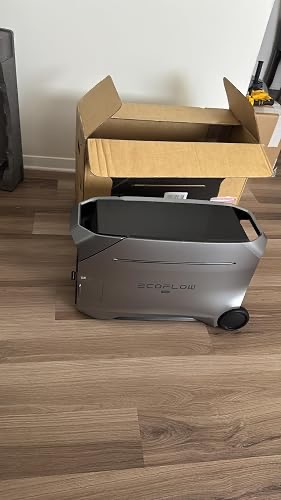
The DELTA Pro 3 weighs 113.5 pounds. Its handle and wheels make it manageable on a smooth floor, and owner reports repeatedly note that benefit. They do not make it a casual lift into a truck, a basement battery, or a unit one person should carry up stairs. Before buying, map the delivery route, thresholds, turning clearance, parking position, ventilation, cable exits, and restraint points.
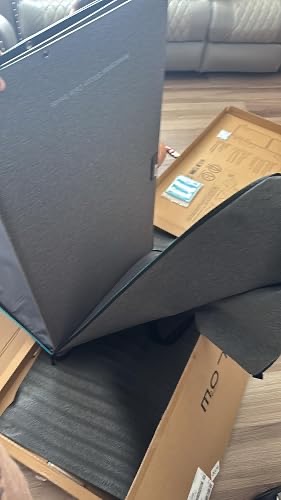
The 400W folding panel is also substantial. It needs a broad shade-free area, wind control, a safe connector route, and storage space. One supplied owner called the panels well built but emphasized their weight. Another received a panel that performed poorly. Inspect cell surfaces, hinges, stands, cable strain relief, and output while the return window is open.
Treat the App as a Control Layer, Not a Safety Substitute
EcoFlow’s app can expose input, output, state of charge, charging limits, and remote controls. Owners often valued that visibility. Use it to create an energy log and select deliberate charging behavior. Do not let remote convenience replace local inspection, documented load limits, or a safe transfer arrangement. Firmware updates should be recorded and followed by a repeat of essential commissioning tests.
Battery state-of-charge estimates can also need calibration after storage or unusual operation. One detailed supplied account reported early shutdown near 50%, then described improved behavior after obtaining the missing AC cable and completing full cycles. That is an anecdote, not a universal procedure. Follow EcoFlow’s current support guidance for the exact symptom and keep screenshots, serials, and case numbers.
Separate Delivery Problems From Product Performance
Large bundles may ship in more than one box. The owner evidence includes missing solar or AC cables, delayed components, damaged packaging, and panel issues. These failures matter because a kit cannot perform if its connector path is incomplete, but they are different from inverter or battery behavior. Inventory every item immediately and match it to the exact bundle documentation.
- Record every tracking number before the first box arrives.
- Photograph the station label, panel label, connector ends, and visible shipping damage.
- Confirm that the cable set reaches the planned panel location without unsafe extensions.
- Test solar input with the included panel alone in stable sun.
- Open a written support case before the seller’s return deadline if any part is missing or mismatched.
Plan Expansion Around Voltage and Current, Not Panel Count
The wide PV receiver is a strong platform feature, but adding panels is an electrical design exercise. Record cold-corrected open-circuit voltage, operating voltage, short-circuit current, series count, parallel count, connector type, and port assignment. The high-voltage and low-voltage ports have different windows. A physically compatible connector does not make an array electrically safe.
If a fixed rooftop array, Smart Home Panel, extra batteries, or other ecosystem parts are planned, price the complete system before using the starter-bundle price as the comparison. The 400W panel may remain useful as a portable backup even after a larger array is installed. Its value is flexibility, not receiver saturation.
Who Gets the Most From This Exact DELTA Pro 3 Bundle?
This bundle fits a homeowner, RV owner, or workshop user who needs native 120/240V capability, wants 4kWh of expandable LFP storage, and accepts that the included panel is an extender. It is especially persuasive when fast wall charging or another source can cover long cloudy periods and when the buyer intends to expand solar later.
Choose a different configuration when the primary goal is daily off-grid solar recovery, when one person must lift the system frequently, or when the circuit plan has not been resolved. A larger compatible array may be a better purchase than accepting a promotional 400W pairing. Buyers who need only 120V and modest loads can also save money and weight with a smaller station.
Bottom Line: A Strong 240V Station With Starter-Array Economics
The DELTA Pro 3 is the compelling part of this kit: 4,096Wh, 4,000W continuous output, native 120/240V, expansion options, two PV inputs, wheels, and detailed app control. The 400W panel is useful and portable, but it leaves most of the receiver unused and turns full solar recovery into a long project.
Buy the exact bundle if that asymmetry is intentional. Commission the electrical path, log a full load day, verify the panel and every cable, and create a recovery calendar before relying on it. The station can anchor a serious backup design; the included array should be judged as the first piece of that design, not the finished system.
Pros & Cons Analysis
Based on documented specifications and owner feedback
Pros
- Useful 240V architecture — Native split-phase output, TT-30R and locking 120/240V connectivity support credible home and RV missions after a circuit audit.
- Deep base reserve — Four kilowatt-hours can protect refrigeration, communications, lighting and scheduled appliances when their real watt-hours are measured.
- Strong recovery platform — Separate high- and low-voltage PV inputs plus fast AC and optional ecosystem charging allow a layered recovery plan.
- Owner-control tools — The app exposes energy flow, reserve and charging controls, while integrated wheels make one-level movement practical.
- Expandable design — Compatible extra batteries let a validated system grow without replacing the station.
Cons
- Starter-array mismatch — A 400W nameplate panel needs roughly 13 idealized hours for an empty-to-full recharge and can lose ground against large active loads.
- Integration is a project — Voltage capability does not replace transfer, neutral, grounding, conductor, breaker and startup-load review.
- Portable has limits — Wheels do not solve stairs, vehicle lifting, soft ground or safe restraint.
- Panel deployment is substantial — The broad 400W module needs storage, wind control, clean connectors and a long shade-free footprint.
- Support evidence conflicts — Missing components, calibration cases and varied remedy reports make return-window commissioning essential.
A 240V Platform That Needs More Generation
Buy the DELTA Pro 3 + 400W bundle for the station's circuit flexibility, storage and expansion—not because one panel completes the system. It becomes a strong backup foundation after safe integration, load logging and a realistic recovery calendar.
Frequently Asked Questions
Can one 400W panel fully recharge the DELTA Pro 3 in one day?
Usually not from empty. EcoFlow's bundle estimate is about 13 hours under specified conditions, and real weather or active loads can extend that time.
Can the DELTA Pro 3 power 240V appliances?
It provides native 120/240V output, but every appliance, inlet, transfer device, startup requirement and wiring path must be compatible.
Is this a complete whole-home solar system?
No. It is a portable station and starter panel. Whole-home integration and faster solar recovery require additional approved equipment and design.
How heavy is the station?
About 113.5 lb. Wheels help on smooth floors, but lifting, stairs and vehicle loading require a separate handling plan.
Can solar capacity be expanded?
Yes, within the two documented PV input windows and current limits. Cold-corrected Voc, current, topology and connectors must be checked.
What should be tested after delivery?
Inventory every box and cable, verify both AC and solar charging, test outputs with benign loads, and simulate the intended backup path before the return deadline.
Technical Specifications
| Brand | EcoFlow |
|---|---|
| Kit model / SKU / ASIN | DELTA Pro 3 + 400W panel bundle (ASIN B0D145TFFY; US) |
| Power-station model | EcoFlow DELTA Pro 3 |
| Included solar-panel model and quantity | 1 × EcoFlow 400W Portable Solar Panel |
| Battery capacity | 4,096Wh |
| Battery chemistry | LiFePO4 (LFP) |
| Cycle-life rating | 4,000 cycles to at least 80% capacity |
| Expandable capacity | Up to 12,288Wh with compatible DELTA Pro 3 extra batteries |
| Continuous AC output | 4,000W |
| Surge / peak output | 8,000W |
| AC voltage, frequency, and waveform | 120/240V, 60Hz, pure sine wave |
| AC outlets and high-current / RV / 240V outputs | Standard 120V AC plus TT-30R and L14-30R 120/240V outputs; use only with an approved circuit path |
| USB and DC outputs | USB-A, high-power USB-C, regulated 12V car/DC5521 and Anderson DC outputs |
| Maximum station solar input | 2,600W total |
| PV input voltage/current range and connector | High port 30–150V / 15A; low port 11–60V / 20A; XT60i paths |
| Included panel rated power | 400W |
| Panel Voc / Vmp / Isc / Imp | Voc 48V / Vmp 41V / Isc 11A / Imp 9.8A |
| Panel construction and cell type | Foldable monocrystalline portable panel; up to 23% published conversion efficiency |
| Panel weather rating | IP68 panel |
| Panel dimensions and weight, folded / deployed | About 42.0 × 24.4 × 1.0 in folded and 93.1 × 42.2 × 1.0 in deployed; about 35.3 lb |
| Solar recharge estimate with included panel | EcoFlow publishes up to about 13 hours from empty under its bundle test assumptions |
| Maximum AC input and AC recharge time | Up to 1,800W from a standard 120V outlet; roughly 80% in about 50 minutes under specified conditions |
| Car, alternator, and other charging methods | 12V/24V vehicle charging; compatible optional EcoFlow alternator charger and other documented ecosystem inputs |
| UPS / EPS support and transfer time | UPS support with about 10ms transfer; commission the exact protected load |
| App and connectivity | EcoFlow app over Wi-Fi and Bluetooth |
| Station dimensions, weight, operating limits, and weather rating | About 27.2 × 13.4 × 16.1 in; 113.5 lb; indoor station with no published weatherproof enclosure rating |
| Station and panel warranties | Station 5 years; panel 12 months on the current US direct-store terms |
| Included in the box | DELTA Pro 3, AC charging cable, car cable, DC5521 cable, handle cover and documentation; 400W panel, case and solar cable path |