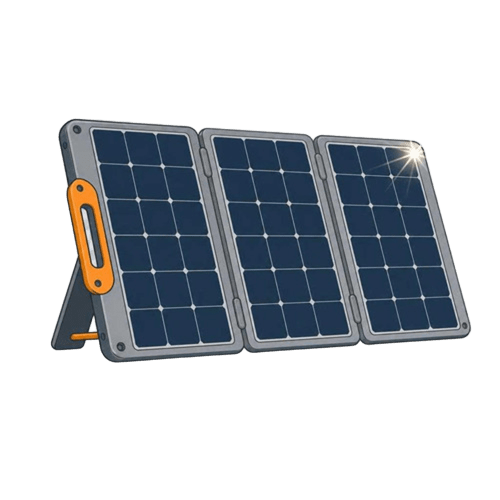
Jackery HomePower 3600 Plus Review: A 3600Wh Home-Backup Kit That Nails Your Essentials — Not Your Whole House
At a Glance
KEY FEATURES
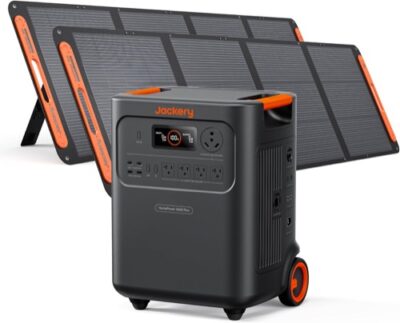
- Exact kit: Jackery HomePower 3600 Plus JHP-3600A with two SolarSaga 200W bifacial portable panels.
- Energy and output: 3,584Wh LFP battery, 3,600W continuous AC, and 7,200W surge.
- Solar boundary: 400W included versus a 1,000W station solar-input ceiling.
- Recovery: Fast AC charging is the practical bad-weather complement to the small included array.
- Best fit: Measured 120V home essentials where wheels, fast recovery, and staged solar expansion matter.
PROS
- 3,584Wh LFP capacity supports a substantial essentials plan.
- 3,600W output and 7,200W surge give useful appliance headroom.
- Wheels and an extendable handle make 77.2 lb more manageable.
- Fast AC charging provides a realistic poor-weather recovery path.
CONS
- Two 200W panels are undersized for rapid recovery of a 3,584Wh battery.
- Whole-house and 240V expectations require a separate circuit and transfer audit.
- Panels, cables, and the station consume meaningful storage and deployment space.
- Large multi-box deliveries demand immediate inventory and commissioning.
Best for staged home backup
Exact-kit documentation plus 41 usable qualitative owner records; solar recovery is rated lower because the included 400W array is small relative to 3,584Wh storage. No first-party test or population-rate claim.
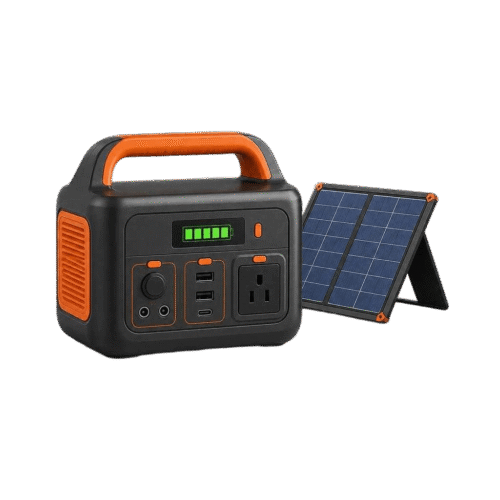
The Jackery HomePower 3600 Plus kit makes two very different promises in one shipment. The station is a large 3,584Wh LiFePO4 power source with 3,600W continuous output, 7,200W surge capability, fast wall charging, and a chassis designed to roll rather than be carried casually. The solar side is two portable 200W panels. That 400W nameplate array is useful for extending an outage and learning the system, but it is small relative to both the battery and the station’s 1,000W solar-input ceiling.
That mismatch determines the verdict. This is a credible home-essentials battery with a starter recovery kit, not an automatically self-sustaining whole-house solar system. Forty-one usable owner records reinforce the distinction: accounts describe refrigeration, networking, security equipment, televisions, lights, travel, fast AC recovery, and practical wheel-and-handle use. The same evidence also includes winter panel output near 100W per panel, long recharge days, cable and connector friction, awkward panel handling, and both successful and difficult remedy experiences. Those reports show what to inspect and commission; they do not establish a population failure rate.
Start With the Outage Mission, Not the 3,600W Headline
A 3,600W inverter tells you how much simultaneous AC load the station can support after startup behavior is verified. It does not tell you how long those loads will run. Runtime comes from watt-hours. Begin by listing the equipment that truly needs power: perhaps a refrigerator, freezer, router, modem, security hub, a few lights, medical equipment, and brief use of a microwave or coffee maker. Measure each device over a realistic cycle rather than copying its maximum label.
Separate continuous energy from short tasks. A refrigerator may cycle, while a resistance heater consumes power continuously. A 1,500W kettle can fit under the inverter limit yet spend a meaningful slice of the battery in a short session. A well pump or compressor can have a modest running draw and a much larger start. Prove the hardest motor by itself before combining it with the rest of the house plan, and keep a reserve for conversion loss, battery protection, cold conditions, and an orderly shutdown.
| Essentials-planning line | What to record | Why it changes the purchase |
|---|---|---|
| Cycling loads | Watt-hours over at least one full compressor or pump cycle | Average energy, not the label wattage, sets overnight runtime |
| Motor starts | Highest observed startup event with other loads disconnected | A station can have ample energy yet reject an abrupt surge |
| Continuous electronics | Router, modem, cameras, computers, medical devices | Small loads become large energy users when they run all day |
| Optional comforts | Cooking, entertainment, fans, and charging sessions | These are the first loads to schedule when reserve falls |
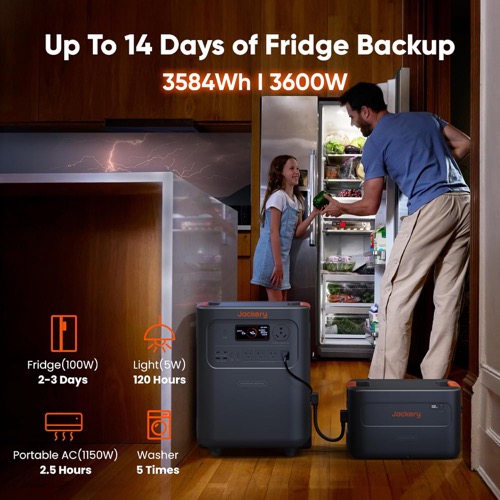
Turn 3,584Wh Into a Written Daily Energy Ledger
A useful planning equation is usable AC watt-hours ≈ rated watt-hours × a conservative delivery factor. The factor accounts for inverter loss, station overhead, temperature, reserve, and aging. Do not publish one universal percentage as fact; verify your delivered unit with a stable, measured load. Once you have a conservative usable figure, divide it by the measured average watts of the load group.
The ledger matters because “runs a house” is not a technical load description. A 120W average essentials group and a 1,200W average group differ by a factor of ten even though both sit below the 3,600W inverter rating. Schedule high-draw tasks while solar or utility input is available. During a prolonged outage, use the display as a log: write down state of charge, input watts, output watts, and time together. A single percentage without the corresponding load cannot explain why the battery fell faster than expected.
Energy at dawn + solar harvested during the day − essential-load watt-hours − optional-load watt-hours = energy available for the next night.
If that result declines for two consecutive days, the system is not energy-neutral. Reduce loads, add a compatible array, add another charging source, or accept shorter coverage.
The Included 400W Array Is the Critical Recovery Constraint
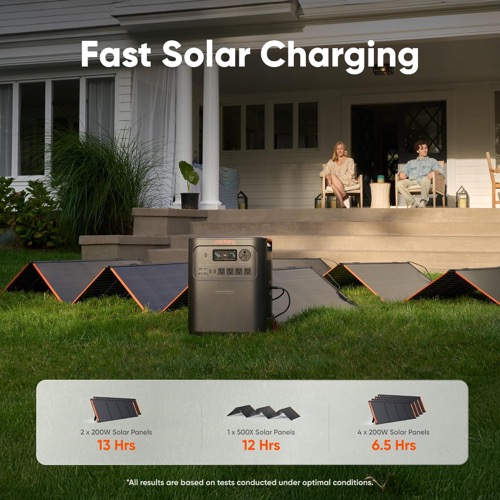
Dividing 3,584Wh by 400W produces 8.96 hours, but that is not a real empty-to-full forecast. It assumes both panels deliver their full nameplate output continuously and ignores conversion loss, heat, suboptimal sun angle, cable loss, shade, clouds, receiver taper, and power consumed while charging. A planning range of roughly 10–12 peak-sun hours is more honest under favorable conditions; winter, smoke, haze, or partial shade can stretch recovery across several days.
The owner evidence makes that limitation tangible. Some reports describe around 100W from each nominal 200W panel in winter conditions. That observation should not be treated as a defect rate or universal yield, but it shows why four nameplate watts are not four harvested watt-hours. Before an outage, deploy both panels, verify connector seating and polarity, remove shade from every section, aim them at the sun, and record stable input after the system has settled.
Use the 1,000W Solar Ceiling as an Upgrade Map
The station can accept more solar than the exact bundle includes, but a larger array is an electrical design task. Do not choose panels by wattage alone. Confirm the current manual’s input voltage window, current ceiling, connector system, and allowed array topology. Calculate cold-corrected open-circuit voltage for the coldest expected morning. Confirm operating voltage and current at the station, and never assume a physically compatible plug is electrically compatible.
Panel placement also becomes infrastructure at this scale. Portable panels need wind control, dry connector management, theft awareness, and cable routes that do not create a trip path. Owner reports mention a desire for longer cable reach and frustration with proprietary connection details. Map the distance from the sunny location to the protected station before buying extra modules. Long, undersized extensions can waste the output you paid to add.
- Read the exact station input limits. Use the JHP-3600A documentation for the delivered revision.
- Build a cold-weather electrical worksheet. Record series count, parallel count, cold Voc, operating voltage, and maximum current.
- Choose the physical route. Keep connectors dry, supported, and clear of doors, tires, and foot traffic.
- Commission each string separately. Confirm stable input before combining arrays or assigning outage duty.
Home Backup Still Needs a Circuit and Transfer Plan
The HomePower 3600 Plus provides significant 120V capability, but the exact bundle is not a universal whole-house replacement. Determine whether loads will plug directly into the station, use a manufacturer-approved transfer product, or connect through another code-compliant method. Never backfeed a receptacle. A fixed transfer arrangement, 240V loads, grounding and neutral behavior, and branch-circuit protection belong with a qualified electrician and the exact Jackery documentation.
List every 240V appliance separately. A station can have enough total wattage for household essentials while still lacking the required voltage or connection method for a well pump, central air conditioner, range, dryer, or other split-phase load. If those circuits are essential, resolve them before purchase. The presence of a high surge number does not create a 240V supply.
Refrigerator, freezer, router, lights, television, and chargers connected safely to the station: plausible after measured-load testing.
Potentially practical with the correct listed transfer equipment and qualified installation.
Requires a circuit-by-circuit voltage and energy audit; the name “HomePower” is not the audit.
Requires utility-loss, low-battery, and restoration tests on the final configuration.
Fast AC Charging Is the Weather Backup
Fast wall charging changes how this bundle can be used. If utility service returns briefly, or a compatible generator supplies a stable charging source, rapid AC recovery can refill the station much faster than the included solar array. That makes the 400W panels useful as an extender rather than the only lifeline. Verify the required circuit capacity, charging setting, cable condition, ventilation, and generator compatibility before an emergency.
Do not hide the trade-off: faster input means more branch-circuit demand and potentially more cooling noise. Use a lower input rate when time permits and a higher rate when the recovery window is short. If the station is parked near sleeping areas, test the sound profile at the exact charge rate you plan to use. The system is easier to live with when charge speed is an intentional operating mode.
Weight, Panel Handling, and Cable Reach Decide Daily Usability
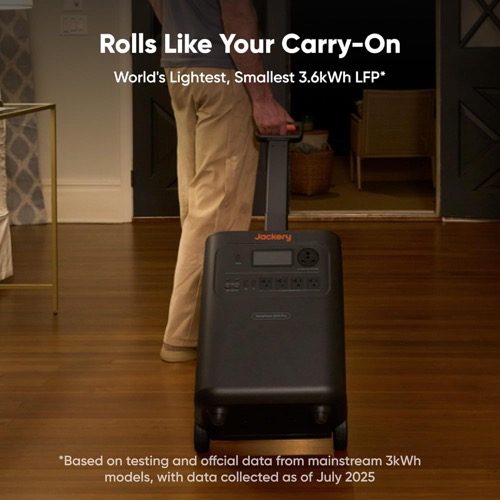
At 77.2 pounds, the station is transportable in a different sense from a 20-pound camping unit. The integrated wheels and handle reduce rolling effort on smooth surfaces, and owners specifically value that design. They do not remove stairs, vehicle lift height, soft ground, thresholds, or tie-down requirements. Choose a ventilated parking place close to the protected loads and charging circuit, then minimize unnecessary movement.
The panels add another handling layer. Two folding 200W modules require floor or vehicle space, a setup area, angular adjustment, and protection from gusts. Several owner reports describe the panels or their deployment as awkward. Practice in good weather: unfold, connect, route cables, stabilize the panels, and pack everything again. An emergency system that has never been deployed is still an unopened project.
Inspect the Complete Delivery Before the Return Window Closes
Large kits can arrive in multiple boxes and on different days. Photograph every shipping label and the station’s serial plate. Inventory the two exact SolarSaga 200W panels, solar leads, adapters, AC cable, documentation, and any bundle-specific accessories. Check panels for cell cracks, damaged fabric, weak stands, connector damage, and uneven output. One supplied account describes a prompt panel replacement, while other remedy narratives are more difficult. Neither outcome predicts yours; both make early documentation valuable.
Who Should Buy the HomePower 3600 Plus 400W Kit?
The bundle makes sense for a homeowner or RV user who wants a capable, wheeled 3.6kWh-class station, values fast AC recovery, and sees the included panels as the beginning of a charging plan. It is particularly coherent when outages are usually short, utility or generator charging remains available, and the 400W array will offset daytime essentials rather than refill from empty every day.
Choose another configuration if solar must be the primary recovery source, winter outages dominate, or the system must support 240V circuits without additional approved equipment. In that case, compare a larger compatible array, a different bundle, or a professionally designed fixed backup system. Also reconsider if the station must travel up stairs frequently; wheels solve rolling, not lifting.
Cold Weather Changes Both the Load and the Solar Side
Winter is the most demanding version of this bundle’s mission. Refrigerators and freezers may cycle differently, heating controls and blowers can add loads, battery charging has temperature limits, and the sun is lower for fewer hours. At the same time, photovoltaic voltage rises in the cold while available daily energy often falls. Calculate cold-corrected array voltage before adding panels and follow the station’s charging-temperature guidance. Never warm the station with an unsafe heater or enclose it so tightly that cooling air cannot move.
Build a winter ledger separately from a summer one. Measure the fireplace or furnace-support equipment that would actually be used, decide which heating loads are beyond the system, and reserve more energy for a longer night. Deploy the included panels at the steeper angle appropriate to the season and keep snow, frost, and partial shade off every active section. A winter observation near 100W per 200W panel is a reminder that a cold bright nameplate calculation and a real short-day harvest are different quantities.
| Winter variable | Risk | Response |
|---|---|---|
| Short daylight | Fewer harvest hours | Begin with more reserve or add an approved recovery source |
| Low sun angle | Poor panel orientation | Use a season-appropriate tilt and reposition through the window |
| Cold array voltage | Input ceiling can be exceeded | Calculate cold Voc before changing series count |
| Heating demand | Large continuous energy use | Protect essentials and exclude resistance heat from the default plan |
Expansion Adds Runtime Only When Recovery Grows With It
Extra battery capacity can extend coverage, but it does not fix slow solar recovery. If the system expands from 3,584Wh to a much larger bank while the array remains 400W, the time from empty grows in the same direction. Calculate the usable energy required per outage day, the available peak-sun harvest, and the fastest approved backup charge source as one system. Expansion is justified when the existing array regularly reaches full and overnight storage remains inadequate; it is premature when the battery already ends cloudy days lower than it began.
Expansion also changes floor space, cable routing, transport, cost, and fire-safety planning. Use only exact compatible modules and cables. Keep connectors protected from strain and movement, label every module, and repeat the utility-loss and restoration drill after altering the system. More stored energy increases the value of disciplined commissioning.
Bottom Line: Buy the Battery, Then Audit the Solar Plan
The Jackery HomePower 3600 Plus is the strong half of this exact kit. It offers enough stored energy and inverter capability to build a serious essentials plan, and its wheels plus rapid AC recharge make a large battery more manageable. The two included 200W panels are useful, but they do not match the station’s energy scale or solar-input potential.
Buy this bundle when 400W is an acceptable starter array and another recovery path remains available. If your goal is multi-day solar autonomy, price the correct compatible array, cables, transfer equipment, and installation before checkout. The honest verdict is not that the panels are bad; it is that a 3,584Wh home-backup battery deserves a recovery design larger than its promotional bundle may suggest.
Pros & Cons Analysis
Based on documented specifications and owner feedback
Pros
- Serious energy reserve — The battery can support refrigeration, communications, security, lighting, and scheduled high-draw tasks when their real watt-hours are measured.
- Useful inverter margin — The 3,600W continuous rating leaves room for mixed 120V loads, although difficult motor starts still require proof.
- Large-station mobility — Integrated wheels and a telescoping handle make one-floor movement far easier than lifting a conventional 77-pound box.
- Flexible recovery strategy — Fast AC input lets solar act as an extender rather than the only route back to full during cloudy outages.
- Room to improve solar — A 1,000W station ceiling gives a qualified designer space to build beyond the included 400W array.
Cons
- The bundle is solar-light — Even idealized arithmetic exceeds nine nameplate hours from empty; real weather, heat, losses, taper, and active loads extend that time.
- Home integration is not automatic — Selected circuits, 240V appliances, neutral and grounding behavior, and transfer equipment must match the exact system and local code.
- Portability has limits — Wheels do not solve stairs, vehicle lifting, soft ground, or safe restraint in transit.
- Portable panels add labor — Two modules require setup space, wind management, clean connectors, cable routing, and repeated angle adjustments.
- Service readiness matters — Photos, serials, input/output logs, and early delivery checks improve any missing-part or panel-remedy case.
A Strong Home-Essentials Battery With a Starter Solar Array
The HomePower 3600 Plus station is capable enough for a serious measured essentials plan. The exact 400W bundle is best when solar extends runtime and fast AC or another approved source handles poor-weather recovery; it is not a complete multi-day solar-autonomy design by itself.
Frequently Asked Questions
Can two 200W panels fully recharge the HomePower 3600 Plus in one day?
Not reliably from empty. Nameplate arithmetic is nearly nine hours before losses; real recovery depends on peak-sun hours, weather, angle, temperature, shade, cable loss, taper, and active loads.
Can this exact kit run an entire house?
It can support a measured set of compatible 120V essentials, but whole-house coverage depends on circuit voltage, startup power, daily energy, transfer equipment, and installation. Audit every circuit rather than relying on the product name.
Does the station accept more solar than the bundle includes?
Yes, the station solar ceiling is higher than the included 400W. Any expansion must remain inside the exact manual's voltage, current, connector, and array-topology limits.
Is the HomePower 3600 Plus easy to move?
It rolls more easily than many large stations because it has wheels and a handle, but it still weighs about 77.2 lb. Stairs and vehicle loading may require two people or lifting equipment.
Should I use fast charging every day?
Use the charge rate that fits the available circuit, recovery window, noise tolerance, and battery-management guidance. Fast charging is valuable during short utility windows; a slower rate may be quieter when time permits.
What should I test before relying on it for an outage?
Inventory every box, test AC and each solar panel, prove the hardest motor start, log a full essentials cycle, and simulate utility loss, low reserve, and restoration on the final configuration.
Technical Specifications
| Brand | Jackery |
|---|---|
| Kit model / SKU / ASIN | HomePower 3600 Plus + 2 × SolarSaga 200W bundle (ASIN B0FMXCPWBN; US) |
| Power-station model | Jackery HomePower 3600 Plus, model JHP-3600A |
| Included solar-panel model and quantity | 2 × Jackery SolarSaga 200W bifacial portable panels |
| Battery capacity | 3,584Wh |
| Battery chemistry | LiFePO4 (LFP) |
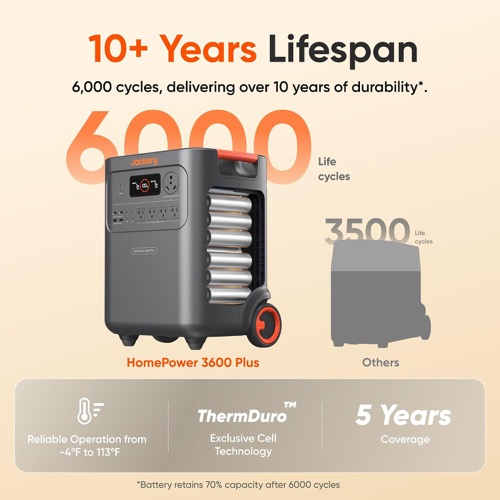
| Cycle-life rating | 6,000 cycles to at least 70% capacity |
| Expandable capacity | Up to 21.5kWh per station with five Battery Pack 3600 units |
| Continuous AC output | 3,600W |
| Surge / peak output | 7,200W surge from one station; two-station hardware is required for 240V |
| AC voltage, frequency, and waveform | 120V, 60Hz, pure sine wave |
| AC outlets and high-current / RV / 240V outputs | 5 × 120V AC including one 30A outlet; no native 240V from one station |
| USB and DC outputs | 2 × USB-C 100W, 2 × USB-A 18W, 1 × 12V/10A car socket |
| Maximum station solar input | 1,000W across two DC inputs |
| PV input voltage/current range and connector | 16–60V DC / 12A per port, 24A total; dual DC8020 inputs |
| Included panel rated power | 400W total (2 × 200W) |
| Panel Voc / Vmp / Isc / Imp | Per panel: Voc 22V / Vmp 18V / Isc 12.5A / Imp 11.5A |
| Panel construction and cell type | Two foldable bifacial monocrystalline panels |
| Panel weather rating | IP68 panels |
| Panel dimensions and weight, folded / deployed | Each panel: folded 23.62 × 23.50 × 1.57 in; deployed 89.76 × 23.50 × 0.98 in; 14.33 lb |
| Solar recharge estimate with included panel | Calculated about 10–12 peak-sun hours with the included 400W array; Jackery's 6-hour figure uses two 500W panels |
| Maximum AC input and AC recharge time | 1,720W ±50W; about 2.5 hours to full |
| Car, alternator, and other charging methods | 12–16V vehicle input up to 8A; generator and optional car-fast-charger paths supported |
| UPS / EPS support and transfer time | UPS supported; 20ms transfer |
| App and connectivity | Jackery app over Wi-Fi and Bluetooth |
| Station dimensions, weight, operating limits, and weather rating | 15.2 × 12.2 × 19.3 in; about 77.2 lb; charge/discharge -4–113°F; no published station IP rating |
| Station and panel warranties | Station and panels each 3 years plus 2 years with registration |
| Included in the box | HomePower 3600 Plus, AC cable, 2 × SolarSaga 200W panels, solar charging leads, documentation; transfer switch and batteries sold separately |