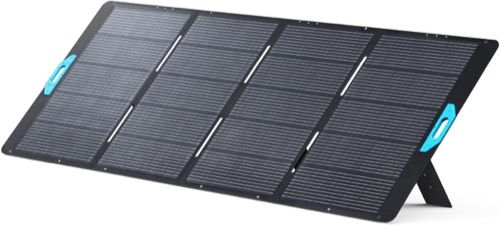
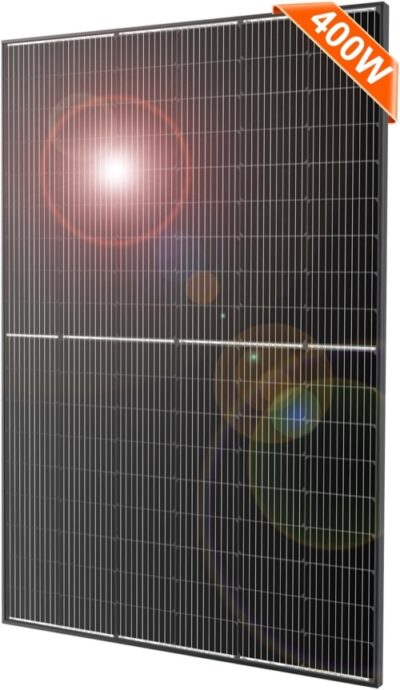
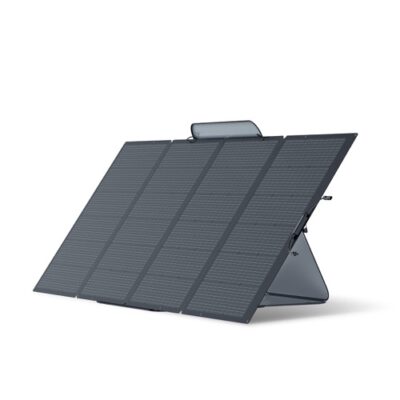
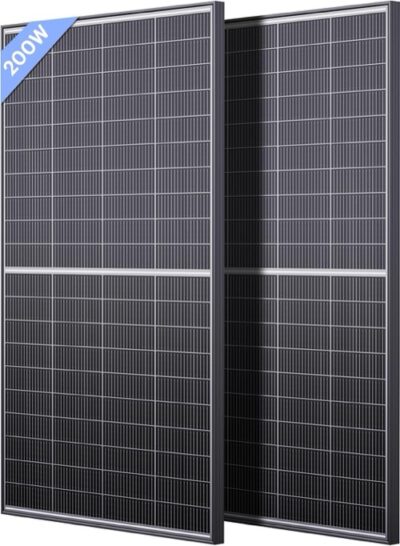
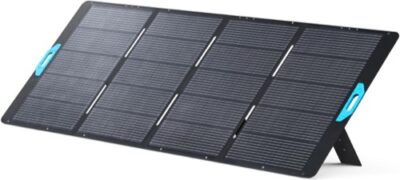
A 400W panel is the point where solar stops being a trickle and starts being a plan. At roughly four peak sun hours, a well-set 400W array banks somewhere near 1,300 watt-hours a day — enough to bring a mid-size power station back from empty or hold an RV battery bank through a long weekend off the grid. That is why so many buyers jump straight to this class: it is the smallest panel that can actually keep pace with a real daily draw.
The catch is that “400W” describes wildly different hardware. Some of these are one rigid slab of glass you bolt down and forget; others fold into a suitcase and ride in the truck; one is a two-sided bifacial pair that harvests light off the ground behind it, and another ships as four small panels with a controller in the box. They weigh anywhere from 30 to 56 pounds, run voltages from 23V to 67V, and terminate in MC4, XT60, or Anderson plugs that do not swap freely. Pick on the watt number alone and you can still end up with a panel that overshoots your station’s input, won’t reach the sun, or is too heavy to reposition.
This guide sorts the best 400W solar panels by the three things that decide whether the number on the box turns into charge in your battery: real-world output after heat derating, the form factor that suits how you’ll mount or carry it, and connector-plus-voltage fit with the station or bank you’re feeding. We ground every figure below in owner-reported output from the full reviews, so the watts here are the ones people actually measure — not the lab peak.
Not Sure How Many Watts You Need?
Our Solar Panel Output Calculator turns a rated wattage into real watt-hours for your location’s sun hours — so you can see whether 400W actually refills your power station in a day, holds an RV battery bank, or covers your off-grid loads before you spend a cent.
Use the Solar Calculator — Jump to the Form Factor Guide
How We Chose the Best 400W Solar Panels
There is no lab behind these rankings, and we won’t pretend there is. What we did instead was read the owner-measured output for every panel — the 340W and 461.9W peaks as well as the 195W and 250W disappointments — and weigh each panel on the criteria that actually separate 400W hardware: real watts after heat derating, whether the voltage and connector fit common station inputs, weight against how you’ll move or mount it, weatherproofing for permanent versus stow-and-go use, and whether a controller ships in the box. No panel tops every column. The bifacial pair over-produces but is 48 pounds of glass; the budget suitcase nearly matches it on a clear day but rolls the quality-control dice. The lineup spans rigid slabs, foldable suitcases, a bifacial 2-pack, and a full MPPT kit precisely because the right answer changes with the job.
| Criterion | Why It Matters at 400W | Weight |
|---|---|---|
| Real-world output after heat | 400W is a cool-cell lab peak; monocrystalline panels shed roughly 13% once the cells bake, so measured watts range from ~275W to 420W across this group | High |
| Voltage and station input fit | These run 23V to 67V — enough to overshoot a small station’s solar input ceiling, so voltage matters as much as the connector shape | High |
| Form factor vs weight | A 30 lb suitcase you reposition and a 56 lb bolt-down kit solve different problems; weight-per-watt decides which gets used | High |
| Weatherproofing (IP rating) | Ranges from a printed “keep out of rain” warning to a sealed IP68 junction box built for years outdoors | Medium |
| Controller included | Only the Renogy kit ships a controller; every other panel needs a power station’s MPPT or one you supply for a bare battery | Medium |
| Connector ecosystem | Native MC4 flexes to almost anything with an adapter; a bundled XT60 or Anderson tip is simpler for that brand but locks you in | Medium |
| Warranty and brand backing | Spans an unstated no-name term to Callsun’s 25-year performance commitment — a real signal on a panel meant to live outside | Low |
Selection criteria:
- Real-world output — measured owner watts after heat and angle losses, not the nameplate; N-type and bifacial cells (Callsun) hold the top end best
- Voltage and input fit — panel Vmp/Voc checked against common 60V solar-input ceilings, since two-panel series designs push voltage high
- Form factor and weight — rigid, foldable suitcase, bifacial 2-pack, or full kit, matched to whether you carry or bolt it down
- IP rating — from IP67 surface to a sealed IP68 junction box, and honest about panels that warn against rain
- Controller — included MPPT (Renogy kit) versus panels that rely on a station’s built-in controller or one you add
- Connector — MC4, XT60, Anderson, or IP68 solar connectors, and what adapter your station actually needs
- Warranty — from no stated term (DOKIO, Ayahoomane) to Renogy’s multi-year and Callsun’s 25-year coverage
Form Factor Guide: Rigid Slab vs Foldable Suitcase vs Bifacial vs Kit
At 400W the shape of the panel matters more than at any smaller size, because the weight and voltage climb with the watts. A rigid slab is the cheapest path to the wattage but a two-person lift you mount once. A foldable suitcase trades some ruggedness for the ability to fold flat and chase the sun. A bifacial pair adds free rear-side watts but only when ground-mounted over a reflective surface. And a full kit hands you a controller and brackets so a bare 12V battery bank works out of the box. Match the shape to how you’ll deploy it before you compare watt figures.
| Form Factor | Panels in This Lineup | Weight / Portability | Durability | Output Notes | Best For |
|---|---|---|---|---|---|
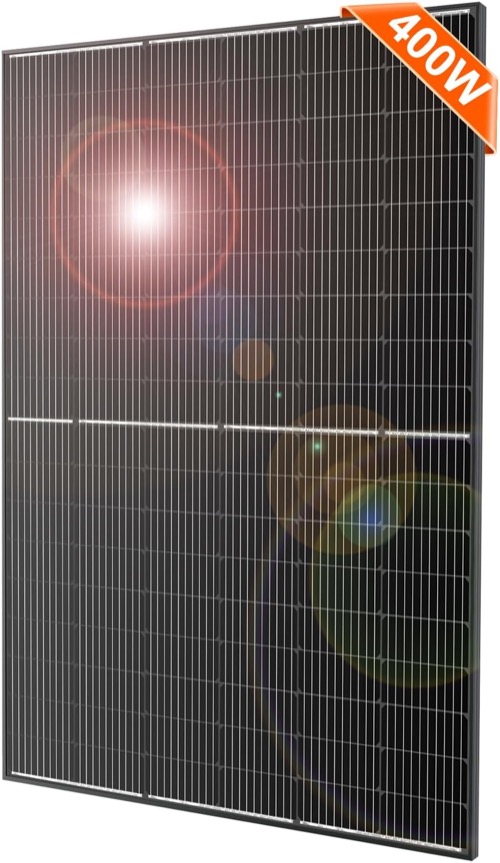
| Rigid glass slab | DOKIO 400W | Heaviest single panel here at ~49 lb and 5.6 ft long — bolt-down, not carry-around | Tempered glass, aluminum frame, sealed junction box; built for permanent outdoor mounting | ~328W in good sun with an MPPT; monocrystalline cells punish any shade | The cheapest fixed 400W for a roof, ground rack, boat, or shed |
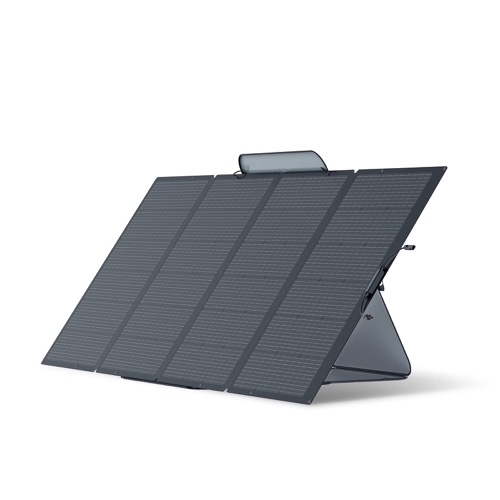
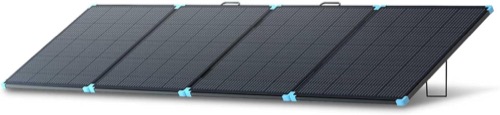
| Foldable suitcase | EcoFlow 400W, Renogy Suitcase, Anker PS400, Ayahoomane 400W | ~30 to 35 lb; folds flat with a handle so you can reposition it for the sun | Fiberglass or ETFE over cells; the Renogy has no glass to crack, budget suitcases can warp | 275-390W depending on cell quality and heat; angle it on the kickstands for the real gain | Power-station charging on camping, RV, and blackout duty where you set up and take down |
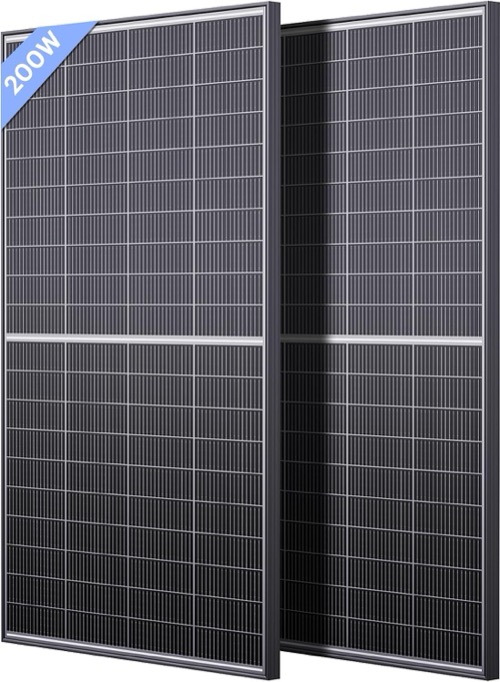
| Rigid bifacial | Callsun 400W (2×200W) | ~48 lb for the pair; rigid glass panels meant to be mounted or set down and left | Toughest here — 3.8mm tempered glass, IP68 junction box, one survived a 40mph gust impact | Beats 400W in good sun (420W+) when the rear side sees reflected light; front-side only flush on a dark roof | Ground-mount or tilt off-grid arrays feeding a 60V-input power station for years |
| Complete rigid kit | Renogy 400W Kit (4×100W + 40A MPPT) | ~56 lb kit across four 100W panels — the most modular to mount, the most to wire | 3.2mm low-iron glass, 35mm aluminum frame, 2400 Pa wind / 5400 Pa snow rating | ~328W to a 12V bank; the included MPPT charges lead-acid, AGM, gel, and LiFePO4 | Permanent 12V/24V systems on RVs, vans, cabins, and boats charging a bare battery bank |
Worth Knowing — Weight does not track watts across these shapes. The Renogy Suitcase packs 400W into ~30 lb and folds flat, while the DOKIO rigid slab is ~49 lb of glass for the same rating. If you’ll move the panel, weight-per-watt matters more than the nameplate; if you’ll bolt it down once, it barely matters at all.
How to Choose a 400W Solar Panel
Before you buy, run this short gauntlet. At 400W the two costly regrets are a voltage that overshoots your station’s input and a form factor that is heavier or less packable than the job needs.
What to prioritize in a 400W solar panel:
- Real-world watts after heat, not the 400W lab peak — check the cell type and owner-measured output
- A Vmp/Voc that lands inside your power station’s solar input range and below its ceiling
- The form factor that matches how you’ll mount or carry 30-56 pounds of panel
- The right connector for your station or bank — MC4, XT60, or Anderson are not interchangeable
- Whether you need a controller in the box (bare battery bank) or a station’s MPPT will do the work
Common buyer mistakes:
- Buying on the 400W number without checking the derated real-world figure
- Ignoring voltage — a two-panel series design can blow past a 60V solar input limit
- Choosing a heavy rigid slab when a foldable suitcase would cover the same daily load
- Wiring a 400W panel straight to a 12V battery with no charge controller
Wattage & Daily Energy: What 400W Actually Buys
Start with the load you cover in a day, then size the panel to refill it. Across this lineup, 400W lands roughly 1,150 to 1,410 Wh on a four-peak-sun-hour day depending on cell type and controller — the Anker PS400 at a measured 0.72 factor sits near 1,150 Wh, while the bifacial Callsun credits its rear side for ~1,410 Wh. For translating watts into real energy, see our guide on how much power a solar panel produces. The takeaway — a single 400W panel refills a 1kWh-class station in a good day, but a 2kWh station takes most of a day or a second panel.
Real-World Math — At 4 peak sun hours and a 0.82 factor, a 400W panel banks roughly 1,312 Wh/day — enough to recharge a 1,000Wh power station with headroom, or run a camp fridge, lights, and device charging with room to spare. Drop to 0.72 for a panel that only feeds a station’s MPPT directly, and you’re closer to 1,150 Wh.
Real-World Output vs Rated Watts
The 400W rating is a Standard Test Conditions figure — 25°C cells, 1,000 W/m², perfect angle. Real output runs lower every time, and at this size heat is the loudest thief: EcoFlow’s own support told an owner the cells can reach ~140°F and lose roughly 13% efficiency once hot. Cell quality sets the ceiling. N-type bifacial (Callsun) over-produces the rating in good light, A+ mono suitcases (Renogy, Ayahoomane) land at 315-390W, and a plain foldable feeding a station directly (Anker) measures 275-300W. Always plan with the derated number, not the nameplate.
Voltage, Connectors & Power Station Compatibility
This is where 400W buyers get caught. Voltage swings widely: the EcoFlow runs 23V, the DOKIO 31V, the Ayahoomane 36V, and two-panel series designs like the Callsun (~54V) and Anker (57.6V Voc) push near the 60V ceiling many stations enforce. Confirm your station’s solar input range and its maximum voltage before buying — overshoot it and charging pauses or the input refuses the panel. Connectors add a second layer: DOKIO and EcoFlow output bare MC4, the Anker bundles an MC4-to-XT60 cable, and the Ayahoomane breaks out to Anderson, XT60, DC7909, and DC5525. For brand-specific matching, our portable panel for power station guide goes deeper.
Buying Note — Many stations let you “overpanel” — connect a 400W panel to a 300W input and the station simply takes what it can. That is fine for current, but voltage is the hard limit: a series pair near 54-57V is safe under a 60V cap, yet stringing two of those pairs in series will blow past it. Watch volts, not just watts.
Form Factor & Portability
The weight spread here is wide and it maps to the job. The Renogy Suitcase at ~30 lb folds flat and is the easiest 400W to reposition; the twin foldables from EcoFlow and Anker sit at ~35 lb; and the rigid DOKIO slab (~49 lb) and Renogy kit (~56 lb) are bolt-down hardware, not carry-around gear. Foldables prop on kickstands and chase the sun, rigid panels mount once and stay. Worth knowing — every foldable here has a weaker kickstand or stand than its panel, so plan for wind with stakes or weights.
Pro Tip — If you relocate the array or store it in a vehicle, a folding suitcase at 30-35 lb beats a rigid slab every time — even though both are “400W.” If it lives on a roof or ground rack, buy the cheapest rigid watts and skip the folding hardware you’ll never fold.
Weatherproofing (IP Ratings)
IP ratings run the full range at this size. The Callsun’s sealed IP68 junction box and the Renogy Suitcase’s IP67 panel with IP68 connectors are built to live outside for years; the Anker’s IP67 and EcoFlow’s IP68 main body handle rain and dust well — though EcoFlow is explicit that its junction box and plugs are not waterproof. At the bottom, the DOKIO carries no stated rating (tempered glass and a sealed junction box, treated as rain-ready) and the Ayahoomane is printed “keep out of rain” despite an IP67 surface. Match the rating to exposure: a sealed junction box for permanent mounts, splash resistance for stow-between-showers use.
Charge Controllers (When You Need One)
Keep this simple, and see the dedicated section below for the full breakdown. Six of these seven panels ship without a controller — they rely on a power station’s built-in MPPT, so charging an EcoFlow, Anker, Bluetti, or similar station means just the right cable. Only the Renogy 400W Kit includes a controller (a 40A MPPT Rover), which is why it is the pick for a bare 12V or 24V battery bank. For any other panel feeding a lead-acid, AGM, or LiFePO4 battery directly, you supply your own MPPT — and for LiFePO4, one with an LFP profile. Our MPPT vs PWM guide covers the difference.
What Can These 400W Solar Panels Do?
Watts stay abstract until real loads sit next to them. At 4 peak sun hours — a fair average across much of the US and Europe — here is what the 400W class delivers, and where the real-world factor moves the number.
| Real-World Factor | Est. Daily Output (4 PSH) | Example Panels | Best Suited For |
|---|---|---|---|
| 0.72 (direct to station MPPT) | ~1,152 Wh/day | Anker SOLIX PS400 | Feeding a mid-size station; multi-day fills on a big station |
| 0.80 (foldable, heat-limited) | ~1,280 Wh/day | EcoFlow 400W | Recharging a 1kWh station in a strong day; RV house battery |
| 0.82 (mono + MPPT) | ~1,312 Wh/day | DOKIO, Renogy Suitcase, Renogy Kit, Ayahoomane | 1kWh-class station daily; steady charge into a 12V/24V bank |
| 0.88 (bifacial, well-placed) | ~1,408 Wh/day | Callsun 400W Bifacial | Off-grid banks and mid-size stations with the biggest daily harvest |
Output estimates use 4 peak sun hours and the review-specific real-world factor for each panel. Actual output varies with sun angle, weather, shading, cell temperature, cable length, and controller type.
Cloudy days cut deeper than you’d expect. A 400W panel that pushes 350W in bright sun can fall to 50-120W under heavy overcast — enough to slow a station’s drain but not fully refill it. For cloudy regions, plan a second panel or an occasional wall-outlet top-off rather than relying on one panel to keep up.
400W Deployment Guide
- Charging a 1kWh-class power station: A single 400W panel refills it in a good day; any pick here works, so choose on form factor and connector
- Charging a 2kWh+ power station: Expect most of a day or run two panels in parallel — owners of large stations consistently add a second
- RV / off-grid 12V or 24V battery bank: The Renogy Kit’s included MPPT makes it plug-and-play; any bare panel needs a controller you supply
- Ground-mount off-grid array: The bifacial Callsun rewards a reflective surface and an air gap with rear-side watts a flat panel can’t touch
- Fixed rooftop or shed: The DOKIO rigid slab is the cheapest clean 400W, replacing four 100W panels and their extra joints
Do You Need a Charge Controller?
Most 400W panels here output 23-36V through their main connector (the series designs reach ~54-57V), which falls inside the solar input range of most EcoFlow, Anker, Bluetti, and Jackery power stations. Those stations have a built-in MPPT controller, so you do not need a separate one to charge them — just the right cable and a voltage that stays under the input ceiling. You do need a controller if you’re charging a standalone 12V or 24V lead-acid, AGM, or LiFePO4 battery directly. The Renogy 400W Kit is the only pick that includes one (a 40A MPPT Rover); the other six are bare panels.
| Charging Scenario | Separate Controller Needed? | Why |
|---|---|---|
| 400W panel → EcoFlow / Anker / Bluetti / Jackery power station | No | The station has built-in MPPT; connect the right cable and stay under the voltage cap |
| Renogy 400W Kit → 12V / 24V battery bank | No — it’s included | Ships a 40A MPPT Rover with lead-acid, AGM, gel, and LiFePO4 profiles |
| Bare 400W panel → standalone 12V AGM or lead-acid battery | Yes — PWM or MPPT | No overcharge or anti-drain protection without a controller |
| Bare 400W panel → LiFePO4 battery (RV, van, DIY bank) | Yes — MPPT with LFP mode | LiFePO4 needs a specific charge profile; the wrong one shortens battery life |
| Two-panel series pair (~54V) → small station | Check the input ceiling | The station’s MPPT handles it only if the voltage stays under the input limit |
Worth Knowing — Wire a 400W panel straight to a 12V battery with no controller and it can backfeed overnight, slowly draining the bank you meant to charge — and 400W of unregulated current can overcharge it fast. Every bare-battery setup needs a controller with anti-drain protection. Power stations handle this automatically; the Renogy kit bundles it.