Renogy 400W Portable Solar Panel Suitcase Review: The Foldable Fiberglass Powerhouse for Off-Grid Living
At a Glance
KEY FEATURES
- Power output: 400 W (rated), A+ monocrystalline cells
- Output: up to 67.5 V DC, 12.1 A; IP68 solar connectors (no station adapter cable included)
- Cell efficiency: 23% (high-tier for a portable panel)
- Weatherproofing: IP67 panel with hail-resistant ETFE coating and aluminum backsheet; IP68 waterproof connectors
- Charge controller: None — direct panel output; pair with a power station or a separate MPPT controller for 12V batteries
- Best for: Charging portable power stations on RV trips, camping, off-grid cabins, and home blackout backup
PROS
- Real 300-390W output in good sun from a folding panel
- Rigid fiberglass suitcase with no glass to crack
- One-minute setup with integrated kickstands
- IP68 connectors fit most power stations
- Portable at ~30 lb and lighter per watt than glass panels
CONS
- Some owners top out near 250W and expected more
- Kickstands feel flimsy and the mounting plate is sharp
- Tips or flies in wind unless you stake it down
- No universal station adapter cable included
- Bulky even folded; won't fit small car trunks
Editor's Choice
Based on exact documentation and qualitative exact-ASIN Amazon owner evidence; no hands-on test or population-rate claim
Saturday morning at a dispersed campsite, and the power station is down to 40 percent after a night of running the cooler and charging phones. You unfold the Renogy 400W suitcase across a patch of open gravel, kick out the stands, angle it toward the sun, and clip the leads in — by early afternoon the station is climbing back toward full while you’re off on a hike. That’s the whole pitch for a rigid folding panel that pulls near its rating: serious off-grid watts that still ride in the truck bed.
Maybe you’ve weighed the alternatives — two separate 200W panels wired together, a fabric blanket that sags after a season, or a rooftop array you can’t reposition when you park in the shade. Each one carries a catch. What Renogy puts on the table instead is a single 400W unit that deploys in about a minute and shrugs off the elements without a sheet of glass to shatter.
Here’s the honest framing: the hardware is genuinely good, but it’s big, it catches wind, and a few units underperform or show coating trouble down the road. For RV owners, campers, and backyard preppers who want real watts on demand, that can be a fair trade. For a light day trip or a tiny car trunk, it’s overkill — and that matters before you buy.
It also earns a spot in our best 400W solar panels comparison — worth a look if you are weighing the alternatives.
The official RSP400LSC specification makes compatibility unusually easy to screen: 47.2V open circuit, 11A short-circuit current, 40V/10A at maximum power, and a 400W rating. Those numbers can exceed the voltage window of smaller power stations even when a solar connector is available. The owner’s first decision is therefore electrical, not brand-based.
Portable in system design
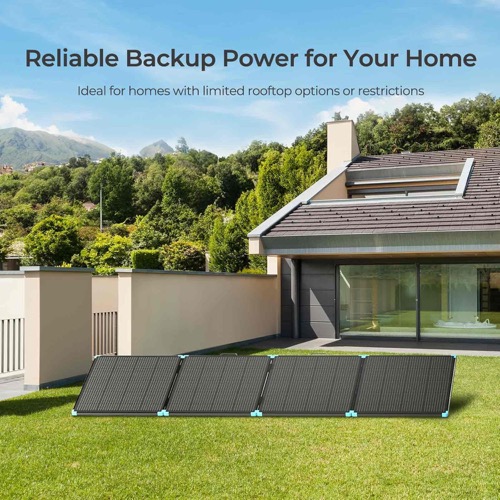
No permanent roof attachment, so the array can chase sun, move around shade, and serve more than one campsite or vessel.
Heavy in human handling
At about 30.2 pounds and nearly 112 inches open, it needs storage space, a clear deployment lane, and careful control in wind.
The owner record supports both sides of that distinction. Many accounts praise useful output, the ability to shift the array during camping or sailboat use, and strong charging in favorable sun. Other owners report shipping scuffs, bent cable routing near a grommet, sharp stand hardware, weak or inconsistent sections, or difficult support. Those observations do not yield a defect rate, but they make a receiving inspection essential.
Inspect before the first field trip:
- Open all sections on a clean surface and look for scratches, white marks, creases, lifted edges, and unequal panels.
- Cycle every kickstand with gloves and check plates/edges for burrs or pinch points.
- Inspect the cable exit, grommet, solar connectors, polarity labels, and strain relief.
- Record each section’s appearance and the whole panel’s Voc and loaded input in controlled sun.
- Save packaging, warranty terms, seller identity, and serial/model photographs.
Output reports span overcast use, strong clear-sun charging, receiver caps, and possible underperforming units. The clean diagnosis is comparative: aim the whole panel consistently, remove shade, begin with the station below its taper region, and record volts, amps, and watts. If one section appears damaged or the full assembly is much weaker than a known-good compatible source in the same conditions, document it before the return window closes.
| Field condition | Adjustment | What not to infer |
|---|---|---|
| Passing cloud | Wait for stable irradiance before comparing | A brief trough is not a panel failure |
| Narrow campsite shadow | Move the suitcase rather than accepting one shaded section | Nominal 400W does not overcome cell shade |
| Wind | Lower, orient, or anchor using a load-safe method | Kickstands alone are not storm restraint |
| Wet weather | Protect connections and dry before folding | IP67 does not waterproof the station or every junction |
Renogy documents IP67 protection for the panel and a three-year material/workmanship term. Still, portable construction needs maintenance: clean only when disconnected and cool, avoid abrasive grit, prevent cable crushing in the folds, and store it dry without heavy objects on top. The panel is best for buyers who value movable high-wattage harvest enough to accept the storage and handling burden.
Which Power Stations It Feeds
For a panel like this, the obvious question is “will it plug into the gear I already own?” Usually, yes. It uses IP68 waterproof solar connectors and hooks up to most portable power stations on the market — owners report clean connections with Anker (including the C1000 and F2000), Bluetti, and Victron MPPT setups.
Here’s the catch, though: it ships as just the panel. No universal station adapter cable is included, so you supply the adapter that matches your station’s input port. Owners wish that cable came in the box, and it’s the most common “read the fine print” gripe.
One nice bonus is overpaneling headroom. Many stations let you connect a higher-wattage panel than their MPPT fully uses — they just take what they can and ignore the rest. One owner confirmed with Anker that the C1000X can be overpaneled above its 600W input.
| Power Station / Battery | Typical Use | Compatible? | Notes |
|---|---|---|---|
| Anker C1000 / C1000X | Camping, backup | Compatible | Owners confirm overpaneling above the listed input |
| Anker F2000 / SOLIX | Home backup, A/C loads | Compatible | Ran a window A/C for ~6 hours in owner testing |
| Bluetti EB / AC series | Off-grid, camping | Compatible | Owners report easy hookup |
| EcoFlow River / Delta | Camping, home backup | Compatible | Works via the right MC4-to-station adapter |
| Jackery / Goal Zero | Camping, off-grid | Needs adapter | Match your station’s input plug |
| 12V battery (AGM / gel / LiFePO4) | RV, boat, cabin | Needs adapter | Requires a separate MPPT controller |
Buyer Heads-Up — This panel is two 200W sections wired in series, so its open-circuit voltage runs high — one owner measured around 47V. Do not string two of these in series to double up, or you’ll blow past the 60V input limit most stations enforce. Run them in parallel instead, and watch your station’s voltage ceiling.
What the Fiberglass Suitcase Harvests in Full Sun
Rated at 400W, the panel translates in good sun to roughly 328W of real output, or about 1,312 Wh on a typical day with four solid peak sun hours. In practice, owners regularly beat that midpoint, reporting 300-plus watts and peaks of 385W in Chicago, 390W in Arizona in January, and 395W on one clear day.
What does that mean day to day? Plenty to run real loads, not just top a phone. One owner hooked a window inverter A/C to an Anker F2000, fed this panel in, and ran the unit for around six hours on a 2kWh bank during hot summer days. To be fair, that’s the panel firing on all cylinders — real life is messier.
Not everyone hits those numbers. A recurring complaint is topping out near 250W, with one owner getting 250W flat on an RV roof (300W once tilted on the stands) and another watching yield drop after a rainstorm. A few decided two separate 200W panels would’ve served them better.
Cloudy days behave better than you’d expect. Pacific Northwest owners still pulled over 200W in December overcast and 50-100W in the rain, and one reported around 300W under full cloud cover with a clear view of the sky. The parallel wiring keeps it producing under partial tree cover instead of collapsing at the first shadow.
| Condition | Estimated Output | What That Means |
|---|---|---|
| Full sun, ideal angle | ~328-390 W | Runs real loads; recharges a 1kWh station fast |
| Partly cloudy sky | ~160-200 W | Still strong charging; just slower to fill the bank |
| Overcast / heavy clouds | ~50-100 W | Keeps trickling; won’t fully charge but holds ground |
| Panel flat vs. tilted | ~250 W flat, ~300 W tilted | Angle it on the kickstands for the real gain |
| Winter sun (northern US) | ~200-260 W avg | Still usable; fewer peak sun hours overall |
| Partial tree shade | Drops but keeps producing | Parallel wiring softens the hit vs. a series panel |
Real-World Math — Using a 0.82 real-world factor, this 400W panel delivers roughly 328W in good sun. Stack up 4 peak sun hours and you’ve banked around 1,312 Wh for the day. That’s enough to put a serious dent in a 2kWh power station every day — the difference between grid dependence and running your fridge through a multi-day outage.
For this 400W suitcase, treat the estimate as a site-specific range shaped by its four-section orientation, partial shade, cell heat, cable loss, station limits, and battery charge stage.
Kickstands and the 60-Second Setup
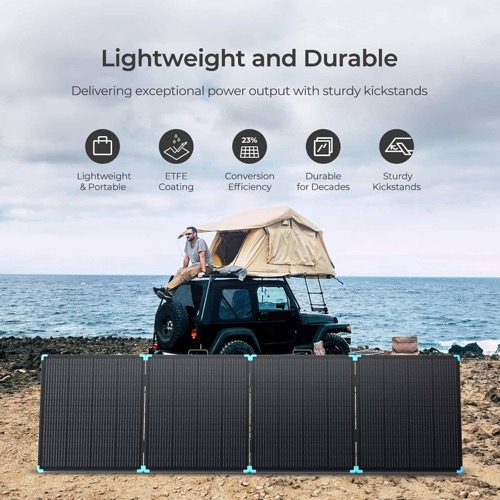
Setup is about as easy as 400W gets. Unfold it, kick out the integrated stands, angle it at the sun, and plug in — owners consistently clock it around a minute and call it easy to deploy, move, and pack away. Next to fabric-style folding panels, it feels quick and tidy.
Opinions split on the kickstands. Some owners find them sturdy; others call the wire legs flimsy, and one buyer was cut twice on the sharp metal plate that joins the panel to the stands. They also don’t adjust, so one owner built PVC extensions to hit a steeper ~40-degree winter angle and pulled them off for summer.
Wind is the real setup challenge. This panel catches a breeze like a sail, and owners repeatedly warn it’ll tip or fly on even a moderately windy day. Bring stakes, carabiners, bungees, or weights — and figure that out at home, not once you’re already at a gusty campsite.
Then there’s placement. Since no station cable is included and the connectors are on one side, owners add heavy-gauge MC4 extensions to put the panel in full sun while the station sits in the shade. Use thick copper — thin or long runs lose watts fast.
Practical Tip — Buy a 10-gauge MC4 extension cable at the same time as the panel. The included connectors are IP68, but there’s no station adapter or extension in the box, and experienced owners refuse to go thinner than 10 AWG because voltage drop on a long, light cable quietly eats your watts.
The Fiberglass Suitcase, Up Close
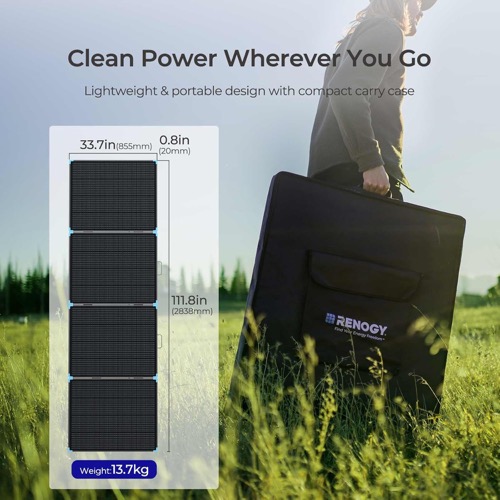
First impression for most buyers is that this thing feels premium. Owners describe the frame as rigid and well assembled, with reinforced corners, one-piece metal handles, and blue corner protectors that keep the panels off the ground. The build reads as gear you’ll actually use outdoors, not gear photographed outdoors for marketing.
Folded, it’s four connected panels riding in a soft cordura-style case rather than a hardshell — and it doesn’t need one, since there’s no glass. That’s a real advantage. Fiberglass and ETFE lamination replace the fragile glass sheet you’d crack on a rocky campsite, and the aluminum backsheet helps keep it from cooking in direct heat.
The handles deserve a note. They’re formed from a single piece of metal, unpadded, which some owners actually prefer — nothing to rot in the rain. On the flip side, a couple of buyers received units with scuffed handles from shipping, so inspect it on arrival.
Where things get less flattering is the small hardware. One owner found a middle panel’s rubber grommet pinching the cable, with stress marks already showing on the red wire, and immediately filed a return. Quality control isn’t perfectly consistent — worth opening and unfolding it fully the day it shows up.
IP67, Fiberglass, and Foul Weather
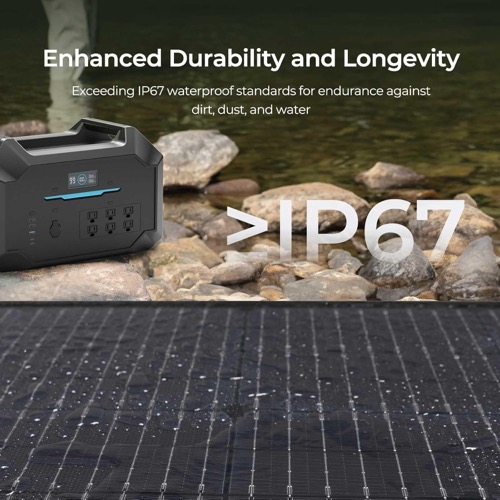
There’s a real IP rating here, not just marketing. The panel carries an IP67 rating, the solar connectors are IP68, and the surface uses a hail-resistant ETFE coating over an aluminum backsheet. That’s a genuinely outdoor-rated build meant for rain, snow, and blazing heat.
In day-to-day use, owners run it hard and it holds up. The fiberglass frame and no-glass design survive repeated setup, transport, and outdoor exposure without feeling flimsy, and buyers describe reinforced corners that inspire confidence. This isn’t a fair-weather fabric panel.
Coating is the one honest caveat. A small group of owners report the panel coating failing over time, with output dropping as a result, and one saw yield fall off significantly while traveling in a remote area where returns are a hassle. It’s not the norm, but it’s worth watching if you leave the panel exposed for long stretches.
| Feature | This Panel | What It Means Outdoors |
|---|---|---|
| IP rating | IP67 panel / IP68 connectors | Handles rain and brief immersion; connectors sealed |
| Frame / backing | Fiberglass + aluminum backsheet | Resists cracking and heat; no glass to shatter |
| Panel surface | Hail-resistant ETFE lamination | Wipes clean; decent UV and impact resistance |
| Junction / connectors | IP68 sealed | Safe to leave connected in wet weather |
| Coating longevity | Mostly solid, some failures | Watch for coating trouble on long exposure |
| Overheating control | Aluminum backsheet | Helps prevent heat throttling in direct sun |
| Long-term owner reports | Mostly positive, isolated degradation | Durable for most; QC variance is the real risk |
Worth Knowing — IP67 means the panel handles heavy rain and brief immersion, and the IP68 connectors are sealed even tighter. That’s a step above many folding panels that only claim vague “weather resistance.” You can leave this staked out through a passing storm — just anchor it first so the wind doesn’t take it.
Warranty, Certifications, and the Fine Print
Renogy backs this panel with a 3-year material and workmanship warranty. That’s a reasonable window for a portable panel, and Renogy’s track record helps — several owners mention running the brand’s folding panels and controllers for years without issues. No specific safety certifications are listed in the product details beyond the manufacturer’s durability claims.
Since it charges a power station — which has its own protection circuitry — the stakes on the panel side are lower. If you wire it directly to a 12V battery bank, you’re leaning entirely on the separate MPPT controller you add, so choose a reputable one. Renogy sells a version bundled with its Rover controller on the brand’s own site, which owners say handles AGM, flooded, gel, and LiFePO4 profiles and is fully waterproof.
On safety incidents, the feedback is reassuring — no melting connectors or cracking insulation in normal use. The issues owners raise are performance and hardware: the occasional coating failure, the sharp kickstand plate, and a grommet pinching a cable on one unit. Nothing points to a fire or thermal risk.
Long-Term Ownership — Monocrystalline cells themselves usually last for years, degrading slowly. On a folding panel, the real weak points are the connectors, the coating, and the hinge hardware — and here, batch quality. Test output on arrival, store it dry and folded in its case, and anchor it against wind so a gust never sends 30 pounds of fiberglass tumbling.
Is the Suitcase Right for Your Kit? — Use-Case Fit Matrix
| Use Case | Fit | Why |
|---|---|---|
| Charging a power station while camping | Strong fit | Real 300-390W in sun; plugs into most stations |
| RV / van supplemental solar | Strong fit | Reposition for sun when roof panels are shaded |
| Home blackout / emergency backup | Strong fit | Runs fridges and A/C off a station through outages |
| Off-grid cabin or long wilderness trip | Strong fit | Big daily harvest to keep a large bank topped |
| Sailboat / marine auxiliary power | Solid fit | IP67 sealing suits wet decks; anchor against wind |
| Backyard prepping / grid independence | Strong fit | Built for exactly this — real watts on demand |
| 12V battery charging (with controller) | With caveats | Works, but you supply the MPPT controller |
| Light day trips and picnics | Skip | Overkill and bulky for small, casual power needs |
| Windy exposed sites without anchors | Borderline | Will tip or fly unless you stake it down |
| Packing in a small car trunk | Borderline | Big even folded; won’t fit compact hatchbacks |
| Winter use needing steep tilt | With caveats | Kickstands are fixed; DIY extensions needed |
| Buyer wanting an all-in-one cable kit | With caveats | No station adapter cable is included |
Pick it if you want:
- A single 400W panel that delivers real off-grid power without a rooftop install
- To run a fridge, fans, or even a window A/C off a power station during outages
- A rugged fiberglass panel with no glass to crack on rough terrain
- Broad compatibility with the Anker, Bluetti, or EcoFlow gear you already own
Look past it if you need:
- A light, compact panel for day trips or a small car trunk
- A grab-and-go kit with the station adapter cable already included
- Adjustable tilt for dialed-in winter sun angles out of the box
- A panel you can leave unanchored on a windy, exposed site
This is a different tool for a different job — a serious power panel, not a casual one.
Renogy 400W portable suitcase: Decision Snapshot
| Spec | Value |
|---|---|
| Max Power Output | 400 W (A+ monocrystalline) |
| Output Voltage | ~33 V DC operating (up to 67.5 V Voc) |
| Connector | IP68 solar connectors (no station cable included) |
| Cell Efficiency | 23% |
| Weatherproof Rating | IP67 panel / IP68 connectors / ETFE coating |
| Charge Controller | None — direct output |
| Cable Length | Not specified (extension usually added) |
| Mount Type | Built-in fixed-angle kickstands |
| Best For | Charging power stations on RV, camping, and off-grid trips |
Renogy 400W Solar Suitcase Review: The Quick Take
If you want a foldable panel that delivers real off-grid power without a rooftop install, the Renogy 400W solar panel does exactly that. In good sun it pulls a genuine 300-390W into a power station, it folds into a soft case, and the fiberglass build shrugs off rain, snow, and heat with no glass to crack. Just know going in: it’s big even folded, it’ll tip in a stiff breeze unless you stake it down, the kickstands don’t adjust, and no station adapter cable comes in the box. For RV, cabin, and blackout backup, though, it’s an easy panel to recommend.
Is the Fiberglass Suitcase Worth It?
Weigh it all up and the Renogy suitcase comes out ahead for most off-grid trips. It pulls a real 300-390W in good sun, folds into a soft case, and takes rain, snow, and heat on a fiberglass frame with no glass to break. Compatibility is broad, setup runs about a minute, and one 400W unit beats wiring two 200W panels together — hard advantages to argue with.
The trade-offs are just as real: it’s big even folded, it’ll tip in wind unless you anchor it, the kickstands don’t adjust, no station cable comes in the box, and a few units show coating or output trouble over time. Reach for it when you want serious portable power for an RV, cabin, boat, or blackout kit and you’re ready to stake it against the wind — for that job this Renogy 400W solar panel is an easy yes. Skip to something else if you need a light, compact panel for casual day trips, or an all-in-one cable kit ready out of the box; a smaller panel will serve you better there.
Pros & Cons Analysis
Based on documented specifications and owner feedback
Pros
- Real output lands close to the rating — owners regularly report 300-plus watts into a power station in good sun, with peaks of 385W in Chicago, 390W in Arizona, and 395W on one clear day. For a folding portable panel, getting that near 400W surprises a lot of buyers.
- Fiberglass suitcase build feels premium — buyers describe the frame as rigid and well assembled, praise the reinforced corners and one-piece metal handles, and note it survives repeated setup and transport without feeling flimsy. There's no glass to crack.
- Sets up in about a minute — unfold it, kick out the integrated stands, angle it at the sun, and plug in. Owners consistently call it easy to deploy, move, and pack away, especially next to fabric-style folding panels.
- Genuinely portable for its power class — at around 30 pounds it's lighter per watt than older glass briefcase panels, folds flat, and rides in a soft carry case. Owners take it camping, keep it on a sailboat, or stow it in a vehicle.
- Handles partial shade better than expected — the parallel wiring keeps it producing useful power under scattered tree cover and clouds, and one owner still pulled around 300W under full cloud cover with a clear view of the sky.
- Plays nice with most power stations — owners hook it straight to Anker, Bluetti, and Victron gear, and several note you can overpanel stations like the Anker C1000X above their listed input as long as you watch the voltage limit.
- Charges through overcast skies — Pacific Northwest owners still pulled 50-100W on rainy days and 200-plus watts in December overcast, which beats the cheap panels bundled with some power stations.
- Strong long-run value versus two 200W panels — buying one 400W suitcase instead of a pair of 200W units saves money and skips the risky series wiring, and owners frame the per-year cost over a durable panel as easy to justify.
Cons
- Output can fall short of the 400W claim — a recurring gripe is topping out around 250W in real use, with one owner getting 250W flat on an RV roof and another watching yield drop after a rainstorm. A few decided they'd have been better off with two separate 200W panels.
- Kickstands and hardware draw complaints — the fixed-angle legs strike some owners as flimsy wire, and one buyer was cut twice on the sharp metal plate that joins the panel to the stands. The legs also don't adjust for winter sun angles.
- It catches wind like a sail — several owners warn that even a light breeze can tip or fly this thing. You need stakes, weights, or bungees worked out ahead of time, not once you're already on site.
- Big even folded — the suitcase is bulky enough that one owner couldn't fit it in a compact hatchback trunk. It eats a decent chunk of cargo space, so it's overkill for day trips and light picnics.
- Coating and yield issues on some units — a handful of owners report the panel coating failing and output dropping, with one seeing yield fall off significantly while traveling in a remote area where returns are a hassle.
- No universal adapter cable in the box — it ships as just the panel with IP68 solar connectors, so you supply the adapter for your specific station. Owners wish a station cable came included instead of being sold separately.
- Spotty factory quality control — one owner found a middle panel's grommet pinching the cable with stress marks already showing on the red wire, and another had a corner come apart out of the box. Handles arrived scuffed on a couple units.
- Weight isn't for everyone — the mostly-metal build that some love as sturdy strikes others as heavier than they'd like to haul, and moving it any real distance often means a collapsible cart.
Is the Fiberglass Suitcase Worth It?
Weigh it all up and the Renogy suitcase comes out ahead for most off-grid trips. It pulls a real 300-390W in good sun, folds into a soft case, and takes rain, snow, and heat on a fiberglass frame with no glass to break. Compatibility is broad, setup runs about a minute, and one 400W unit beats wiring two 200W panels together — hard advantages to argue with.
The trade-offs are just as real: it's big even folded, it'll tip in wind unless you anchor it, the kickstands don't adjust, no station cable comes in the box, and a few units show coating or output trouble over time. Reach for it when you want serious portable power for an RV, cabin, boat, or blackout kit and you're ready to stake it against the wind — for that job this Renogy 400W solar panel is an easy yes. Skip to something else if you need a light, compact panel for casual day trips, or an all-in-one cable kit ready out of the box; a smaller panel will serve you better there.
Frequently Asked Questions
How much power does the Renogy 400W Solar Suitcase actually produce?
In good sun with a decent angle, owners regularly report 300-plus watts into a power station, with peaks of 385W in Chicago, 390W in Arizona in January, and 395W on one clear day. That said, some owners top out closer to 250W, especially flat on an RV roof or after weather exposure. Like any panel, the 400W figure is a lab rating, not a daily guarantee — real output depends on angle, sun hours, and temperature.
Does it charge on cloudy or overcast days?
Yes, just slower. Owners in the Pacific Northwest still pulled over 200W in December overcast and 50-100W on rainy days, and one buyer reported around 300W under full cloud cover with a clear view of the sky. The parallel wiring helps it keep producing useful power under partial tree cover instead of collapsing the moment a shadow lands on it.
Is the Renogy 400W Solar Suitcase waterproof?
It's built for weather. The panel carries an IP67 rating with a hail-resistant ETFE coating and an aluminum backsheet, and the solar connectors are IP68 rated. Owners run it through rain, snow, and heat, though a few report the panel coating failing on their units over time. Treat it as a genuinely outdoor-rated panel, but keep an eye on the coating if you leave it exposed for long stretches.
What power stations and connectors does it work with?
It uses IP68 solar connectors and hooks up to most portable power stations on the market. Owners connect it to Anker (including the C1000 and F2000), Bluetti, and Victron MPPT gear without trouble. The catch is that it ships as just the panel — no universal station adapter cable is included, so you'll need the right adapter for your specific station's input port.
Can I overpanel my power station with a 400W panel?
Often yes. Many power stations let you connect a higher-wattage panel than their MPPT will fully use — the station simply takes as much as it can and ignores the rest. One owner confirmed with Anker that the C1000X can be overpaneled above its 600W input limit. Just watch the voltage: this panel is two 200W sections wired in series, so its open-circuit voltage runs higher than a single small panel. Don't string two of these in series or you'll blow past the 60V limit most stations enforce.
Does it come with a charge controller for 12V batteries?
No. The panel outputs directly with no built-in controller. Most owners run it into a power station, which has its own controller. To charge a 12V battery (AGM, flooded, gel, or LiFePO4) directly, you'll need to add your own MPPT controller and the right cable — several owners use a Victron MPPT, and Renogy sells a version bundled with its Rover controller on the brand's own site.
How do I keep it from blowing over in the wind?
Plan for it before you go. Owners repeatedly warn that even a light breeze can tip or fly this panel because of its large surface area. Bring tent stakes, small carabiners, and bungee cords, or set some weights to anchor it. On a calm day it's a non-issue, but figure out your tie-down solution at home, not once you're already at a windy campsite.
Are the kickstands adjustable for winter sun angles?
No, the kickstands are a fixed angle. Some owners like that because it makes the setup simpler and removes a potential weak point, but others wish they could tilt the panel steeper in winter. One owner made PVC extensions to hit roughly 40 degrees in the winter months and removed them for a lower summer angle. If seasonal angle tuning matters to you, plan for a DIY workaround.
Does the cable reach my power station?
Not always, and no adapter cable is even included. Owners commonly add MC4 extension cables to place the panel in full sun while the station sits in the shade. Just use heavy-gauge copper — thinner or longer runs lose watts fast, and experienced owners stick to 10-gauge cable for extensions to keep the loss down.
Is it too heavy and bulky to travel with?
It depends on your use case. At around 30 pounds it's actually lighter per watt than older glass briefcase panels, and short carries from car to campsite are fine. For longer distances, owners use a collapsible cart. But it's big even folded — one owner couldn't fit it in a compact hatchback trunk — so it's overkill for day trips and better suited to RV, cabin, and backyard backup use.
Technical Specifications
| Brand | Renogy |
|---|---|
| Model / SKU | RSP400LSC-US (ASIN B0D4LMVKYD) |
| Panel format | Four-section portable suitcase |
| Rated output (Pmax) | 400W |
| Cell technology | Monocrystalline |
| Module efficiency | — |
| Voltage at maximum power (Vmp) | 40V |
| Current at maximum power (Imp) | 10A |
| Open-circuit voltage (Voc) | 47.2V |
| Short-circuit current (Isc) | 11A |
| Power tolerance | — |
| Maximum system voltage | 600VDC UL |
| Maximum series fuse | 15A |
| Output connector | Solar connectors |
| Output cable | — |
| Deployed dimensions | 111.8 × 33.7 × 0.8 in |
| Folded dimensions | 27.9 × 33.7 × 3.2 in |
| Weight | 30.2 lb |
| Surface and frame | ETFE surface with fiberglass reinforcement |
| Positioning / mounting | Integrated aluminum kickstands; flush or table placement |
| Environmental protection | Panel at least IP67; connectors IP68 |
| Wind / snow load | — |
| Operating temperature | -40°F to 185°F (-40°C to 85°C) |
| Included accessories | One 400W suitcase panel; controller and station adapter not included |
| Product warranty | 3-year material/workmanship; 10-year 80% output warranty |