EBL 200W Solar Panel Review: Can a Battery Brand Make a Reliable Solar Panel?
At a Glance
KEY FEATURES
- Power output: 200 W (claimed), monocrystalline silicon with 6-layer ETFE lamination
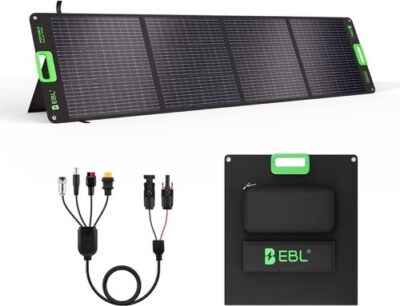
- Output: 18 V DC, MC-4 to 4-in-1 cable (XT60 / Anderson / DC 7.9×0.9mm / Aviation connectors)
- Cell efficiency: Up to 23.5% (high tier for a portable panel)
- Weatherproofing: IP65 splash resistant; 840D Oxford fabric backing; PET-coated surface
- Charge controller: Built-in MPPT controller (overcharge protection; up to 11.1A); separate controller needed for 12V battery charging
- Best for: Power station charging (EcoFlow, Jackery, Bluetti, EBL), RV and camping off-grid power, 12V car/boat/RV battery maintenance with a separate controller
PROS
- EBL brand build quality — repeat buyers trust it from batteries to panels
- Lightweight and foldable — easy to carry and store in a closet or trunk
- 4-in-1 cable plus built-in MPPT — plug into most power stations and go
- IP65 weather resistance — handles rain, splashes, and dust outdoors
- Charges power stations and 12V batteries in good sun
CONS
- Real-world output often lands below the 200W rating in everyday sun
- Sensitive to shade and poor angle — output drops sharply when off-sun
- Included adapters don't fit every station — some need their own adapter
- Thin fabric kickstands — hold an angle but shift in wind without anchoring
- Short cable and occasional dead-on-arrival units reported
Editor's Choice
Based on exact documentation and qualitative exact-ASIN Amazon owner evidence; no hands-on test or population-rate claim
This EBL 200W solar panel review tackles the question most buyers actually have: EBL built its name on rechargeable AA batteries and power banks, so can that same know-how produce a solar panel worth trusting? It’s a fair thing to wonder. Charging cells and harvesting sunlight are not the same engineering problem.
Here’s the dilemma. You’re scrolling Amazon for a 200W portable panel, and EBL pops up at a competitive price next to names like Jackery and Bluetti. You recognize the brand — but from the battery aisle, not the solar aisle. Is this a smart crossover, or a battery company wandering out of its lane?
To be fair, the only honest way to answer that is to look at the panel itself — real output versus the 200W rating, build quality, and how owners say it holds up. So this review leans on the product specs and actual customer experiences, not the logo on the box. Let’s see whether EBL earned the spot in your cart.
EBL publishes ESP-200 electrical, folded-size, weight, material, and included-cable details.
The retained exact-ASIN accounts support troubleshooting themes, not reliability or satisfaction rates.
The EBL 200W requires a stricter evidence boundary than the better-documented products in this batch. The owner record includes successful plug-and-charge use, low-input complaints, a warranty replacement, a report of slow charging, and a request for a longer lead. That is enough to expose the important decision points, but not enough to estimate typical output or failure frequency. A cautious review should therefore lean on the ESP-200’s documented electrical envelope and show buyers how to diagnose their own delivered unit.
| Gate | ESP-200 fact to check | Reason it matters |
|---|---|---|
| Receiver voltage | 23.8V open circuit; 19.8V operating | The station must accept the panel before connector choice matters |
| Receiver current | 10.1A operating current | A lower station ceiling can cap input with a healthy panel |
| Cable route | Solar connector to XT60, Anderson, DC7909, or aviation adapter | Every junction adds a fit, polarity, and loss check |
| Deployment space | About 95.75 inches long when open | A 200W folder needs more clear, stable ground than its closed size suggests |
Start commissioning with the receiving battery below its taper region, the panel cool, all sections unshaded, and the sun normal to the cells. Record open-circuit voltage only with appropriate equipment and safe procedures, then record stable loaded watts, voltage, and current at the station. Repeat after the panel warms. If input is unexpectedly low, compare the receiver’s maximum current and wattage, remove every narrow shadow, reseat solar connectors, and try the panel on another compatible receiver before labeling it defective.
EBL identifies ETFE lamination, 900D Oxford cloth, and a 17.95-pound weight for its current ESP-200 page. That makes it portable between a vehicle and campsite, but not light enough to ignore storage and handling. Keep it upright and protected in transit, avoid crushing folds, shelter the adapter junction and station from water, and use an extension only when its conductor size, connector rating, polarity, and voltage drop are appropriate.
The purchase case is strongest for an owner who wants a documented 200W-class folder and is prepared to verify the station interface. It is weaker for someone who expects one included tip to guarantee full power across every power-station generation or who needs robust population-level longevity evidence.
Does It Actually Charge?
The EBL 200W solar panel is rated at 200W, which in good sun translates to roughly 130-160W of real output — call it around 590 Wh on a solid four-hour peak-sun day. That’s enough to keep a midsize power station topped up through a weekend and to seriously slow the drain on a bigger one.
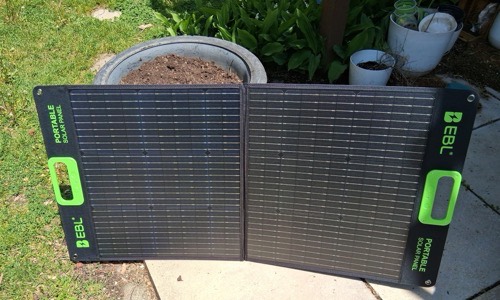
In practice, the honest picture is more mixed. Owners charging power stations in direct sun report steady, reliable results — one kept an EcoFlow Delta 2 charged through the day without drama. The catch is that real-world numbers don’t always hit the headline figure. One buyer trying to feed a large EBL power bank measured only about 80W when they needed closer to 150W, which left the bank crawling toward full. A reviewer in Arizona saw far less than expected at midday, and several note the panel is sensitive to shadows.
| Condition | Estimated Output | What That Means |
|---|---|---|
| Full sun, ideal angle | ~150 W | Charges most power stations steadily; ~590 Wh over a good day |
| Partly cloudy sky | ~75 W | Net gain shrinks; a 1000Wh station charges slowly |
| Overcast / heavy clouds | ~40-60 W | Trickles power; won’t refill a big station, slows the drain |
| Panel angle 45° off optimal | ~95-110 W | Noticeable hit; aim it properly to avoid this |
| Winter sun (northern US) | ~80-90 W avg | Still useful; 2-3 peak sun hours vs summer’s 4-5 |
| Panel in partial shade | ~15-45 W | Big drop; even a corner shadow hurts output a lot |
Real-World Math — Using a 0.74 output factor, this 200W panel delivers roughly 148W in good sun. Over a 4-hour peak-sun day, that’s about 590 Wh. A 1000Wh power station from empty would need close to two solid sun days at that rate — so plan on topping up daily, not refilling from dead overnight.
These are estimates. Real output swings with angle, sky conditions, shade, temperature, and how far your cable forces you to place the panel.
Connectors and Device Support
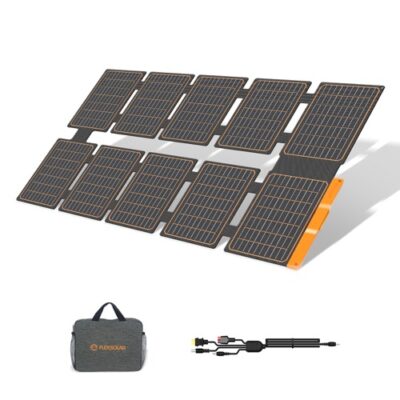
The big compatibility win here is the included MC-4 to 4-in-1 cable. It carries XT60, Anderson, DC 7.9×0.9mm, and aviation connectors, so it plugs straight into the bulk of popular power stations without extra shopping.
That said, it’s not literally everything. A few owners found the bundled adapters didn’t match their specific station and had to supply their own. So check your station’s solar input before you assume it’ll just click in.
| Power Station / Device | Connector | Compatible? | Notes |
|---|---|---|---|
| EcoFlow River Pro / Delta series | XT60 | Compatible | Owner kept a Delta 2 charged through the day |
| Jackery Explorer (1000, etc.) | Anderson | Compatible | Standard Anderson input |
| Bluetti AC200MAX and similar | Aviation | Compatible | Use the aviation connector |
| GRECELL / ROCKPALS / FlashFish | DC barrel | Needs adapter | May need a DC size adapter (sold separately) |
| EBL power stations | Anderson | Compatible | Same-brand pairing works as expected |
| 12V battery (direct) | MC-4 | Not compatible | Needs a separate charge controller and clips |
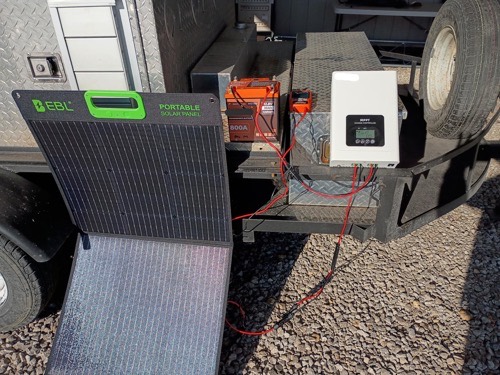
For 12V battery charging, the panel handles a wide range of chemistries — but only through a separate controller.
| Battery Type | Typical Use | Compatible? | Notes |
|---|---|---|---|
| Flooded lead-acid | Car, truck, RV | Compatible | Standard 12V charging via separate controller |
| AGM (sealed) | RV, boat, UPS | Compatible | No gassing risk; good for sealed bays |
| Gel cell | Marine, mobility | Needs adapter | Use a controller with a gel charge profile |
| LiFePO4 (12V) | RV, van life, backup | Needs adapter | Use a controller set to the LFP profile |
| 24V battery bank | Large RV / boat bank | Not compatible | This panel outputs 18V; series wiring of panels required |
Buyer Heads-Up — The panel’s built-in MPPT is for power-station-style solar input, not for regulating a 12V battery directly. Charging a car, RV, or boat battery means buying a separate charge controller and alligator clips. Never wire a battery straight to the panel.
What's It Like to Handle?
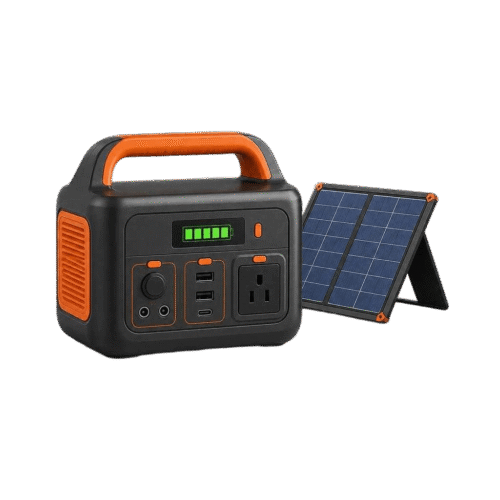
First impressions skew positive. Owners reach for words like lightweight, thin, and very portable, and several mention the non-slip rubber handle and the magnetic-style closure that keeps the two halves together in transit. At roughly 18.6 pounds folded down to about a quarter of its open size, it slides into a closet or trunk without a fight.
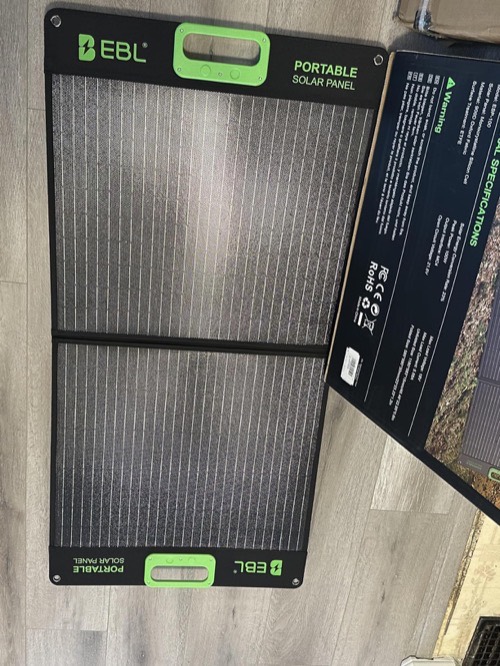
The construction feels a step above bargain panels. EBL uses 6-layer ETFE lamination over monocrystalline cells, a PET-coated surface, and a rugged 840D Oxford fabric backing — and buyers describe it as solid, not flimsy. Repeat EBL customers, the ones who already own the brand’s batteries and power banks, tend to say the quality they trust shows up here too.
There’s one honest catch. Like EBL’s other foldable panels, this one has no rigid edge frame, so the surface can bow a little when set up. It’s not a dealbreaker, but you’ll want to keep heavy gear off it. Owners also flag the kickstands as thin — functional, but the kind you anchor against something on a windy day.
Mount, Cable, and Installation
Setup is genuinely quick. You unfold the panel, flip out the kickstands, plug the matching connector into your station, and you’re charging. Owners who call themselves non-technical say they had it running in minutes, and the rear zippered pocket keeps the cable and adapters from wandering off.
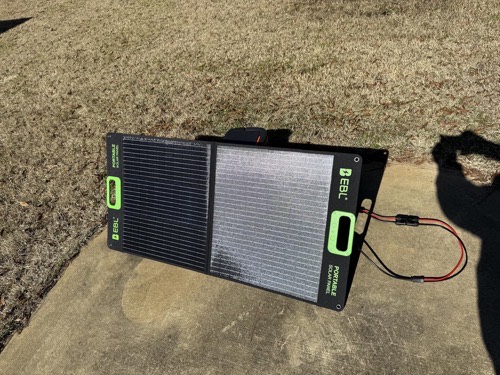
The mounting story is the weak spot. Four adjustable kickstands with a push-button mechanism and front transport locks hold the panel at an angle, but across EBL’s foldable line, owners describe the fabric-backed stands as thin and a bit flexible. They work — just expect to anchor the panel against something solid when it’s breezy, or it can shift and lose its aim.
Cable length is the other recurring gripe. The 4-in-1 cable lives in the back pocket, and owners of EBL’s panels repeatedly say the cord runs short when the panel needs to sit out in the sun while the station stays in the shade. If your setup puts any distance between panel and station, plan ahead.
Practical Tip — Before your first trip, budget for a matching solar extension cable. Placing the panel in full sun while your power station rests in shade often adds 10-15 feet, and the stock cord won’t reach. Match the connector type so you don’t lose output to a cheap adapter.
Built to Last Outdoors?
The EBL 200W carries an IP65 rating, which means it shrugs off rain, splashes, and dust but is not built for submersion. In plain terms: a passing shower is fine, a puddle is not. Owners who left it out through rain report it kept working afterward, which is the reassurance most campers want.
The materials back that up. The ETFE-laminated cells, PET-coated surface, and 840D Oxford fabric backing give it heat, dust, and corrosion resistance, and buyers describe the whole thing as feeling well-made rather than cheap. For a foldable panel that lives in a trunk between trips, that durability matters more than spec-sheet bragging.
| Feature | This Panel | What It Means Outdoors |
|---|---|---|
| IP rating | IP65 | Protected from rain and dust, not submersion |
| Frame material | Aluminum + Oxford fabric backing | Resists corrosion; no rigid edge frame, so it can bow slightly |
| Panel surface | ETFE lamination with PET coating | Tough and scratch-resistant for a foldable panel |
| Junction box seal | Not stated | Keep the cable box out of pooling water |
| Connector weatherproofing | Not stated | Tuck connectors into the zippered pocket when not in use |
| Operating temperature range | Up to 60°C (140°F) upper; lower not stated | Handles hot summer sun; verify for hard freezes |
| Long-term owner reports | Mostly positive after rain | A few dead-on-arrival units, but build praise dominates |
Worth Knowing — IP65 protects against water jets but not immersion. For a panel you fold up and store between uses, that’s plenty. Just don’t leave it face-up collecting water in a downpour, and keep the cable connectors dry.
Warranty and Safety Coverage
EBL doesn’t publish specific third-party safety certifications for this panel, and the warranty length isn’t stated on the listing either. That’s not unusual for an Amazon-sold portable panel, but it’s worth knowing if paperwork matters to you. The IP65 rating is the main certified spec here.
On the safety side, reviews are reassuring. There are no reports of overheating, smoke, or melting connectors — the failures that do show up are dead-on-arrival units rather than anything hazardous. A couple of buyers received a panel that simply didn’t charge and had to troubleshoot before returning it. The upper temperature rating of 60°C suggests it’s comfortable in hot summer sun, though EBL doesn’t list a cold-weather floor.
Long-Term Ownership — Monocrystalline panels degrade slowly, around 0.5% a year, so the cells aren’t usually the first thing to go. The weak points on foldable panels tend to be the cable, connectors, and folding hinges. Keeping the connectors dry and not over-flexing the panel does more for longevity than any spec.
Is the support enough? For camping and station charging, where a dud can be swapped early, the risk is low. For someone wiring this into a permanent RV or boat setup, the lack of a stated warranty is a fair reason to test output hard in the first week.
Who Should Buy the EBL 200W?
The EBL 200W lands as a strong fit for some jobs and a poor one for others. Here’s how it maps across common buyer scenarios.
| Use Case | Fit | Why |
|---|---|---|
| Power station charging on camping trips | Strong fit | 4-in-1 cable plus MPPT charges most stations in good sun |
| RV off-grid power (with power station) | Strong fit | Keeps a midsize station topped up day to day |
| 12V car / truck battery maintenance | Solid fit | Works with a separate controller and clips |
| RV battery trickle charge (season storage) | Solid fit | Plenty of wattage; needs a controller for direct charging |
| Boat / marine battery maintenance | With caveats | IP65 handles splashes; keep connectors out of standing water |
| Motorcycle / ATV battery in storage | Solid fit | Ample wattage; a smaller panel would also do |
| Off-grid cabin or shed 12V power | Solid fit | Good for lights and small loads via a controller |
| Charging USB devices / phones directly | Skip | 18V output; route through a power station, not direct |
| Buyer wanting one-day refill of a big station | Borderline | Real output often trails the 200W rating |
| Install in a shaded location | Skip | Output collapses in partial shade |
| High-draw loads (power tools, big inverter) | Not recommended | One panel can’t keep up with heavy continuous loads |
| Buyer who wants certified, published specs | With caveats | Voc, Isc, warranty, and cable length aren’t listed |
Overall Assessment
So, can a battery brand make a reliable solar panel? Based on the product data and owner experiences in this EBL 200W solar panel review, mostly yes — with eyes open. The build quality EBL is known for carries over, the 4-in-1 cable and built-in MPPT make it easy to live with, and IP65 handles real outdoor use. For keeping a power station charged on trips or maintaining a 12V battery with a controller, it does the job and feels worth the price.
Here’s the honest line. If your sun is good and your expectations are realistic, the EBL 200W solar panel is an easy recommendation for camping, RV, and backup power. If you’re counting on a full 200W in everyday conditions, want it for a shaded spot, or need a depleted big station refilled in an afternoon, this isn’t your panel — and no marketing line should convince you otherwise. Match it to the right job and it earns its keep.
EBL ESP-200: Decision Snapshot
| Spec | Value |
|---|---|
| Max Power Output | 200 W (monocrystalline) |
| Output Voltage | 18 V DC |
| Connector | MC-4 to 4-in-1 (XT60 / Anderson / DC / aviation) |
| Cell Efficiency | Up to 23.5% |
| Weatherproof Rating | IP65 (splash and dust resistant) |
| Charge Controller | Built-in MPPT (separate controller needed for 12V batteries) |
| Cable Length | Not specified (in rear zippered pocket) |
| Mount Type | 4 adjustable kickstands |
| Best For | Charging power stations and 12V batteries off-grid and in RVs |
EBL 200W: What You Need to Know
If you want a foldable panel to keep a power station charged on camping and RV trips, this EBL 200W solar panel review lands on a cautious yes. In good sun it charges stations like an EcoFlow Delta 2 reliably, the build feels sturdy for its weight, and the 4-in-1 cable means you’re plugged in within minutes. The built-in MPPT controller and 23.5% cells are real advantages at this price. Just know going in: real-world output often lands below the 200W headline, and the panel is fussy about shade and angle — so a depleted 1000Wh+ station won’t refill in a single grey afternoon.
You'll probably be happy if you want: — EBL ESP-200
- A foldable panel to keep a power station charged on camping and RV trips
- Plug-and-play compatibility with EcoFlow, Jackery, Bluetti, and EBL stations
- A way to maintain a 12V car, RV, or boat battery using your own controller
- Something light and packable that survives rain and dust
You might want to skip it if you need: — EBL ESP-200
- One-day full charging of a depleted 1000Wh+ station from a single panel
- Reliable output in a shaded or poorly angled install
- Direct USB/phone charging without a power station in between
- Published electrical specs and a stated warranty before you buy
Pros & Cons Analysis
Based on documented specifications and owner feedback
Pros
- EBL brand quality carries over — longtime EBL battery and power-bank owners say the build quality they trust shows up here too. Several describe themselves as repeat EBL buyers who reach for the brand specifically because past products held up.
- Genuinely portable and lightweight — at folded size with a non-slip handle and magnetic-style closure, customers consistently call it light, thin, and easy to carry. Folds down to roughly a quarter of its open size and stows in a closet or trunk without hassle.
- Plug-and-play setup with 4-in-1 cable — the included MC-4 to XT60/Anderson/DC/Aviation cable means most people hook it to a power station and start charging within minutes. Buyers describe setup as quick and simple, even those who aren't technical.
- Charges power stations reliably in good sun — owners report keeping an EcoFlow Delta 2 topped up through the day, and others say it charges their station and 12V batteries quickly and steadily when the sun cooperates.
- Built-in MPPT controller — the panel includes an auto-optimizing MPPT controller that resumes charging when sun returns and adds overcharge protection. This is a step up from the bare PWM or no-controller panels in this price range.
- IP65 weather resistance holds up — buyers who left the panel through rain report it kept working fine afterward. The PET-coated surface and 840D Oxford fabric backing feel sturdy and handle splashes and dust.
- Versatile beyond power stations — with a separate controller and clips, owners use it to charge 12V car, RV, boat, AGM, and LiFePO4 batteries. Series and parallel connection support lets you pair panels for more output.
- Smart cable management — the built-in zippered pocket on the back keeps the cable and adapters together, so everything you need travels with the panel. Owners appreciate not hunting for loose cords at the campsite.
Cons
- Real-world output below the 200W rating — one owner trying to charge a large EBL power bank measured only about 80W instead of the roughly 150W they expected, leaving the bank crawling toward full. Output gaps between rated and real-world wattage are the most common performance gripe.
- Underperforms badly in poor sun and shade — a buyer in Arizona reported far less than expected output at midday, and several owners note the panel is sensitive to shadows. Proper angle makes a big difference, and partial shade drops output sharply.
- Included adapters don't fit every station — a few owners found the bundled connectors didn't match their specific battery station and had to supply their own adapter to make it work. The 4-in-1 cable covers most stations, not all.
- Cloudy-day output drops off — while some say it still trickles power on overcast days, the panel clearly slows down. On grey days you get a fraction of the rated wattage, which a 1000Wh+ station can outrun.
- Cable runs short for distant placement — owners of EBL's foldable panels repeatedly flag the supplied cord as too short when the panel sits far from the device. Many end up buying an extension to place the panel in better sun.
- Kickstands feel thin — across EBL's foldable line, owners describe the fabric-backed kickstands as flexible and basic. They hold an angle but can shift in wind, so the panel needs anchoring on a breezy day.
- Defective units do show up — a few buyers received a panel that simply didn't work out of the box and spent hours troubleshooting a dead unit. Returns are a hassle, especially for anyone far from a drop-off point.
- Panels can bow slightly — owners of EBL's foldable panels note the surface bows a bit since there's no rigid frame around the edges. It's not a dealbreaker, but you'll want to avoid setting heavy objects on it.
Our Verdict
Charging performance (3.4/5) — In good sun the EBL 200W charges power stations and 12V batteries reliably, helped by its high-efficiency monocrystalline cells and built-in MPPT. But there are real reports of output well below the 200W rating — one owner measured roughly 80W when expecting ~150W — plus weak performance in shade and poor angles.
Value & compatibility (3.8/5) — The built-in MPPT, four-connector 4-in-1 cable, series/parallel support, and broad station compatibility deliver good value, usually at a lower price than power-station-branded panels. The output gap and occasional dead-on-arrival units hold it back.
Build & weatherproofing (4.0/5) — IP65, 6-layer ETFE lamination, a PET-coated surface, and 840D Oxford fabric backing feel sturdy and survive rain, though thin kickstands and slight panel bow (no rigid frame) keep it just below the top tier.
Install & usability (4.2/5) — The 4-in-1 cable, zippered cable pocket, push-button kickstands, and light weight make setup fast and genuinely portable. A short cable and adapters that don't fit every station are the main friction points.
Bottom line — Best for keeping a power station charged on camping and RV trips, off-grid and blackout backup, and 12V battery maintenance with a separate controller. Skip it if you need a one-day refill of a depleted 1000Wh+ station, reliable output in shade, direct USB charging, or published specs and a stated warranty.
Frequently Asked Questions
Does the EBL 200W solar panel charge on cloudy days?
Yes, but slowly. Owners report it still trickles some power on overcast days, but output drops to a fraction of the 200W rating. On a fully grey day, a large 1000Wh+ power station can outrun what the panel brings in. For meaningful charging, you want direct sun and a good angle — the panel is noticeably sensitive to shade and cloud cover.
Will the EBL 200W panel charge my power station?
It works with most. The included MC-4 to 4-in-1 cable has XT60, Anderson, DC 7.9x0.9mm, and aviation connectors, covering EcoFlow (XT60), Jackery and Bluetti (Anderson/aviation), EBL, and many others. Owners have kept an EcoFlow Delta 2 charged through the day. A small number found the bundled adapters didn't match their specific station and had to supply their own adapter.
Does it really put out 200 watts?
In strong, direct sun at a good angle, it gets close. In everyday conditions, expect less — one owner trying to charge a large EBL power bank measured around 80W instead of the roughly 150W they needed. Like all panels, the 200W figure is a peak lab rating. Plan around real-world output of roughly 130-160W in good sun, and much less in poor light.
Can I use the EBL 200W panel to charge a 12V car, RV, or boat battery?
Yes, but not directly. You need a separate charge controller and alligator clips (both sold separately) between the panel and the battery. With those, owners charge 12V car, RV, boat, AGM, gel, lead-acid, and LiFePO4 batteries. Never connect a battery straight to the panel — the controller regulates the voltage and protects the battery.
What is the built-in MPPT controller, and does it help?
The panel has an auto-optimizing MPPT controller built in. MPPT tracks the panel's best voltage point and harvests more energy than a basic PWM panel, especially in variable light. It also resumes charging instantly when sun returns after a cloud passes and adds overcharge protection. Note: for charging a 12V battery directly, you still need a separate battery charge controller.
Is the EBL 200W panel waterproof?
It carries an IP65 rating, which means it's splash and dust resistant — fine for rain, wet grass, and outdoor camping. Owners report it kept working after rain. IP65 is not submersion-rated, so don't leave it in standing water or soak it. The cable box and connectors are the parts to keep out of pooling water.
How long is the cable, and is it long enough?
The panel ships with its 4-in-1 charge cable stored in the rear zippered pocket. Across EBL's foldable panels, owners consistently say the cord is short if the panel needs to sit far from the device — for example, in better sun while the station stays in the shade. If you plan to place the panel some distance away, budget for an extension cable that matches your connector type.
Can I connect two EBL panels together for more power?
Yes. The panel supports both series and parallel connections, so you can pair it with another compatible panel to increase voltage or current and shorten charging time. Match the panel type and rating when wiring in series or parallel, and confirm your power station or controller can handle the combined input.
How sturdy are the kickstands?
The panel uses adjustable kickstands with a push-button mechanism and front locks to keep it shut in transit. Owners of EBL's foldable line describe the fabric-backed stands as functional but thin — they hold an angle but can shift in wind. On a breezy day, anchor the panel against something solid so it doesn't tip or twist.
What if my EBL panel arrives defective?
A few buyers received a unit that didn't work out of the box and spent time troubleshooting a dead panel. If yours doesn't charge at all in good sun, test it with a voltmeter and start a return or warranty claim quickly. EBL is an established brand, and most owners report trouble-free units, but it's worth checking output in the first few days.
Technical Specifications
| Brand | EBL |
|---|---|
| Model / SKU | ESP-200 (ASIN B0GCN4LZR2) |
| Panel format | Folding portable panel |
| Rated output (Pmax) | 200W |
| Cell technology | Monocrystalline |
| Module efficiency | — |
| Voltage at maximum power (Vmp) | 18V |
| Current at maximum power (Imp) | 11.1A |
| Open-circuit voltage (Voc) | — |
| Short-circuit current (Isc) | — |
| Power tolerance | — |
| Maximum system voltage | — |
| Maximum series fuse | — |
| Output connector | MC4 with XT60, Anderson, DC7909, and aviation adapters |
| Output cable | — |
| Deployed dimensions | 85.83 × 22.83 × 0.6 in |
| Folded dimensions | 23.11 × 22.76 × 1.4 in |
| Weight | 18.6 lb |
| Surface and frame | ETFE surface with 840D Oxford-fabric body |
| Positioning / mounting | Four integrated kickstands |
| Environmental protection | Panel IP65 |
| Wind / snow load | — |
| Operating temperature | — |
| Included accessories | Panel, output lead, adapter set, and storage bag |
| Product warranty | — |