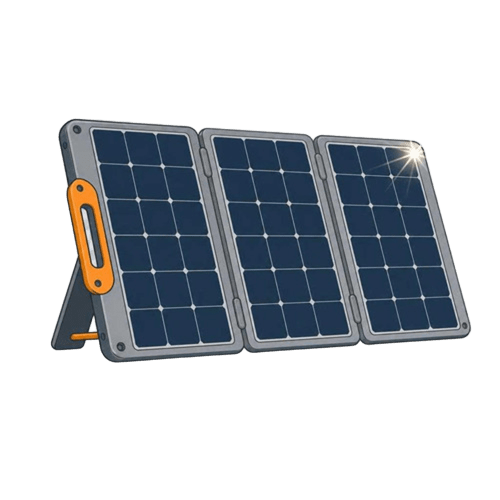
FlexSolar LX-S100 Review: 100W That Fits a Laptop Bag
At a Glance
KEY FEATURES
- 100W folding panel weighs 4.1 pounds and folds to laptop-bag dimensions.
- Separate 100W DC, 45W USB-C, and 18W USB-A outputs.
- Four included adapter ends cover XT60, Anderson, DC7909, and DC5521.
- IP67 panel construction with integrated carry format.
- Best for compact camping kits, Starlink Mini support, and small fridges.
PROS
- Exceptional watts-to-packed-size ratio
- Useful direct USB outputs
- Broad adapter bundle
- Multiple documented camp use cases
- No full electrical data sheet located
- Some owners see 60–80W
- Two later interface-failure reports
- Cable length drew complaints
CONS
- No full electrical data sheet located
- Some owners see 60–80W
- Two later interface-failure reports
- Cable length drew complaints
Compact 100W Pick
Based on exact documentation, retained exact-ASIN evidence, and the expanded qualitative Amazon owner-text review; no hands-on test claimed
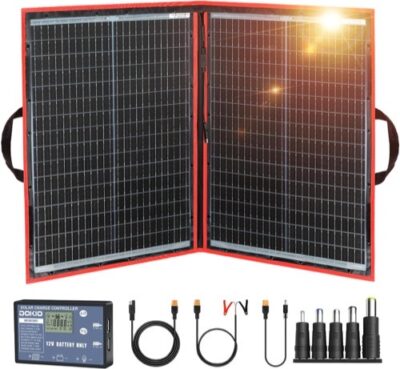
This FlexSolar 100W review starts with the thing you notice before the watts: a 100W solar panel that weighs about 4.1 pounds feels surprisingly light in hand. Most portable 100W panels feel like car-camping gear first and backpacking gear second, often landing in the 6- to 8-pound range with thicker frames, stands, and bulkier cases. Here, the folded panel is closer to a chunky laptop than a campsite appliance.
That matters if you’re packing for a multi-day trail, overlanding trip, Baja-style camp, or emergency kit where every pound earns its place. You want real solar charging, not a tiny phone trickle panel that gives you hope and then stalls at lunchtime. At the same time, you probably don’t want to haul a rigid glass panel just to keep a power station, fridge, Starlink Mini battery, or stack of power banks alive.
Here’s the thing: the FlexSolar 100W is not just a casual gadget charger, even though it does have USB-A and USB-C outputs. It’s better treated as a lightweight field panel for small power stations and serious camp charging. The catch is that it has no kickstand and no separate charge controller, so the ETFE laminate, IP67 rating, and compact fold are the real reasons experienced campers are drawn to it.
The LX-S100’s advantage is physical before it is electrical: it folds into a laptop-sized package and is far easier to place in a pannier, crowded vehicle, or emergency bag than many 100W suitcases. Owners describe that compactness as the reason they selected it. The cost is a ten-section surface without a conventional kickstand, so the campsite must provide a flat area, hanging points, or a safe support.
The available owner evidence describes useful power-station and device charging, easy transport, and strong value for space-limited trips. Other observations describe optimistic output expectations, missing information, connector questions, poor support geometry, or isolated quality concerns. The evidence is informative but limited and lacks ratings or variant metadata; it cannot quantify how frequently either type of outcome occurs.
Documentation boundary: a 100W label and an adapter that fits are not enough for array design. Until the exact Vmp, Imp, Voc, and Isc are confirmed, treat the LX-S100 as a single portable source for individually verified receivers—not a module to combine by assumption.
What Can You Connect? — FlexSolar LX-S100
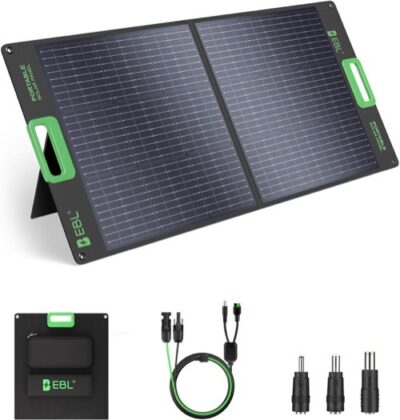
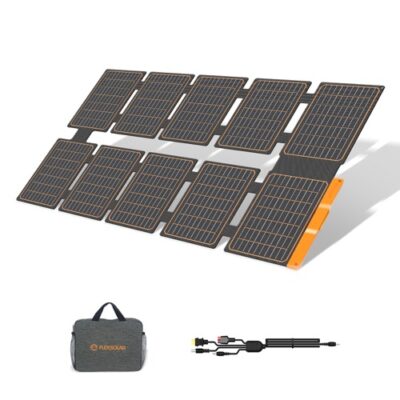
Here’s the practical reality: the current FlexSolar lx-S100 kit does not list MC4 connectors in the provided specs. Instead, it includes USB-A, USB-C, and a 2 m 4-in-1 DC cable with XT60, Anderson, DC5521, and DC8MM tips. That’s actually more convenient for many small power stations than MC4, as long as your input port matches.
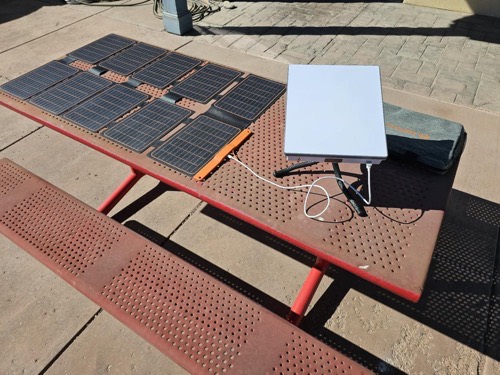
That said, compatibility still deserves a careful check before you buy. Customers have had good results with small power stations, Starlink Mini battery packs, power banks, phones, and camp fridge setups. On the flip side, one buyer said it was not compatible with their battery, and another bought a separate PWM device to charge a Li-ion battery safely.
| Device / Battery Setup | Compatible? | Connector / Requirement |
|---|---|---|
| Small power station with XT60 input | Compatible | XT60 included; common with many portable power stations |
| Small power station with Anderson input | Compatible | Anderson included; verify voltage and max solar input |
| Power station with DC5521 input | Compatible | DC5521 included; good for lower-input stations |
| Power station with DC8MM input | Compatible | DC8MM included; often used on Jackery-style units |
| USB-C phone / tablet / power bank | Compatible | USB-C PD up to 45W; best in strong sun |
| USB-A phone / small device | Compatible | QC3.0 up to 18W; useful for basic charging |
| 12V lead-acid battery | Needs adapter | Solar charge controller required; do not connect directly |
| Li-ion or LiFePO4 battery | Verify first | Chemistry-specific controller required; one owner used a separate PWM device |
| MC4-only solar input | Needs adapter | MC4 not included in listed kit; buy a DC-to-MC4 adapter only if voltage matches |
Adapter Check — Match three things before connecting: plug shape, solar input voltage range, and maximum input wattage. A connector that fits physically can still be wrong electrically.
The 20V DC output is typical for portable solar panels in this wattage class, but it won’t be right for every battery or device on its own. In practice, the safest route is to pair it with a portable power station that already has solar charging management built in. If you’re charging standalone batteries, use a charge controller matched to the chemistry.
Power Delivery in Practice — FlexSolar LX-S100
The FlexSolar 100W is rated at 100W, and in good sun that translates to roughly 76W of expected real-world output using a conservative field factor. In practice, owners report a wide but believable spread: some see around 77W flat, others see 80W in fall conditions, and a few get 88W to 92W when holding or aiming the panel just right. That’s genuinely useful performance from something this packable.
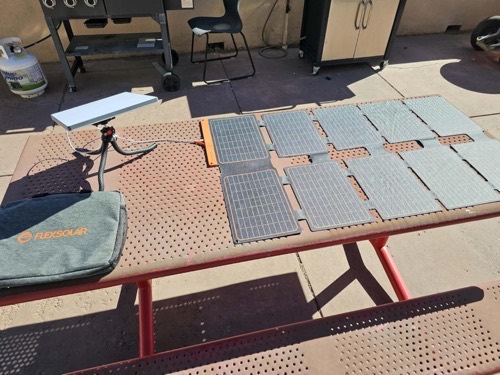
The catch is that not everyone sees those numbers. Some buyers report closer to 60W in direct sun, even near the equator, and one user in the Northeast pointed out that half-power can be normal around northern latitudes depending on the season. Here’s what matters: portable solar output is not just about the panel rating; it’s also about sun angle, temperature, power station input limits, cable losses, clouds, and whether the panel is lying flat.
In real use, the panel shines when paired with small power stations and moderate loads. Customers describe using it with a car fridge and a Rockpals battery setup, keeping a Starlink Mini battery pack topped up, charging phones, filling power banks, and keeping headlamps ready over multiple camp days. Under heavy cloud, though, phone charging can slow way down — one owner saw only a partial phone charge after several hours.
| Condition | Estimated Output | What That Means |
|---|---|---|
| Full sun, ideal angle | ~76W to 90W | Strong power station charging; useful for fridges, power banks, and Starlink Mini battery support |
| Partly cloudy sky | ~35W to 45W | Still useful, but larger loads may only break even |
| Overcast / heavy clouds | ~15W to 25W | Slows battery drain; phone charging may feel slow |
| Panel angle 45° off optimal | ~45W to 60W | Common camp setup result if laid flat or leaned casually |
| Winter sun in northern US | ~35W to 55W average | Works, but expect shorter charging windows |
| Partial shade | ~10W to 30W | Major drop; avoid tree shadows and vehicle shade |
Real-World Math — Using a 0.76 output factor, this 100W panel delivers roughly 76W in good sun. Over a 4-hour peak sun day, that’s about 304 Wh. That’s enough to make a real dent in a small power station, keep phones and power banks topped off, or help offset a camping fridge’s daytime draw.
Worth knowing, your power station can be the bottleneck. One owner connected it to a 300Wh power bank with a 65W PD input limit, so the panel was already near the maximum the battery could accept. If your station only accepts 60W, a 100W panel won’t magically push 100W into it.
From Box to Charging in 60 Seconds
Setup is about as simple as it gets: unfold the panel, point it toward the sun, plug in your cable, and watch your device or power station start taking charge. Customers like that there’s no complicated assembly, and the included bag makes it easy to unpack and repack without babying the panel. In real use, the quiet appeal is that there’s no fan, no fuel, no hum — just the flat panel soaking up sun.
The no-kickstand design is the main trade-off. Owners have leaned it against a car windshield, placed it on a tent, hung it from a rooftop tent ladder, laid it on grass, and clipped it with carabiners. That flexibility is nice, but it also means output can swing a lot if you don’t take a minute to aim it.
Cable length is the other gripe. The included 2 m cable works for tight camp setups, but several users want more reach between the panel and their battery or power station. At the same time, the short cable is part of what keeps the kit compact.
Practical Tip — If your power station needs to stay inside a tent, vehicle, or shaded area, plan on using an extension. Keep the cable as short as practical and use a quality connector to reduce voltage drop.
A small setup note: stronger carabiners may be worth packing. One customer said they’d rather use sturdier clips or even zip ties for real field use. To be fair, the included ones are fine for casual hanging, but they’re not the part of the kit I’d trust most in wind.
Form Factor and Build — FlexSolar LX-S100
Pick it up, and the FlexSolar 100W solar panel immediately feels different from many 100W competitors. There’s no glassy slab, no metal frame with a heavy hinge system, and no built-in leg assembly adding bulk. Instead, it folds into a 12.99 x 10.43 x 2.17-inch package that slides into the included padded bag like a small laptop.
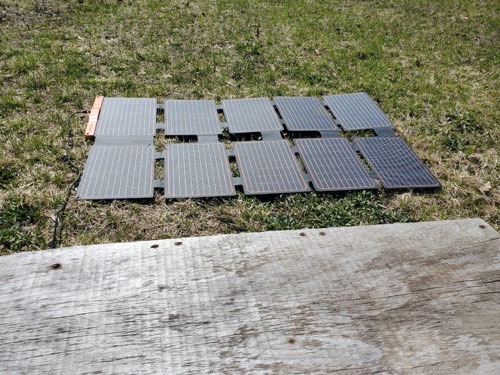
In practice, that makes it much easier to toss into a backpack, car trunk, rooftop tent setup, or emergency bin. Owners repeatedly mention the small footprint as the reason they bought it, and a recurring theme is that it’s lighter than expected. The unfolded size — 45.47 x 26.18 inches — is still large enough to catch meaningful sun, but it doesn’t feel like you’re deploying a construction project at camp.
The panel surface uses ETFE laminate, which is a smart choice for this kind of portable gear. To be fair, ETFE doesn’t have the same rigid, premium feel as tempered glass, and the flexible layout can feel floppy when you’re trying to point it precisely. Still, customers describe the carry bag as durable, and the panel’s soft foldable build makes it easier to pack, clean, and move than a rigid framed setup.
| Design Detail | What You Get | Real-World Impact |
|---|---|---|
| Folded size | 12.99 x 10.43 x 2.17 in | Fits into many backpacks and laptop-style storage spaces |
| Weight | 4.1 lb | Very light for a 100W panel |
| Surface | ETFE laminate | Better scratch and weather resistance than basic PET-style finishes |
| Frame | Not specified | Saves weight, but doesn’t feel as rigid as framed panels |
| Carry setup | Storage bag plus carabiners | Easy to transport and hang, but basic carabiners may be worth upgrading |
IP67 and ETFE: The Outdoor Armor
The FlexSolar 100W carries an IP67 waterproof rating, which is stronger than the vague “water-resistant” language you see on a lot of budget portable panels. In plain English, IP67 means it’s rated against dust and brief immersion, not just light rain. For campers, that gives welcome peace of mind when the sky turns ugly or morning dew soaks everything around the tent.
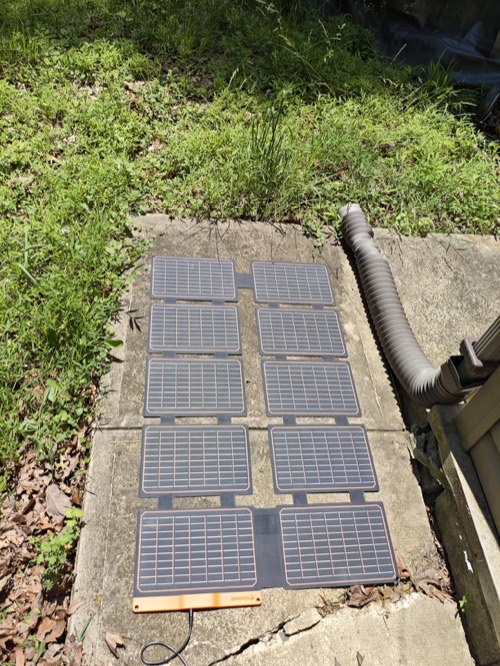
That said, ports and connector orientation still matter. One owner specifically recommends hanging it with the orange connector bar facing down, which helps shield the ports from moisture and lets the panel hang more evenly. Honestly, that’s the kind of field tip that matters more than a polished product photo.
ETFE also helps here because it’s lighter and tougher than glass in a travel context. On the flip side, the product data does not list an operating temperature range, wind rating, or snow load rating, so this isn’t the panel I’d permanently mount on a roof year-round without shelter. It’s best viewed as a weather-ready portable panel, not a fixed residential solar module.
| Feature | This Panel | What It Means Outdoors |
|---|---|---|
| IP rating | IP67 | Better rain and dust protection than many portable panels |
| Frame material | Not specified | Helps keep weight low, but long-term structural data is limited |
| Panel surface | ETFE laminate | Good fit for travel, folding, and repeated handling |
| Junction box seal | Not stated | Avoid leaving the port area exposed to standing water |
| Connector weatherproofing | Not fully specified | Hang connector side down in wet conditions |
| Operating temperature range | Not stated | Use caution in extreme heat or deep winter storage |
| Long-term owner reports | Early feedback is positive | Customers describe it as rugged and field-friendly, though long-term year-round data is limited |
Worth Knowing — IP67 is stronger than IP65 because it adds brief immersion protection. Still, waterproof ratings don’t mean you should leave USB and DC ports sitting in puddled water. Position the connector side downward whenever rain is possible.
Long-Term Ownership Considerations
The FlexSolar 100W review wouldn’t be complete without talking about safety and long-term use. FlexSolar lists a 1-year warranty, IP67 waterproofing, ETFE laminate, and built-in IC protection against over-voltage, over-current, and short circuits. That’s a good baseline for a portable camp panel, though safety certifications are not specified in the product details.
Customer feedback is mostly reassuring, but there is one report of a slight electrical burning smell. That’s not a common theme, and most owners describe the panel as working well, but you should take any hot-plastic or electrical smell seriously. Stop using the panel, disconnect it, and contact support if that happens.
In practice, the bigger long-term concern is likely wear around cables, ports, folds, and hanging points rather than the solar cells themselves. ETFE is a good outdoor surface material, and the panel’s low heat retention impressed at least one owner who packed it shortly after use. Still, portable folding panels live a harder life than fixed rigid panels because they’re handled, packed, dragged, leaned, and clipped over and over.
| Ownership Factor | What to Expect | Buyer Note |
|---|---|---|
| Warranty | 1 year | Reasonable for a budget-friendly portable panel |
| Safety certifications | Not specified | Use with compatible devices and avoid questionable adapters |
| Heat behavior | Generally positive owner feedback | One owner noted it stayed cooler than a rigid panel |
| Safety complaints | Rare, but one electrical smell report | Disconnect immediately if you notice burning odor |
| Long-term weak points | Cables, ports, folds, clips | Store dry and avoid strain on the connector bar |
Long-Term Ownership — Monocrystalline panels often degrade slowly, but portable panels usually fail first at the cable, connector, fold seam, or port area. Protect the connector side, avoid sharp bends, and dry the panel before long-term storage.
For most campers and emergency-kit buyers, the warranty feels sufficient. For a permanent RV roof install or marine setup exposed full time to salt air, I’d look at a rigid panel with published wind, snow, and temperature specs. Different tool, different job.
Which Buyers Will Love This — Use-Case Fit Matrix — FlexSolar LX-S100
The sweet spot for the FlexSolar 100W solar panel is portable, medium-demand power. It’s too much panel if you only want to trickle-charge a phone once in a while, but it’s not enough if you’re trying to recharge a large battery bank from deep discharge every day. In practice, it punches above its weight when paired with a small power station.
| Use Case | Fit | Why |
|---|---|---|
| Backpacking power for phones and power banks | Strong fit | Very light for 100W and folds small enough for pack use |
| Car camping with small power station | Strong fit | Good output and useful connector kit |
| Camping fridge with battery station | Strong fit | Owners report it can offset daytime draw in good sun |
| Starlink Mini battery pack support | Solid fit | Customers report successful pass-through charging setups |
| Overlanding / rooftop tent camp | Strong fit | Easy to hang, lean, or deploy around a vehicle |
| Emergency home charging kit | Solid fit | Good for phones, power banks, tablets, and small stations |
| RV battery trickle charge | With caveats | Needs the right controller if charging a battery directly |
| Boat / marine battery maintenance | Borderline | IP67 helps, but salt-air and permanent-mount specs are limited |
| 12V car battery maintenance | With caveats | Requires a proper charge controller |
| Laptop charging by USB-C | Solid fit | USB-C PD up to 45W, but sun must be strong |
| High-draw inverter loads | Skip | Not enough panel for heavy appliances or power tools |
| Full-shade campsite charging | Not recommended | Partial shade can slash output |
FlexSolar LX-S100: Decision Snapshot
| Spec | Value |
|---|---|
| Max Power Output | 100W monocrystalline |
| Output Voltage | 20V DC |
| Connector | USB-A, USB-C, XT60, Anderson, DC5521, DC8MM |
| Cell Efficiency | 24% |
| Weatherproof Rating | IP67 |
| Charge Controller | None — direct output with built-in IC protection |
| Cable Length | 2 m / 6.6 ft |
| Mount Type | Eye holes and carabiners; no kickstand |
| Best For | Backpackers, campers, overlanders, small power stations, Starlink Mini battery packs, and emergency charging kits |
FlexSolar 100W in a Nutshell
If you want a lightweight 100W portable solar panel for camping, overlanding, backpack-friendly power, or topping off a small power station, this panel does what you’d expect. Customers consistently like the compact fold, low weight, useful USB/DC outputs, and surprisingly strong harvest when it’s aimed well. That said, the FlexSolar 100W review picture is not all sunshine: output depends heavily on angle and season, the 6.6-foot cable may feel short, and the lack of kickstand means you’ll need to get creative with a tent, ladder, windshield, backpack, or carabiners.
Worth Knowing — A 100W rating is a lab-condition number. In real camp use, seeing 60W to 90W can still be a solid result, especially from a lightweight foldable panel without rigid legs.
You'll probably be happy if you want: — FlexSolar LX-S100
- A 100W portable solar panel for camping that doesn’t feel like a boat anchor
- A compact panel for small power stations, power banks, and USB-C devices
- A weather-ready travel panel with IP67 and ETFE
- A camp-friendly panel you can hang, lean, or lay out quickly
- A good watts-per-pound option for overlanding and emergency kits
You might want to skip it if you need: — FlexSolar LX-S100
- A rigid panel with built-in kickstands for perfect sun tracking
- Guaranteed 100W output every time you unfold it
- A direct-to-battery charger with an included MPPT or PWM controller
- A long cable for spread-out camp layouts
- A permanent outdoor panel with published wind and snow load ratings
Buyer Heads-Up — If your main goal is charging a bare 12V battery, budget for a proper solar charge controller. This panel is easiest and safest when used with a power station that already manages solar input.
So, Is It Worth It? — FlexSolar LX-S100
For the right buyer, yes. This FlexSolar 100W review comes down to one simple trade: you give up the rigid frame and built-in kickstand, and you get a much lighter, smaller, easier-to-pack 100W panel. Customers who use it for camping fridges, small power stations, power banks, and Starlink Mini battery setups tend to be the happiest.
That said, don’t buy it expecting a framed 100W panel experience in a featherweight body. You’ll need good sun, smart positioning, and sometimes an extension cable or separate charge controller. If portability matters as much as output, the FlexSolar 100W solar panel is a genuinely useful field panel that earns its spot in a camping or emergency-power kit.
Pros & Cons Analysis
Based on documented specifications and owner feedback
Pros
- Very light for a 100W panel — Customers consistently mention that the 4.1 lb weight feels unusually easy to carry compared with other 100W portable panels.
- Compact folded size — Buyers like that it folds down close to laptop size, making it practical for backpacks, car storage, overlanding setups, and camping kits.
- Good real-world output for the size — Owners report output in the 77W to 92W range in good sun when angled well, which is strong for a lightweight portable panel.
- Useful for small power stations — Customers have paired it successfully with Rockpals, Jackery-style units, and small battery packs for camping fridges, Starlink Mini setups, and power bank charging.
- Direct USB charging is handy — The USB-A QC3.0 and USB-C PD outputs are appreciated for phones, tablets, power banks, headlamps, and smaller electronics.
- Good included connector kit — The 4-in-1 DC cable with XT60, Anderson, DC5521, and DC8MM tips covers many popular small power stations.
- Travel-friendly carry case — Owners describe the padded storage bag as durable and useful for keeping the panel protected in transit.
- IP67 and ETFE laminate — The waterproof rating and tough surface make it more reassuring for outdoor use than bargain panels with vague weather claims.
- Runs cooler than some rigid panels — One owner noted it stayed cool enough to fold and pack after use while a metal-framed panel remained hot.
- Strong value for watts per dollar — Buyers repeatedly describe it as hard to beat for portability, output, and price when compared with bulkier folding panels.
Cons
- No built-in kickstand — The blanket-style design is easy to pack, but owners often have to lean it on a ladder, tent, windshield, or hang it with carabiners to get a better sun angle.
- Floppy when aiming at the sun — Several users note that the flexible fold-out design makes precise aiming harder than rigid panels with legs.
- Does not always reach 100W — Some buyers only see around 60W in direct sun, especially depending on latitude, season, angle, power station limits, and measurement conditions.
- Compatibility still needs checking — One owner reported it was not compatible with their battery setup, and another bought a separate PWM device for Li-ion battery charging.
- USB charging slows in clouds — Feedback suggests phone charging under heavy cloud can be slow; one buyer saw only a partial phone charge after several hours in overcast weather.
- Cable could be longer — Some buyers like the included cable but wish it gave more placement flexibility around camp or vehicle setups.
- Carabiners are basic — One customer felt the included carabiners were not especially confidence-inspiring and would rather use stronger clips or zip ties.
- Port orientation matters in wet weather — A buyer suggested hanging it with the connector bar facing down to better protect ports from moisture.
- One safety smell complaint — A customer reported a slight electrical burning smell, which is uncommon in the feedback but worth taking seriously if it happens.
- Seasonal output varies a lot — Owners in northern latitudes and winter conditions report noticeably lower harvest than summer or desert use.
Bottom Line: Choose It When Packed Volume Is the Constraint
The LX-S100 compresses a useful 100W class into a 4.1-pound package with unusually broad direct outputs. Its strongest use is a compact camp system with a buffer battery—not a permanent unattended array. The captured evidence supports good portability and workable 60–80W field inputs, while two later port failures make inspection and the one-year warranty relevant.
Frequently Asked Questions
How much power did FlexSolar LX-S100 owners report?
Individual exact-ASIN owners reported about 60W, 75–80W, and 77W in different setups. Those readings are not averaged because sun, angle, device limits, temperature, and cable conditions differ.
Can it run a Starlink Mini?
Some owners use it with a buffer battery to support Starlink Mini. Do not connect by wattage alone: check the intermediary battery or power station input limits and budget for clouds and startup/load variation.
Which outputs does it have?
FlexSolar publishes a 100W DC output, up to 45W USB-C PD output, and 18W USB-A output. Included adapters cover DC5521, DC7909, Anderson, and XT60.
Is the FlexSolar S100 waterproof?
The manufacturer publishes IP67 for the panel. Protect open ports, adapter junctions, and the receiving device according to their own ratings; the whole connected system is not automatically IP67.
Is it a good long-term fixed panel?
Its main advantage is compact temporary deployment. Two captured owners reported output interfaces failing after months of use, so inspect ports and cable strain. The targeted sample cannot quantify long-term failure frequency.
Technical Specifications
| Brand | FlexSolar |
|---|---|
| Model / SKU | LX-S100 (ASIN B0DX6W8HM4) |
| Panel format | Ten-section folding portable |
| Rated output (Pmax) | 100W |
| Cell technology | Monocrystalline |
| Module efficiency | — |
| Voltage at maximum power (Vmp) | — |
| Current at maximum power (Imp) | — |
| Open-circuit voltage (Voc) | — |
| Short-circuit current (Isc) | — |
| Power tolerance | — |
| Maximum system voltage | — |
| Maximum series fuse | — |
| Output connector | DC plus USB-C and USB-A |
| Output cable | Four-in-one DC5521/DC7909/Anderson/XT60 adapter cable |
| Deployed dimensions | 45.47 × 26.18 in |
| Folded dimensions | 12.99 × 10.43 × 2.17 in |
| Weight | 4.1 lb |
| Surface and frame | E-film laminate, frameless folding construction |
| Positioning / mounting | Flat, hung, or user-supported temporary deployment |
| Environmental protection | Panel IP67 |
| Wind / snow load | — |
| Operating temperature | — |
| Included accessories | Panel, carry bag, four-in-one adapter cable |
| Product warranty | 1 year |