Anker SOLIX PS400 Review: Carrying, Setup and 400W Charging
At a Glance
KEY FEATURES
- 400W rating with 48V operating voltage and 57.6V open circuit.
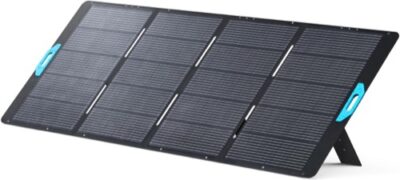
- Approximately 35 lb; 39 × 26.6 inches folded.
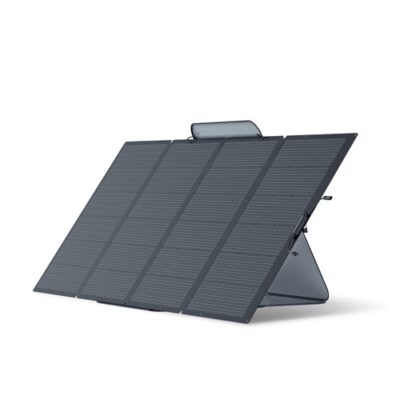
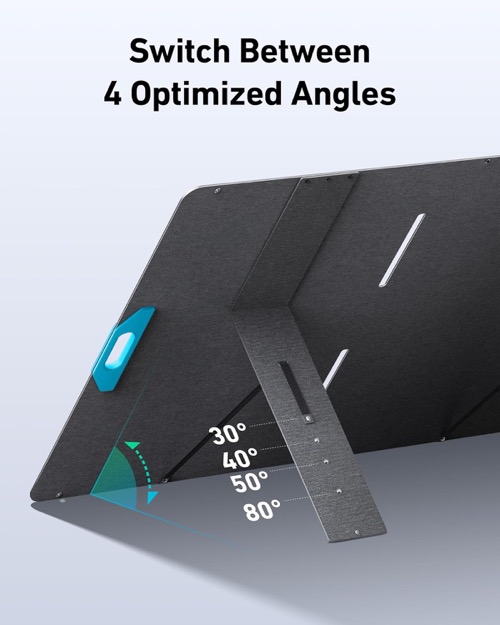
- Four documented support angles: 30°, 40°, 50° and 80°.
- MC4 leads and an MC4-to-XT60 connection cable included.
PROS
- Large collecting surface in one folding package
- Four supported aiming angles
- Useful station-charging and outage owner examples
CONS
- Roughly 35 lb with a broad folded footprint
- Support and snap handling can be awkward
- 57.6V Voc requires exact receiver approval
- Mixed hardware and after-sales experiences
Best Anker high-output fit
Based on exact documentation, retained exact-ASIN evidence, and the expanded qualitative Amazon owner-text review; no hands-on test claimed
The Anker SOLIX PS400 puts a large collecting surface into one folding package. That is convenient beside a parked vehicle or a power station, but its roughly 35-pound weight is not a footnote: several supplied owners found the carry and unfolding harder than the electrical setup. Start with the place you will store and deploy it, not an assumed daily watt-hour yield.
One large folder still needs a workable carry route
The current US product page lists 35.3 lb; the A2437 guide lists 35.5 lb. Neither is a light hiking panel.
Check the folded footprint against the actual vehicle opening and storage shelf, not just the available floor area.
The open panel needs a clear patch of ground and enough room to reach its supports without bending the sections.
One buyer returned two panels because their partner could not lift one alone. Another, who described themselves as six feet tall and 200 pounds, found the size just manageable. Those accounts make the carrying decision personal: a strong output specification cannot compensate for a panel that stays packed because setup is too awkward.
This assessment uses the exact Amazon offer B0BWQJ19M4, supplied customer accounts and manufacturer documentation, not our own hands-on test. Older Kickstarter-version complaints are not treated as proof that every current PS400 has the same hardware.
The stands help with aiming; they do not remove the handling work
Anker lists 30°, 40°, 50° and 80° kickstand positions on its current US PS400 page. Owners who repositioned the panel appreciated having supported angles, while other accounts describe awkward snaps, three supports under four folding sections, or needing a second person to set it out.
- Try the complete lift. Include the storage shelf, vehicle sill and walk to the sunny position. Do not assume the power station and panel will be carried together.
- Inspect handles, snaps and supports. Photograph shipping damage or loose hardware before loading the panel or attempting a repair.
- Set all sections on stable ground. Use the documented supports and check the assembly when wind or sun direction changes. Do not treat the folding body as a rigid roof module.
57.6V open circuit is the compatibility checkpoint
The PS400 is specified at 48V operating voltage, 8.33A operating current and 57.6V open-circuit voltage. That last value matters when comparing it with a station’s solar-input ceiling. A receiver described as accepting “up to 60V” is not automatically a safe match: the exact manufacturer’s approval and cold-weather voltage margin still need checking.
A connector is not a compatibility certificate. The included MC4-to-XT60 lead changes the connection, not the panel’s voltage. Check the exact receiver’s permitted voltage, current, power, polarity and cable arrangement before connecting it.
The package lists two 3m MC4 leads and a 0.5m MC4-to-XT60 cable. Do not count the two MC4 conductors as a six-metre extension. Plan the actual route to a shaded station using our panel-to-power-station compatibility checks. A standalone battery requires its own correctly matched charge controller and protection; it is not a direct MC4 load.
Owner readings answer different questions
| Supplied account | What it contributes | What remains unknown |
|---|---|---|
| A two-panel setup showed about 275W per panel. | A concrete example of useful station input below the nameplate rating. | Irradiance, cell temperature and receiver settings were not controlled. |
| A C1000 camper user reported over 300W on a favorable day. | The larger panel can provide substantial input in a suitable setup. | It does not establish a typical daily yield or all-day average. |
| A buyer reported about 195W from each of two successive units in July. | Disappointing results deserve a repeatable check of the panel, cable and receiver. | The account alone cannot identify the cause or a failure rate. |
| An owner described two panels helping recharge batteries during a hurricane outage. | The panel can be part of an emergency charging plan. | No whole-home load coverage or guaranteed recovery time follows from that story. |
These observations do not support a fixed “288W real-world output” or “1,152Wh per day” promise. A high instantaneous reading and useful daily energy are different measures. When estimating how much energy a panel can produce, account for your site’s sun, interruptions, temperature and the receiver’s charging behavior rather than applying one unexplained percentage to every day.
Weather protection and after-sales support need separate checks
Anker advertises IP67 for the panel, but its US instructions explicitly require the MC4 ports to be covered with their rubber plugs before exposure to rain or water. That is not permission to leave an assembled station, adapters and open connections outside unprotected. Follow the instructions for the connected arrangement, not just the panel’s headline rating.
- Test before the return window closes. Record the delivered model, cable arrangement, station, charge level, conditions and stable input reading.
- Keep mechanical and electrical faults distinct. A broken handle needs a different support record from low charging input.
- Confirm the applicable written warranty. Supplied accounts include both helpful support and unresolved or disputed claims; neither outcome is guaranteed for the next buyer.
Choose the PS400 for fewer pieces, not effortless portability
A sensible use case when the carrying route is short, the open footprint fits and the exact station approves the panel. One folder means fewer separate panels to position.
Compare smaller modules in a permitted array, or a different portable format. Extra connectors may be worth avoiding a single load that one person cannot manage.
Buying two PS400s is not an automatic upgrade path: it changes carrying weight, footprint and array electrical values. Compare the 400W panel alternatives around your receiver and handling limits before choosing a second panel or a series/parallel arrangement.
Pros & Cons Analysis
Based on documented specifications and owner feedback
Pros
- Fewer separate panels to place — the 400W folding format may suit a stationary vehicle-based charging stop.
- Several aiming positions — documented angles support repositioning through changing sun conditions.
- Relevant charging accounts — owners describe substantial station input and emergency battery recharging, without establishing universal results.
Cons
- Carrying can decide the purchase — one buyer returned panels because their partner could not lift one alone.
- Unfolding is not effortless — owner comments about snaps and three supports under four sections merit a practical setup check.
- Not every XT60 station is a match — voltage, current, temperature margin and the approved cable still govern compatibility.
- Weather protection has boundaries — Anker explicitly requires MC4 ports to be covered before rain or water exposure.
- Service outcomes vary — both helpful support and unresolved claims appear in the supplied accounts.
One PS400 is simpler only if you can handle it
The PS400 makes sense beside a compatible station when the carry is short and the complete panel can be supported and re-aimed without difficulty. Its large single-folder format can simplify positioning compared with several separate panels, but not necessarily lifting.
Compare smaller modules when one person cannot comfortably manage the weight, and resolve receiver approval before purchase. Individual strong-output and outage accounts do not promise a daily refill; support and hardware complaints justify an early inspection and documented charging test.
Frequently Asked Questions
Does the Anker PS400 normally produce 400W?
400W is its rated output, not an all-day guarantee. Supplied owners report substantially different readings with different stations and conditions. The evidence does not establish a typical wattage or fixed daily watt-hour yield.
Will the PS400 work with a 60V-input power station?
Do not infer approval from that number alone. The panel lists 57.6V open circuit, and cold conditions can increase voltage. Confirm the exact receiver maker’s permitted panel, temperature margin, current and cable arrangement.
Is the PS400 easy for one person to carry?
It weighs roughly 35 lb and folds to about 39 × 26.6 inches. Some owners manage it; others describe difficult handling or a return because another household member could not lift it. Test the actual storage and carry route.
Can I leave the connections out in rain?
Do not extend the panel’s IP67 rating to the full charging system. Anker’s US page requires the MC4 ports to be covered with rubber plugs before rain or water exposure. Follow the connected equipment’s weather instructions.
Should I buy two PS400 panels immediately?
Only when the approved array design, receiver capacity, carrying weight and deployed footprint support it. Buying two does not authorize an arbitrary series or parallel connection.
Does it charge a standalone battery directly?
No. A standalone battery needs a suitable charge controller, correctly designed wiring and protection. The panel’s MC4 output is not a regulated battery charger.
Technical Specifications
| Brand | Anker |
|---|---|
| Model / SKU | SOLIX PS400, ASIN B0BWQJ19M4; match delivered revision to its guide (A2437 reference) |
| Panel format | Four-section folding portable |
| Rated output (Pmax) | 400W |
| Cell technology | Monocrystalline |
| Module efficiency | Up to 23% advertised conversion efficiency; not an independent module measurement |
| Voltage at maximum power (Vmp) | 48V |
| Current at maximum power (Imp) | 8.33A |
| Open-circuit voltage (Voc) | 57.6V |
| Short-circuit current (Isc) | Confirm on the delivered label and matching guide |
| Power tolerance | Confirm on the delivered label and matching guide |
| Maximum system voltage | — |
| Maximum series fuse | — |
| Output connector | MC4 |
| Output cable | Two 9.8 ft MC4 cables and 1.6 ft MC4-to-XT60 cable |
| Deployed dimensions | 100.0 × 39.0 × 1.2 in |
| Folded dimensions | 39.0 × 26.6 × 2.0 in |
| Weight | US product page: 35.3 lb; A2437 guide: 35.5 lb (16.12 kg) |
| Surface and frame | ETFE surface with polymer-composite backing |
| Positioning / mounting | Kickstand angles at 30°, 40°, 50°, and 80° |
| Environmental protection | Panel IP67; Anker requires MC4 ports covered with rubber plugs before rain or water exposure |
| Wind / snow load | — |
| Operating temperature | — |
| Included accessories | Panel, two MC4 cables, MC4-to-XT60 cable, and safety manual |
| Product warranty | Confirm written coverage for the seller and delivered revision |