The Short Answer
How much power does a solar panel produce? Less than the number on the box — a panel’s rated watts are lab figures, and real output usually runs about 70-85% of that in strong sun, and much less in heat, haze, or when it’s mounted off-angle. A 400W panel realistically makes around 300-330W in good conditions, not 400W.
Put simply, rated watts tell you the ceiling. Real watts are what actually reaches your battery. Over a full day, a well-set 400W panel banks somewhere near 1,300 watt-hours at four peak sun hours — enough to refill a mid-size power station or hold an RV battery bank through a weekend.
Key Takeaways
- Rated watts are a lab ceiling. Real-world output is roughly 70-85% of the rating in good sun, less in poor conditions.
- Use this formula: Wh/day = rated watts × real-world factor × peak sun hours. A 400W panel at 0.82 × 4 PSH makes about 1,312Wh/day.
- Peak sun hours drive everything. The same panel makes far more in Arizona (5-6 PSH) than in the UK (2-3 PSH).
- Real output falls short because of heat, angle, shade, cloud, dust, and cable loss — every one of these chips away at the rating.
- Size for your actual daily draw, not the panel’s headline wattage. A 200W panel can run a small 12V fridge in good sun, but only with a battery buffer.
Does a 400W Solar Panel Actually Produce 400W?
This is the heart of the whole topic, so let’s settle it first. A 400W panel does not produce 400W in normal use. That figure comes from Standard Test Conditions — a lab bench at 25°C, with 1,000 watts of light per square meter hitting the cells dead-on. Outside, almost none of those conditions hold at once.
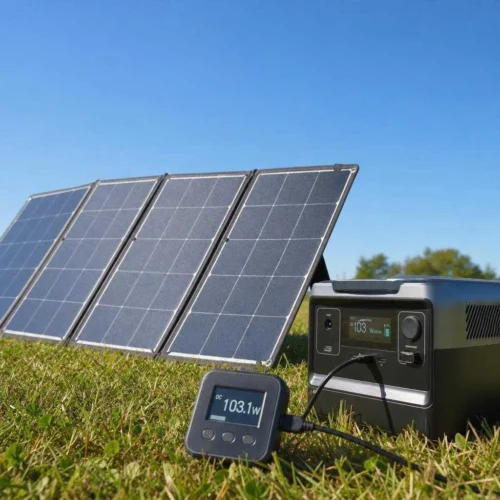
Here’s the real number. The DOKIO 400W monocrystalline panel lands near 328W in strong direct sun — about 82% of its rating — which works out to roughly 1,312Wh across a typical four-peak-sun-hour day. That 0.82 figure is the “real-world factor,” and it’s the single most useful number when you’re estimating output.
Output reality check — A 400W panel in strong sun with an MPPT controller typically delivers 300-330W. In partial cloud, expect 100-200W. In full overcast, 60-120W. Flexible panels run lower still, closer to 70% of rated, because they trap heat against the surface they’re mounted on. Plan around the lower end.
Flexible panels make the gap wider. A Renogy 100W flexible panel tends to sit around a 0.70 real-world factor — so that 100W rating turns into about 70W in good sun, and roughly 280Wh across a four-hour day. The same pattern holds for the Renogy 200W flexible panel. It’s not a defect; it’s physics. Laminated panels bonded to a roof or wall run hotter, and hot cells make less power.
The Daily-Output Formula
You don’t need engineering software to estimate output. One line covers it.
Wh/day = rated watts × real-world factor × peak sun hours
Real-world factors:
Monocrystalline + MPPT controller: 0.82
Monocrystalline + PWM controller: 0.78
Direct-connect, no controller: 0.68
Flexible / laminated panels: ~0.70
Rated watts you read off the box. The real-world factor discounts for heat, wiring, and controller efficiency. Peak sun hours (PSH) captures how much usable sun your location gets — more on that below.
Worked example — Take a 400W monocrystalline panel with an MPPT controller in a region that averages 4 peak sun hours. 400 × 0.82 × 4 = 1,312Wh/day, or about 1.3 kilowatt-hours. Drop to a cloudy 2.5 PSH climate and the same panel makes 400 × 0.82 × 2.5 = 820Wh/day. Same hardware, very different day.
Notice what changed the answer: not the panel, but the sun. That’s why two people with identical panels can report wildly different output — location does most of the work.
Real Output by Panel Size
Here’s what the common panel sizes actually deliver. These figures assume good, direct sun and a monocrystalline panel; flexible panels land toward the lower end of each range.
| Panel Size (Rated) | Typical Real Output in Good Sun | Daily Output at 4 Peak Sun Hours |
|---|---|---|
| 100W | ~70-85W | ~280-340Wh/day |
| 200W | ~140-165W | ~560-660Wh/day |
| 400W | ~300-330W | ~1,200-1,320Wh/day |
Worth knowing: these are good-day numbers. A bright but hazy sky, a flat mount, or an afternoon of passing clouds pulls every row lower. Treat the top of each range as a best case, not a promise.
What “Peak Sun Hours” Means and How It Varies
Peak sun hours confuse a lot of people, so here’s the plain-English version. One peak sun hour equals one hour of full-strength sun — 1,000 watts per square meter. Your location might have 12 hours of daylight but only 4 or 5 hours’ worth of that full-strength energy once you account for the weak morning and evening sun.
In practice, PSH is the multiplier that decides your daily output. It swings hard by region and season.
| Region | Average Peak Sun Hours/Day | Notes |
|---|---|---|
| Northern Europe (UK, Scandinavia) | 2-3 PSH | Large seasonal swing; size up generously |
| Pacific Northwest (US) | 3-4 PSH | Better than northern Europe, still cloudy |
| Central US / Central Europe | 4-4.5 PSH | A solid baseline for sizing |
| US Sunbelt (TX, CA, AZ, FL) | 5-6 PSH | Favorable; panels punch closer to rated |
| Southern Europe (Spain, Greece) | 5-6 PSH | Similar to the US Sunbelt |
| Equatorial / tropical | 6+ PSH | Highest production potential |
Season matters just as much as region. A panel in Chicago might see 6 PSH in June and barely 2 in December. If you’re sizing for year-round use, plan around your worst month.
Why Real Output Falls Short of the Rating
Several losses stack up between the spec sheet and your battery. None is huge on its own, but together they explain the whole 15-30% gap.
| Factor | Typical Output Loss | Notes |
|---|---|---|
| Partial shading | 30-80% | Even one shaded cell drags the whole panel down |
| High temperature | 0.3-0.4% per °C above 25°C | Panels get hot in the sun and lose output |
| Flat or off-angle mount | 10-20% | Tilt toward the sun for the best yield |
| PWM instead of MPPT | 15-25% | MPPT recovers more energy from the same panel |
| Cloud cover (overcast) | 70-90% | Full overcast drops output to 10-30% of rated |
| Dust, dirt, and debris | 5-15% | Clean the glass if it’s dusty or leaf-covered |
| Cable resistance (long runs) | 1-5% | Use the right wire gauge for the distance |
Pro tip — Heat is the loss people forget. On a hot day, a panel’s cells can sit 25-30°C above the air temperature, which alone can shave 10-15% off output. That’s part of why a “400W” panel makes 328W, not 400W, even under a clear midday sky.
How Much Power Does a Solar Panel Produce per Hour, Day, Month, and Year?
Averages help here, but read them with a caveat: a panel doesn’t produce evenly through the day. It peaks for a couple of midday hours and trails off morning and evening. These figures assume 4 peak sun hours and a 0.82 real-world factor for a monocrystalline panel.
| Time Frame | 100W Panel | 200W Panel | 400W Panel |
|---|---|---|---|
| Per peak hour (real) | ~82W | ~164W | ~328W |
| Per day | ~328Wh | ~656Wh | ~1,312Wh |
| Per month | ~9.8kWh | ~19.7kWh | ~39kWh |
| Per year | ~120kWh | ~240kWh | ~479kWh |
Two things to keep in mind. First, the per-hour figure is a peak, not an average — you’ll only see it around midday under clear skies. Second, the monthly and yearly totals assume steady 4-PSH weather all year, which almost nowhere gets. Sunny regions beat these; cloudy ones fall short.
What Is the 33% Rule in Solar Panels?
The 33% rule is a back-of-the-envelope shortcut for daily output. Take the panel’s rated watts, multiply by the hours of daylight, then keep about a third. The reason it works: a panel only hits full output for a few midday hours, so over a whole day you capture roughly a third of its theoretical maximum.
Worked example — A 400W panel with about 10 hours of daylight: 400 × 10 × 0.33 ≈ 1,320Wh/day. Compare that to the peak-sun-hours method: 400 × 0.82 × 4 ≈ 1,312Wh/day. The two land within 1% of each other — which is why the 33% rule is a handy gut check.
Use the 33% rule for a fast estimate in your head, then confirm with real peak sun hours for your area when it counts. Both methods agree because they’re describing the same reality from different angles: you never get rated watts for a full day.
Worked Example: Can a 200W Solar Panel Run a Refrigerator?
This is one of the most common questions, and the answer depends entirely on which fridge you mean. Let’s do the math for the two cases.
A small 12V compressor fridge (the camping/RV kind): these draw roughly 400-600Wh per day, depending on size and ambient heat. A 200W panel at 4 PSH produces about 560-656Wh/day. So yes — a 200W panel can run a small 12V fridge in good sun. The catch is you need a battery in between, because the fridge runs around the clock while the panel only makes power in daylight.
Worked example — 12V portable fridge draw: ~500Wh/day. 200W panel × 0.82 × 4 PSH = 656Wh/day. That covers the fridge with about 150Wh to spare — thin headroom. Drop to a cloudy 2.5 PSH day and you get 410Wh, which no longer covers it. This is why a battery buffer and some cloud headroom matter.
A full-size household AC refrigerator: these draw 1,000-2,000Wh per day and run on AC power. A single 200W panel can’t keep up, and you’d also need an inverter and a sizeable battery. For that job you’re looking at 400W or more of panel plus real battery storage.
- Small 12V fridge, good sun, with a battery buffer: yes, a 200W panel works.
- Small 12V fridge, cloudy climate: possible, but size up to 300W+ for headroom.
- Full-size AC household fridge: no — a 200W panel isn’t enough on its own.
Sizing a Panel for What You Actually Need
The lesson in all of this: don’t shop on rated watts alone. Start with your device’s daily draw in watt-hours, then work backward with the formula. A camera needs a few watts. A 12V fridge or battery bank needs a couple hundred watts. Refilling a power station in a day usually means stepping up to a 400W-class panel.
Form factor changes the math too. If you need something you can roll up or bond to a curved surface, a flexible panel is convenient — just remember it’ll run closer to a 0.70 real-world factor, so buy a bit more wattage than the rigid math suggests.
Best practice — Size your panel to produce at least 1.5-2× your device’s daily draw. That headroom covers cloudy days and keeps a battery topped up without you having to reach for a wall charger.
Want to skip the arithmetic? Our Solar Panel Output Calculator turns a rated wattage into real watt-hours for your location’s sun hours — so you can see exactly what a panel will produce before you buy.
Bottom Line
So, how much power does a solar panel produce? Not its rated watts — plan on about 70-85% of that in good sun, and less in heat, haze, or off-angle. Run the numbers with Wh/day = rated watts × real-world factor × peak sun hours, and you’ll get a figure you can actually build a setup around: roughly 328Wh/day from a 100W panel, 656Wh from a 200W, and 1,312Wh from a 400W at four peak sun hours.
Don’t let the rated-versus-real gap discourage you — it’s predictable, and once you plan for it, solar is reliable. Base your estimate on your worst month rather than your sunniest, size for a bit more than your daily draw, and lean toward more wattage if you’re in a cloudy climate or running something around the clock like a fridge. When in doubt, size up slightly rather than under-buy.

Leave a Reply