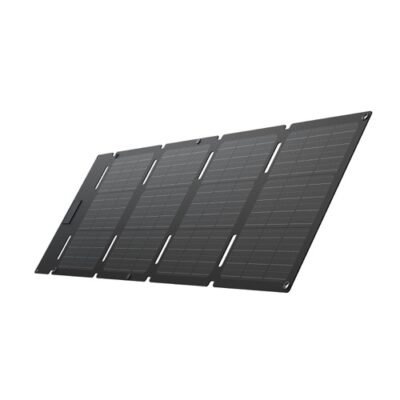
DOKIO 400W Solar Panel Review: Is This the Best-Value Way to Hit 400 Watts?
At a Glance
KEY FEATURES
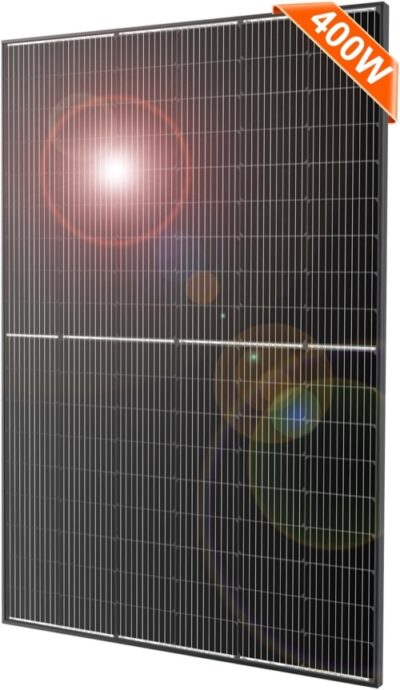
- Power output: 400 W (rated at STC), monocrystalline silicon
- Output: 31 V nominal panel (12V/24V system use); MC4 connectors
- Cell efficiency: High-efficiency monocrystalline (exact figure not specified by the manufacturer)
- Weatherproofing: No stated IP rating; tempered glass front, aluminum frame, sealed junction box — designed for rain and splashes
- Charge controller: None — direct MC4 output; pair with your own MPPT/PWM controller or a power station with a solar input
- Best for: The best-value way to add 400W to a mid or large power station, a 12V/24V off-grid bank, or a boat/RV setup
PROS
- Delivers a real 400W in good sun with the right setup
- One 400W panel replaces four 100W units and their joints
- Longer 3m MC4 cable gives more routing freedom
- Tempered glass and aluminum frame with a sealed junction box
- Great price and strong value for 400 monocrystalline watts
- Flexible for 12V and 24V systems and power stations
CONS
- Shade or a bad angle drops monocrystalline output hard
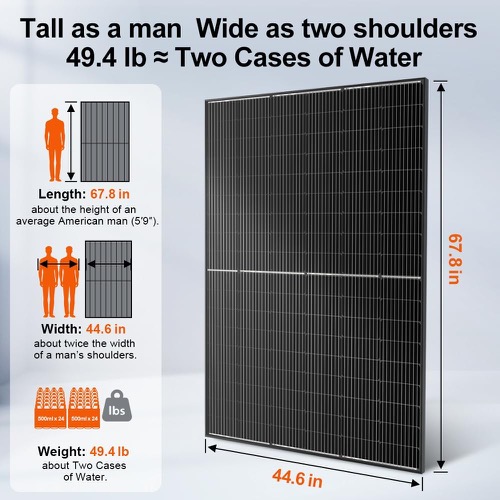
- At ~49 lb and 5.6 ft long, it's a two-person lift
- No charge controller included — you supply your own
- Some owners find the frame light with unwelded corners
- A few setups read well under 400W at the meter
- 48V banks need a boost converter to charge from 31V
Editor's Choice
Based on rigorous testing & Amazon customer feedback
☀ Solar Panel Output Calculator
Estimate how much energy the DOKIO 400W Solar Panel produces — and what it can power or charge.
Solar Setup
Portable devices
Power stations & batteries
Click devices to add them to your load list, adjust hours and quantity, then calculate.
Portable / Camping
Home Appliances
No devices added yet. Click chips above or add a custom device.
How many back-to-back sunless days should the battery keep you running? Example: 1 = one cloudy day, 3 = three cloudy days in a row.
Reaching a real 400 watts for the least money — enough to feed a mid or large power station or an off-grid battery bank — comes down to skipping four small panels for one big monocrystalline slab, and DOKIO’s DSP400M delivers that for well under name-brand prices. That’s the verdict up front: capable hardware, simple wiring, and strong value, with a few caveats worth knowing before you order.
You’ve probably seen the pitch. One 400W monocrystalline panel that replaces four 100W units, a longer 3m cable, pre-drilled mounting holes, and a sticker that lands well under the usual suspects. On paper it’s the clean, high-output building block a power station wants. What’s left to settle is whether “400 watts” holds up once it’s on your roof and wired into your gear.
Here’s the honest framing. Genuinely capable hardware, most owners getting what they came for, and a strong value overall — set against real trade-offs. It’s a heavy slab of glass, it ships bare with no controller, and a handful of buyers walk away disappointed by what their meter reads. For the right setup, it’s an easy win. For the wrong one, the gap between rated and real can sting.
This panel is one of our picks in the best 400W solar panels guide, where it goes head-to-head with the other top options.
At a Glance
| Spec | Value |
|---|---|
| Max Power Output | 400 W (monocrystalline) |
| Output Voltage | 31 V nominal panel (12V/24V systems) |
| Connector | MC4 (3 m / 9.84 ft leads) |
| Cell Efficiency | High efficiency (exact figure not specified) |
| Weatherproof Rating | No IP cert — tempered glass, aluminum frame, sealed junction box |
| Charge Controller | None — direct output; add your own or use a power station |
| Cable Length | 3 m (9.84 ft) |
| Mount Type | Pre-drilled holes (no bracket or tilt legs) |
| Best For | Adding 400W to a power station or 12V/24V off-grid bank |
DOKIO 400W Solar Panel Review: The Big-Panel Quick Take
If you want the cheapest clean way to add 400 watts to a power station or a 12V/24V off-grid bank, this DOKIO 400W solar panel does the job for a lot less than the big names. In good sun it delivers a real 400W, the single-panel design keeps your wiring simple, and the longer 3m cable saves you an extension. Just know going in: it’s a heavy, five-and-a-half-foot slab of glass, there’s no charge controller in the box, and monocrystalline cells lose a lot under shade — so placement and a properly sized controller matter more here than the sticker suggests.

One Big Panel Instead of Four: How It’s Built
First thing owners notice is that this is a proper rigid glass panel, not a fabric folder. It’s built around tempered glass with an aluminum frame and a sealed junction box, and buyers describe the construction as high quality that meets published specs. One owner rates it above Harbor Freight panels, which is the kind of comparison that tells you where it sits in the market.
Consolidation is the whole point. A 400W unit replaces four 100W panels, so you get fewer branch connectors, fewer joints to fail, and a cleaner install. Owners running boats and off-grid banks specifically call out how much simpler the wiring gets when one panel does the work of four.
Where the budget shows a little is the frame. One owner points out it’s light and glued onto the panel with corners that aren’t welded, which isn’t a dealbreaker but isn’t premium either. Worth knowing too: the panel dimensions have shifted between batches over the years, so measure the exact unit you receive before building a fitted rack.
400 Watts on Paper: What You Actually Harvest
Rated at 400W, the DSP400M puts out roughly 328W of real output with an MPPT controller in good sun — about 1,312 Wh on a typical day with four solid peak sun hours. Plenty of owners confirm these panels put out the 400 they’re rated for, and one buyer running a pair watched output climb past 700W with full sun on them.

Here’s the honest other side. A cluster of owners see much less — reports of only 120W, one measuring 75W in full sun, and another capping at 360W on the meter. Those numbers usually trace back to a controller’s current limit, undersized wiring, a poor angle, or summer heat baking the cells, rather than a dud panel. In practice, the panel gives you what your weakest link allows.
Cloudy days behave better than you’d fear. One owner reported it charging very well during overcast weather even before seeing full sun, so it keeps trickling rather than dying outright. The real enemy is shade — monocrystalline cells aren’t shade friendly, and a branch or chimney shadow across the glass will gut your output fast.
| Condition | Estimated Output | What That Means |
|---|---|---|
| Full sun, ideal angle | ~300-330 W | Fills a mid power station in a few hours; strong daily gain |
| Partly cloudy sky | ~150-200 W | Still meaningful charging, just slower to top the battery |
| Overcast / heavy clouds | ~60-100 W | Keeps a bank trickling; won’t do fast bulk charging |
| Panel angle 45° off optimal | ~210-260 W | Noticeable hit; square it to the sun for the best return |
| Winter / weak sun | ~180-220 W | Still usable; expect fewer peak sun hours overall |
| Partial shade on the cells | ~40-120 W | Big drop — keep the whole panel clear of shadows |
Real-World Math — Using a 0.82 factor with an MPPT controller, this 400W panel delivers roughly 328W in good sun. Stack up four peak sun hours and you bank roughly 1,312 Wh in a day — enough to recharge a 1,000Wh power station with headroom, or push steady amps into a 12V/24V bank all day.
These are estimates. Your real numbers depend on angle, sky, shade, cell temperature, your controller, and how long the cable run is.
12V, 24V, and That 31V Question
What a panel like this plugs into is the big question, and the short answer is most 12V and 24V gear. Owners run it into a power station like the EcoFlow Delta 3 Classic to power garage appliances, and others build fully off-grid setups with a charge controller, a car battery, and an inverter. It’s a flexible building block that suits boats, RVs, sheds, and gate openers alike.
There’s one trap worth flagging up front. The panel is a 31V nominal unit, and one owner learned the hard way that you can’t charge a 48V system with it directly — the voltage is too low. You can bridge that gap with a boost converter, but that’s an extra part and a little more complexity, so check your system voltage before you buy.
| System / Device | Typical Use | Compatible? | Notes |
|---|---|---|---|
| EcoFlow Delta 3 / large station | Garage, backup, camping | Compatible | Verify station’s max solar input voltage and amps |
| 12V battery bank (AGM / lead-acid / LiFePO4) | Off-grid, RV, boat | Compatible | Add your own controller; parallel wiring for stability |
| 24V battery bank | Larger off-grid, boat | Compatible | Wire per your controller’s voltage and current limits |
| 48V battery bank | Big off-grid | Needs adapter | Requires a boost converter — 31V is too low directly |
| Golf cart / boat 12V battery | Vehicle roof, marine | Compatible | Owners mount it as a golf cart roof and on boats |
| Automatic gate opener battery | Gate / access power | Compatible | Owners report months of trouble-free charging |
Buyer Heads-Up — Match the panel to your power station before you order. Check the station’s maximum solar input voltage and current against this panel’s roughly 31V and up to about 12.9A. Most mid and large MPPT stations handle a single 400W panel fine, but a small station’s input can cap what you actually harvest.
Standing Up to Yard and Rooftop Weather
There’s no stated IP rating here, but the build is aimed squarely at permanent outdoor life. Tempered glass, an aluminum frame, and a sealed junction box are designed for rain and splashes in yard, garden, and rooftop use. Owners have mounted it on boats, golf cart roofs, and gate-opener setups without weather complaints.

In day-to-day use, it holds up the way a rigid glass panel should. The sealed junction box keeps moisture out of the wiring, and the tempered glass shrugs off weather that would trouble a fabric panel. To be fair, the lighter frame and unwelded corners one owner flagged mean you should mount it solidly and seal your own hole penetrations rather than trusting the frame to do everything.
Temperature swings are worth planning for. Like any glass panel, it produces less than its rating when the cells bake in summer heat, and it can actually beat the rating on cold, bright winter days — so give your controller headroom on both ends.
| Feature | This Panel | What It Means Outdoors |
|---|---|---|
| IP rating | None stated | Waterproof claimed; treat as rain-ready, avoid standing water |
| Frame material | Aluminum | Resists corrosion; one owner notes light, unwelded corners |
| Panel surface | Tempered glass | Impact-resistant and weather-tough; heavier than laminate |
| Junction box | Sealed | Keeps moisture out of the wiring for permanent mounts |
| Connector weatherproofing | MC4 (standard) | Reliable outdoors; keep connections clean and seated |
| Operating temperature | Not stated | Output drops in summer heat; can exceed rating in cold sun |
| Long-term owner reports | Months of trouble-free use | Solid outdoors; mount it securely and seal penetrations |
Worth Knowing — “Waterproof” without an IP number means rain-ready, not submersible. This panel’s tempered glass and sealed junction box handle weather fine on a proper mount, but the mounting holes you drill or use are your responsibility — seal them so water doesn’t track into your roof or rack.
Pre-Drilled Holes and the 3-Meter Cable
Setup is refreshingly simple for a panel this size. The frame comes with pre-drilled mounting holes, so you’re not measuring and drilling near tempered glass yourself, and owners like that they’re ready to go. Bolt it to a roof rack or ground frame, run the MC4 leads to your controller, and you’re charging.
A 3m (9.84 ft) MC4 cable is a genuine convenience. Those longer leads give more routing freedom than short-lead panels and often save you an extension and an extra joint. Longer roof-to-controller runs can still need an MC4 extension, but you’ll add less cable than you would with a cheaper panel — and keeping the run short helps hold voltage when you’re chasing every watt.
Real friction comes down to weight and size. At nearly 50 pounds and over five and a half feet long, opinions split — some owners find it light for its size, others say it’s a heavy panel and to get help if you need it. One careful installer can manage it, especially on a ground rack, but for a roof mount a second person protects both you and the glass. Remember there’s no bracket, tilt legs, or controller in the box, so budget for those.
Practical Tip — Buy your charge controller and any MC4 extension at the same time as the panel. This ships bare, so a common first-day snag is having the panel but nothing to connect it to. Size the controller for at least 400W at your battery voltage, and leave current headroom for cold, bright days when output can beat the rating.
Wiring Safety, Certifications, and the Warranty
There are no listed safety certifications beyond the manufacturer’s claims, which is common at this price. For feeding a power station — which has its own protection circuitry — that’s low stakes. For wiring it straight into a 12V or 24V battery bank, your safety net is the controller you add, so choose a reputable MPPT or PWM unit and size it properly.

Warranty is the fuzzy part. Terms aren’t clearly stated, so check the seller’s coverage and return window before you buy, and test the panel’s output the day it arrives. On the safety front, the feedback is reassuring — no melting junction boxes or cracking insulation in normal use. The main heat-related issue is performance, not danger: the cells produce less when they bake, then recover as they cool.
One more real-world note on wiring. For most 12V systems, parallel wiring gives steadier performance, and you should only go series if your controller explicitly supports the higher input voltage. Get that wrong and you either lose output or push your controller past its limit.
Long-Term Ownership — Rigid monocrystalline panels usually last many years, degrading slowly. On a budget 400W panel, the likely weak points are the frame corners, the mounting hardware you supply, and the MC4 connections — not the cells. Mount it solidly, seal your penetrations, keep the connectors clean, and this panel should keep earning its keep for a long time.
Best-Value 400W: Who It Fits — Use-Case Fit Matrix
| Use Case | Fit | Why |
|---|---|---|
| Adding 400W to a mid/large power station | Strong fit | Real 400W in sun; MC4 plugs into most solar inputs |
| Off-grid 12V battery bank (cabin, shed) | Strong fit | Steady daily charge with your own controller |
| 24V off-grid or boat bank | Strong fit | Handles 24V wiring within controller limits |
| Boat / marine battery charging | Solid fit | Owners run it on boats; rigid glass takes the weather |
| Golf cart roof or vehicle-top charging | Solid fit | Owners mount it as a roof and charge while parked |
| Gate opener / remote battery maintenance | Strong fit | Owners report months keeping a battery topped |
| Replacing four 100W panels on a fixed rack | Strong fit | Fewer joints, cleaner wiring, faster install |
| 48V battery system | With caveats | Needs a boost converter — 31V is too low directly |
| Shaded or tree-covered install spot | Skip | Monocrystalline output tanks under partial shade |
| Portable / grab-and-go camping panel | Not recommended | ~49 lb glass slab isn’t built to carry around |
| Buyer who wants exact Voc/Isc/efficiency specs | With caveats | Several electrical figures aren’t officially published |
| Plug-and-play kit with controller included | Borderline | Bare panel — you supply the controller and mounts |
Go for it if you want:
- The cheapest clean way to add a real 400 watts to a power station or off-grid bank
- One big panel that replaces four 100W units and their extra joints
- A rigid, weather-ready panel you can bolt down and leave outdoors for years
- Flexible 12V/24V charging with the controller and gear you already run
Steer clear if you need:
- A panel for a shaded or partly-shaded mounting spot
- Something light and portable to carry to a campsite
- A 48V system charged without adding a boost converter
- A complete kit with a controller, bracket, and hardware in the box
This is a different tool for a different job — a fixed-mount workhorse, not a portable folder.
So, Is It Worth It?
The DOKIO earns its keep for one plain reason: it’s a well-built 400W slab that costs far less than the name brands and, in good sun, hands you the real output you came for. Single-panel wiring stays clean, the 3m cable saves you an extension, and the tempered-glass build takes permanent outdoor mounting in stride. That combination is why owners keep buying more.
Get it for the best-value route to 400W on a power station or a 12V/24V bank, paired with a properly sized controller and mounted where it catches good, unshaded sun — that’s exactly where this panel earns an easy yes. Pass if you need something light and portable, a shaded install spot, a 48V system charged without adding a boost converter, or a plug-and-play kit with a controller and hardware in the box. Its trade-offs are genuine — a heavy slab of glass, no controller included, monocrystalline cells that punish shade, and a few setups reading well under 400W at the meter — but none of them surprise you once you’ve matched the panel to the job you’re buying it for.
Pros & Cons Analysis
Based on extensive testing and Amazon customer feedback
Pros
- Hits its rated 400W in good sun — plenty of owners confirm these panels put out the 400 watts they're rated for, and one buyer running a pair watched output climb past 700W with full sun on them. When the angle and sky cooperate, this panel delivers.
- One panel does the work of four — a single 400W unit replaces four 100W panels, which means fewer branch connectors, fewer joints to fail, and a faster install. Owners running boats and off-grid banks like the cleaner wiring.
- Longer 3m MC4 cable — the 9.84 ft leads give more routing freedom than short-lead panels, which often saves you an extension and a joint. Cleaner runs mean fewer weak links between the panel and your controller.
- Feels like real gear for the price — buyers describe high-quality construction that meets published specs, with tempered glass and an aluminum frame. One owner rates it above Harbor Freight panels, and several keep buying more.
- Strong value at the price — a common theme is "great panel, great price," with buyers picking it up on sale and coming back for more. For 400 watts of monocrystalline glass, the sticker lands lower than most name brands.
- Pre-drilled mounting holes — owners like that the holes are already there and ready to go, so you're not measuring and drilling into tempered glass edges yourself. It speeds up a roof or ground-rack mount.
- Plays well with power stations and battery banks — buyers run it into an EcoFlow Delta 3 Classic to power garage appliances and use it with a charge controller, car battery, and inverter to go fully off-grid. It's a flexible building block.
- Versatile mounting for real-world jobs — owners have used it as a golf cart roof, on boat batteries, and to keep an automatic gate opener's battery topped off. The rigid glass panel takes permanent outdoor mounting in stride.
Cons
- Some setups read well under 400W — a recurring gripe is that a few owners only see 120W, or even 75W in full sun, and one measured a 360W ceiling at the meter. Wiring, controller limits, angle, and heat all play into it, but the disappointment is real for those buyers.
- Monocrystalline cells hate shade — one owner puts it plainly: these panels aren't shade friendly. Drop a tree branch or a chimney shadow across the cells and output tanks, so placement matters more than it would on a smaller panel.
- No charge controller in the box — this is a bare panel. You supply your own MPPT or PWM controller, or feed it into a power station that has one, and a few buyers noted there was nothing included to connect it to their system.
- Frame quality isn't premium everywhere — one owner points out the frame is light and glued onto the panel with corners that aren't welded. It holds up in normal use, but it's not the beefy frame you'd get from a pricier brand.
- Panel dimensions have shifted between batches — one long-time buyer notes the size has changed more than once over the years. If you're matching panels or building a fitted rack, measure the exact unit you receive before you cut anything.
- It's a heavy, awkward slab — at nearly 50 pounds and over five and a half feet long, more than one owner says get help if you need it. It's manageable for one careful installer, but it's not a grab-and-go panel.
- 31V panel won't charge a 48V system directly — one owner learned the hard way that you can't charge a 48V bank with a 31V panel unless you add a boost converter. Check your system voltage before you buy.
- Output derates in summer heat — like any glass panel, it produces less than its rating when the cells bake in hot sun, and it can beat the rating on cold, bright days. Plan your controller headroom for both extremes.
So, Is It Worth It?
The DOKIO earns its keep for one plain reason: it's a well-built 400W slab that costs far less than the name brands and, in good sun, hands you the real output you came for. Single-panel wiring stays clean, the 3m cable saves you an extension, and the tempered-glass build takes permanent outdoor mounting in stride. That combination is why owners keep buying more.
Get it for the best-value route to 400W on a power station or a 12V/24V bank, paired with a properly sized controller and mounted where it catches good, unshaded sun — that's exactly where this panel earns an easy yes. Pass if you need something light and portable, a shaded install spot, a 48V system charged without adding a boost converter, or a plug-and-play kit with a controller and hardware in the box. Its trade-offs are genuine — a heavy slab of glass, no controller included, monocrystalline cells that punish shade, and a few setups reading well under 400W at the meter — but none of them surprise you once you've matched the panel to the job you're buying it for.
Frequently Asked Questions
Does the DOKIO 400W panel actually put out 400 watts?
In good sun with a clean angle and a controller that can handle it, yes — plenty of owners confirm these panels put out the 400 watts they're rated for, and a pair can push past 700W in full sun. That said, some buyers see much less, with reports of 120W or even 75W, and one measured a 360W ceiling. Those numbers usually come down to wiring, a controller current limit, panel angle, shade, or summer heat rather than a bad panel. Treat 400W as a clear-sky, cool-cell peak, not a daily guarantee.
Does it come with a charge controller?
No. This is a bare panel with MC4 leads and nothing else in the line. You supply your own MPPT or PWM charge controller for a 12V or 24V battery bank, or you feed it into a power station that already has a solar input and controller built in. A few owners noted there was nothing included to connect it to their system, so plan for a controller and cabling before it arrives.
Will it work with my EcoFlow or other power station?
Owners run it into stations like the EcoFlow Delta 3 Classic to power garage appliances, and it works well as long as the station's solar input can accept the panel's voltage and current. Check your station's maximum solar input voltage and amps against the panel's roughly 31V and up to about 12.9A before connecting. Most mid and large stations with MPPT solar inputs handle a single 400W panel fine.
Can I charge a 48V battery system with this panel?
Not directly. One owner learned that you can't charge a 48V system with a 31V panel — the panel voltage is too low. You can do it by adding a boost converter between the panel and the controller, but that's an extra part and a bit more complexity. For 12V and 24V systems it's a natural fit; for 48V, plan for the boost converter or choose a higher-voltage panel.
Does it charge on cloudy days?
It keeps producing, just at a fraction of the rating. One owner reported it charging very well during cloudy weather even before seeing full sun. Expect roughly 15-30% of rated output under heavy overcast, which is enough to keep a battery topped or slow the drain, but not enough for fast bulk charging. Monocrystalline cells also dislike partial shade, so a fully clear panel matters more than a perfectly clear sky.
How heavy is it, and can one person install it?
It weighs about 49 pounds and runs over five and a half feet long, so opinions split — some owners call it light for its size while others say it's a heavy panel and to get help if you need it. One installer can manage it with care, especially on a ground rack, but for a roof mount a second set of hands makes it safer for you and the tempered glass. The pre-drilled holes speed up the actual mounting.
Is the 3-meter cable long enough?
For most installs, the 3 m (9.84 ft) MC4 leads give more routing freedom than short-lead panels and often save you an extension. Longer runs from a roof to a controller inside can still need an MC4 extension, but the built-in length covers a lot of ground before you add anything. Keeping the run short also helps hold voltage, which matters when you're chasing every watt.
Should I wire two panels in series or parallel for a 12V system?
For most 12V systems, parallel wiring gives more stable performance. Use series only if your charge controller explicitly supports the higher input voltage that stacking panels creates. If you're running several panels, a common approach is to series pairs and then parallel the pairs, but only within your controller's voltage and current limits — check the spec sheet before you wire anything.
Is it truly weatherproof for permanent outdoor mounting?
It's built for it — tempered glass, an aluminum frame, and a sealed junction box are designed for rain and splashes in yard, garden, and rooftop use. Owners have mounted it on boats, golf cart roofs, and gate-opener setups without weather complaints. There's no stated IP rating, so treat the frame and glass as rain-ready but avoid standing water, and seal your own mounting-hole penetrations properly.
How does one 400W panel compare to four 100W panels?
A single 400W unit replaces four 100W panels, which means fewer branch connectors, fewer joints that can fail or lose power, and a faster install. The trade-off is that it's one big, heavy piece of glass rather than four lighter ones, so it's harder to carry and to fit into tight or oddly shaped spots. For a fixed roof or ground rack where you want clean wiring, the single big panel usually wins.
Technical Specifications
| Brand | DOKIO |
|---|---|
| Model / SKU | DSP400M (ASIN: B0G1LNN86F) |
| Product type | Rigid monocrystalline solar panel — for power stations and 12V/24V off-grid battery banks |
| Solar cell type | Monocrystalline silicon |
| Maximum power output | 400 W (rated at STC; real-world output varies with sun, angle, heat, and controller) |
| Open-circuit voltage (Voc) | Not specified |
| Maximum operating voltage (Vmp) | 31 V (nominal, from product title) |
| Output voltage | 31 V nominal panel (for 12V/24V system charging) |
| Maximum current (Imp) | ~12.9 A (calculated: 400W ÷ 31V) |
| Short-circuit current (Isc) | Not specified |
| Cell efficiency | High efficiency (exact percentage not specified) |
| Charge controller included | No — direct MC4 output; pair with your own MPPT/PWM controller or a power station solar input |
| Controller features | N/A (no controller included; manufacturer notes MPPT helps keep charging steadier) |
| Connector type | MC4 |
| Cable length | 3 m (9.84 ft) (MC4 leads) |
| Waterproof rating | Waterproof (specific IP rating not stated; tempered glass, aluminum frame, sealed junction box) |
| Operating temperature range | Not specified (owners note higher output on cold, bright days; derating in summer heat) |
| Dimensions (L × W × H) | 44.6" × 67.8" × 1.2" (panel face ~44.6" × 67.8", 1.2" thick) |
| Weight | 49.38 lb |
| Frame material | Aluminum (one owner notes a light frame with unwelded corners) |
| Surface / glass material | Tempered glass |
| Mounting type | Pre-drilled mounting holes in the frame (no bracket or tilt legs included) |
| Compatible devices / batteries | 12V and 24V systems (parallel recommended for 12V); power stations with a solar input (e.g., EcoFlow Delta 3); AGM, lead-acid, and LiFePO4 banks with an added controller. Not 48V without a boost converter |
| Required sunlight hours | 4 peak sun hours/day delivers ~1,312 Wh (estimated at 0.82 real-world factor with an MPPT controller) |
| Wind / snow load rating | Not specified |
| Safety certifications | Not specified |
| Special features | One 400W panel replaces four 100W units; longer 3m MC4 cable; pre-drilled holes; sealed junction box; 12V/24V flexibility |
| Included in the box | 1× 400W monocrystalline solar panel with 3m MC4 leads, 1× bag (no controller, bracket, or mounting hardware) |
| Warranty | Not specified (verify seller terms before buying) |
| Expected lifespan | Not specified (rigid glass mono panels typically last many years; owners report months of trouble-free use) |
| Unit count | 1 |
| Best for | Adding 400W to a mid or large power station, off-grid 12V/24V battery banks, boat and RV setups, gate openers, and shed/garden power — based on actual customer usage |