Renogy 200W Flexible Solar Panel Review: The Lightweight, Bendable Choice for Curved Van and Marine Roofs
At a Glance
KEY FEATURES
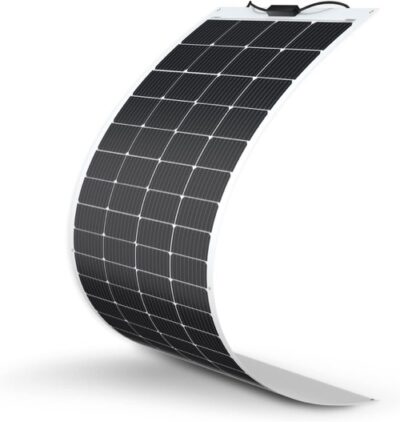
- Power output: 200 W (claimed), monocrystalline silicon with half-cut PERC cells
- Output: 12 V DC nominal; IP67 solar connectors with 12 AWG, 27.6 in leads
- Cell efficiency: 22% (high-tier for a flexible panel)
- Weatherproofing: IP67 junction box and connectors; frameless polymer laminate (all-black, glare-free); 5400 Pa snow / 2400 Pa wind load
- Charge controller: None — direct panel output; pair with a separate MPPT or PWM controller for 12V batteries
- Best for: Curved van/marine/RV roofs, 12V deep-cycle and lithium battery charging, and overland camper installs where weight and shape matter
PROS
- Near-rated 189-198W in full, direct sun
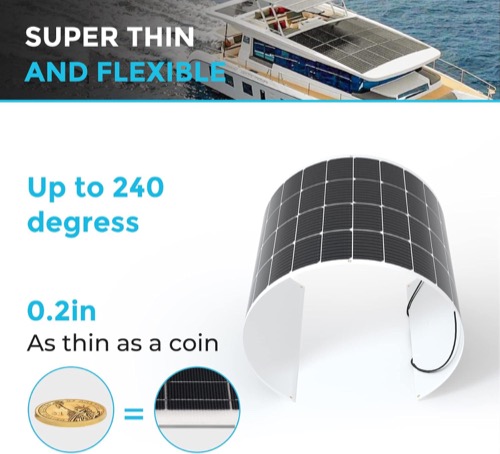
- Light (10.8 lb) and bends to 240 degrees for curved roofs
- Pre-drilled holes make install quick and simple
- IP67 junction box and connectors handle wet weather
- Durable over multiple seasons of real use
CONS
- Output sags when flush-mounted on a hot roof
- Even a little shade drops production sharply
- Short 27.6 in leads usually need an extension
- No charge controller included — you supply one
- Isolated laminate-peel and soldering QC reports
Editor's Choice
Based on exact documentation and qualitative exact-ASIN Amazon owner evidence; no hands-on test or population-rate claim
Two hundred watts is printed on the laminate; the figure that actually lands in your battery is another matter — and on a bendable sheet, that spread runs wider than the spec label admits. Closing that gap is what this Renogy 200W flexible solar panel review sets out to do: pin down what the panel really delivers on a curved roof, and where the flexible design quietly costs you something.
You’ve seen the pitch — 200 watts on one ultra-light sheet that bends up to 240 degrees, all-black and glare-free, ready to hug a van roof or a boat deck. On paper it’s the tidy answer when you only have room for one panel and it has to follow a shape. Flexible panels, though, play by different rules than rigid glass, and those rules show up fast in the real-world numbers.
Here’s the honest framing: the Renogy 200W flexible panel is capable hardware with a couple of trade-offs baked into the format. It runs hotter when stuck flat, it hates shade more than a framed panel does, and you supply your own controller. For the right roof, that’s a fair deal — for a flat, load-bearing surface with room to spare, the math might point you elsewhere.
Cross-shopping? See how it ranks in our best flexible solar panels roundup.
The expanded evidence makes this a roof-design review as much as a panel review. Exact 200W accounts include RV, truck-camper, barn, vehicle, and marine-style installations. Some owners report useful charging and appreciate the low mass and single-panel footprint. Others describe sharp losses from a narrow strip of shade, underwhelming controller input, junction-box or solder problems, visible cell changes, early loss of output, and mixed warranty experiences. These reports justify a stricter commissioning and inspection plan, not a claim that a fixed share of panels fail.
| Design question | Why it matters here | Evidence to keep |
|---|---|---|
| Can the site stay unshaded? | Owners repeatedly describe severe output loss from small obstructions. | A day-long shade survey covering vents, racks, antennas, and roof gear |
| Can the laminate shed heat? | Flexible modules generally run hotter when bonded without airflow. | Roof material, adhesive pattern, clearance, and cell-temperature plan |
| Can the panel be replaced? | Some reports involve faults after installation. | Accessible connectors, documented cable route, and removable attachment |
| Is the receiver compatible? | “12V” does not define controller limits. | Delivered Voc, Vmp, Isc, Imp, polarity, and cold correction |
The correct test separates the panel from the rest of the system. Inspect the laminate and junction box, photograph the label, verify polarity, record open-circuit voltage, then observe controller input in stable sun with a battery that can accept charge. Repeat after the module warms. If several panels are involved, test each one independently before combining them. This prevents a loose connection, shaded module, controller ceiling, or battery taper from being misdiagnosed as cell failure.
Renogy documents the reviewed RSP200DB-72-US as a 200W, 9BB half-cut flexible module with 20.1V Vmp, 23.9V Voc, IP68 junction box, IP67 connectors, and a 240-degree maximum curve. Those values define the product boundary; they do not mean the panel should be repeatedly bent through that range or walked on. Use a gentle, supported curve and distribute wind and road loads across the substrate.
The resulting verdict is conditional. It makes sense where weight, curvature, or available footprint rules out glass, and where the owner accepts more installation engineering and inspection. On a flat roof with room for a framed panel and airflow, a rigid module remains the simpler durability benchmark.
A Laminate You Can Curve to the Roofline
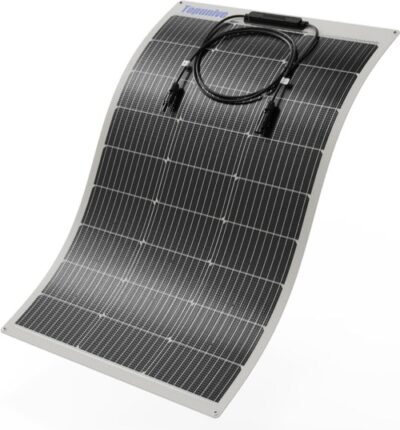
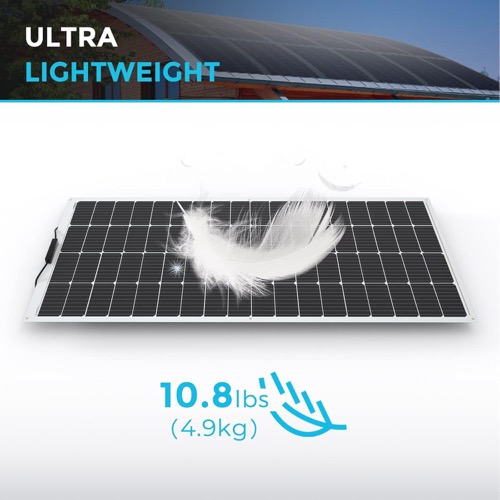
First thing owners notice is how little there is to it. At 10.8 pounds and about a tenth of an inch thick, this is roughly half the weight of a comparable rigid panel, and it lands as a slim, all-black sheet rather than a framed slab. That glare-free surface looks tidy on a roof rack or boat deck.
Its headline trick is the bend. It flexes up to 240 degrees, so it wraps a curved van roof, a camper corner, or a boat’s cabin top without cracking. One owner summed up the appeal plainly: an install that would have been much harder with a rigid panel “worked perfectly” because these could follow the shape.
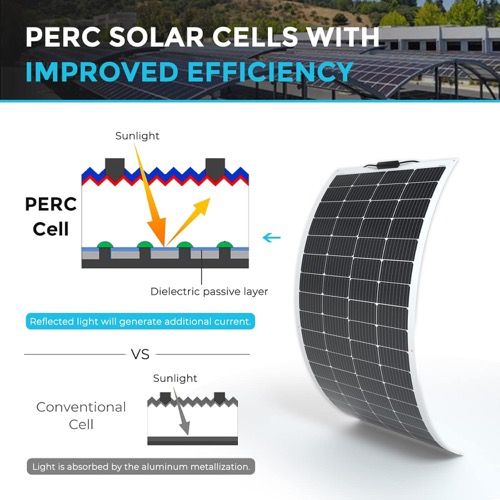
Underneath the polymer laminate sit monocrystalline half-cut PERC cells, the same high-efficiency tech you’d find on a good rigid panel. Owners describe the build as sturdy and tough, and most report no delamination. The honest caveat is that a few have seen the top laminate cover peel after a few months on a roof — not common, but it’s the flexible-format weak point to keep an eye on.
Curved-Surface Mounting Without the Frame
Installation is where the flexible format shines. Pre-drilled mounting holes, a slim profile, and half the weight of rigid make this, in one owner’s words, “the easiest solar installation I’ve ever done.” There’s no heavy frame to wrestle and no bracket kit to fight.
You’ve got options for how it goes down. Screw it through the pre-drilled holes, or bond it with adhesive or specialty tape to keep the roof sealed — one owner simply taped his to a carport awning with tarp-repair tape and kept an RV battery topped. On a flat metal roof, mounting it over a thin spacer for an air gap is the move that keeps it cooler and holds output up in heat.
One real friction point is cable. Those 12 AWG solar connector leads run just 27.6 inches, so most installs need an MC4 extension to reach a controller or battery bay. Sort that out before you stick the panel down, not after.
Practical Tip — Buy an MC4 extension in the length you actually need at the same time as the panel, and keep the connector type consistent (MC4 to MC4). The 27.6-inch factory leads reach almost nothing on a real roof, and matching connectors avoids the voltage drop you get from cheap adapters.
IP67, Snow Load, and the Delamination Question
Weather sealing is a bright spot. The junction box and solar connectors carry an IP67 rating, which covers rain and brief immersion, and owners run these through wet seasons and marine use without electrical trouble. The panel also claims a 5400 Pa snow load and 2400 Pa wind rating, so it holds up under heavy snow and strong gusts.
Longevity backs that up in the field. One truck-camper owner logged two years and over 30,000 miles through “every imaginable season,” and another reports three good years across several of these panels. For a flexible laminate, that’s a reassuring track record.
One honest caveat sits at the surface. A few owners report the top laminate cover peeling within a few months of roof mounting — the classic flexible-panel failure mode. It’s not the norm here, but it’s the thing to inspect early and the reason a clean, flat, well-bonded install matters more on a flexible panel than a framed one.
| Feature | This Panel | What It Means Outdoors |
|---|---|---|
| IP rating | IP67 junction box + connectors | Handles rain and brief immersion at the box |
| Frame material | None — frameless laminate | Sheds weight; no corrosion, but no rigid edge protection |
| Panel surface | Polymer laminate over mono cells | Wipes clean; the laminate is the wear point |
| Junction box seal | Sealed (IP67) | Keeps moisture out of the wiring |
| Connector weatherproofing | IP67 solar connectors | Weather-rated connections |
| Snow / wind load | 5400 Pa snow / 2400 Pa wind | Handles heavy snow and strong gusts |
| Operating temperature | Up to 45°C (113°F) rated | Flush mounting runs hot; an air gap helps |
| Long-term owner reports | Two-plus years on campers | Mostly durable; watch the laminate bond |
Buyer Heads-Up — Shade is this panel’s real enemy. Owners warn that even a couple of inches of shadow on one edge can drop production sharply, and they wish it had stronger bypass diodes. Mount it where no rack bar, vent, or antenna throws a shadow across it at peak sun.
Batteries and Power Stations It Feeds
Output here is 12V nominal, so the real question is what you’re charging and what sits between the two. With a controller in the line, owners run it into 12V deep-cycle barn batteries, RV house banks, and lithium setups. One uses it to restore a lithium solar battery and run a fridge while camping; another keeps a 300Ah battery topped through a carport install.
Here’s the thing to plan around: there’s no controller in the box. For a 12V battery of any chemistry, you add your own MPPT (or PWM) unit and the right cable. If you’re feeding a portable power station instead, the station’s built-in controller does the work — you just need the correct solar input adapter for your specific unit.
| Battery / Device | Typical Use | Compatible? | Notes |
|---|---|---|---|
| 12V deep-cycle lead-acid | Barn, cabin, RV | Compatible | Add a charge controller |
| AGM (sealed) | RV, boat, van | Compatible | Pairs well with an MPPT unit |
| Gel cell | Marine, mobility | Needs adapter | Use the gel profile on the controller |
| LiFePO4 (12V) | Van life, off-grid | Compatible | Set the LFP profile on the controller |
| Portable power station (Bluetti, etc.) | Camping, backup | Needs adapter | Match the station’s solar input plug |
| 24V battery bank | Large marine bank | Not compatible | Panel is 12V output; needs series wiring of two |
Worth Knowing — On a flexible 12V panel, the controller’s battery-type setting matters as much as the wiring. Charging a LiFePO4 or gel battery on a plain lead-acid profile can cut its life short, so set the profile to match your battery before you leave it running for the season.
Wind, Snow, and What Renogy Stands Behind
On paper, the protective numbers are solid: a 5400 Pa snow load, a 2400 Pa wind rating, and IP67-sealed electrical connections. There are no specific safety certifications listed beyond the manufacturer’s own claims, which is worth noting if you’re wiring it into a larger 12V system — the controller you add carries the real protection burden there, so pick a reputable one.
Warranty terms aren’t spelled out in the listing, so verify Renogy’s current coverage before you buy. The after-sale experience is the softer spot in owner feedback: a couple received a damaged panel or a defective unit and waited weeks for a refund. And one buyer had to open the junction box to resolder the bus bars after getting only two-thirds output on day one, then hit 105% of rated once fixed — a quality-control miss, though not one most people would want to DIY around.
To be fair, safety incidents don’t come up. The recurring heat issue is about performance, not danger — the panel throttles output when it bakes flush against a hot roof, then recovers as it cools.
Long-Term Ownership — Monocrystalline cells degrade slowly, roughly half a percent a year, so the cells aren’t usually what fails first on a flexible panel. The laminate bond, the leads, and the connectors are the parts to watch. Bond it flat and clean, add an air gap where you can, and inspect the edges each season.
Where a Flexible 200W Panel Earns Its Keep — Use-Case Fit Matrix
| Use Case | Fit | Why |
|---|---|---|
| Curved van or camper roof | Strong fit | Bends to 240°; light enough for any roof |
| Boat deck / marine curved surface | Strong fit | IP67 connections; sheds weight on the water |
| 12V deep-cycle battery charging (with controller) | Strong fit | Real 156-190W in sun keeps a bank topped |
| Truck-camper / overland roof | Strong fit | Owners log years and 30K+ miles on it |
| Off-grid barn or shed 12V lights | Solid fit | Plenty of power for LED loads with a battery |
| Charging a portable power station | Solid fit | Works with the right solar input adapter |
| Flush mount on a hot, flat metal roof | Borderline | Heat derates output; add an air gap |
| Full-shade or partly shaded spot | Skip | Any shade drops production sharply |
| Max output-per-dollar vs rigid glass | Borderline | Rigid is more consistent when shape allows |
| Flat load-bearing roof, weight no concern | With caveats | A rigid panel may give steadier watts |
| High-draw loads without a battery | Not recommended | It’s a charging panel, not a generator |
| Buyer needing guaranteed near-rated output | With caveats | Real watts swing with heat and shade |
Bank on it if you want:
- A light, bendable panel that follows a curved van, camper, or boat roof
- Max watts on a single sheet where there’s no room for two rigid panels
- IP67-sealed connections that handle rain and marine spray
- A tidy, all-black, glare-free look that sits nearly flush
Think twice if you need:
- A panel for a shaded or partly shaded mounting spot
- The most consistent output-per-dollar on a flat, roomy roof
- A ready-to-charge kit with the controller and cables in the box
- Guaranteed near-rated watts without managing heat and angle
This is a different tool for a different job — great for curves and weight limits, less ideal when a rigid glass panel would simply sit flat.
Renogy 200W flexible panel: Decision Snapshot
| Spec | Value |
|---|---|
| Max Power Output | 200 W (monocrystalline, half-cut PERC) |
| Output Voltage | 12 V DC nominal (Voc 23.9 V) |
| Connector | Solar connectors (MC4-style), IP67 — no USB |
| Cell Efficiency | 22% (high for a flexible panel) |
| Weatherproof Rating | IP67 junction box and connectors; frameless laminate |
| Charge Controller | None — direct output (you supply one) |
| Cable Length | 27.6 in leads (extension usually needed) |
| Mount Type | Pre-drilled holes; adhesive or screw; bends to 240° |
| Best For | Curved van, marine, and camper roofs |
What 200 Watts Looks Like on a Flexible Panel
Rated at 200W, the panel translates in good sun to roughly 156W of real output at a 0.78 factor, or about 624 Wh on a typical day with four solid peak sun hours. Renogy quotes an average of 1000 Wh per day at 5 sun hours, but that figure assumes near-nameplate output, so treat the lower number as your planning baseline.
In practice, the ceiling is higher than that average when conditions cooperate. Owners who keep the panel angled and cool report input watts averaging 189-195W in direct sun, one measured 198W per panel “as advertised,” and a pair sent just over 400W to a Bluetti Elite 400 at noon. Even a January sun gave one owner 104W, which is respectable for deep winter.
Two things pull real-world output down, and both matter more on a flexible panel. Heat is the first — stuck flat to a dark roof with no airflow, the cells warm up and throttle back, which is why one owner deliberately mounted his over a polycarbonate sheet for an air gap. The second is shade, and it’s brutal here.
| Condition | Estimated Output | What That Means |
|---|---|---|
| Full sun, ideal angle, airflow | ~156-190 W | Fast 12V charging; a strong day’s harvest |
| Partly cloudy sky | ~70-90 W | Still meaningful; slower to fill the battery |
| Overcast / heavy clouds | ~20-40 W | Trickles only; won’t fully charge a big bank |
| Panel 45° off optimal | ~100-120 W | Noticeable hit; reposition if you can |
| Winter sun (northern US) | ~80-105 W | Usable; fewer peak sun hours overall |
| Any shade across the panel | ~15-45 W | Sharp drop — avoid shaded mounting spots |
Real-World Math — Apply a 0.78 real-world factor and the 200W panel settles near 156W under good sun; stretch that across a 4-hour peak sun day and you bank about 624 Wh. Enough to keep a 100Ah (roughly 1200 Wh) 12V house battery topped against daily draw, or recharge a mid-size power station in a day of clear sky.
These are estimates. Your actual numbers depend on angle, sky, shade, surface temperature, and how long your cable run is.
Renogy 200W Flexible Solar Panel Review: The Bendable Bottom Line
If you want max watts on one lightweight sheet that follows a curved roof, the Renogy 200W flexible solar panel review verdict is a qualified yes. It’s light at 10.8 pounds, it bends where rigid panels can’t, and in full sun owners pull a real 189-198W with IP67-sealed connections that shrug off rain. Just know going in: shade drops output hard, flush mounting on a hot roof costs you watts, the factory leads are short, and there’s no controller in the box — so budget for an extension and an MPPT unit before you install.
Is the Bendable 200W Worth It?
For the right roof, the Renogy 200W flexible solar panel lands somewhere genuinely useful — a light, bendable, high-efficiency sheet that fits where rigid glass can’t, pulling a real 189-198W in full sun through weather-sealed connections owners lean on across years of hard use. Buyers pay a small premium for the flexibility, the low weight, and the tidy all-black look, and by and large they call it money well spent. Where it fits, it fits beautifully: a curved surface, a weight limit, or an install a framed panel simply won’t tolerate, so long as you manage heat with an air gap and keep the laminate clear of shade. Take those constraints away — a flat, load-bearing roof with room to spare and no weight worries — and the calculus shifts, since a rigid glass panel will hand you steadier watts for the money. Match this one to the job it was built for and it earns its keep; ask it to behave like a rigid panel on an easy roof and you’re paying for flexibility you don’t need.
Pros & Cons Analysis
Based on documented specifications and owner feedback
Pros
- Strong output in full, direct sun — owners who kept the panel angled and cool report input watts averaging 189-195W, and one measured 198W per panel "as advertised." A pair feeding a Bluetti Elite 400 sent just over 400W at noon.
- Genuinely light and bendable — at 10.8 pounds and about half the weight of a comparable rigid panel, it curves up to 240 degrees to follow a van, boat, or camper roofline. Buyers repeatedly call the flexibility "worth the extra cost."
- Easy, no-fuss installation — pre-drilled mounting holes and a slim profile make this "the easiest solar installation I've ever done," in one owner's words. Several tape or bolt it down in minutes with no frame to wrestle.
- Holds up over years of real use — one truck-camper owner logged two years and over 30,000 miles through "every imaginable season," and another reports three years across multiple panels. Durability comes up as a genuine strength.
- IP67 junction box and connectors — the sealed box and weather-rated solar connectors handle rain and brief immersion, which matters on a marine deck or an exposed camper roof. Owners run them through wet seasons without electrical trouble.
- Plenty of power for 12V jobs — owners charge deep-cycle barn batteries, top off RV house batteries, and restore lithium banks with it. "Plenty of power for my LED lights" is a recurring line.
- All-black, glare-free look — the low-profile black laminate sits nearly flush and looks tidy on a roof rack or boat, without the glint of a framed glass panel. It's a small thing owners still appreciate.
- Costs a little more, but fits where rigid can't — buyers admit it runs "a little more expensive than some," yet the flexibility solved installs that a rigid panel couldn't, especially on curved surfaces.
Cons
- Flat, flush mounting bleeds real watts — one owner maxed out under 100W on a 200W panel in direct sun and returned it, noting flex panels simply aren't as efficient as rigid glass when they can't shed heat. Mounting flush to a hot roof is the usual culprit.
- Shade kills output fast — a common warning is that even a couple of inches of shade on one side drops the whole panel's production sharply. Owners wish it had better bypass diodes to block the drain from a shaded section.
- Short factory leads — the 12 AWG solar connector cables run only 27.6 inches, so most installs need an MC4 extension to reach a controller or battery bay. Plan the run before you stick the panel down.
- Laminate bond can fail — a few owners report the top laminate cover peeling within a few months of roof mounting. It's not the norm, but it's the failure mode to watch on a flexible panel.
- Occasional soldering QC issue — one buyer opened the junction box to resolder the bus bars after getting only two-thirds output on day one, then hit 105% of rated after the fix. A quality-control miss that not everyone can DIY around.
- Needs a controller you supply — there's no charge controller in the box, so pairing it with a 12V battery means buying an MPPT (or PWM) unit and the right cable separately.
- Runs hot without an air gap — one owner mounted the panel over a polycarbonate sheet specifically to create airflow and hold performance up in heat. Stuck straight to a dark roof, output sags on hot, still days.
- Refund and DOA hassles — a couple of owners received a damaged panel and waited weeks for a refund on returned units. The hardware is good; the after-sale experience isn't always smooth.
Is the Bendable 200W Worth It?
For the right roof, the Renogy 200W flexible solar panel lands somewhere genuinely useful — a light, bendable, high-efficiency sheet that fits where rigid glass can't, pulling a real 189-198W in full sun through weather-sealed connections owners lean on across years of hard use. Buyers pay a small premium for the flexibility, the low weight, and the tidy all-black look, and by and large they call it money well spent. Where it fits, it fits beautifully: a curved surface, a weight limit, or an install a framed panel simply won't tolerate, so long as you manage heat with an air gap and keep the laminate clear of shade. Take those constraints away — a flat, load-bearing roof with room to spare and no weight worries — and the calculus shifts, since a rigid glass panel will hand you steadier watts for the money. Match this one to the job it was built for and it earns its keep; ask it to behave like a rigid panel on an easy roof and you're paying for flexibility you don't need.
Frequently Asked Questions
How much power does the Renogy 200W flexible solar panel actually produce?
In full, direct sun with the panel angled and able to breathe, owners report input watts averaging 189-195W, and one measured 198W per panel as advertised. Renogy rates it for an average of 1000 Wh per day at 5 sun hours, but a more realistic planning figure is around 624 Wh per day at 4 peak sun hours. Flush-mounted on a hot roof, expect meaningfully less, and even a little shade pulls output down fast.
Why does output drop so much when part of the panel is shaded?
This is the most common gripe. Even a couple of inches of shade on one side can cut the whole panel's output sharply, because the flexible design does not isolate a shaded section well. If you can, mount it where nothing — a rack bar, an antenna, a vent — casts a shadow across it during peak sun. Partial shade is the fastest way to lose most of your watts.
Does it come with a charge controller?
No. The panel outputs directly, so charging a 12V battery means adding your own MPPT or PWM controller and the right cable. Most owners run it with an MPPT unit for a 12V deep-cycle, AGM, or LiFePO4 bank. If you are feeding a portable power station like a Bluetti, the station's own controller handles it once you match the solar input plug.
Is the Renogy 200W flexible panel truly waterproof?
The junction box and solar connectors carry an IP67 rating, which covers rain and brief immersion, and owners run these through wet seasons and marine use without electrical trouble. The laminate surface itself sheds water fine. The one thing to watch over the long haul is the laminate bond, since a few owners report the top cover peeling after a few months of roof mounting.
How do I mount it on a curved van or boat roof?
The panel bends up to 240 degrees, so it follows most curved surfaces without cracking. It has pre-drilled mounting holes for screws, and many owners bond it down with adhesive or specialty tape instead to keep the roof sealed. On a flat metal roof, mounting it over a thin spacer to create an air gap helps it run cooler and hold output up in heat.
Will the factory cables reach my battery or controller?
Probably not on their own. The 12 AWG solar connector leads are only 27.6 inches long, so most installs need an MC4 extension to reach a controller or battery bay. Buy the extension in the same connector type to avoid voltage drop from cheap adapters, and plan the cable run before you stick the panel down.
What can I charge with it?
It is a 12V-nominal panel, so with a controller it charges 12V deep-cycle lead-acid, AGM, gel, and LiFePO4 batteries. Owners use it for barn and cabin LED lights, RV house batteries, truck-camper power, and restoring lithium banks. It also feeds portable power stations when you match the correct solar input adapter for your unit.
Does it handle heat and cold well?
It carries an upper temperature rating of 45 degrees C (113 degrees F) and a 5400 Pa snow load, and multi-year owners have run it through hard winters and hot summers. The catch is heat derating: like any panel, it loses efficiency as the surface heats up, and a flexible panel stuck flat to a dark roof gets hot. An air gap under it makes a real difference on hot days.
Is a flexible panel worth it over a cheaper rigid one?
It depends on your roof. If you have a curved surface, a weight limit, or an install where a framed glass panel simply will not sit right, the flexibility is worth the small price premium — owners say exactly that. If you have a flat, load-bearing roof with room and no weight concern, a rigid glass panel usually gives you more consistent output per dollar.
Technical Specifications
| Brand | Renogy |
|---|---|
| Model / SKU | RSP200DB-72-US (ASIN B0BF4VHWJP) |
| Panel format | Semi-flexible laminate |
| Rated output (Pmax) | 200W |
| Cell technology | 9BB half-cut monocrystalline |
| Module efficiency | 16.7% |
| Voltage at maximum power (Vmp) | 20.1V |
| Current at maximum power (Imp) | 10.02A |
| Open-circuit voltage (Voc) | 23.9V |
| Short-circuit current (Isc) | 10.74A |
| Power tolerance | ±3% |
| Maximum system voltage | 600VDC UL |
| Maximum series fuse | 15A |
| Output connector | Solar connectors |
| Output cable | 12 AWG, 27.6 in |
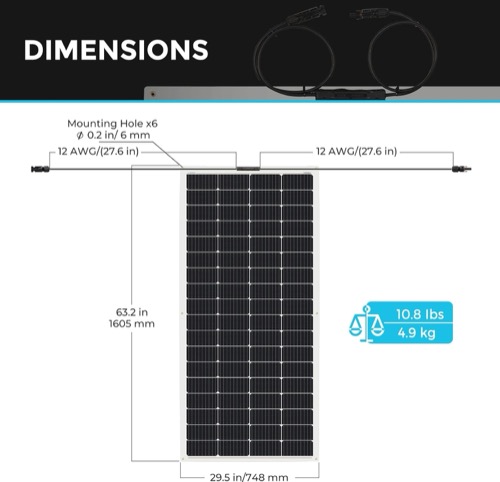
| Deployed dimensions | 63.2 × 29.5 × 0.1 in |
| Folded dimensions | — |
| Weight | 10.8 lb |
| Surface and frame | Frameless flexible laminate |
| Positioning / mounting | Curved-surface mounting; flexes up to 240° |
| Environmental protection | IP68 junction box; IP67 connectors |
| Wind / snow load | 2400Pa wind / 5400Pa snow |
| Operating temperature | -40°F to 185°F (-40°C to 85°C) |
| Included accessories | One 200W flexible panel |
| Product warranty | 5-year material/workmanship; 25-year output warranty |