Some roofs were never built for a rectangle of glass. An Airstream’s rounded shoulder, a camper van’s crowned top, a sailboat’s arched cabin — a rigid panel bridges the arc, tents at the corners, and refuses to lie flush. That mismatch is the entire reason flexible panels exist, and it’s why the best flexible solar panels aren’t judged the way rigid ones are. Here, “fits the shape” and “adds almost no weight” carry as much weight as raw watts.
There’s a trade you make for that fit, and it pays to understand it before you spend. A bendable laminate has no aluminum frame lifting it off the surface and no glass to keep it cool, so glued flat to a dark roof with no air gap, the cells heat-soak and give back fewer watts than the number on the box. Owner testing across these seven panels tells a consistent story: tilted in clean sun they can hit near-rated output, while flush-mounted on a hot roof they routinely lose 20 to 40 percent. None of that makes them a bad buy — it just means you size and mount them differently.
This roundup ranks seven of the best flexible solar panels from a 50W maintenance panel at under three pounds to a 260W twin-pack and a controller-included kit. We lean on real numbers pulled straight from each product’s review — measured amps, flat-mount versus tilted output, laminate failure reports, and bend limits — rather than nameplate marketing. Match the panel to your surface, your battery, and your tolerance for the heat-under-adhesive trade-off, and you’ll land on the right one without overpaying for watts you’ll never see.
Not Sure How Many Watts You Need?
Our Solar Panel Output Calculator estimates the real daily energy a flexible panel produces from your location’s sun hours — and factors in the lower real-world efficiency that comes with a frameless, flat-mounted laminate, so you can see whether a pick will actually keep your 12V bank or power station topped up.
Use the Solar Calculator — Jump to the ETFE vs PET Guide
How We Chose the Best Flexible Solar Panels
We didn’t bench-test these in a lab, and we won’t pretend to. What we did was read each panel’s full owner-feedback record and pull the numbers that actually predict how a bendable panel behaves on a roof — measured watts tilted versus flat, laminate delamination and cracking reports, bend limits, and whether the seller ships replacements when a unit underperforms. Flexible panels punish the wrong assumptions harder than rigid ones, so we weighted real-world output and heat behavior above nameplate wattage. No single panel sweeps every category: the compact pick trades watts for a two-pound body, the budget pick trades a brand warranty for half the price, and the kit trades an MPPT controller for plug-and-play simplicity.
| Criterion | Why It Matters for Flexible Solar | Weight |
|---|---|---|
| Real-world output (tilted vs flat) | A frameless laminate heat-soaks when glued flat, so measured watts diverge from the rating far more than on a framed rigid panel | High |
| Curvature and bend limit | “Flexible” spans a gentle 45 cm radius to a claimed 270° — the wrong assumption cracks cells during install | High |
| Weight and profile | The whole reason to go flexible: 2.87 to 10.8 lb here, roughly 70% lighter than glass, with a near-flush low profile | High |
| Laminate durability | Delamination, hotspots, and yellowing are the flexible-format failure modes — ETFE resists UV aging better than cheaper PET | Medium |
| Weatherproofing (IP rating) | Most rate only the junction box (IP67/IP68); several state no certified panel rating, so sealing your own edges matters | Medium |
| Controller and wiring included | Only the kit ships a controller; the rest are bare MC4 leads needing a separate MPPT and extension cables | Medium |
| Value and support | Price per usable watt, plus whether a warranty and replacement path stand behind the panel when a batch runs weak | Low |
Selection criteria:
- Real-world output — measured owner watts tilted and flat, not the STC nameplate; flexible laminates carry a lower real-world factor (roughly 0.62 to 0.78 here) than framed mono
- Curvature — the actual bend limit, from the unbranded panel’s 45 cm minimum radius to the Renogy 50W’s 248° and ECO-WORTHY’s 270° claim
- Weight and profile — 2.87 to 10.8 lb, near-flush mounting for stealth van and marine builds
- Laminate and cells — monocrystalline throughout (half-cut PERC, 9BB, or 12BB), with ETFE versus PET surface durability weighed in
- Weatherproofing — junction-box IP67/IP68 where certified; several panels rate the box only, not the whole laminate
- Controller fit — kit includes a 30A PWM; every other pick needs a separately bought MPPT or PWM controller
- Value and warranty — cost per usable watt against brand backing, from Renogy’s 5-year coverage to the unbranded panel’s seller-by-seller terms
ETFE vs PET: The Laminate That Decides Lifespan
The surface film is the single most important durability spec on a flexible panel, and it’s the one buyers skip. Because there’s no glass, the laminate is what takes the UV, the heat, and the flex stress for years — and not all of it is equal. ETFE (the fluoropolymer on the unbranded Topunive’s face, over a TPT back sheet) resists yellowing and abrasion far better than the cheaper PET film that shows up on bargain panels. When owners of the Renogy and ECO-WORTHY panels report delamination, hotspots, or cell clusters that “look faded at an angle,” the laminate bond and film quality are what’s aging — not the silicon underneath, which degrades slowly.
| Laminate Type | UV / Heat Resistance | Typical Failure Mode | What It Means for You |
|---|---|---|---|
| ETFE (fluoropolymer) | Strong — self-cleaning, holds clarity under years of sun | Slow; edge delamination if the bond is stressed | Worth paying for on a permanent marine or roof install |
| PET / polymer laminate | Moderate — can yellow and micro-crack sooner | Yellowing, hazing, laminate peel over time | Fine for maintenance duty; inspect edges each season |
| Frameless build (all types) | Runs hotter than framed glass with no air gap | Heat derating; hotspots on shaded cells | Leave airflow or a slight tilt to protect output and life |
Worth Knowing — The failure that ends a flexible panel is almost never water; it’s heat and flex. Give the back a little airflow instead of gluing it dead-flat, avoid bends past the rated radius, and seal the edges and wire entries — and the laminate outlasts several of the batteries it charges.
How to Choose a Flexible Solar Panel
Before you commit adhesive, run through this checklist. It’s the fastest way to dodge the three regrets that come up again and again in owner reports — a bend that cracked a cell, a flat mount that bakes off watts, and a panel that arrived weak with no easy replacement path.
What to prioritize in a flexible solar panel:
- Real-world watts, not the nameplate — check whether owners measured near-rated output tilted or lost a third of it flat
- The bend limit your surface actually needs, in degrees or minimum radius
- Weight and thickness that suit a stealth van, marine, or weight-sensitive roof
- A junction box IP rating (IP67/IP68) and an ETFE surface for a permanent install
- A plan for the controller and extension cables, since only the kit includes them
Common buyer mistakes:
- Trusting the rated watt and gluing the panel flat to a dark, airless roof
- Forcing a “270°” panel around a tight curve and hearing cells crack
- Skipping the separate MPPT controller a bare panel needs to charge a 12V battery
- Not testing output the week it arrives, then missing a short return window on a weak unit
Curvature: Matching the Panel to Your Surface
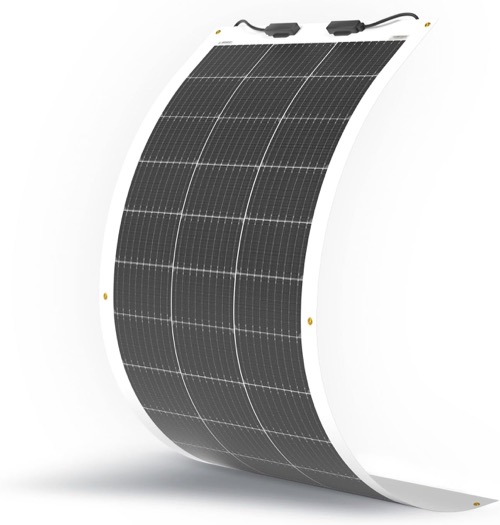
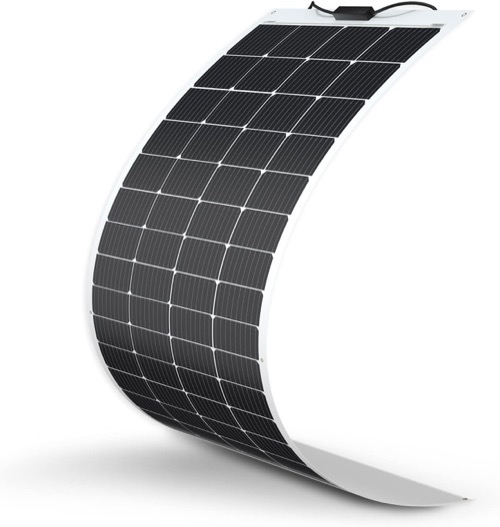
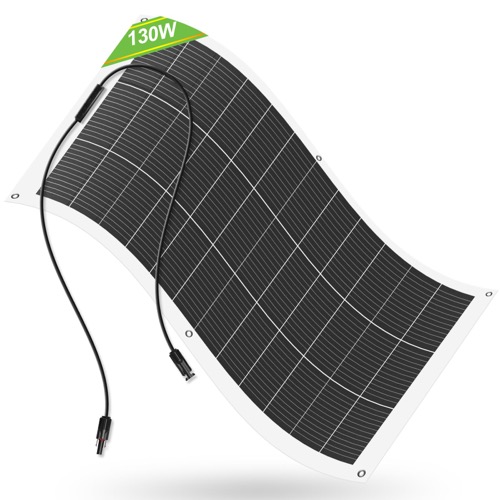
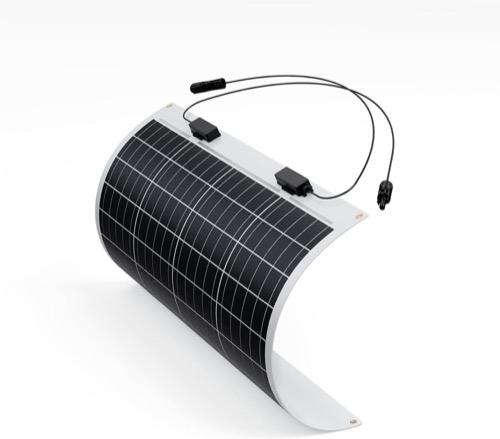
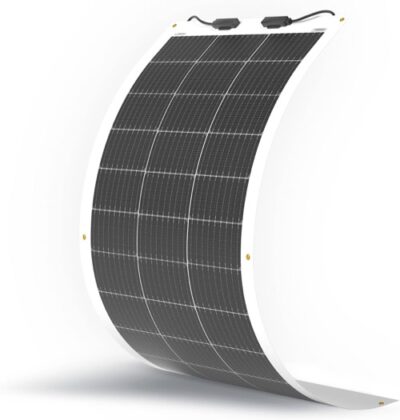
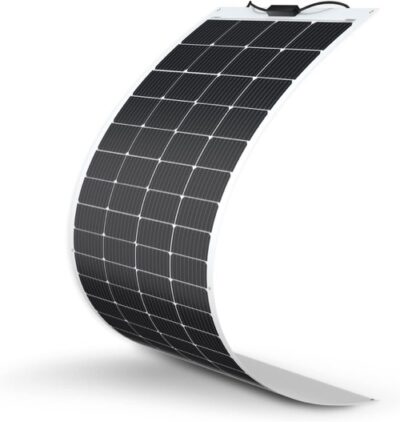
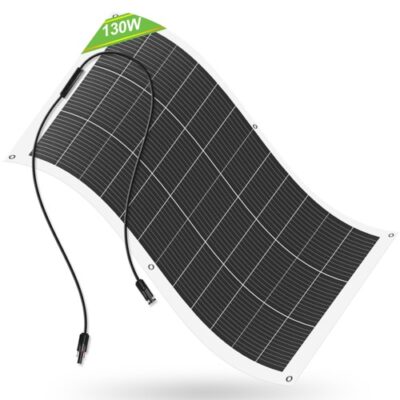
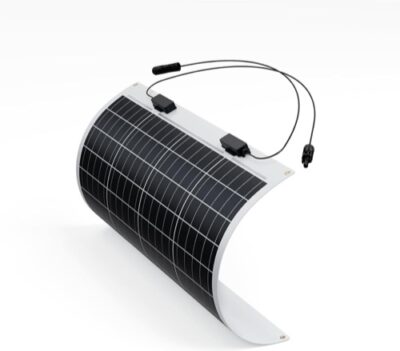
This is the spec rigid buyers never think about, and it’s the one that breaks flexible installs. “Flexible” ranges widely across this lineup: the unbranded 100W bends to a 17.7 in (45 cm) radius, the Renogy 50W flexes up to 248°, and both ECO-WORTHY 130W panels claim 270° — though owners consistently call them semi-flexible and report audible cracking when pushed past a gentle curve. Renogy’s own 200W bends to 240°, while the 100W is best treated as a gentle-curve panel, not a foldable one. Measure your roof’s arc first, then buy to it. Every panel here suits a rounded RV cap, a van crown, or a boat cabin top; none of them rolls up, and forcing a tight bend is how owners fracture cells during install.
Real-World Math — A flexible 100W panel at a 0.70 real-world factor and 4 peak sun hours delivers roughly 280 Wh/day — enough to fight parasitic camper drain and hold a pair of AGM batteries topped, which is exactly what owners lean on it for. Tilt it and vent the back, and you claw back above that number; glue it flat and hot, and you drop below it.
Real-World Output vs Rated Watts
The rated watt is a Standard Test Conditions figure — 25°C, perfect light, zero angle loss — and flexible panels stray from it further than rigid ones because they can’t shed heat. The owner data across these picks makes the gap concrete: the Renogy 200W pulls a measured 189-198W tilted in clean sun but sags under 100W flush on a hot roof; ECO-WORTHY’s 130W tests anywhere from 51W flat to 121W with a steep winter mount and MPPT; the unbranded 100W lands a genuine 75-89W in good sun, with one owner catching 97W. The pattern is the same every time — angle and airflow decide whether you see the rating. Always plan with the real-world factor (roughly 0.62 to 0.78 here), never the nameplate.
Weight and Profile
This is why you’re buying flexible in the first place, and the spread is real. The Renogy 50W at 2.87 lb and roughly a tenth of an inch thick nearly vanishes on a cabin top; the ECO-WORTHY panels run 4.4 lb each; and the Renogy 200W is the heavyweight here at 10.8 lb for a single 63-inch sheet. All are around 70% lighter than comparable glass and mount near-flush, which is the stealth-build advantage that no rigid panel can match. Pick the profile for how your roof carries weight and how invisible you need the install to be, then confirm the wattage covers your load.
Pro Tip — On a moving vehicle, a near-flush flexible panel adds essentially no wind resistance and no drilling — but that same flat mount is what heats it up. If you can add a thin spacer or mount over a vented backer for even a small air gap, you protect both midday output and the laminate’s lifespan.
Mounting: Adhesive, Tape, and Grommets
Frameless means no bracket kit, which is both the appeal and the work. Owners bond these down with 3M VHB tape, heavy-duty adhesive, silicone, or Renogy’s mounting adhesive, and several report tape-only installs still holding years later. The catches show up in the details: ECO-WORTHY’s panels resist conforming, so one owner spent over an hour of hand pressure per panel, and adhesive can lift on a curve if you rush it. Renogy notes the 50W’s grommets are stationary-only — anything mobile must be bonded with structural adhesive. Plan your wire routing before the glue sets, because swapping cables on a stuck-down panel is, in one owner’s words, “royally challenging.”
Charge Controllers (When You Need One)
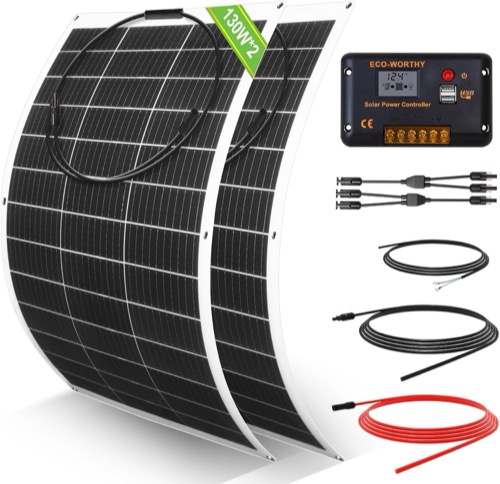
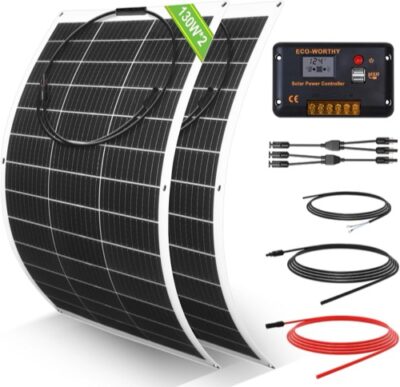
Keep this simple, and see the dedicated section below for the full breakdown. Six of these seven panels ship as bare MC4 leads with no controller — charging any 12V battery means adding your own MPPT (strongly preferred here) or PWM unit. The lone exception is the ECO-WORTHY 260W kit, which bundles a 30A PWM controller with an LCD, dual USB, and lead-acid/gel/lithium support, so you can start charging out of the box. Feeding a portable power station instead? Its built-in controller handles the panel directly through an MC4 adapter. Our MPPT vs PWM guide covers why owners repeatedly credit MPPT and series wiring for their best numbers on these panels.
What Can These Flexible Solar Panels Do?
Watts stay abstract until you put a battery next to them. At 4 peak sun hours — a fair average across much of the US and Europe — here’s the real daily energy each panel delivers, using the lower real-world factors that flexible laminates earn, plus where you’ll want more panel than the label implies.
| Panel | Est. Daily Output (4 PSH) | Best Suited For | Watch Out |
|---|---|---|---|
| Renogy 50W | ~136 Wh/day | Maintaining a stored 12V marine, RV, or vehicle battery; light DC loads | Maintenance-class only — won’t run a fridge on its own |
| Renogy 100W / Unbranded 100W | ~280-300 Wh/day | Topping a 12V house bank; fighting parasitic drain; supplementing a roof array | Flat, hot mounting drops output; single cell shaded craters it |
| ECO-WORTHY 130W | ~364 Wh/day | Set-and-forget upkeep of a 12V AGM or lead-acid bank on an RV or boat | Single panels often test well under 130W without MPPT and a good angle |
| ECO-WORTHY 260W Kit | ~707 Wh/day | Marine and RV house-battery charging with everything in the box | Flat-mount output nearer 175-190W; PWM controller caps the harvest |
| ECO-WORTHY 2×130W Twin | ~645 Wh/day | Bigger van, skoolie, and cabin builds scaled on an MPPT controller | Very setup-sensitive; PWM or single-panel feeds cut watts hard |
| Renogy 200W | ~624 Wh/day | Max watts on one curved sheet; a 100Ah 12V bank; mid-size power station | Any shade drops it sharply; short 27.6 in leads need an extension |
Output estimates use each panel’s real-world factor (0.62-0.78 for flexible laminates) and 4 peak sun hours. Actual output varies with tilt, airflow behind the panel, weather, shading, temperature, cable length, and controller type.
Shade hurts these more than rigid panels, and it’s worth planning around. Because the cells wire in series, a single shaded 5-inch cell dropped one Renogy 100W owner’s output to zero, and ECO-WORTHY owners warn a couple of inches of shadow can crater the whole panel. Rooftop AC units, vents, and antennas are the usual culprits, so mount for clean, unobstructed sun across the day.
Do You Need a Charge Controller?
Almost certainly yes, unless you’re feeding a power station. Six of these seven panels output roughly 18-24V DC through bare MC4 leads with no regulation of their own — wire one straight to a 12V battery and it can overcharge the bank or backfeed current at night. The ECO-WORTHY 260W kit is the exception, arriving with a 30A PWM controller ready to charge lead-acid, gel, or lithium. For every other pick, you supply the controller, and owner reports are near-unanimous that MPPT beats PWM here, especially with the ECO-WORTHY panels wired in series.
| Charging Scenario | Separate Controller Needed? | Why |
|---|---|---|
| Any bare panel here → 12V AGM or lead-acid battery | Yes — MPPT or PWM | No overcharge or anti-backfeed protection without one |
| Bare panel → LiFePO4 bank (van, RV, marine) | Yes — MPPT with LFP profile | Lithium needs a specific charge profile; the wrong one shortens life |
| ECO-WORTHY 260W kit → 12V battery | Included | Ships with a 30A PWM controller; set the battery type first |
| Any panel → EcoFlow / Jackery / Bluetti / Goal Zero station | No | The station’s built-in MPPT handles it; use an MC4 adapter |
| Two panels in series into a 24V bank | Yes — MPPT sized for the array | Series raises voltage; owners credit MPPT + series for best output |
Worth Knowing — On a flexible panel the controller’s battery-type setting matters as much as the wiring. Owners repeatedly report that an MPPT unit with the right LFP or gel profile pulls noticeably more usable watts than a cheap PWM, and it protects the battery you’re trying to keep alive. Budget for a reputable controller before you install any of the six bare panels here.