Callsun 400W Bifacial Solar Panel Review: What a Two-Sided N-Type Array Actually Delivers Off-Grid
At a Glance
KEY FEATURES
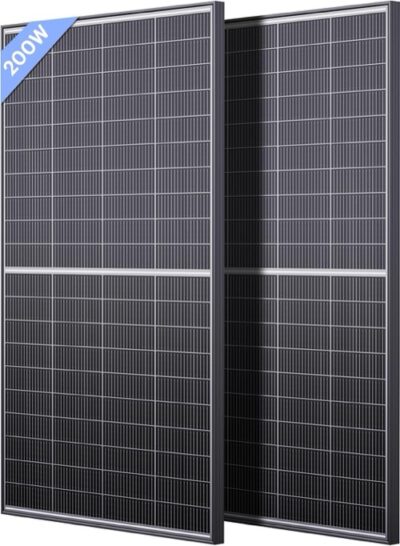
- Two 200W N-Type 16BB bifacial panels.
- 23.74V Vmp and 27.31V Voc per panel.
- 51.3 × 30.3-inch framed modules.
- IP68 junction box.
- Best for ground racks and carefully designed station arrays.
PROS
- Two-panel layout flexibility
- Bifacial rear-side opportunity
- Sturdy framed construction
- Useful series voltage for compatible inputs
- Not one portable 400W panel
- Exact current should be checked on delivered labels
- Rear gain depends on mounting
- Series can approach strict station voltage ceilings
CONS
- Not one portable 400W panel
- Exact current should be checked on delivered labels
- Rear gain depends on mounting
- Series can approach strict station voltage ceilings
Best two-panel bifacial set
Based on exact documentation, retained exact-ASIN evidence, and the expanded qualitative Amazon owner-text review; no hands-on test claimed
Bifacial panels sell you a second number — the bonus watts a transparent back supposedly harvests off the ground behind the glass. Callsun’s 400W kit (2× 200W N-type) leans hard on that pitch, dangling up to 30% rear-side gain. What the spec sheet leaves out is how much of that bonus actually lands, because the rear side only pays out when it can see reflected light, and most mounting setups never give it a clean look.
Read the listing and you get a premium résumé: N-type 16BB cells, 25% efficiency, a see-through back that catches diffuse light, and an anti-shade split design. Priced like a mid-tier panel, it reads better than most. Whether that rear-side math holds up once the panels are bolted somewhere and the battery is actually low is the real question.
Owner data answers it with an asterisk. Among 400W kits in this class, few perform as consistently, and buyers keep coming back for second and third sets. But you’re buying heavy, rigid glass and aluminum with no controller in the box — a permanent-install piece of gear, not a grab-and-go camping panel. Which of those two things you need reshapes the whole calculation.
For the full field of options, this one features in our best 400W solar panels guide.
This two-module identity changes the review. One panel is documented at 23.74V Vmp and 27.31V Voc; the pair can be arranged for different receivers, but a convenient connector arrangement is not proof of electrical compatibility. In series, voltage approximately doubles while current stays near one module. In parallel, voltage remains near one module while current approximately doubles. Exact Imp and Isc should be read from the delivered labels before cable, fuse, branch, or controller decisions are finalized.
| Configuration | Main opportunity | Limit to calculate |
|---|---|---|
| One 200W panel | Commission each module separately | Single-panel receiver window |
| Two in series | Higher operating voltage and lower array current | Cold-corrected combined Voc |
| Two in parallel | Lower voltage for a compatible input | Combined current and branch protection |
The expanded owner pool includes ground racks, garages, RVs, cabins, and portable stations. Useful reports describe both panels producing together, station input clipping, better results after correcting angle or wiring, and rear exposure over reflective surroundings. Other reports focus on shipping damage, connectors, support, and output below an owner’s expectation in heat. These observations explain what to investigate; they do not prove a fixed bifacial gain or universal wattage.
Bifacial rule: budget from the documented front-side rating. Rear irradiance depends on clearance, surface reflectance, angle, shade, and the mounting hardware itself.
Pairing It With Power Stations and 12V Systems
Buyers of any 400W kit ask the same thing first: “will it match my station’s input window?” For 60V-input power stations, the answer is a clean yes. Two panels in series land near 54V, sitting just under the common 60V cap on units like the Bluetti Elite 400, EcoFlow Delta 2, Dabbsson 2K, and Pecron models — owners with those setups pair them without drama.
Here’s the catch, though: scaling up takes planning. Buyers running four or six panels describe careful series-and-parallel math to stay under both the voltage limit and the 20-25A current window, and one owner hit a 500W solar-input ceiling that briefly paused charging when the sun broke through clouds just right. Bigger arrays mean mixing configurations — two-plus-two into one is a common trick.
| Device / Battery | Typical Use | Compatible? | Notes |
|---|---|---|---|
| Bluetti Elite 400 | Off-grid garage, backup | Compatible | Two in series near 54V fits the 60V input |
| EcoFlow Delta 2 (+ extra battery) | Camping, home backup | Compatible | Owner reports 420W+ into the 60V input |
| Dabbsson 2K | Off-grid, backup | Compatible | Owners run series/parallel under 60V and 20-25A |
| Pecron E3880LFP / F5000LFP | Off-grid, outages | Compatible | Scales well in 4- and 6-panel arrays |
| 12V battery bank (AGM / lead-acid / LiFePO4) | RV, boat, shed | Needs adapter | Add your own MPPT controller and cabling |
| Low-voltage 12V charge controller | Small off-grid | Needs adapter | Wire in parallel (~27V) instead of series |
Buyer Heads-Up — There’s no charge controller in the box. To wire straight to a 12V battery bank, you supply your own MPPT controller and cables. Check your controller’s max input voltage before choosing series (~54V) or parallel (~27V) wiring — the wrong choice either overshoots the limit or leaves watts on the table.
Pushing Past 400 Watts in Real Sun
Rated at 400W, the kit translates in good sun to roughly 350W of steady real output, or about 1,408 Wh on a typical day with four solid peak sun hours. In practice, owners regularly beat that. One caught 420W from the pair just leaning them against a garage wall, and another measured 461.9W with two panels in series on a hot afternoon.
What does that mean day to day? Plenty to keep a mid-size power station charged and run garage tools, lights, and small appliances off-grid. Per-panel numbers tell the same story — buyers report output past 200W each when the sun and angle line up, which is exactly what you’d hope for from N-type cells plus a working rear side.
Heat is the honest limiter. One owner in Texas ran clear skies at 92°F and measured 7.1A instead of the rated 8.43A, landing around 380W rather than a full 400. The -0.3%/K temperature coefficient is low for the class, but still, mid-afternoon air will trim the top end. Cloudy days behave better than you’d expect — owners report the panels keep batteries topped rather than dropping to nothing.
| Condition | Estimated Output | What That Means |
|---|---|---|
| Full sun, ideal angle, ground-mount | ~350-420 W | Beats the rating with bifacial gain; strong daily charge |
| Partly cloudy sky | ~175-250 W | Still meaningful; batteries keep climbing, just slower |
| Overcast / heavy clouds | ~80-140 W | Keeps trickling; won’t fully charge but holds ground |
| Panel angle 45° off optimal | ~230-290 W | Noticeable hit; reposition or tilt for the best return |
| Still, hot day (90°F+) | ~360-385 W | Peak trims back a slice; recovers as air cools |
| Flush-mounted on dark roof | ~300-350 W | Loses most bifacial rear gain; front side only |
Real-World Math — Using a 0.88 real-world factor that credits the bifacial rear gain, this 400W kit delivers roughly 350W in good sun. Stretch that across four solid peak sun hours and the day lands near 1,408 Wh — enough to put a serious dent in most power stations daily, and far more than a single 200W panel could manage.
These are estimates. Your actual numbers depend on angle, sky, shade, temperature, cable run, and — uniquely for a bifacial panel — how much light bounces up behind the glass.
Where a Bifacial 400W Array Earns Its Keep — Use-Case Fit Matrix
| Use Case | Fit | Why |
|---|---|---|
| Off-grid garage / shed power station charging | Strong fit | Ground-mount bifacial gain; owners hit 420W+ |
| RV / van roof solar (with room) | Solid fit | Strong front-side output; loses rear gain flush-mounted |
| Ground-mount off-grid cabin array | Strong fit | Reflective ground boosts the rear side meaningfully |
| Charging a 60V-input power station | Strong fit | Two in series near 54V fits the common cap |
| Scaling to a 4-6 panel array | Solid fit | Works well; needs series/parallel planning |
| 12V battery bank maintenance | With caveats | Great output, but you supply the MPPT controller |
| Marine / boat deck mounting | Solid fit | IP68 and aluminum handle it; mind the weight |
| Hot-climate midday charging | Solid fit | Low temp coefficient; small peak dip in still heat |
| Portable camping / carry-in-and-out use | Not recommended | Heavy rigid glass — a permanent-mount panel |
| Flush-mount tight to a dark roof | Borderline | Kills most of the bifacial rear gain |
| Full-shade install location | Skip | Split design helps partial shade, not heavy shade |
| Buyer wanting a plug-and-play battery kit | With caveats | No controller, cables, or bracket in the box |
Makes sense if you want:
- A 400W kit that reliably beats its rating in good sun
- Ground-mount or tilt setups where the bifacial rear side adds real watts
- A tough, sealed panel built to charge a 60V power station for years
- A voltage tuned to slot under common 60V input caps
Doesn’t make sense if you need:
- A light, foldable panel to carry in and out on camping trips
- A ready-to-run battery kit with a controller and cables included
- Full bifacial gain from a flush roof mount tight against a dark surface
- A panel for a heavily shaded install spot
Different tool for a different job — a permanent-install workhorse, not a portable weekend panel.
Bolting Down a 400W Array
Setup is straightforward for a rigid panel, but it’s a mount-it job, not an unfold-it one. Pre-drilled holes on the back let you bolt straight to rail mounts, and the clean 54V-in-series voltage means the electrical side is simple for 60V power-station owners. Some buyers just lean the panels against a wall or set them on the ground, which works — and even boosts the bifacial gain.
Weight and wiring are the two things to plan for. At 23.8 lb each, the pair is close to 48 lb of glass, so a second set of hands helps on a roof and a solid mounting surface is a must. There’s no bracket or tilt mount in the box, so if you want an angle, that’s a separate buy.
Cable length splits owners. Most say the leads are plenty long for series wiring with the panels spaced a foot or more apart, and one specifically pushed back on the complaint — you’re running a cable to them anyway. Still, the gripe shows up often enough that you should measure your run and budget for an extension if your panels sit far apart.
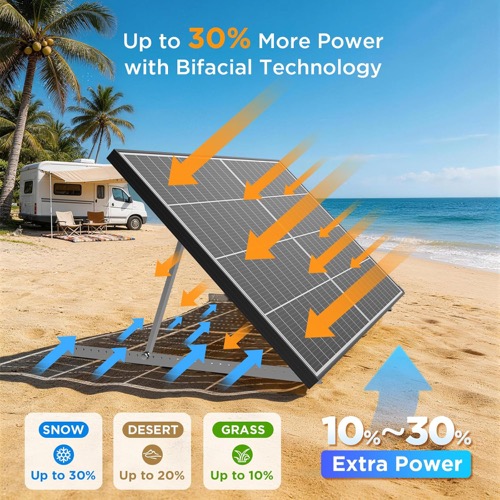
Practical Tip — For the biggest bifacial payoff, mount these with an air gap behind the glass and over a reflective surface — light concrete, gravel, snow, or a pale wall. Flush against a dark RV roof, the second side sees almost nothing, and you’re back to a good-but-ordinary 400W of front-side output.
Two Panels, One N-Type 16BB Build
First thing owners mention is the build feel. The frame is corrosion-resistant aluminum in black — several buyers say they prefer the look over the usual silver — wrapped around a 3.8mm tempered glass front. At 23.8 lb per panel, each one has a reassuring heft that says permanent install, not weekend trip.
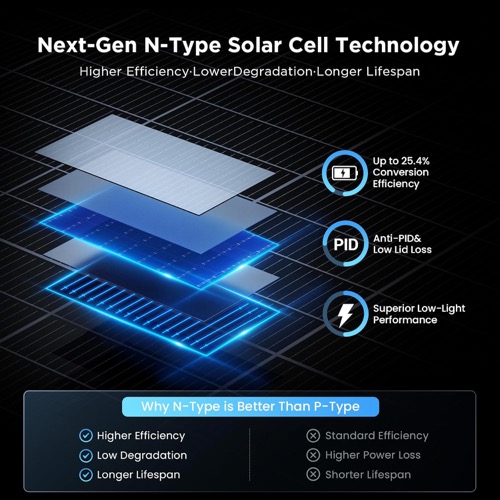
Cells are where the real story lives. N-type monocrystalline with a 16-busbar layout cuts down on hot spots and hidden cracks, and the transparent bifacial backsheet is what sets this kit apart from a standard rigid panel. Instead of an opaque back, light passes through and bounces off whatever’s behind the glass. Pre-drilled holes on the back make bolting to rail mounts straightforward.
Durability shows up in the field, not just the spec sheet. One owner had a 40mph gust toss a panel into a steel propane tank before they could grab it — the damage was a paint scuff off the tank, not a crack in the glass. Packaging draws praise too: thick foam on corners, sides, and backs means panels arrive intact even two to a box.
Tempered Glass, IP68, and Years Outdoors
Weatherproofing is where this kit earns real trust. The junction box carries an IP68 rating — the sealed end of the scale — the frame is corrosion-resistant aluminum, and the front is 3.8mm tempered glass. This is a panel engineered to sit outside full-time, which is exactly what the 25-year performance commitment implies.
Owner feedback backs the marketing rather than fighting it. The propane-tank gust story is the standout — a panel took a hard hit and shrugged it off — and buyers routinely note zero shipping damage even when panels double up in one box. For a heavy glass panel, that’s reassuring.
That low -0.3%/K temperature coefficient matters for hot climates too. It won’t fully stop heat derating — that Texas owner still saw a peak dip at 92°F — but it keeps the loss to a slice rather than a chunk, so summer output stays dependable.
| Feature | This Panel | What It Means Outdoors |
|---|---|---|
| IP rating | IP68 junction box | Sealed against dust and water — built for permanent mounting |
| Frame material | Corrosion-resistant aluminum | Resists rust and won’t warp in heat; adds solid heft |
| Panel surface | 3.8mm tempered glass | Impact-resistant front; survived a 40mph gust impact per owner |
| Rear surface | Transparent bifacial backsheet | Harvests reflected light; needs air gap to work |
| Temperature coefficient | -0.3%/K (185°F upper rating) | Low loss in heat; small peak dip in still, hot air |
| Long-term owner reports | Durable, no damage in transit or use | Owners buy repeat sets; built for the long haul |
Long-Term Ownership — Callsun’s 25-year performance commitment promises at least 84.5% output after 25 years, plus 10 years of technical support. N-type cells degrade slowly, and on a glass-and-aluminum panel the frame and junction box outlast most failure points. Keep the glass clean and the wiring dry and this array should still be pulling strong watts a decade or two out.
The 25-Year Promise and What Backs It
There aren’t specific third-party safety certifications called out for this kit beyond the manufacturer’s own specs, which is common in this segment. For charging a power station — which has its own protection circuitry — that’s lower stakes. Wiring directly to a 12V bank puts more weight on the MPPT controller you add, so pick a reputable one.
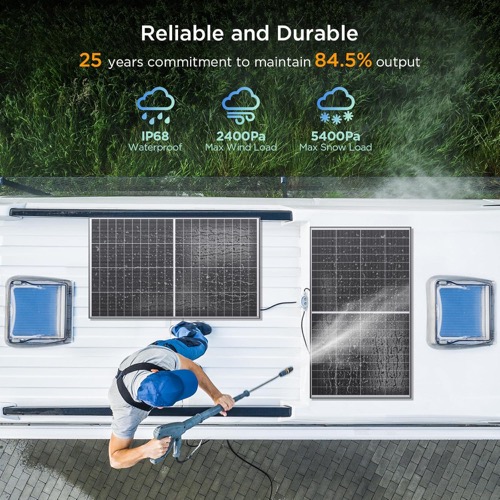
Warranty is a genuine strength. Callsun backs the panels with 10 years of technical support and a 25-year performance commitment holding at least 84.5% output after a quarter century. For buyers planning a permanent off-grid system, that long horizon is worth more than a short return window.
On safety incidents, owner feedback is calm — no reports of melting junction boxes or cracking in normal use. The main heat-related story is performance, not danger: peak output dips a little in still, hot air, then recovers as the panel cools.
Worth Knowing — An IP68 junction box is the sealed end of the rating scale, well above the IP65 or IP67 you’ll see on many camera and trickle panels. Combined with tempered glass and an aluminum frame, this is hardware meant to live outside for decades, not a fair-weather panel you bring in before a storm.
Callsun 400W pair: Decision Snapshot
| Spec | Value |
|---|---|
| Max Power Output | 400 W total (2× 200 W, N-type monocrystalline) |
| Output Voltage | 27.31 V DC open circuit per panel (~54.6 V in series) |
| Connector | Solar connector (MC4-style) — no controller included |
| Cell Efficiency | 25% (up to 30% bifacial rear gain, placement dependent) |
| Weatherproof Rating | IP68 junction box, aluminum frame, tempered glass |
| Charge Controller | None — direct output |
| Cable Length | Not specified (most find leads adequate for series wiring) |
| Mount Type | Pre-drilled holes for rail mounts (no bracket) |
| Best For | Ground-mount or rooftop off-grid charging of 60V power stations |
Callsun 400W Bifacial Solar Panel Review: The Two-Sided Verdict
If you want a 400W array that reliably beats its rating and lasts for years outdoors, the Callsun 400W bifacial solar panel is one of the easiest picks in this class. In good sun the pair pushes past 400W — owners report 420W and higher — the build is genuinely tough, and the 54V-in-series voltage slots neatly under most 60V power-station input caps. Just know going in: these are heavy rigid glass panels with no controller or bracket in the box, and the headline bifacial bonus only shows up when you mount them with an air gap over a reflective surface — not flush against a dark roof.
Is a Bifacial 400W Array Worth It?
For most off-grid and power-station buyers, this Callsun 400W bifacial solar panel review lands in a confident place: it’s one of the best-performing 400W kits in its class, regularly beating its rating with real 420W-plus output, wrapped in a build tough enough to survive a wind-thrown impact. The bifacial rear side is a genuine bonus when you mount it right, the 54V-in-series voltage fits popular 60V stations, and the 25-year commitment backs the long game. Those are real wins.
Trade-offs are just as clear. These are heavy, rigid glass panels with no controller or bracket in the box, the bifacial payoff shrinks to nothing flush against a dark roof, and hot, still air trims a little off the peak. So here’s the if/then: if you’re building a ground-mount or rooftop off-grid setup with room to place these well, the Callsun 400W bifacial solar panel is an easy recommendation. If you need something light and portable, or a plug-and-play battery kit out of the box, look at a folding panel or a full solar generator kit instead.
Pros & Cons Analysis
Based on documented specifications and owner feedback
Pros
- Consistently over-produces its rating — this is the headline theme. Owners report a real 420W peak from the pair leaning against a garage wall, 461.9W in series in the afternoon heat, and per-panel numbers well past 200W when the sun and angle line up. The bifacial rear-side harvest is doing real work here.
- Bifacial rear glass adds free watts on the ground — the transparent backsheet pulls in reflected and diffuse light off concrete, gravel, snow, and light-colored walls. Owners ground-mounting these on a driveway or leaning them against a house catch the biggest bonus.
- Genuinely solid build — tempered glass, a corrosion-resistant aluminum frame, and thick corner foam in the box. One owner had a 40mph gust throw a panel into a steel propane tank and walked away with nothing but a paint scuff. Several mention the black frame looks sharper than the usual silver.
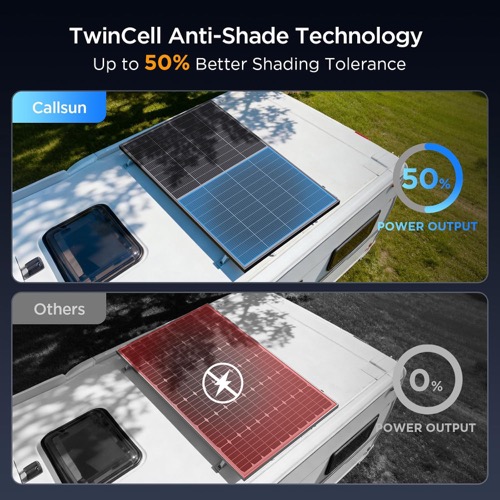
- TwinCell anti-shade split design — each panel is split into two independent halves, so a shadow across one section doesn't zero out the whole panel. Owners with partial tree or building shade note output holds up better than on conventional panels.
- Built around the 60V portable-power sweet spot — buyers pairing these with a Bluetti Elite 400, EcoFlow Delta 2, Dabbsson 2K, or Pecron unit love that two panels land near 54V in series, sitting just under common 60V solar input caps.
- Charges even on partly cloudy days — a recurring note is that output stays useful when the sky goes gray, keeping batteries topped rather than dropping to nothing. Owners in cloudier setups still report daily full charges.
- N-Type 16BB cells and 25% efficiency — the higher-grade N-type cells and 16-busbar layout reduce hot spots and squeeze more power out of the same footprint, which is why owners keep beating the label on sunny days.
- Strong watts-per-dollar and packaging — buyers repeatedly call the price great and note panels arrive undamaged even when two ship in one box, thanks to heavy foam on the corners, sides, and backs. Many come back to buy a second or third set.
Cons
- Heat still trims the top end — one Texas owner running clear skies at 92°F measured 7.1A instead of the rated 8.43A and landed around 380W rather than a full 400. The -0.3%/K coefficient is low, but scorching still, mid-afternoon air will shave a slice off peak output.
- The rear gain depends entirely on placement — flush-mount these tight to a dark RV roof and the second side sees almost nothing. The 30% figure is a best-case ground-mount number, not something you get bolted flat to a van.
- Heavy, rigid glass panels — at 23.8 lb each, the pair is close to 48 lb of glass and aluminum. These aren't fold-and-go camping panels; they're meant to be mounted or set down and left, and they need two hands and a real mounting surface.
- Still a rigid panel — plan your shade — the split design softens partial shading, but heavy or moving shade over both halves still knocks output down hard. It buys tolerance, not immunity.
- You have to mind the input limits — several owners describe careful series-and-parallel math to stay under both the 60V and the 20-25A window on their station, and one hit a 500W solar-input ceiling that briefly paused charging. Bigger arrays take planning.
- No charge controller or battery cables included — the box is two panels and nothing else. To wire straight to a 12V battery bank you supply your own MPPT controller and cabling; there's no plug-and-play battery kit here.
- Cable length splits opinions — most owners say the leads are plenty long for series wiring with spacing, but the complaint shows up often enough in the market that you should confirm your run length and budget for an extension if panels sit far apart.
- Price bounces around — owners planning to scale up mention the cost swings on Amazon, so the deal you see today may not hold when you go back for panels three and four.
Bottom Line: A Flexible Two-Panel Array, Not a Portable Slab
Callsun's reviewed 400W offer is two rigid 200W bifacial panels. The format provides configuration flexibility and a rear-side opportunity, but the buyer must verify both labels and calculate series voltage or parallel current before connection.
Frequently Asked Questions
Is this one 400W panel?
No. The reviewed offer contains two rigid 200W bifacial panels for 400W total nameplate power.
Can I connect the two panels in series?
Only when cold-corrected combined Voc stays below the receiver ceiling and operating voltage is in range.
Can they be connected in parallel?
Potentially, but combined current, connector, branch protection, conductor, and controller limits must be checked.
Will bifacial output exceed 400W?
Rear light can add output in favorable placement, but no fixed bonus is guaranteed. Size the design from documented front ratings.
Will the pair charge a power station?
Only if the chosen series or parallel configuration fits the exact station's voltage, current, watts, connector, and polarity.
Technical Specifications
| Brand | Callsun |
|---|---|
| Model / SKU | DB200W two-panel offer (ASIN B0DC6T55ZK) |
| Panel format | Two rigid bifacial panels |
| Rated output (Pmax) | 400W total; 200W per panel |
| Cell technology | N-Type 16BB bifacial monocrystalline |
| Module efficiency | — |
| Voltage at maximum power (Vmp) | 23.74V per panel |
| Current at maximum power (Imp) | — |
| Open-circuit voltage (Voc) | 27.31V per panel |
| Short-circuit current (Isc) | — |
| Power tolerance | — |
| Maximum system voltage | — |
| Maximum series fuse | — |
| Output connector | MC4-compatible solar connectors |
| Output cable | — |
| Deployed dimensions | 51.3 × 30.3 × 1.4 in per panel |
| Folded dimensions | — |
| Weight | 23.8 lb per panel |
| Surface and frame | Tempered glass with anodized aluminum frame |
| Positioning / mounting | Framed mounting holes |
| Environmental protection | IP68 junction box |
| Wind / snow load | — |
| Operating temperature | — |
| Included accessories | Two 200W bifacial panels |
| Product warranty | 25-year performance term; product term — |