EcoFlow DELTA 2 Max Review: Runtime, Charging and Backup Limits
At a Glance
KEY FEATURES
- 2,048Wh LFP battery; 3,000-cycle rating to 80% capacity.
- 2,400W combined rated AC output; 4,800W surge is not continuous power.
- Two solar inputs, each 11–60V / 15A / 500W; 1,000W combined.
- US AC charging up to 1,800W, with an adjustable custom rate.
- 23kg / 50.7lb; two 100W USB-C ports and a shared 126W DC output budget.
- Up to 6,144Wh with two compatible extra batteries; AC timeout and EPS behavior need configuration.
PROS
- 2,048Wh LFP battery and 2,400W output cover many household and RV loads.
- Dual 500W solar inputs allow up to 1,000W from correctly matched arrays.
- App-adjustable charging speed helps balance recovery time, circuit demand, and noise.
- Expandable to 6,144Wh with two compatible extra batteries.
CONS
- About 51 lb and rear-facing connections complicate frequent movement and cabinet installation.
- Fast charging and heavy loads can make cooling fans noticeable.
- EPS/pass-through behavior should be tested before assigning critical unattended loads.
- Expansion adds runtime but also cost, cables, and stationary bulk.
Editor's Choice
Based on exact documentation and qualitative exact-ASIN owner evidence; no hands-on test or population-rate claim
⚡ Can the EcoFlow DELTA 2 Max Run It?
Choose a common device and see the estimated runtime, whether the inverter can handle it, and how long the power station may take to recharge.
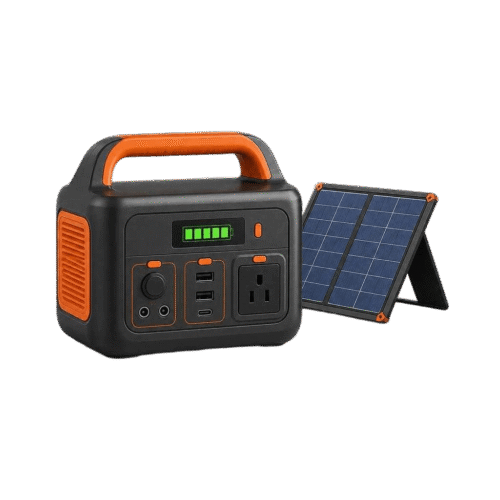
The EcoFlow DELTA 2 Max is a 2,048Wh power station whose strongest argument is recovery flexibility: adjustable AC charging, two solar inputs and compatible extra batteries. The harder buying question is whether its output settings and recharge plan suit your actual outage routine. This review covers the US EFD350 offer, ASIN B0C4DW17PD, using manufacturer documentation and genuine customer accounts—not our own hands-on testing.
It belongs in the 2,000W-class power-station shortlist when you need appliance-capable output without moving to a large wheeled system. Its 2,400W inverter does not make the 2,048Wh battery an all-day source for every appliance connected to it.
Refrigerator reports are useful only with their conditions
Owner experiences support refrigeration as a plausible job, but not one universal runtime. Compressor cycling, room temperature, door opening, the starting charge and other connected loads change the result. A test that ends when utility power returns is not a battery-to-empty measurement.
| Customer account | What it establishes | What it cannot establish |
|---|---|---|
| A freezer remained powered during a reported 15-hour outage. | An example of useful outage coverage. | The maximum freezer runtime: the outage ended first. |
| A refrigerator owner reported 29 hours with about 10% charge remaining. | A result for that refrigerator and household routine. | A promise for a different refrigerator, climate or mixed load. |
| Another owner initially reported a long refrigerator test, then later described an inverter fault and a prolonged replacement problem. | Initial success and later service experience are separate parts of ownership. | A failure rate for all DELTA 2 Max units. |
For your own estimate, start with measured daily watt-hours rather than the appliance’s maximum watts. Our refrigerator backup guide explains that distinction; the runtime planning guide covers conversion losses and reserve. Treat any calculated result as a planning estimate until the actual load has completed a representative cycle.
Three power numbers that should not be interchanged
The rated combined inverter output on battery. Check the total of simultaneous loads and each motor’s startup demand.
A starting-power specification, not permission to run a 4,800W appliance continuously.
A mode for selected compatible appliances, not an increase in rated continuous output. EcoFlow excludes strict-voltage equipment and disables X-Boost in bypass operation.
Household wiring is a separate installation question. Do not connect the station to a wall outlet to feed a home circuit. Any transfer equipment, furnace connection or grounding arrangement needs the applicable manufacturer’s instructions and a qualified installer; an owner’s improvised adapter is not an installation method.
Backup controls matter as much as battery size
EcoFlow’s current DELTA 2 Max web manual lists EPS transfer within 20ms. An earlier regional manual lists 30ms. Confirm the documentation applicable to your delivered unit and firmware; neither figure describes a zero-transfer online UPS.
The current manual specifically warns that intermittent loads such as refrigerators can trigger an AC timeout, and directs users to select “Never” for the AC timeout in the app when needed. Customer complaints about output settings and restoration behavior make that a practical check, not a reason to assume every unit will fail. The distinction between EPS backup and a dedicated UPS is especially important for unattended equipment.
- Record the configuration. Keep the firmware version, charge limits and timeout settings with your appliance’s requirements.
- Observe a complete load cycle. Include the quiet interval between compressor starts, not just the initial switch-on.
- Check loss and restoration. On a noncritical, compatible test load, confirm operation when utility power disappears and returns. Follow the manuals and remain present.
- Recheck after changes. A new firmware version, appliance or charge setting can change the setup you originally verified.
This is not a recommendation for life-critical backup. If you are considering a CPAP power arrangement, obtain the device maker’s and clinician’s guidance, use an approved power path and maintain an appropriate backup plan. A customer reporting CPAP use does not establish medical compatibility or a safe number of nights.
Choose the charging route before adding capacity
Fast AC input is valuable when a short utility or generator window is available. The US manual lists up to 1,800W AC charging, with the custom rate adjustable through the app. Share the circuit sensibly: the available supply and other connected loads still matter. Charging taper, battery temperature and the selected limit prevent one fixed recharge time from describing every situation.
| Route | Documented boundary | Buying implication |
|---|---|---|
| Solar | Two inputs, each 11–60V, 15A and 500W; 1,000W combined maximum. | Check voltage, current, cold-weather margin and the approved array separately for each input. |
| Vehicle | 12V/24V input; 8A default current. | A recovery option during driving, not a substitute for high-rate AC charging. |
| Extra batteries | Up to two compatible batteries; 6,144Wh total system capacity. | More stored energy also means more energy to replace. Expansion does not increase the base inverter’s rating. |
The solar connection uses the appropriate XT60/XT60i charging cable; MC4 describes the common panel-side connection, not the station socket. The current manual lists solar panels and their charging cables separately. An owner complaint about missing solar cables is therefore a reason to verify the exact package before checkout, not proof that every delivery is incomplete.
One outage account describes several days of use with a gasoline generator recharging the station. That supports a combined recovery strategy; it does not show that the battery lasted several days on one charge. Decide whether solar is your main energy source or a daytime supplement before spending on expansion.
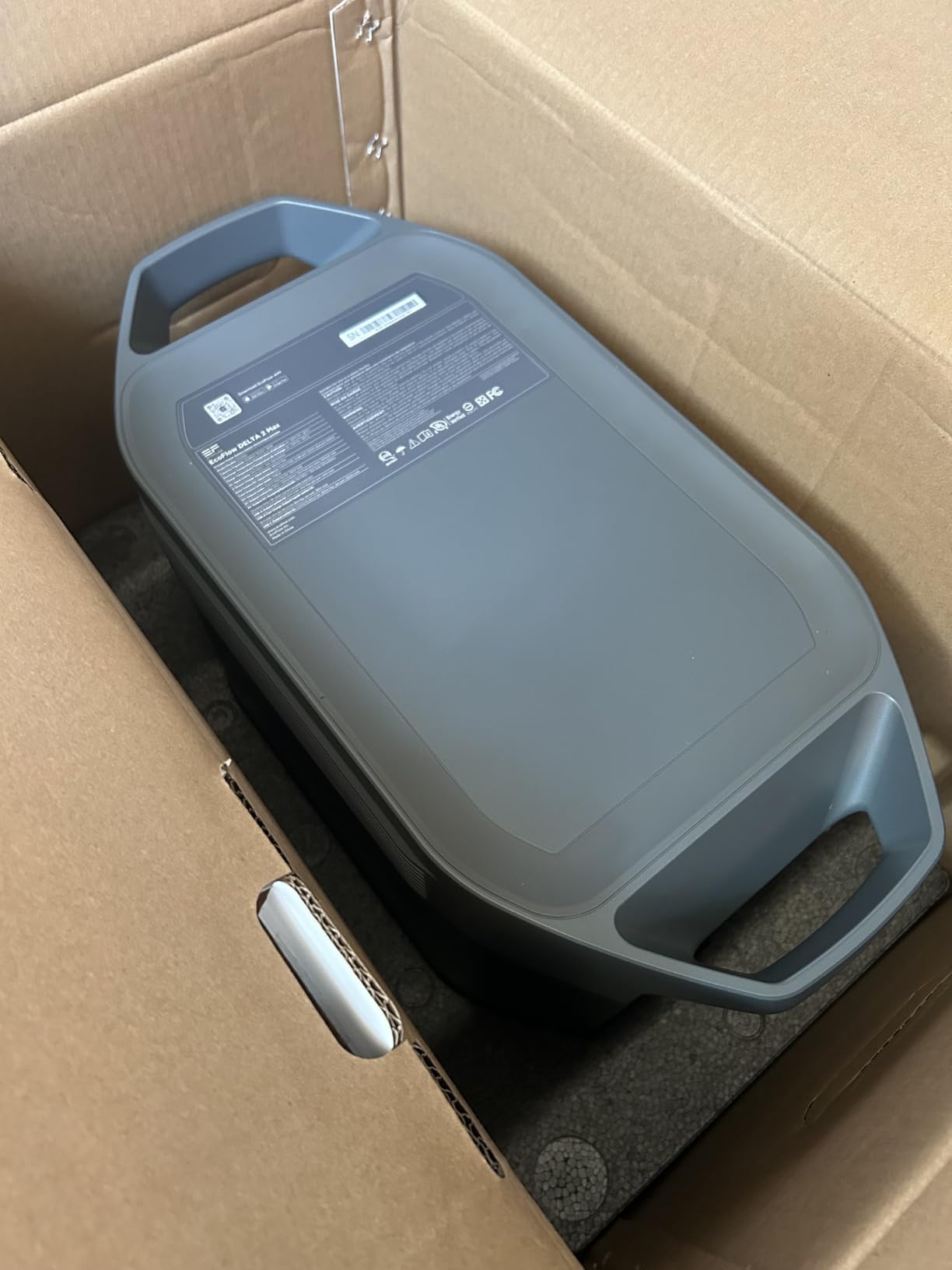
The handles help; the 50.7-pound lift remains
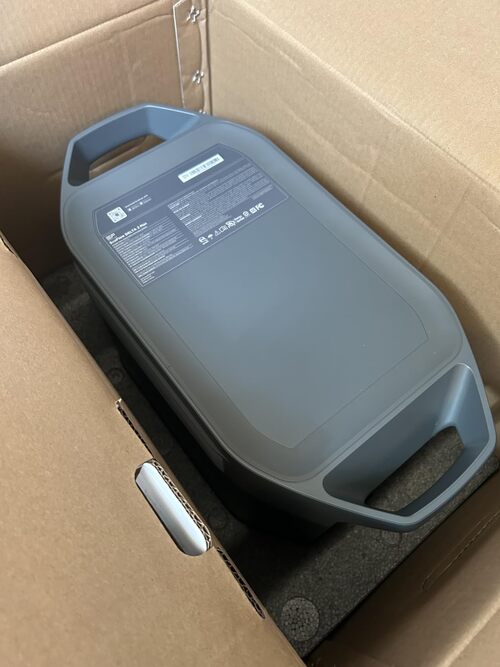
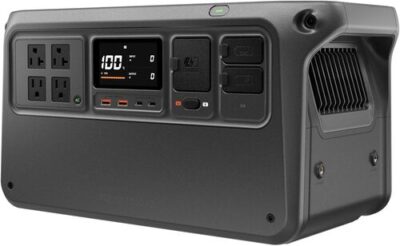
The 23kg station is movable, but stairs, shelf height and car loading deserve a trial before you rely on it. Allow room for rear connections and unobstructed cooling. Keep the station dry; a portable solar setup does not make its receiving battery an outdoor weatherproof installation.
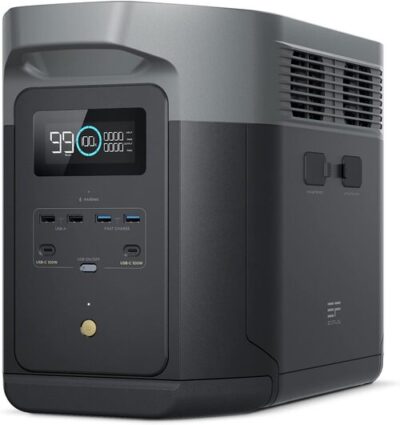
For smaller equipment, the two USB-C ports each support up to 100W. The car outlet and two DC5521 outlets share a 126W total limit, so their individual labels must not be added together as independent budgets. Direct DC or USB operation is useful only when the appliance supports the exact voltage, connector and protocol.
Buy the charging flexibility, not a promise of unattended continuity
The DELTA 2 Max is a strong candidate for measured refrigeration and household essentials when its weight is manageable and you have a dependable recharge route. Its adjustable charging, dual solar inputs and expansion options make the system adaptable. Compare those priorities—not just the battery headline—in our Jackery versus EcoFlow comparison.
Owner reports include both successful outage service and hardware or replacement difficulties. They justify saving serial numbers, settings and test records, but cannot establish a population-wide reliability rate. Use the return window to validate your own load and recovery plan rather than storing the unopened station for the next emergency.
Pros & Cons Analysis
Based on documented specifications and owner feedback
Pros
- Balanced 2kWh platform — The battery is large enough for meaningful refrigeration and outage work while remaining smaller than trolley-class home-backup stations.
- Appliance-capable inverter — The 2,400W continuous rating covers many kitchen, workshop, RV, and household devices once startup behavior is confirmed.
- Two useful solar channels — Independent 500W inputs support two compatible arrays or orientations and make partial-shade planning more flexible.
- Charge behavior is configurable — The app can trade recharge time for quieter cooling and lower branch-circuit demand rather than locking every user into one mode.
- Expansion protects the initial purchase — Owners can add runtime later without replacing the base inverter and control platform.
Cons
- The app carries real responsibility — Charge limits, input rates, firmware, and output behavior are easier to manage digitally, so configuration records matter.
- Weight is between portable and installed — The side handles help, but stairs and repeated car loading can make a cart or two-person lift more realistic.
- Cooling can conflict with quiet rooms — Owner accounts make clear that fast input and demanding AC output are different acoustically from light standby service.
- Backup is not identical to a dedicated UPS — Sensitive computing or medical applications still need an exact transfer and recovery test, and sometimes a purpose-built UPS.
- Service anecdotes run both ways — Preserve serials, logs, app screenshots, and load details so a support case is specific rather than interpretive.
A Flexible Recharge Platform That Still Needs a Backup Plan
The DELTA 2 Max earns its place through adjustable charging and a useful balance of storage and appliance output. Choose it when the 23kg lift is manageable, your load has been measured and your recharge route is dependable.
For unattended backup, the purchase also depends on timeout settings, transfer compatibility and restoration behavior. Critical equipment needs an appropriate backup architecture, not a runtime promise inferred from another owner’s refrigerator.
Frequently Asked Questions
How long will the DELTA 2 Max run a refrigerator?
There is no verified universal runtime. Owners report different results, including a 15-hour freezer outage and a 29-hour refrigerator account with reserve remaining. Those are individual conditions, not promises. Measure your refrigerator’s daily watt-hours, allow for losses and reserve, and verify a complete operating cycle.
Is DELTA 2 Max a zero-interruption UPS?
No. The current EcoFlow web manual lists EPS transfer within 20ms, while an earlier regional manual lists 30ms. Confirm the documentation for your unit and firmware, and test compatible noncritical equipment. US pass-through also has a separate 15A limit, with operation above 12A restricted to less than three hours.
Why might AC output switch off between refrigerator cycles?
The manual warns that intermittent loads can trigger AC timeout. Check the app’s AC timeout and select Never where the manual calls for it, then verify the complete cycle and remaining battery reserve. A different fault still needs diagnosis rather than repeated resets.
Can X-Boost supply 3,400W continuously?
It does not raise the rated 2,400W continuous inverter output. EcoFlow describes compatibility with selected higher-rated appliances in X-Boost mode, excludes strict-voltage equipment and does not support this mode during bypass operation.
Which solar panels and cable does it need?
Each solar input is limited to 11–60V, 15A and 500W, with 1,000W combined. Confirm the approved array, cold-weather voltage margin and XT60/XT60i charging cable. The current manual lists panels and solar charging cables separately.
Can it power a CPAP overnight?
Do not infer medical compatibility or a safe runtime from battery size or owner anecdotes. Follow the CPAP maker’s approved power requirements and clinician guidance, account for humidifier and heated-hose settings, and retain a suitable backup plan. It is not a recommendation for life-critical equipment.
Does adding batteries increase appliance power?
No. Up to two compatible extra batteries increase total stored energy to 6,144Wh, but do not increase the base station’s rated inverter output. They also increase recharge demand, bulk and cost.
Technical Specifications
| Brand | EF ECOFLOW |
|---|---|
| Model / SKU | DELTA2 Max / EFD350 (ASIN: B0C4DW17PD) |
| Battery capacity | 2048 Wh |
| Battery chemistry | LiFePO4 (LFP) |
| Cycle-life rating | 3000 cycles to 80% capacity |
| Expandable capacity | Yes — supports up to 2 expansion batteries (up to 6144 Wh total) |
| Continuous AC output | 2400 W continuous |
| Surge / peak output | 4800 W starting wattage (3400 W via X-Boost for some high-wattage appliances) |
| AC voltage, frequency, and waveform | US: 120V, 50/60Hz, pure sine wave |
| AC outlets | 6 × 120V AC outlets |
| High-current, RV, or 240V output | No dedicated RV, 30A, 240V, or other high-current AC outlet published for this exact model |
| USB-C outputs | 2 × USB-C, up to 100W each |
| USB-A outputs | 2 × 12W USB-A and 2 × 18W fast-charge USB-A |
| 12V / DC outputs | Car outlet: 12.6V / 10A / 126W; 2 × DC5521: 12.6V / 3A / 38W each; all DC outlets share 126W total |
| Maximum solar input | 1000 W (dual 500 W inputs; XT60i / MC4 adapter setup may be needed) |
| Solar input range and connector | Two XT60/XT60i charging connections; each input 11–60V, 15A, 500W. Use the approved panel cable and array. |
| Maximum AC input | 1800 W (fast AC charging, adjustable in app) |
| AC recharge time | Depends on starting charge, selected input rate, battery temperature and taper; US maximum AC charging input is 1,800W |
| Solar recharge estimate | No fixed field time established; daily input depends on approved array, weather, orientation, receiver taper and concurrent loads |
| UPS / EPS support and transfer time | Current web manual: EPS within 20ms; earlier regional manual: 30ms. Verify documentation for delivered unit/firmware. US bypass: 15A maximum; above 12A for less than three hours. |
| App / connectivity | Yes — EcoFlow app (Wi-Fi / Bluetooth control and monitoring) |
| Operating temperature / weather rating | Charge: 0–45°C; discharge: -10–45°C. Keep dry and ventilated; not a weatherproof outdoor installation. |
| Dimensions | 497 × 242 × 305mm |
| Weight | 23 kg / about 50.7 lb |
| Warranty | 5-year manufacturer warranty |