DJI Power 1000 V2 Review: Fast, Quiet Backup Power for Campers, Drone Pilots, and Short Outages
At a Glance
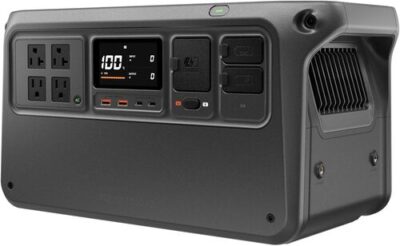
KEY FEATURES
- DJI Power 1000 V2: portable power station / solar generator for camping, RV use, home backup, drone charging, and mobile work
- Battery: 1024Wh, LiFePO4 / LFP chemistry, marketed with a 10-year lifespan
- AC output: 2600W continuous, 2600W listed starting wattage, pure sine wave reported by owners
- Ports: 4 AC outlets, 2 USB-C ports at up to 140W each, USB-A not specified in supplied V2 listing, no built-in 12V car socket
- Recharge: AC 0-80% in 37 minutes, solar input requires optional DJI solar adapter hardware, car charging requires optional DJI adapter
- Smart features: DJI app support, firmware updates, UPS / EPS function with claimed 10ms switchover
- Build: 31.2 lb / 14.14 kg, 19.2 x 8.85 x 9.05 in, black finish, fixed side handles
- Best for: drone creators, weekend camping, RV power, short blackouts, CPAP backup, refrigerators, Starlink, routers, and small appliances
PROS
- 1,024Wh LFP battery with unusually high 2,600W continuous output.
- Fast grid charging and dual 140W USB-C suit creator workflows.
- SDC ecosystem adds drone, vehicle, solar, and expansion options.
- Manageable 31-pound class for a 1kWh station.
CONS
- Useful solar and vehicle routes require exact accessories sold separately.
- Marketplace evidence can mix Power 1000 V2 with adjacent DJI models.
- UPS recovery, firmware, and output auto-off need exact-load testing.
- High inverter output can disguise the limited 1,024Wh energy budget.
Editor's Choice
Based on exact documentation and qualitative exact-ASIN owner evidence; no hands-on test or population-rate claim
⚡ Can the DJI Power 1000 V2 Run It?
Choose a common device and see the estimated runtime, whether the inverter can handle it, and how long the power station may take to recharge.
You’ve probably seen the same spec soup on every power station listing: watts, Wh, UPS, MPPT, USB-C, surge, solar input. After a while, it all blurs together. What matters is whether the thing keeps your fridge cold, your CPAP running, your drone batteries charged, and your work setup alive when the outlet disappears.
The DJI Power 1000 V2 isn’t meant to run a whole house. In practice, it makes the most sense as a quiet, high-output 1kWh battery for weekend camping, RV use, drone shoots, short blackouts, and small-appliance backup. The catch is that DJI leans hard on its accessory ecosystem, especially for solar and 12V use.
The first job in a DJI Power 1000 V2 review is model control. The supplied marketplace file contains some material about adjacent DJI Power products, including Power 2000. Those records were excluded from exact-model conclusions. DJI’s current documentation identifies the V2 as a 1,024Wh LFP station with 2,600W continuous output under the stated conditions, dual 140W USB-C ports, fast grid charging, SDC accessory support, and expansion to a much larger system. That combination is unusually attractive to drone pilots and mobile creators, but only when the required adapters are available and priced into the purchase.
Owner evidence makes accessories, app behavior, charging, noise, shipping condition, and support the main acceptance-test themes. Positive accounts describe rapid charging, manageable size, quiet light-load use, drone support, and short backup duty. Critical accounts describe hard-to-source cables, output state after interruption, firmware or pairing trouble, charging faults, and difficult remedies. These reports point to what should be tested during the return window; they cannot be converted into a defect rate.
| Mission | Why the V2 fits | What to verify |
|---|---|---|
| Drone production day | SDC fast-charge support and dual 140W USB-C | Exact aircraft cable, charge sequence, accessory stock, and daily energy |
| Network or workstation backup | 10ms UPS specification and app controls | Transfer, deep-discharge recovery, auto-off, firmware, and restart state |
| Vehicle-based charging | Optional 1kW and 1.8kW car/solar routes | Alternator capacity, cable route, thermal behavior, and accessory cost |
| High-watt appliance | 2,600W continuous output boundary | Startup, average watts, runtime, reserve, and simultaneous loads |
The 37-minute 0–80% and 56-minute full figures are manufacturer results under defined conditions, not universal wall-clock promises. Ambient temperature, input mode, state of charge, configured rate, and active pass-through loads change the result. Likewise, a 2,600W inverter can run a high-watt device without turning 1,024Wh into a long-duration supply. Measure watt-hours over the real duty cycle and preserve reserve for conversion loss, temperature, and shutdown.
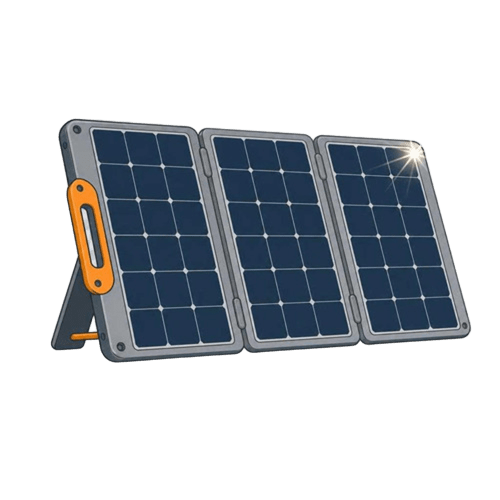
Solar is not a bare-panel connection. The simple route uses DJI’s MPPT adapter, while higher-power solar and vehicle charging use additional SDC hardware. Confirm input limits from the exact manual and accessory, cold-corrected array voltage, connector, polarity, and cable loss. If the accessory bundle becomes expensive or unavailable, a station with integrated conventional solar inputs may be the better system even if its base-unit specifications look less exciting.
Evidence-led verdict: Power 1000 V2 is strongest when rapid AC recovery, high USB-C output, compact 1kWh storage, and DJI-specific charging all matter. It is weaker when the buyer wants a conventional plug-and-play solar path or cannot validate seller region, accessories, firmware, and UPS recovery immediately.
Power 1000 V2: Verify the Model Before the Mission
If you want a quiet, fast-charging power station with more output than most 1kWh units, the DJI Power 1000 V2 works well. For this DJI Power 1000 V2 review, the clearest pattern is simple: owners like the power, the build quality, the charging speed, and the low noise. That said, it’s not the easiest pick if you already own third-party solar panels, need a built-in 12V car socket, or want UPS behavior you never have to think about. It’s best for active use — camping, drones, tools, outages — not silent set-and-forget critical backup.
A 31-Pound Creator Station With Accessory Dependencies
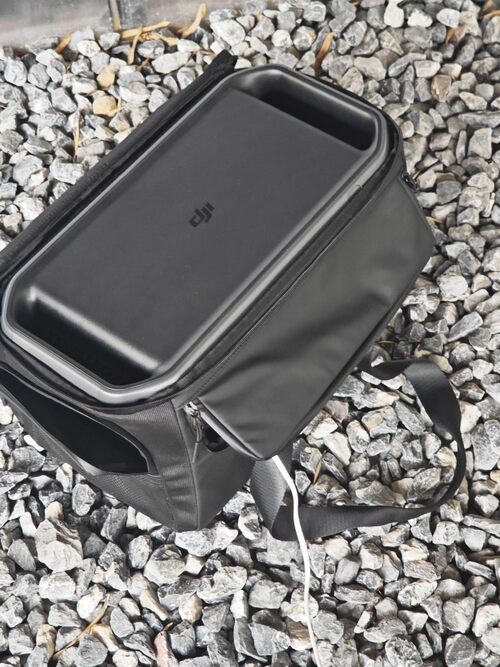
DJI gives this unit a compact, serious-looking shell with fixed side handles and a black finish. At 31.2 lb, it has solid heft without becoming a rolling-cart-only power station. You can move it from garage to car, car to campsite, or office to bedroom, but you won’t want to carry it across a long trail.
In practice, the side handles feel sturdy, though some buyers prefer the simplicity of a single top handle. The shape is easy enough to fit in a trunk, under a desk, or beside an RV cabinet. Still, if you mount optional side accessories, one handle can become less convenient.
The display is one of the nicer everyday touches. Customers like being able to see live input, output, battery percentage, and remaining runtime without guessing. Worth knowing, though: the clean layout doesn’t solve every usability issue, especially when firmware updates or accessory pairing enter the picture.
Buyer Heads-Up — This is portable in the “carry it from the car to the campsite” sense, not the “throw it in a backpack” sense.
One Kilowatt-Hour Across Cameras, Networks, and Appliances
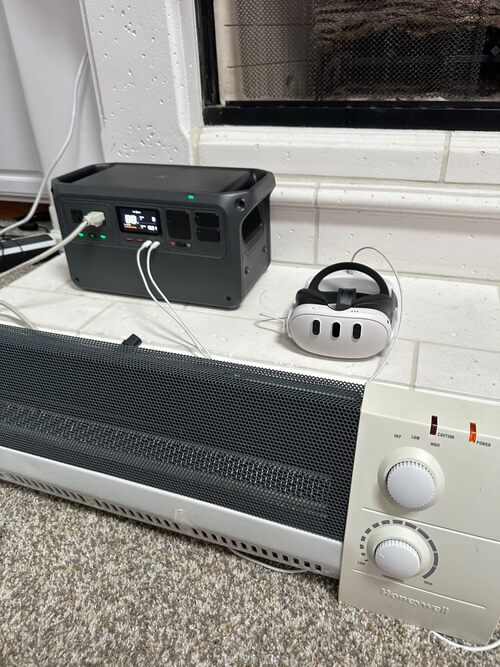
The DJI Power 1000 V2 has a 1024Wh battery. On paper, that sounds like enough for a lot of things, and for smaller loads it really is. In real use, it’s a good match for routers, laptops, CPAP machines, drone batteries, lights, a mini fridge, and short bursts from kitchen appliances.
Here’s the thing: high output does not mean endless runtime. A 1500W kettle, heater, or air fryer can run, but it will chew through this battery quickly. Customers using it for workstations, TVs, Starlink, camera gear, and CPAP backup tend to sound happier than buyers expecting long heavy-appliance runtime.
| Device | Typical Power Draw | Estimated Runtime | Realistic with Margin |
|---|---|---|---|
| Smartphone charging | 10-15Wh per charge | 60-80 charges | 50-65 charges |
| Laptop | 50-80Wh per charge | 10-16 charges | 8-13 charges |
| Wi-Fi router | 10-20W | 42-84 hours | 35-70 hours |
| CPAP machine, no humidifier | 30-60W | 14-28 hours | 11-23 hours |
| CPAP with humidifier | 50-90W | 9-17 hours | 7-14 hours |
| Mini fridge | 40-80W cycling | 10-21 hours | 8-17 hours |
| Full-size refrigerator | 100-200W cycling plus surge | 4-8 hours | 3-6 hours |
| Electric blanket | 50-80W | 10-17 hours | 8-14 hours |
| Drone batteries | 60-100Wh per battery | 8-13 charges | 6-10 charges |
| 1500W kettle or heater | 1500W | About 30 minutes | Brief use only |
Real-World Math — At 0.82 AC efficiency, the listed 1024Wh delivers roughly 839Wh through the AC outlets. Subtract a 10% reserve, and you’re working with about 755Wh of practical AC energy.
That math explains why a fridge, router, laptop, or CPAP feels reasonable, while a space heater feels punishing. In practice, the sweet spot is steady loads under 300W or short bursts from higher-watt appliances.
The 2,600W Rating Needs an Energy Budget
The headline feature is the 2600W output. That’s a lot for a 1024Wh portable power station, and customers report using it with coffee makers, air fryers, heaters, induction-style cooking, freezers, refrigerators, power tools, and even a Bambu Lab printer setup.
On the flip side, output and capacity are different things. The DJI Power 1000 V2 portable power station may handle a big load electrically, but a large heater or kettle can still drain it in under an hour. For short appliance use, it punches above its weight. For long appliance use, you’ll want more battery.
| Device | Typical Draw | This Unit? |
|---|---|---|
| Phone / tablet | 10-25W | Easy |
| Laptop | 50-100W | Easy |
| LED lights | 5-15W each | Easy |
| Wi-Fi router | 10-20W | Easy |
| Starlink Mini | 25-60W | Easy |
| Mini fridge | 40-80W cycling | Easy |
| CPAP, no humidifier | 30-60W | Easy |
| CPAP, humidifier on | 50-90W | Easy |
| Full-size fridge | 100-200W cycling, higher startup surge | Easy, but runtime-limited |
| Drone battery charger | 60-100W | Easy |
| Microwave, 700W class | Around 1100W draw | Briefly only |
| Electric kettle, 1500W | 1500W | Briefly only |
| Hair dryer | 1600-1875W | Briefly only |
| Window AC, 5000 BTU | 500W run, higher startup surge | Borderline |
| Corded power tool | 600W run, higher startup surge | Easy to borderline |
Worth Knowing — Continuous output is the real ceiling. The listed starting wattage here is 2600W, but high-draw appliances still drain the battery fast even when they don’t trip the inverter.
A few owners also report AC output shutting down under certain appliance patterns, especially with cycling loads or after the battery reaches zero. To be fair, many customers run fridges, tools, and coffee makers with no drama. Still, test your exact appliance before trusting it during an outage.
Fast AC Is Built In; Fast DC Is an Ecosystem Choice
AC charging is one of the DJI’s strongest features. The supplied manufacturer documentation states 0-80% in 37 minutes, and customers often describe the wall recharge as one of the main reasons they bought it. How long that charge lasts under load is modeled in our station runtime estimation guide.
In practice, that means you can top it off while packing the car, prepping for a storm, or getting ready for a shoot.
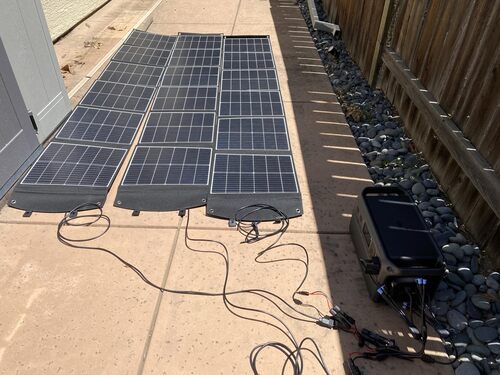
Solar is less straightforward. The DJI Power 1000 V2 solar generator can use solar, but buyers repeatedly point out that you need DJI adapter hardware. Some users also mention heat and sustained-input limits with the solar modules, so don’t assume every third-party panel setup will work cleanly on day one.
| Charging Mode | Time, 0% to 100% | Noise Level |
|---|---|---|
| Eco AC mode | About 2-3 hours | Quiet |
| Standard AC | About 1.5-2 hours | Low to moderate |
| Fast AC | About 1-1.2 hours | Noticeable fan under load |
| 0-80% fast AC | 37 minutes claimed | Noticeable fan |
| Car 12V adapter | About 10-13 hours at 80-100W | Silent from the unit |
| 100W solar | About 11-13 hours strong sun | Silent |
| 200W solar | About 5.5-7 hours strong sun | Silent |
| 800W solar setup | About 1.5-2 hours strong sun | Silent, but adapter-dependent |
Adapter Check — Solar charging is not plug-and-play out of the box. If you already own panels, budget for the correct DJI solar adapter and check voltage, amperage, and connector limits before connecting anything.
Car charging is useful, but it’s not as simple as plugging into every vehicle’s 110V outlet. Several owners note that many vehicle AC outlets don’t provide enough power for the DJI’s AC charging requirement. For road trips, the dedicated DJI car-charging accessories matter.
SDC, Dual 140W USB-C, and the Adapter Ledger
Port selection is a mixed bag. You get four AC outlets and two high-power USB-C ports rated up to 140W each, which is excellent for laptops, cameras, tablets, and creator gear. Drone pilots camping off-grid should browse our top camping power station picks. For a drone pilot or mobile filmmaker, those USB-C ports are the kind of feature you end up using daily.
The catch is DC flexibility. Customers often complain that there’s no built-in 12V car socket, and solar or vehicle input leans on DJI’s SDC accessory system. If most of your gear is AC and USB-C, you’ll probably be fine. If your camping setup depends on 12V fridges and common plug-in adapters, you’ll want to price the accessories before buying.
The 26dB Number Describes One Charging Condition
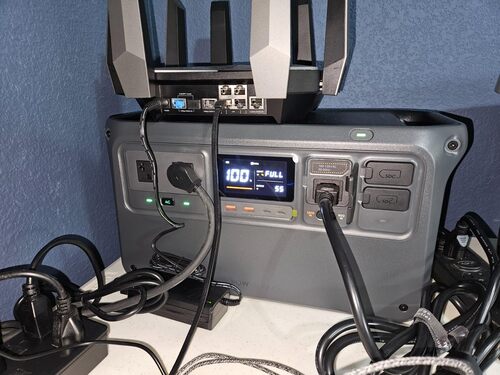
The DJI Power 1000 V2 is quiet under light loads. Owners use it beside workstations, in RVs, in bedrooms, and around camping setups without the constant buzz they associate with some other power stations. Under small loads, the sound profile is more “quiet hum” than generator replacement noise.
That said, fans can become more obvious during fast AC charging or heavier output. A few customers also report heat, odor, or over-temp style errors, so ventilation matters. Don’t stuff it in a sealed cabinet under a heavy load, and don’t assume “quiet” means “heat-free.”
Best Practice — Give the side vents room to breathe, especially during fast charging, solar charging, or high-watt appliance use.
Firmware, Auto-Off, and UPS Recovery Must Be Commissioned
The screen is clear, practical, and easy to understand. You can see battery percentage, live input, live output, and remaining time, which helps avoid the dead-battery loop. In practice, that makes it easier to decide whether you can keep running the fridge or should save power for the router and phones.
The app is more complicated. Some V2 owners like the DJI app and firmware access, especially compared with the older accessory-dongle complaints around previous units. At the same time, feedback around firmware updates is uneven, with owners mentioning confusing update steps, errors, and accessories that only work properly after an update.
Worth knowing, the DJI 1024Wh LiFePO4 power station feels easy when you use it as a big battery. It feels less simple when you start adding solar modules, SDC cables, vehicle charging hardware, and firmware updates.
LFP Durability With a Five-Year Documentation Check
The DJI Power 1000 V2 uses LiFePO4 chemistry. That’s the right choice for a power station meant for frequent charging, daily-ish use, and long ownership. LFP batteries are usually heavier than older lithium-ion packs, but they’re favored for thermal stability and cycle life.
DJI markets this unit with a 10-year lifespan and backs the product listing with a 5-year warranty. In real customer experiences, support feedback is split. Some owners describe helpful returns, refunds, and replacements, while others complain about slow communication, confusing repair status, or warranty-region problems.
Long-Term Ownership — A 10-year LFP lifespan claim is useful only if the electronics, firmware, and support experience hold up. Battery chemistry is strong here, but reliability reports are not perfectly clean.
Safety deserves a plain warning. A few customers report overheating, electrical smells, smoke-like odor, error codes, or units that shut down unexpectedly. Most owners do not describe those problems, but they’re serious enough that you should not ignore odd smells, repeated errors, or heat behavior.
Best Practice — For storage, leave the unit around 50-80% charge and top it off every few months. LiFePO4 is forgiving, but storing any battery at 0% or 100% for long periods is not ideal.
DJI Power 1000 V2 Mission Matrix
| Use Case | Fit | Why |
|---|---|---|
| Weekend car camping | Strong fit | Quiet, compact for its output, and enough capacity for lights, fridge, phones, and small appliances |
| RV side-trip / van life | Solid fit | Good output and quiet operation, but 12V and solar accessories matter |
| Home blackouts under 8 hours | Strong fit | Works well for router, Starlink, laptops, CPAP, lights, and short refrigerator support |
| Multi-day off-grid cabin | With caveats | Needs solar, expansion, or careful load management |
| CPAP overnight backup | Strong fit | Good capacity for overnight use, especially with efficient DC or USB-C conversion |
| Refrigerator backup | Solid fit | Strong inverter support, but limited runtime for long outages |
| Jobsite power tools | Solid fit | High output helps, though battery size limits heavy all-day tool use |
| Quiet bedroom UPS | With caveats | Quiet under light loads, but UPS reliability feedback is mixed |
| Hurricane / multi-day outage | Borderline | Useful as part of a system, not enough alone for multi-day home backup |
| Tailgating / outdoor events | Strong fit | Plenty of AC output, fast recharge, and manageable car-to-table portability |
| Backpacking / lightweight EDC | Skip | Too heavy for long carry or pack use |
| Apartment without solar access | Solid fit | Fast AC charging makes it practical even without panels |
Choose the V2 When the DJI Ecosystem Pays Back
- A quiet 1024Wh battery for camping, RVs, and short outages
- Fast AC charging for storm prep or last-minute trips
- A strong inverter for coffee makers, tools, fridges, and creator gear
- DJI drone fast-charging support in the field
- High-power USB-C ports for laptops and cameras
Choose a More Conventional Platform When
- Built-in 12V output without buying accessories
- Simple third-party solar panel compatibility out of the box
- A proven always-on UPS for critical gear
- Multi-day blackout backup from one battery
- A sub-20 lb power station
Pros & Cons Analysis
Based on documented specifications and owner feedback
Pros
- Creator workflow is a real differentiator — Dual 140W USB-C and supported SDC drone charging can reduce the number of separate chargers and conversion stages in a field kit.
- Fast wall recovery — The documented recharge profile makes short turnarounds plausible when temperature, input settings, and the electrical circuit permit.
- Useful output headroom — The 2,600W boundary accommodates many short high-draw tasks that smaller 1kWh stations reject.
- Expansion can change its role — Supported batteries allow the same control platform to move from mobile work toward longer backup.
- Owner missions are broad — Exact-model accounts support creator, camping, electronics, appliance, and short-outage scenarios.
Cons
- Accessory planning is unavoidable — Solar, rapid vehicle charging, drone batteries, and expansion each depend on the correct SDC or MPPT hardware.
- Identity errors are unusually costly — Power 1000, Power 1000 V2, Power 1000 Mini, and Power 2000 do not share every limit or accessory assumption.
- Software behavior carries responsibility — App pairing, firmware, auto-off, output state, and recovery should be documented before unattended use.
- Service evidence points both ways — Preserve seller, region, serial, logs, and shipping records so a remedy request is model-specific.
- Capacity still governs runtime — The inverter can accept large loads that consume a 1,024Wh battery quickly after reserve and conversion loss.
Our Verdict
The main takeaway from this DJI Power 1000 V2 review is that DJI built a powerful, quiet, fast-charging 1kWh station with a few frustrating choices around accessories and reliability. It's genuinely useful for drone owners, campers, RV travelers, mobile workers, and anyone who wants short-outage backup without fumes or engine noise.
Buy it if you value high output, quick AC recharge, quiet operation, and DJI ecosystem support. That said, don't buy it blindly as a critical UPS or simple solar-first system unless you're ready to test your setup and buy the right adapters. Different tool, different job — and this one works best when you actually use it, not when you expect it to disappear in the background forever.
Frequently Asked Questions
How long will the DJI Power 1000 V2 run a refrigerator?
For a full-size refrigerator, buyers commonly report a few hours of backup depending on compressor cycling, door opening, room temperature, and starting surge. It is better for short outages than whole-day refrigerator backup unless you add solar or extra battery capacity.
Can the DJI Power 1000 V2 run a CPAP overnight?
Yes, it can work well for CPAP backup, especially if you use an efficient DC or USB-C converter. With humidifier and heated tube settings turned up, runtime drops noticeably, so test your exact setup before relying on it overnight.
Can it run a microwave, kettle, coffee maker, or air fryer?
The 2600W output gives it enough headroom for many short high-watt tasks, and customers report using coffee makers, air fryers, kettles, heaters, and induction-style appliances. The catch is runtime: high-watt heat appliances drain a 1024Wh battery fast.
How fast does the DJI Power 1000 V2 recharge from AC power?
The supplied listing claims 0-80% in 37 minutes, and many owners praise the fast wall recharge. Full charging is typically closer to about an hour or a little more, depending on mode, outlet, temperature, and charging limit settings.
Does the DJI Power 1000 V2 solar charge out of the box?
No. Owners repeatedly note that solar charging requires optional DJI adapter hardware. If you already own third-party panels, check connector type, voltage, amperage, and DJI adapter requirements before buying.
Does the UPS mode work reliably?
Feedback is mixed. Some owners use it successfully for routers, Starlink, TVs, game consoles, and computer gear, while others report AC shutdowns, overload errors, or failed switchover behavior. It is useful, but not something to trust blindly with critical medical or business equipment without testing.
Is the DJI Power 1000 V2 quiet enough for indoor use?
Usually, yes. Many customers describe it as very quiet under light loads and good for RVs, offices, and bedrooms. Fan noise becomes more noticeable during fast AC charging or high-watt output.
Is the battery LiFePO4?
Yes. The DJI Power 1000 V2 uses an LFP / LiFePO4 battery, which is generally preferred for long cycle life, thermal stability, and frequent use compared with older lithium-ion chemistry.
Does it have a built-in 12V car socket?
No standard built-in 12V cigarette-lighter output is listed in the supplied V2 specs, and several owners complain that 12V use requires an extra adapter. This matters if you run fridges, pumps, or common camping gear from 12V.
Is the DJI Power 1000 V2 good for drone owners?
Yes, this is one of its strongest use cases. DJI drone owners like the SDC fast-charging support, high-watt USB-C ports, and ability to recharge drone batteries, controllers, laptops, lights, and camera gear in the field.
What are the biggest complaints?
The main complaints are accessory costs, solar not being plug-and-play, missing built-in 12V output, mixed UPS reliability, confusing firmware updates, and some reports of errors, shutdowns, smells, or warranty frustration.
Technical Specifications
| Brand | DJI |
|---|---|
| Model / SKU | DYM1000V2L (ASIN: B0FD9Z5F3S) |
| Battery capacity | 1024 Wh |
| Battery chemistry | LiFePO4 (LFP) |
| Cycle-life rating | Not published for this exact model in the current source set |
| Expandable capacity | Yes |
| Continuous AC output | 2600 W continuous |
| Surge / peak output | 2600 W listed starting wattage (separate peak surge not specified) |
| AC voltage, frequency, and waveform | 110V AC, pure sine wave; frequency not published for this exact model |
| AC outlets | 4 × 110V AC outlets |
| High-current, RV, or 240V output | No dedicated RV, 30A, 240V, or other high-current AC outlet published for this exact model |
| USB-C outputs | 2 × USB-C (140W each, 280W total) |
| USB-A outputs | Not published for this exact model in the current source set |
| 12V / DC outputs | Not included (adapter required for 12V-style output) |
| Maximum solar input | Up to 800 W documented (requires optional DJI solar adapter hardware; not included out of box) |
| Solar input range and connector | Not published for this exact model in the current source set; exact PV voltage/current window and connector are unavailable |
| Maximum AC input | ~1600 W |
| AC recharge time | 0-80% in 37 minutes (full charge commonly reported around 1-1.2 hours in fast mode) |
| Solar recharge estimate | Depends on array size, PV compatibility, sun, temperature, and charge limits; no exact-model time is published |
| UPS / EPS support and transfer time | Yes |
| App / connectivity | Yes |
| Operating temperature / weather rating | Not published for this exact model in the current source set |
| Dimensions | 19.2 x 8.85 x 9.05 in |
| Weight | 31.2 lb (14.14 kg) |
| Warranty | 5-year manufacturer warranty |