Pecron F3000LFP Review: 3kWh Power and Solar Trade-offs
At a Glance
KEY FEATURES
- Storage: 3,072Wh LiFePO4; manufacturer-rated 3,500 cycles to about 80% capacity.
- Standalone AC: Up to 3,600W at 120V; US product page lists 4,500W peak for five seconds.
- Charging: Up to 1,800W AC at 120V or 1,600W solar through one XT60 input.
- USB-C: One 100W port and one 18W port—not two 100W outputs.
- UPS boundary: Loads below 1,800W at 120V; 8–20ms transfer per the US manual.
- Handling: About 63.3 lb; optional expansion and vehicle-charging equipment add to the system.
PROS
- 3,072Wh LFP capacity and 3,600W AC output suit substantial outage and RV loads.
- Up to 1,600W solar input gives a properly designed array useful recovery speed.
- Strong capacity and output per dollar compared with many premium-brand stations.
- Local display and multiple output types cover mixed backup equipment.
CONS
- At roughly 63 lb, routine movement calls for a cart or fixed location.
- Owner accounts flag app setup, fan behavior, idle draw, and input compatibility as commissioning items.
- Expansion and faster vehicle charging require model-specific optional accessories.
- No 240V output for split-phase loads.
Editor's Choice
Based on exact documentation and qualitative exact-ASIN owner evidence; no hands-on test or population-rate claim
⚡ Can the Pecron F3000LFP Run It?
Choose a common device and see the estimated runtime, whether the inverter can handle it, and how long the power station may take to recharge.
The Pecron F3000LFP combines 3,072Wh of battery storage with 3,600W continuous AC output. Its appeal is substantial 120V backup capacity in a roughly 63-pound station; the buying decision turns on your loads, charging arrangement and tolerance for setup work.
This review separates published specifications from owner-reported experiences; it is not a hands-on test. Compare it with other 3,000W-class power stations, then use the power-station sizing calculator to estimate your own energy requirement.
The Pecron F3000LFP is compelling because its current exact-model documentation combines a 3,072Wh LFP battery, 3,600W continuous pure-sine output, a manufacturer-published 4,500W five-second peak allowance, and as much as 1,600W of solar input. That is serious electrical headroom for the price class. It is not evidence that every appliance will start, that every array will reach the ceiling, or that the station will deliver all 3,072Wh through an AC outlet. The sensible purchase test is whether its unusually strong specification sheet compensates for a more hands-on ownership experience.
The supplied owner record supports both sides of that decision. Accounts describe refrigerators, RV air conditioning, office equipment, Starlink, pumps, tools, cooking appliances, and mixed outage loads. Other accounts focus on app pairing, fan activity, low-load solar behavior, generator or charging compatibility, idle consumption, shipping condition, and support. Those reports identify the commissioning work a buyer should perform; they do not establish a failure rate or a guaranteed runtime.
Capacity planning should start with watt-hours, not the 3,600W headline. A 120W average load asks for 960Wh over eight hours before conversion losses and reserve. A 600W average load consumes the same amount in about 1.6 hours. High inverter capacity lets the station start and run demanding devices, but it does not create energy. Owners considering overnight office, CPAP, refrigerator, or communications backup should measure average draw over a full duty cycle and reserve capacity for startup events and battery aging.
| F3000LFP question | Evidence to collect | Pass condition |
|---|---|---|
| Will the array work? | Cold-corrected Voc, operating voltage, array current, connector, polarity | Every value remains inside the exact 25–120V / 25A input envelope |
| Will the load start? | Running watts, measured startup event, other active loads | No overload and acceptable voltage behavior during repeated starts |
| Will UPS use recover? | Transfer event, low-battery shutdown, restoration behavior | Your exact equipment stays on or restarts predictably |
| Is idle use acceptable? | Overnight percentage change with selected outputs enabled | Standby loss fits the stored-energy budget |
Solar design is where this model can outperform smaller stations, but only with a compatible series/parallel plan. Pecron specifies a 25–120V input range and 25A ceiling for the high-power solar input. Calculate cold-corrected open-circuit voltage rather than using panel wattage alone. Partial shade, an array below the MPPT wake-up range, a nearly full battery, hot cells, thin extension cable, or a poor connector can all reduce displayed input. A stable reading below 1,600W may simply reflect the system boundary.
The physical decision is just as important. At about 63 pounds, the F3000LFP is movable but not casual luggage. Assign it a ventilated location close enough to loads to avoid improvised extension-cord tangles, yet protected from weather and vehicle movement. If it will travel between an RV and a home, budget for a cart and a repeatable tie-down method rather than relying on the handles for every move.
Evidence-led verdict: the F3000LFP is a high-value system component for a technically confident buyer. Its case weakens quickly if you want appliance-like simplicity, silent operation under every charge mode, or support that removes the need for careful documentation.
The F3000LFP Value Proposition in One Decision
If you want big backup power for RV trips, outages, and semi-portable solar setups, the Pecron F3000LFP does a lot right. It gives you a large 3072Wh battery, a 3600W inverter, fast wall charging, and one of the more generous solar input limits in this class. Daily panel-to-battery math is in our multi-day off-grid runtime planner.
That said, the Pecron F3000LFP review story is not all sunshine. It’s heavy, the app can be annoying, and the separate car-charging and expansion accessories are worth knowing about before you buy.
A 63-Pound Station Needs a Movement Plan
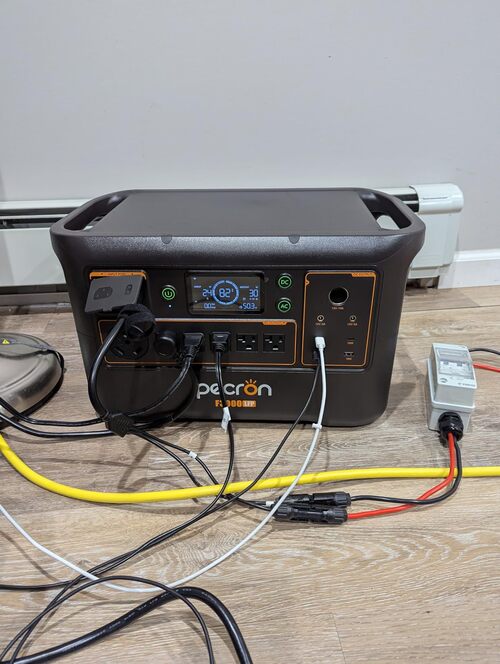
The F3000LFP looks and feels like a serious power station. Owners describe it as compact for its capacity, but nobody should confuse that with lightweight. At 63.3 lb, it has a solid heft that feels reassuring in a garage or RV, but less fun when you’re carrying it across a yard. EcoFlow shoppers at this price point should read our Pecron and EcoFlow capacity-per-dollar analysis.
In real use, this is more “move it from the vehicle to the campsite” than “carry it around all afternoon.” Several buyers mention carts, hand trucks, or the dedicated accessory cart as the smarter way to move it. That’s fair for a 3kWh LiFePO4 battery, but it still matters if you camp solo or have stairs.
Worth knowing, the footprint is actually pretty manageable for the power you get. It can sit on a camper floor, in a truck build, or near a sump pump without eating the whole space. The front-facing port layout also helps because most of the things you plug in are visible at a glance.
Buyer Heads-Up — This is portable in the “has handles and can ride in your vehicle” sense. It is not portable in the “carry it one-handed to a picnic table” sense.
Turn 3,072Wh Into a Load Budget
The F3000LFP has a 3072Wh LiFePO4 battery. Here’s what that means in plain English: it has enough storage for real appliances, not just phones and laptops. In practice, owners are using it for refrigerators, RV power, Starlink, electric blankets, CPAP machines, office gear, sump pumps, and small tools.
That said, runtime depends heavily on what you plug in. A fridge cycles on and off, so it might run far longer than the watt label suggests. A space heater or kettle pulls hard the whole time, so it drains even a big battery quickly.
| Device | Typical Power Draw | Estimated Runtime | Realistic with Margin |
|---|---|---|---|
| Smartphone charging | 10-15Wh per charge | 170-250 charges | About 150-220 charges |
| Laptop charging | 50-80Wh per charge | 32-50 charges | About 28-45 charges |
| Wi-Fi router | 10-20W | 117-235 hours | About 95-190 hours |
| CPAP, no humidifier | 30-60W | 39-78 hours | About 32-65 hours |
| CPAP, humidifier on | 50-90W | 26-47 hours | About 22-40 hours |
| Mini fridge | 40-80W cycling | 29-59 hours | About 24-50 hours |
| Full-size refrigerator | 100-200W cycling | 12-24 hours | About 10-20 hours |
| Electric blanket | 50-80W | 29-47 hours | About 24-40 hours |
| Starlink | 50-100W | 23-47 hours | About 20-40 hours |
| 1500W kettle | 1500W | About 1.5 hours total draw | Brief use only |
Real-World Math — At 0.85 AC efficiency, the listed 3072Wh battery delivers roughly 2611Wh through the AC outlets. Subtract a 10% reserve, and you’re working with about 2350Wh of practical AC runtime.
In practice, the sweet spot is backup power for essentials. Refrigerators, routers, laptops, lights, CPAP machines, Starlink, and small pumps all make sense. On the flip side, anything that turns electricity directly into heat — space heaters, kettles, hair dryers, hot plates — will chew through the battery fast even if the inverter can run it.
The 3,600W Inverter Is Not the Whole Story
The US F3000LFP manual distinguishes standalone output, UPS operation and voltage settings. Its USB and solar limits also apply independently; matching one headline wattage is not enough.
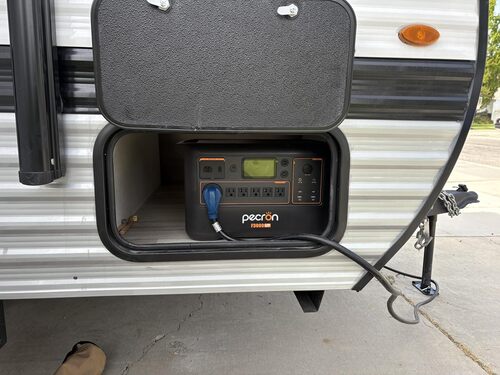
That gives the F3000LFP enough output for much more than basic electronics, and customer feedback lines up with that. Owners mention running RV loads, microwaves, air conditioning for limited sessions, freezers, refrigerators, sump pumps, tools, shop vacs, and e-bike chargers.
PECRON publishes a 4,500W peak allowance for five seconds on its US product page. That is a timed overload claim, not continuous output or a guarantee of motor startup. The US manual rates continuous output at 3,600W with 120V selected, 3,300W at 110V and 3,000W at 100V.
| Device | Typical Draw | This Unit? |
|---|---|---|
| Phone / tablet | 10-25W | Easy |
| Laptop | 50-100W | Easy |
| LED lights | 5-15W each | Easy |
| Wi-Fi router | 10-20W | Easy |
| Starlink | 50-100W | Easy |
| Mini fridge | 40-80W cycling | Easy |
| CPAP, no humidifier | 30-60W | Easy |
| Full-size fridge | 100-200W cycling, higher startup | Easy |
| Sump pump | 500-1500W startup varies | Borderline |
| Microwave, 700W class | About 1100W draw | Easy |
| Electric kettle | 1500W | Easy, but drains fast |
| Hair dryer | 1500-1875W | Easy, but drains fast |
| RV air conditioner | 500-1600W running, higher startup | Borderline |
| Corded drill / shop tool | 600-1500W | Easy |
UPS is a separate limit — The US manual restricts UPS loads to below 1,800W at 120V, with an 8–20ms transfer interval. Do not treat the 3,600W standalone rating as the UPS allowance. Equipment requiring a shorter interruption needs a different solution.
To be fair, this is still one of the more capable outputs in its price tier. If your goal is to run essentials during an outage or avoid firing up the gas generator at night, the F3000LFP has enough muscle for that job.
Designing Around the 1,600W Solar Ceiling
Charging is one of the strongest parts of the Pecron F3000LFP portable power station. AC input goes up to 1800W, and the manufacturer documentation states a 0-100% recharge in about 2 hours. Fridge runtime on 3kWh is modeled in our refrigerator runtime on large batteries guide. Owners generally describe wall charging as very fast, especially for a battery this large.
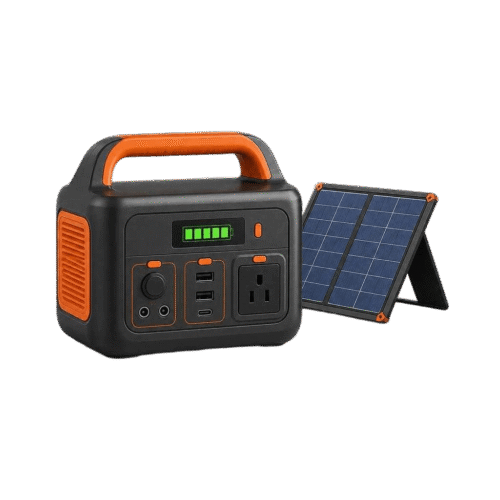
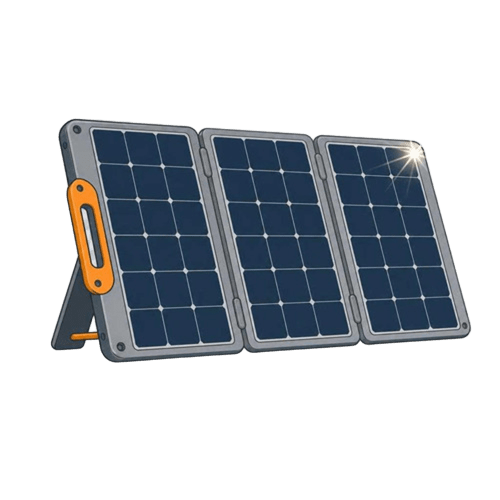
Solar is the bigger long-term advantage. The unit accepts up to 1600W of solar input across a 25-120V range, and Pecron includes an XT60-to-MC4 solar cable. In practice, that makes it easier to build a serious RV roof or off-grid panel setup without bumping into a low-voltage input ceiling.
| Charging Mode | Time, 0-100% | Noise Level |
|---|---|---|
| Reduced AC charging | About 4-6 hours | Quieter fan profile |
| Standard AC charging | About 2.5-3.5 hours | Moderate fan noise |
| Fast AC charging | About 2 hours | Noticeable fan noise |
| Car charging with optional 500W charger | About 6-7 hours | Mostly vehicle noise |
| 100W solar | About 35-40 hours strong sun | Silent |
| 400W solar | About 9-10 hours strong sun | Silent |
| 800W solar | About 4-5 hours strong sun | Silent |
| 1600W solar | About 2-3 hours strong sun | Silent |
That said, solar always depends on sun angle, shade, panel temperature, and wiring. One owner using a larger panel string saw charging drop to zero during partial shading, then return once the panels cleared. In real use, that’s not a deal-breaker, but it means panel placement matters.
Adapter Check — Pecron includes an XT60-to-MC4 solar cable, which is helpful if you already own standard solar panels. For car charging, plan on buying the separate 500W smart car charger if you want faster vehicle input.
A high solar ceiling matters most when you’re off-grid for more than one day. For weekend camping, wall charging before you leave may be enough. For boondocking, cabin use, or storm prep, the 1600W solar input is one of the main reasons to look at this model.
Outputs for RV, Workshop, and Outage Loads
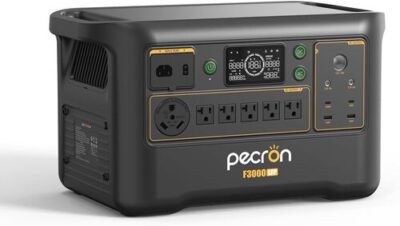
The US manual lists six AC outlets, one 100W USB-C port, one 18W USB-C port, two 18W USB-A ports, a 12V/10A car outlet and two 12V/5A DC5525 outputs. That covers the usual mix of laptops, phones, camera batteries, CPAP gear, lights, routers, and small DC accessories.
For a laptop that supports USB-C charging, use the 100W port; the second USB-C port is limited to 18W. The AC outlets are the bigger story, though, because six outlets make this easier to use as a small emergency power hub. On the flip side, the listing does not clearly show a built-in light, so campers should plan on separate lighting.
Fan Behavior, Standby Draw, and Placement
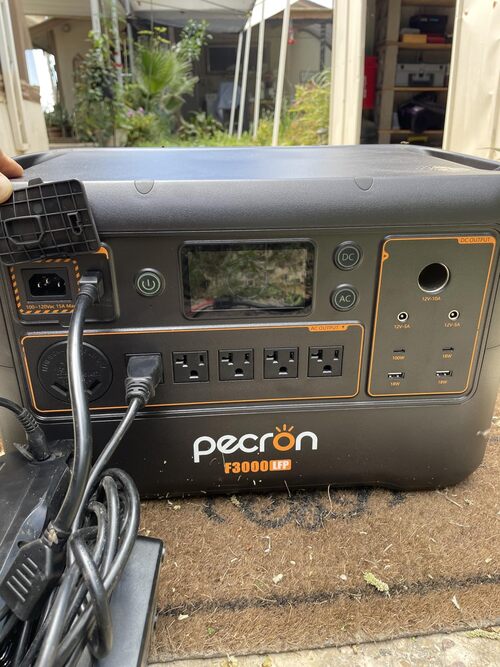
The F3000LFP is fairly quiet under light loads, but it is not silent. Buyers describe the charging noise as an audible fan nearby rather than a piercing whine. In a garage, camper, or home office, that should be fine for most people.
At the same time, fast charging and heavier AC loads will wake the fans up. If you sleep right beside it in a quiet room, you’ll notice it. For emergency fridge backup, sump pump duty, or daytime RV charging, the noise seems easy enough to live with.
Local Controls First, App Convenience Second
The screen covers the basics buyers expect: battery level, input watts, output watts, and charging information. One complaint worth taking seriously is that watt readings may lag for smaller loads, with one owner noticing a delay before the display showed output. That’s annoying, but it does not necessarily mean the unit is failing to power the device.
The app is more divisive. Some owners like the monitoring and remote control, while others complain about pairing, Wi-Fi setup, account login, unclear settings, and a less polished feel than EcoFlow’s app. In practice, the power station works without the app, but the app experience is not the reason to buy this model.
Worth knowing, the Wi-Fi side may require a separate 2.4GHz network if your router blends 2.4GHz and 5GHz bands. Several owners eventually got connected, but the process could be clearer.
Storage and Commissioning for the LFP Pack
The F3000LFP uses LiFePO4 battery chemistry. That’s good news if you plan to cycle the unit often, leave it ready for outages, or use it in an RV or off-grid setup. LiFePO4 batteries are usually heavier than older lithium-ion designs, but they are generally preferred for long-term backup use.
The US manual rates the battery for 3,500 cycles with about 80% capacity retained. This is a manufacturer cycle-life specification, not a measured lifetime from the owner accounts or a calendar-life guarantee.
Long-Term Ownership — LiFePO4 is the right chemistry for frequent cycling, but storage habits still matter. Keep the battery away from extreme heat, avoid storing it empty, and top it off every few months if it sits unused.
The warranty claim is also better than average on paper, with a 2+3 year worry-free warranty listed. Customer-service feedback is mixed but leans positive in the stronger stories: replacements, free parts, and helpful responses. To be fair, a few buyers had trouble reaching support, so keep your order records and test the unit early.
Storage routine — Follow the storage charge level and maintenance interval in the manual supplied with your unit; do not substitute a generic LiFePO4 routine for its instructions.
F3000LFP Buyer Gate: Where the Value Holds
| Use Case | Fit | Why |
|---|---|---|
| Weekend car camping | Strong fit | Huge capacity, plenty of outlets, and no gas-generator noise |
| RV side-trip / van life | Strong fit | Good inverter output, fast AC charging, and high solar input |
| Home blackouts under 8 hours | Strong fit | Easily covers phones, router, lights, fridge cycling, and small essentials |
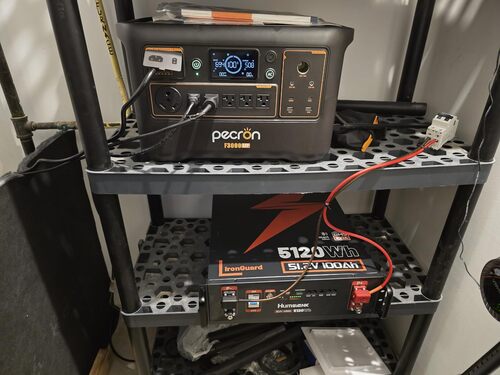
| Multi-day off-grid cabin | Solid fit | Works well with solar, but expansion batteries help for cloudy stretches |
| CPAP overnight backup | Strong fit | Plenty of capacity, especially without humidifier heat |
| Refrigerator backup | Strong fit | Good match for fridge cycling and compressor starts |
| Jobsite power tools | Solid fit | 3600W output is useful, though motor startup should be tested |
| Quiet bedroom UPS | With caveats | UPS works for some users, but fan noise and app quirks matter |
| Hurricane / multi-day outage | Solid fit | Strong with solar and expansion, less ideal as a whole-home backup |
| Tailgating / outdoor events | Solid fit | Lots of output, but heavy to carry often |
| Backpacking / lightweight EDC | Skip | Too large and heavy |
| Apartment without solar access | Solid fit | Fast AC charging helps, though storage space and weight matter |
The F3000LFP Makes Sense When
- A large LiFePO4 battery for RVs, campers, and home outages
- Enough AC output to run real appliances, not just electronics
- A solar-friendly setup with up to 1600W input
- A quiet alternative to a gas generator for overnight or indoor use
- Expansion battery support for longer backup plans
Choose a Different Platform When
- A lightweight unit you can carry around casually
- A polished app experience with effortless pairing
- Included fast car charging out of the box
- A load requiring more than the published 4,500W five-second peak allowance
- A power station mainly for small phones, lights, and laptops
Pros & Cons Analysis
Based on documented specifications and owner feedback
Pros
- Large useful design envelope — The combination of 3,072Wh storage and a 3,600W inverter gives room for refrigerators, pumps, office systems, RV circuits, and short high-draw tasks when each load is verified.
- Solar is more than a token input — A 1,600W ceiling can materially shorten recovery, provided the array stays inside the exact voltage and current window in the coldest expected conditions.
- Value is grounded in hardware — The appeal is not a vague feature count: it comes from battery size, inverter rating, PV headroom, and practical output coverage.
- Owner use cases are broad — Supplied accounts describe successful service across outage, RV, office, communications, refrigeration, and tool scenarios, which helps define credible missions.
- Local operation remains possible — The display and physical controls keep core use available when Wi-Fi pairing or an app account is inconvenient.
Cons
- Commissioning is part of ownership — App pairing, generator behavior, solar wake-up, UPS recovery, idle use, and demanding motor starts should all be tested during the return window.
- Weight changes how it is used — A 63-pound box becomes semi-permanent in many homes and RVs; placement, tie-down, cable routing, and ventilation deserve advance planning.
- Noise is workload-dependent — Fast charging and heavy output can activate noticeable cooling, so bedroom or small-cabin placement may conflict with the performance settings buyers want.
- Accessories affect the real system price — Expansion cables, batteries, and faster vehicle-charging hardware may be separate purchases and must match the F3000LFP exactly.
- Support evidence is mixed — Some owners report effective remedies while others describe friction, making photographs, serial records, measurements, and prompt testing unusually valuable.
Our Verdict
The Pecron F3000LFP review comes down to value and capability. This power station gives you a lot of battery, a lot of inverter, fast AC charging, and serious solar input for buyers who care more about practical backup power than a perfect app. The trade-offs are real — it's heavy, the app can be clunky, and some accessories cost extra — but the core power hardware looks genuinely useful.
If you need a big Pecron F3000LFP portable power station for RV boondocking, refrigerator backup, sump pump protection, Starlink, tools, or blackout essentials, it makes a lot of sense. If you mostly want a small, easy-to-carry camping battery, this is the wrong size class. Different tool, different job — and for large backup power on a tighter budget, the F3000LFP is a strong pick.
Frequently Asked Questions
Can the Pecron F3000LFP run a refrigerator?
Check the refrigerator running demand and startup requirement against the exact station limits. Capacity is 3,072Wh nominal, but compressor cycling, inverter losses and standby consumption determine runtime; this is not a guarantee for every refrigerator.
Can the Pecron F3000LFP run an RV air conditioner?
Several owners report running RV air conditioning for limited periods, including one setup that ran an RV air conditioner, TV, Wi-Fi, and lights for close to two hours. For longer AC use, solar input, shore-power charging, or expansion batteries matter a lot.
How long does the Pecron F3000LFP take to recharge from AC power?
The listing claims up to 1800W AC input and about a 2-hour full recharge. Customer feedback generally supports very fast AC charging, though fan noise becomes more noticeable during high-speed charging.
How much solar input can the Pecron F3000LFP accept?
One XT60 input accepts up to 1,600W and 25A. The US manual requires array open-circuit voltage below 120V and operating voltage above 25V. Include cold-weather voltage rise when checking the array.
Does the Pecron F3000LFP work as a UPS?
The US manual specifies 8–20ms transfer and limits UPS loads to below 1,800W at 120V. This is separate from standalone inverter output. It is unsuitable for equipment requiring a shorter interruption; verify the exact protected device.
Is the Pecron F3000LFP app easy to use?
The app is useful once connected because it shows input watts, output watts, battery level, heat, and charging information. That said, app setup is one of the more common complaints, especially around Bluetooth, 2.4GHz Wi-Fi pairing, account login, and unclear settings.
Is the Pecron F3000LFP quiet enough for indoor use?
Under light loads, customer feedback suggests it is fairly quiet. During fast charging or heavier AC loads, the fan becomes more noticeable, more like a nearby fan than a high-pitched whine.
Can the Pecron F3000LFP charge from a car?
Yes, but not with the basic package alone. The listing says car charging requires Pecron's separate 500W smart car charger.
Is the Pecron F3000LFP expandable?
The US manual permits up to two compatible PECRON 48V packs through the XT120 cascade connection. The US product page lists EP3000-48V and EP3800-48V arrangements. Confirm the battery revision and required cable before purchase.
How heavy is the Pecron F3000LFP?
The listed weight is 63.3 lb. Owners generally find it manageable for short moves, but many recommend a cart or hand truck if you plan to move it around the yard, campsite, or RV often.
Is the Pecron F3000LFP good for camping?
Yes, especially for car camping, RV camping, glamping, and camper setups where weight is not the main concern. It is overkill for lightweight camping but very useful when you want to run a fridge, electric blanket, CPAP, lights, Starlink, or cooking gear.
Technical Specifications
| Brand | Pecron |
|---|---|
| Model / SKU | F3000LFP (ASIN: B0F6YCRKTJ) |
| Battery capacity | 3072 Wh |
| Battery chemistry | LiFePO4 (LFP) |
| Cycle-life rating | Manufacturer-rated 3,500 cycles to about 80% capacity (US manual) |
| Expandable capacity | Up to two compatible PECRON 48V packs via XT120; US product page lists 2 × EP3000-48V for 9,216Wh or 2 × EP3800-48V for 10,752Wh total. Confirm cable and revision compatibility. |
| Continuous AC output | 3,600W at 120V; 3,300W at 110V; 3,000W at 100V (30A maximum) |
| Surge / peak output | 4,500W for 5 seconds, per US product page; not continuous output |
| AC voltage, frequency, and waveform | 100/110/120V selectable; 50/60Hz; pure sine wave (US low-voltage version) |
| AC outlets | 6 × AC outlets |
| High-current, RV, or 240V output | US documentation specifies up to 30A AC output; verify the delivered socket arrangement. No single-unit 240V output. |
| USB-C outputs | 1 × 100W USB-C; 1 × 18W USB-C (US manual) |
| USB-A outputs | 2 × USB-A (18W listed) |
| 12V / DC outputs | 1 × car port; 2 × DC 5525 outputs |
| Maximum solar input | 1,600W maximum; one XT60 input; 25A maximum |
| Solar input range and connector | XT60; array Voc below 120V and Vmp above 25V; respect the 25A input limit and cold-weather voltage rise |
| Maximum AC input | 1,800W at 120V; 1,650W at 110V; 1,500W at 100V; 15A maximum |
| AC recharge time | About 2 hours |
| Solar recharge estimate | Planning estimate: about 2-3 hours with maximum solar in ideal sun; about 4-5 hours with 800W in strong sun |
| UPS / EPS support and transfer time | 8–20ms transfer; UPS loads below 1,800W at 120V per US manual |
| App / connectivity | Yes — app control and monitoring (Bluetooth / 2.4GHz Wi-Fi setup can be tricky) |
| Operating temperature / weather rating | Charge: 0–45°C. Discharge lower limit conflicts: manual −20°C, US product page −10°C; confirm the delivered revision and use the narrower range pending confirmation. Not waterproof. |
| Dimensions | 19.3 × 11.6 × 11.1 in |
| Weight | 63.3 lb |
| Warranty | 2+3-year manufacturer warranty program |