Anker SOLIX C800X review: a camping-ready power station with lights and solar in the box
At a Glance
KEY FEATURES
- Battery: 768Wh, LiFePO4, cycle life not specified in supplied data
- AC output: 1200W continuous, 1600W surge via SurgePad technology; pure sine wave not specified in supplied listing
- Ports: 10 total ports claimed; exact AC / USB-C / USB-A split not specified in supplied data; car outlet mentioned
- Recharge: solar up to 300W input; 80% solar recharge claimed in 2.3 hours under ideal conditions; AC and car charging cables included
- Smart features: smart app controls, UPS support claimed, pass-through behavior not fully detailed in supplied data
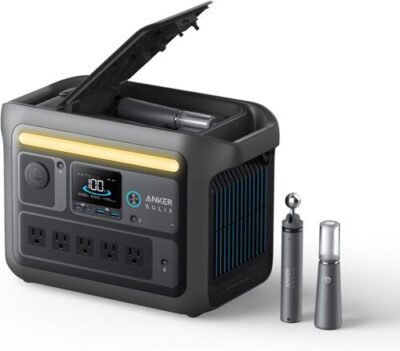
- Build: 24.03 lb, 14.61 x 8.07 x 9.96 inches, black finish, side grab handles
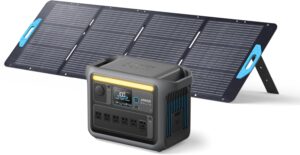
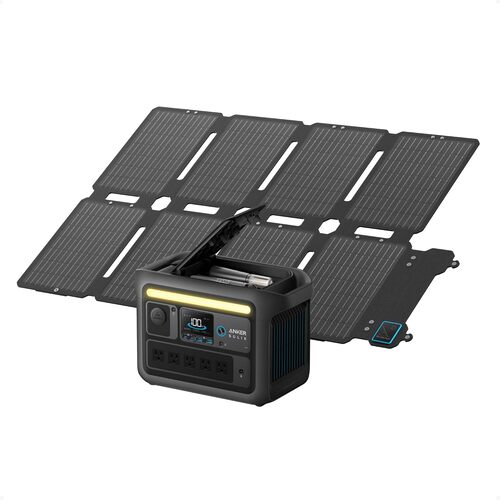
- Included solar panel: PS100X 100W portable solar panel, IP67 water-resistant, folds to 14 x 10.9 x 2.6 inches, up to 23% conversion efficiency
- Best for: weekend camping, glamping, off-grid electronics, outdoor events, phones, laptops, lights, pumps, and short backup use
PROS
- 768Wh LFP storage and 1,200W continuous output.
- Camping lights and solar bundle can replace several separate purchases.
- Fast AC charging plus 300W-class solar support.
- App control and broad output selection.
CONS
- C800X Plus and C800 Plus naming varies by region and seller.
- Exact bundle contents must be verified on arrival.
- Small exact-ASIN evidence set limits broad owner conclusions.
- 768Wh remains modest for repeated high-watt camp cooking.
Editor's Choice
Based on exact documentation and qualitative exact-ASIN owner evidence; no hands-on test or population-rate claim
⚡ Can the Anker SOLIX C800X Run It?
Choose a common device and see the estimated runtime, whether the inverter can handle it, and how long the power station may take to recharge.
This Anker SOLIX C800X review breaks down what you actually get from the 768Wh LiFePO4 battery, 1200W output, built-in camping lights, and included 100W solar panel. We ranked it in our camping power station buyer guide.
Picture a glamping trip where every little device wants attention. Phones need charging, the air mattress pump needs power, the tablet is half-dead, and someone forgot the lantern batteries again.
The C800X isn’t trying to power your whole house. For off-grid recharging strategy, our solar panel pairing guide covers panel sizing beyond the bundled 100W unit. In practice, it makes more sense as a quiet camping and short-outage battery for lights, laptops, phones, pumps, water dispensers, and a few comfort items — and that’s exactly where customer feedback sounds most positive.
The C800X Plus is a bundle decision as much as a power-station decision. Anker documentation and retailer naming overlap with the C800 Plus family, while this post’s exact ASIN is sold as a C800X Plus camping package. Preserve the indexed identity, but verify the physical model label, AC region, lights, panel, cable set, warranty seller, and manual on arrival. Family-level specifications cannot prove that every bundle component is included.
The exact-product owner file is much smaller than the other 02C sources. It supports solar, camping and small-load roles and identifies shipping, support, charging, and fault checks, but it cannot support broad reliability conclusions. This review therefore leans on exact documentation for limits and uses owner feedback only to prioritize acceptance testing.
| Bundle item | Why it matters | Arrival check |
|---|---|---|
| Power station | 768Wh LFP and 1,200W output define the core role | Model, AC voltage, ports, serial, firmware, damage |
| Camping lights | Integrated storage and lighting distinguish the package | Quantity, charging, brightness modes, mounting |
| Solar panel | Changes off-grid value and connector assumptions | Nameplate, connector, cable, measured input in sun |
| AC/DC cables | Missing or regional cables can stop commissioning | Inventory against the seller page and manual |
A 1,200W inverter covers many camp appliances and outage essentials, but 768Wh controls duration. SurgePad can help some high-watt resistive loads by altering voltage; it does not turn the unit into a larger pure 1,600W supply and may not be appropriate for sensitive electronics. Measure average watts and startup behavior, then sequence cooking or heating loads so nighttime lighting, refrigeration, and communications retain reserve.
- Photograph the unopened box, seller label, and every included component.
- Run all AC, USB, 12V, and light outputs with safe representative loads.
- Charge from AC, the included panel if present, and vehicle input.
- Pair the app, record firmware, then prove core operation offline.
- Store the exact invoice, serial, manual, and warranty terms together.
Anker’s C800-family documentation describes rapid AC charging, up to 300W solar, LFP chemistry, and a five-year warranty under applicable registration and regional terms. Check the exact manual because outlet count, input voltage, and package contents can differ by market. For solar, calculate cold-corrected panel Voc and current; never assume an included panel proves that an additional array is safe.
The camping-light concept is genuinely useful when it replaces separate lamps and chargers. It is less valuable if the unit will sit permanently beside a home refrigerator. Compare the price of the whole bundle against a bare 768Wh or 1kWh station plus the specific lights and panel you would actually choose.
Runtime planning should separate base-camp continuity from short comfort loads. Refrigeration, phones, lights, and communications form the overnight floor; a kettle, cooker, blanket, or coffee maker is an optional event. Measure each one, assign a reserve, and prevent app or display percentages from substituting for a watt-hour plan. A 1,200W device can be electrically acceptable and still be a poor use of a 768Wh battery.
Placement also affects whether the bundle works as advertised. Keep ventilation openings clear, protect the station and connectors from rain and condensation, and route lighting cables where they cannot be tripped over or pinched. The power station is not made weatherproof merely because the package is marketed for camping. Store it within the temperature and state-of-charge guidance in the exact manual.
Evidence-led verdict: buy the C800X Plus when the exact verified bundle solves a camping system problem. If bundle contents, regional identity, or seller support are unclear, choose a clearly documented bare station and add accessories deliberately.
C800X Plus: Audit the Bundle Before Rating the Station
If you want a ready-to-go camping power station with useful lights and solar included, the C800X makes a lot of sense. It’s compact for its capacity, strong enough for small appliances and electronics, and customers report good multi-day results when they stick to lighter loads. That said, this Anker SOLIX C800X review has one clear warning: heaters, cooking gear, compressors, and big surge appliances are where expectations need to stay grounded.
A Camp-Oriented Package With Regional Naming Friction
At 24.03 lb, the Anker SOLIX C800X portable power station lands in a nice middle zone. Our power station sizing walkthrough explains when 768Wh is enough versus when to step up. You won’t mistake it for a pocket-sized battery, but it’s still reasonable for car camping, RV storage, outdoor events, and moving around the house during a blackout.
In real use, the side grab handles matter. Owners describe the unit as compact enough to tote around, and the handles help take the awkwardness out of the solid heft. That said, this is still a trunk-to-campsite power station, not something you’d carry down a long trail for fun.
The black finish and rectangular shape should fit cleanly in a car trunk, under a camp table, or beside a bed during backup use. Worth knowing, the supplied data doesn’t spell out the exact AC outlet layout or USB-C wattage, so bulky-plug spacing is hard to judge from the listing alone.
Pro Tip — For camping, treat the C800X like a small power hub: park it near the tent entrance, run lights and charging cables from one place, and avoid scattering little battery packs everywhere.
Allocate 768Wh Between Camp and Emergency Loads
The C800X has a 768Wh battery. In plain English, that’s enough for a weekend of phones, lights, tablets, laptop charging, and small pumps when you’re not asking it to run heat-producing appliances.
In practice, customer stories line up with that use case. One buyer used it across multiple nights for an air mattress compressor, phones, and built-in lights, while another used it for a glamping setup with lights, phones, an iPad, water dispenser, and shower pump and still had a healthy amount left.
Real-World Math — At 0.80 AC efficiency, the listed 768Wh battery delivers roughly 614Wh through the AC outlets. Subtract a 10% reserve, and you’re working with about 553Wh of practical AC energy.
Here’s the thing: light loads make this battery feel bigger than it is. A laptop, phone, LED lights, and small pump sip power compared with a heater or cooking appliance.
On the flip side, one customer felt disappointed after using it with a small heater and cooking load. To be fair, that’s not surprising for a 768Wh unit — heat is the fastest way to turn a full battery into an empty one.
The 1,200W Boundary and SurgePad Exception
The C800X has a 1200W AC inverter with a 1600W surge ceiling through SurgePad technology. That’s plenty for camping electronics, laptops, routers, pumps, lights, CPAP machines, and many smaller appliances.
The catch is startup surge. Anker specifically warns that inductive and compressor-based devices — like pumps and electric saws — may not be suitable when their instant startup draw exceeds the unit’s limit.
Worth Knowing — Continuous output is the real ceiling. The 1600W surge rating only helps for short bursts — it doesn’t turn this into a long-running 1600W power station.
For most campers, the sweet spot is simple: phones, lights, tablets, laptops, routers, small pumps, and a mini fridge. In real use, those are the loads customers seem happiest running.
Honestly, skip this size class if your plan is cooking, heating, or heavy tool work. You’ll want a larger 2000W+ unit for that job.
Fast AC, 300W Solar, and Bundle Verification
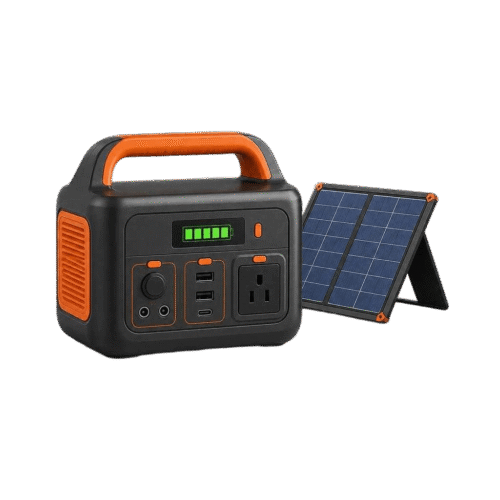
Charging options are one of the better parts of this bundle. You get AC charging, car charging, and solar charging, plus a 100W PS100X portable panel in the box.
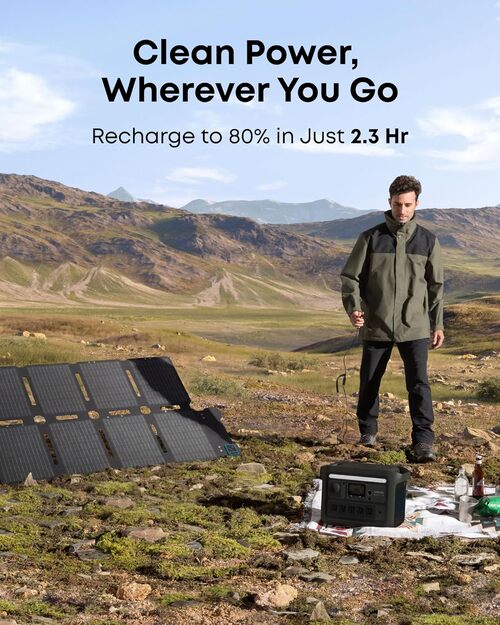
That said, the supplied data is clearer on solar than AC. The manufacturer documentation states up to 300W solar input and says the C800X can recharge to 80% in about 2.3 hours with enough solar under ideal conditions. Brand loyalists comparing Anker to EcoFlow should read our Anker and EcoFlow head-to-head before adding panels.
Grid Recovery — C800X Plus
Worth knowing, Anker mentions fast charging branding in the supplied product description, but the exact AC recharge time isn’t provided here. Before buying, check the current retailer or Anker listing if wall-charge speed is a deciding factor.
In practice, AC speed matters most for outage prep. If the battery is low and a storm is coming, a fast wall recharge can be the difference between “ready” and “almost ready.”
Panel Recovery — C800X Plus
Solar is the more interesting story. The included PS100X panel is water-resistant, folds down small, and uses monocrystalline cells rated up to 23% conversion efficiency.
The catch is that 100W is not the same as the C800X’s 300W maximum solar input. If you need whole-room backup instead, our home outage power station roundup covers larger-capacity options. In real sun, the bundled panel is good for topping up during the day, but it won’t refill the battery as quickly as a full 300W solar setup.
Adapter Check — The supplied data does not specify the solar connector type. If you plan to use third-party panels, confirm connector compatibility before buying extra solar gear.
Road Recovery — C800X Plus
Car charging is best treated as a slow backup option. It’s useful on road trips because you can feed the battery while driving, but it’s not the fastest way to recover a 768Wh pack.
A high solar input matters most if you plan to use the power station off-grid for more than a single day. For one-night camping, the full battery may be enough by itself.
Ten Outputs Share One System Budget
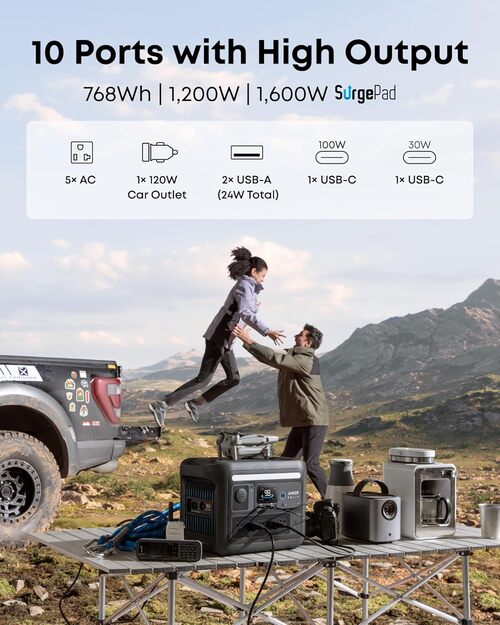
Anker lists 10 total ports, which sounds right for a camp hub. You should be able to plug in a mix of phones, lights, tablets, a pump, and a few other small devices without constantly swapping cables.
The port details are less clear in the supplied listing. AC outlet count, USB-C wattage, USB-A speed, and DC barrel output are not fully spelled out, though the listing does mention a car outlet and includes a car charging cable.
In practice, the missing USB-C wattage detail matters if you’re buying this mainly for laptops. A MacBook owner had a good experience, but anyone with a high-power USB-C laptop should verify the port rating before expecting full-speed charging.
Quick Fit Check
Lights, Fans, and Tent-Side Placement
Customer feedback generally paints the C800X as quiet under normal light-load use. One owner specifically called it compact, quiet power, which is exactly what you want from a battery you might keep near a tent, RV bed, or home office.
In real use, fan noise usually becomes more noticeable during fast charging or heavier AC output on power stations like this. Since the supplied reviews don’t flag fan noise as a major complaint, it seems manageable for ordinary charging and camping loads.
For indoor backup, the C800X makes sense for phones, routers, laptops, LED lights, and CPAP use. Just don’t treat it like a silent whole-room heater backup — that kind of load drains the battery fast and can push the output limits.
Local Camping Use Should Survive Without the App
The product data mentions smart app controls, which is a nice extra if you like checking input, output, and battery state without walking over to the unit. For beginners, though, the bigger win is that owners describe the power station as easy enough to use right away.
Worth knowing, the supplied reviews don’t mention app pairing problems or firmware headaches. That’s good, but the feedback here is more about real-world power use than deep app testing.
Local Readout — C800X Plus
Remote Controls — C800X Plus
Here’s what matters: the C800X seems friendly for normal users. You don’t need to understand MPPT curves or battery chemistry to plug in a phone, run camp lights, or power a pump.
Accept the Exact Seller Bundle During the Return Window
The Anker 768Wh LiFePO4 power station uses LiFePO4 battery chemistry. That’s a good sign for repeat use because LFP batteries are generally preferred for long cycle life, thermal stability, and frequent charge cycles.
To be fair, LiFePO4 also tends to be heavier than older NCM lithium-ion packs. The C800X’s 24 lb weight reflects that trade-off: safer-feeling chemistry and a sturdy battery, but not ultralight portability.
Long-Term Ownership — The supplied data does not list an exact cycle-life rating, so don’t assume a specific number. The 5-year warranty is reassuring, but daily off-grid users should confirm cycle-life details before buying.
Anker also claims UPS support, which may appeal to people who want a backup for routers, small electronics, or work-from-home gear. The supplied data doesn’t give a switchover time, so I’d treat that feature as useful for basic electronics rather than mission-critical medical or server equipment unless you test it first.
Best Practice — For storage, leave the unit around 50–80% charge and top it off every few months. LiFePO4 is forgiving, but storing any battery completely empty or completely full for long periods is still a bad habit.
No customer feedback here mentions overheating, swelling, smoke, or obvious safety failures. The main negative experience is runtime under heavy loads, which is more of an expectation issue than a safety red flag.
C800X Plus Camp-System Scorecard
You’ll probably be happy if you want:
- A 768Wh power station for camping that can handle lights, phones, tablets, laptops, and pumps
- A ready-made solar bundle instead of buying a panel separately
- Built-in camping lights that actually reduce the gear you need to pack
- A compact LiFePO4 unit for short outages and outdoor events
- A backup battery that feels more practical than a noisy gas generator for small loads
You might want to skip it if you need:
- Long runtime for heaters, kettles, microwaves, or cooking appliances
- A true whole-home outage solution
- A backpacking-friendly battery
- Confirmed high-watt USB-C specs from the supplied listing
- Heavy compressor, saw, or pump support without testing surge first
Different tool, different job. The C800X is at its best when you use it as a quiet camp and essentials battery, not as a replacement for a large generator.
Pros & Cons Analysis
Based on documented specifications and owner feedback
Pros
- The bundle can be coherent — A station, fitted lights, panel, and cables can create a ready camp system when every promised item arrives.
- Output covers practical campsite loads — The 1,200W boundary handles electronics, refrigeration, lights, and many short kitchen tasks after verification.
- Recovery options fit weekend use — Rapid AC, modest solar, and vehicle input provide distinct ways to restore a 768Wh battery.
- LFP suits repeated trips — The chemistry and warranty framework are appropriate for regular cycling and storage when the manual is followed.
- Local plus app controls are flexible — Core outputs work from the front panel while the app adds monitoring and configuration.
Cons
- Identity ambiguity is material — Regional C800-family names and packages can differ in lights, panels, plugs, and input assumptions.
- Bundle value disappears if components are wrong — A missing light, cable, or promised panel can make a promotional package worse than a deliberate system.
- SurgePad is not a larger inverter — Reduced-voltage support for selected resistive loads should not be generalized to sensitive devices.
- Capacity requires sequencing — High-draw cooking or heating can consume the battery quickly and undermine overnight essentials.
- Evidence supports caution, not rates — The smaller owner set makes exact-document and return-window testing especially important.
Our Verdict
The bottom line for this Anker SOLIX C800X review is pretty simple: it’s a solid pick for campers, glampers, road-trippers, and apartment dwellers who want quiet backup power for normal electronics. Customer feedback is strongest around lights, phones, laptops, pumps, and multi-day camping use, while the biggest gripe comes from expecting too much runtime from heat and cooking loads.
If your goal is weekend comfort, short blackout backup, or off-grid charging without piecing together a separate solar kit, the Anker SOLIX C800X portable power station is easy to like. If you need to run a hair dryer, big microwave, electric heater, or heavy power tool, you’ll be happier with a larger unit that has more battery and a higher continuous inverter rating.
Frequently Asked Questions
How long will the Anker SOLIX C800X run a laptop?
For a typical laptop using 50–80Wh per full charge, the 768Wh battery can usually provide around 7–10 realistic charges after efficiency losses and a sensible reserve. One owner reported that fully charging a MacBook used only a small portion of the battery.
Can the Anker SOLIX C800X run a CPAP overnight?
Yes, for most CPAP setups it should work well, especially with the humidifier turned off. A 30–60W CPAP load gives roughly 8–15 realistic hours through AC after normal conversion losses and reserve.
Can it run a full-size refrigerator?
Maybe, but it depends on the fridge. The 1200W inverter and 1600W surge rating can handle many smaller fridge loads, but compressor startup surges vary. For outage prep, test your own fridge before relying on it.
Can it run a heater, kettle, microwave, or cooking appliance?
Only briefly, and not always. Anker's own runtime example says a 1500W heater would last about half an hour, but high-draw appliances drain the 768Wh battery fast and may exceed the normal 1200W continuous output.
How fast does the Anker SOLIX C800X recharge with solar?
The supplied listing claims up to 300W solar input and an 80% recharge in about 2.3 hours under ideal sun. With the included 100W panel, expect a much longer recharge because it is only one-third of the unit's maximum solar input.
Does the included 100W solar panel make sense?
Yes for slow off-grid top-ups, camping lights, phones, laptops, and keeping the battery from dropping too far during the day. For faster solar recovery, you would want more panel capacity up to the 300W input limit.
Is the Anker SOLIX C800X easy to carry?
For car camping, yes. Customers describe it as compact and manageable, and the grab handles help. At about 24 lb, though, it is better for trunk-to-campsite use than long-distance carrying.
Is the Anker SOLIX C800X good for off-grid living?
It can be a very useful small off-grid battery for phones, laptops, lights, pumps, and other modest loads. It is not large enough to replace a full home power system or run high-draw appliances all day.
Does it have built-in lights?
Yes. The C800X includes built-in camping lights with three modes, and owners like having them for glamping, tents, night fishing, and outdoor use.
What battery chemistry does it use?
The Anker SOLIX C800X uses a LiFePO4 battery. That chemistry is generally preferred for long-term backup and frequent cycling because it tends to handle repeated charge cycles better than older NCM-style lithium-ion packs.
Technical Specifications
| Brand | Anker |
|---|---|
| Model / SKU | SOLIX C800X Plus / A1755 (ASIN: B0G6ZDP75P) |
| Battery capacity | 768 Wh |
| Battery chemistry | LiFePO4 (LFP) |
| Cycle-life rating | 3,000 cycles |
| Expandable capacity | No |
| Continuous AC output | 1200 W continuous |
| Surge / peak output | 1600 W peak (SurgePad technology) |
| AC voltage, frequency, and waveform | 120V, 60Hz; waveform not published for this exact model |
| AC outlets | 5 × 120V AC outlets |
| High-current, RV, or 240V output | No dedicated RV, 30A, 240V, or other high-current AC outlet published for this exact model |
| USB-C outputs | 2 × USB-C: 100W maximum and 30W maximum |
| USB-A outputs | 2 × USB-A, 12W maximum per port |
| 12V / DC outputs | 1 × 12V/10A car socket |
| Maximum solar input | 300 W (connector type not specified; PS100X 100W panel included) |
| Solar input range and connector | 11–60V, 10A, 300W maximum; XT60 input |
| Maximum AC input | 1,100W UltraFast charging; 750W standard charging |
| AC recharge time | 58 minutes to 100% in UltraFast mode |
| Solar recharge estimate | 80% in 2.3 hours |
| UPS / EPS support and transfer time | Yes |
| App / connectivity | Yes (smart app controls mentioned) |
| Operating temperature / weather rating | Discharge: -4–104°F (-20–40°C); charge: 32–104°F (0–40°C); ingress rating not published |
| Dimensions | 14.61 × 8.07 × 9.96 in (371 × 205 × 253 mm) |
| Weight | 24.03 lb (10.9 kg) |
| Warranty | 5-year manufacturer warranty |