Solar Power Picks logo with sun, solar panel, and green energy icon

  • Home
  • Reviews
  • Best
    • Best portable power stations
  • Guides
    • Portable Power Stations Guides
  • Comparisons
    • Portable Power Stations Comparisons
  • Calculator

Anker vs EcoFlow Power Station Showdown: Portability vs Expansion

COMPARED PRODUCTS

Anker SOLIX C300 Review: Compact LiFePO4 Power for Camping, Travel, and Short Outages

Best Anker Compact Pick

Anker SOLIX C300 Review: Compact LiFePO4 Power for Camping, Travel, and Short Outages

Check price at Amazon Jump to details
Anker SOLIX C1000 Gen 2 Review: Fast-Charging Backup Power That Actually Feels Useful

Best Anker 1kWh Pick

Anker SOLIX C1000 Gen 2 Review: Fast-Charging Backup Power That Actually Feels Useful

Check price at Amazon Jump to details
EcoFlow RIVER 3 Review: A Tiny LiFePO4 Backup for Routers, Laptops, CPAP, and Camping

Best EcoFlow Tiny Backup Pick

EcoFlow RIVER 3 Review: A Tiny LiFePO4 Backup for Routers, Laptops, CPAP, and Camping

Check price at Amazon Jump to details
EcoFlow Delta 2 Max Review: Fast-Charging Backup for Blackouts, RVs, and Camping

Best EcoFlow Bigger Battery Pick

EcoFlow Delta 2 Max Review: Fast-Charging Backup for Blackouts, RVs, and Camping

Check price at Amazon Jump to details

An Anker vs EcoFlow power station decision isn’t really about which logo looks better on a battery box. See how both brands rank in our portable power station best-of list. It’s about avoiding the wrong kind of regret: buying a unit that’s too small for backup power, or buying a 50 lb station when you only needed a router and laptop battery.

In this matchup, Anker’s strongest advantage is practical portability. The Anker SOLIX C300 and Anker SOLIX C1000 Gen 2 both make sense when you want useful backup power that still feels manageable around a house, car, campsite, or RV. Our Anker SOLIX C300 travel review covers the smallest Anker pick.

EcoFlow’s advantage is scale. The EcoFlow River 3 Plus gives you a small UPS-style setup with expansion potential, while the EcoFlow Delta 2 Max is the clear heavy hitter for fridge backup, RV power, and longer outages. Read our EcoFlow River 3 Plus UPS-style review for router and CPAP backup.

Fast Buyer Verdict

Buyer NeedBetter PickWhy
Smallest useful camping batteryAnker SOLIX C300It’s compact, LFP-based, and has excellent 140W USB-C output.
Best one-box portable backup pickAnker SOLIX C1000 Gen 2It has strong 2,000W output without jumping to 50 lb.
Best compact UPS-style optionEcoFlow River 3 PlusIt adds small-load UPS behavior and expandable runtime.
Best larger outage stationEcoFlow Delta 2 MaxIt has the most useful mix of capacity, output, solar, and expansion.
Wrong choice ifYou need whole-home backupThese are still portable stations, not installed battery systems.

Here’s the clean version: pick Anker if you want easier day-to-day portability; pick EcoFlow if you want more room to grow. The Anker C1000 Gen 2 is the most balanced single-unit choice here. The Delta 2 Max is the better choice when runtime and expansion matter more than carry weight.

Buyer Fit Before Specs

Use CaseBest MatchWhy It Fits
Weekend campingAnker SOLIX C300Easy to pack, strong USB-C, enough for small electronics.
Car camping with appliancesAnker SOLIX C1000 Gen 22,000W output handles more campsite and RV loads.
Router / modem backupEcoFlow River 3 PlusSmall UPS-style behavior is useful for network gear.
Refrigerator backupEcoFlow Delta 2 Max2,048Wh capacity gives it the runtime edge.
CPAP overnightAnker SOLIX C1000 Gen 2Better runtime than compact models without 50 lb weight.
RV backupEcoFlow Delta 2 MaxMore outlets, more capacity, expansion, and stronger solar input.
Solar-supported outagesEcoFlow Delta 2 MaxUp to 1,000W solar input gives it the clearest advantage.
Long-term frequent useAnker SOLIX C1000 Gen 2Its listed 4,000-cycle LFP claim is strongest here.

If your main goal is camping, don’t automatically buy the biggest battery. If your main goal is outage backup, don’t expect a 288Wh compact station to behave like a fridge system.

What the Spec Sheet Doesn’t Tell You

The small models are not “bad” because they have smaller batteries. They’re just meant for different jobs. A 288Wh station can be excellent for a laptop, router, phone, drone battery, or camp light, while still being a poor choice for refrigerator backup.

The bigger EcoFlow Delta 2 Max has the opposite problem. It can do far more, but the weight changes how you use it. Outage shoppers should also see home backup station recommendations. At 50.7 lb, it’s more of a garage, RV, or outage-corner unit than something you’ll move around casually.

That’s why this comparison isn’t about declaring one brand better across the board. It’s about matching the box to the job. For more sizing help, see our guide on what size portable power station you need.

Runtime Reality: Small Loads vs Appliance Loads

The spec sheet doesn’t tell the whole story with runtime. A power station loses some energy when converting battery power to AC outlet power. Also, many appliances don’t draw one steady number. Refrigerators and coolers cycle, while heaters and kettles pull hard almost constantly.

For planning, the compact stations are best under light loads. The C1000 Gen 2 is where the comparison becomes useful for fridge, CPAP, Starlink, router, and short appliance use. The Delta 2 Max is the only one here that feels comfortable for longer home-backup tasks.

Table class: runtime-comparison

DeviceTypical Power DrawAnker C300Anker C1000 Gen 2EcoFlow River 3 PlusEcoFlow Delta 2 Max
Phone charging15–20Wh per charge~11 charges~39 charges~11 charges~78 charges
Laptop60–100Wh per charge~2–3 charges~8–12 charges~2–3 charges~16–25 charges
LED lights20W~11 hours~39 hours~11 hours~78 hours
CPAP, no humidifier40–60W~4–5 hours~13–19 hours~4–5 hours~26–39 hours
Wi-Fi router10–20W~11–22 hours~39–78 hours~11–22 hours~78–156 hours
Electric cooler40–80W average~3–5 hours~10–19 hours~3–5 hours~20–39 hours
Full-size refrigerator100–200W average + surgeNot ideal~4–8 hoursLimited~8–15 hours
Space heater1,500WNoNot ideal / ~30 minNoNot ideal / ~1 hour

These are planning estimates, not lab-measured runtimes. Compressor appliances can vary a lot because temperature, door opening, age, insulation, and startup surge all matter.

AC Output: Where Each Brand Stops Making Sense

Battery size answers “how long?” Output answers “can it run at all?” That distinction matters more than many buyers expect.

The Anker SOLIX C300 is for small electronics first. Its 300W AC output is fine for laptops, phones, routers, lights, fans, and some compact coolers. It’s not the station for a microwave, kettle, heater, or big power tool.

The EcoFlow River 3 Plus gives you more AC headroom at 600W continuous, with X-Boost up to 1,200W. Still, its 286Wh battery means you shouldn’t treat it like a real appliance-backup unit. It can technically start some bigger loads, but not for long.

The real appliance comparison is Anker C1000 Gen 2 vs EcoFlow Delta 2 Max. Anker gives you 2,000W continuous output in a 24.9 lb body. EcoFlow gives you 2,400W output, more outlets, and a much bigger battery, but at about double the weight.

Output takeaway: Anker wins the power-to-weight feel. EcoFlow wins maximum capability with the Delta 2 Max.

Charging and Solar: The Wall Outlet Isn’t the Whole Plan

Fast wall charging is useful when you forgot to top off before a trip or you’re using a generator during an outage. Solar input matters when the battery needs to recover away from the grid.

Wall Charging

Anker’s fast charging is excellent. The C300 gets to 80% in about 50 minutes, and the C1000 Gen 2 can refill in about 49 minutes in fast mode. That makes both easy to prep quickly.

EcoFlow is also quick. The River 3 Plus charges in about an hour, and the Delta 2 Max usually lands around 1–1.5 hours depending on settings. However, fast modes usually increase fan noise, so quiet indoor charging may require slower input.

Solar Charging

EcoFlow has the strongest solar story in this group. The River 3 Plus supports up to 220W, which is strong for a small battery. The Delta 2 Max supports up to 1,000W through dual inputs, making it much better for RVs, solar-supported outages, and longer off-grid use.

Anker is more mixed. The C300’s 100W solar cap is fine for its size, while the C1000 Gen 2’s 600W solar input is genuinely useful. Still, you’ll need to check connector type, voltage range, polarity, and adapters before pairing third-party panels.

Car Charging

Car charging is useful, but slow. It’s fine for road-trip top-offs and emergency trickle charging. It’s not how you want to refill a large battery from empty.

Charging takeaway: Anker is excellent from the wall. EcoFlow is better if solar recovery is a major part of your plan.

Carry Weight and Setup Style

Portability is not one category. There’s “throw it in the car” portable, and there’s “move it from the garage to the fridge” portable.

  • Under 10 lb: easy grab-and-go power
  • 10–30 lb: realistic for car camping and room-to-room use
  • 30–50 lb: movable, but not fun to carry far
  • 50+ lb: better treated as semi-portable backup power
  • 100+ lb: wheels matter more than handles

The Anker C300 sits right around the grab-and-go category at about 9 lb. It’s the easiest station here to move often. The EcoFlow River 3 Plus is close at 10.4 lb, though it feels more like a small backup appliance than a tiny travel battery.

The Anker C1000 Gen 2 is the best middle ground. At 24.9 lb, it’s still realistic for car camping, van life, truck use, and moving room to room. The EcoFlow Delta 2 Max crosses into semi-portable territory at 50.7 lb.

Portability takeaway: Anker wins for buyers who’ll move the station often. EcoFlow’s bigger unit wins when the station can mostly stay put.

Battery Life and Ownership Risk

All four models here use LiFePO4 battery chemistry, which is good news. That means this isn’t an older-style comparison where one side is clearly using shorter-life battery tech.

Table class: chemistry-compare

Battery TypeBest ForTradeoff
LiFePO4 / LFPFrequent use, backup power, daily cycling, long-term ownershipHeavier per Wh
NMC / lithium-ionLightweight occasional-use batteriesShorter cycle life and less thermal stability

The Anker C1000 Gen 2 has the strongest listed cycle-life claim here: 4,000 cycles to at least 80% capacity. The C300, River 3 Plus, and Delta 2 Max all list 3,000-cycle LFP claims in the supplied specs.

In real use, cycle life matters most if you’ll keep the battery plugged in, use it as UPS-style backup, recharge it weekly, or pair it with solar. Casual campers may never wear out a modern LFP pack. Daily users should care a lot.

Battery takeaway: Anker C1000 Gen 2 has the strongest listed longevity claim, but all four are better long-term bets than older NMC-style units.

Controls, Ports, and Annoying Little Details

This is where daily ownership gets real. The best battery on paper can still annoy you if the ports are wrong, the app is flaky, or the fan kicks on beside your bed.

Anker’s small models are especially strong for USB-C users. The C300 has two 140W USB-C ports, which is great for modern laptops. The C1000 Gen 2 also has high-power USB-C reported, plus app control, Wi-Fi, Bluetooth, UPS-style backup, and fast charging controls.

EcoFlow gives you more system-style control. The River 3 Plus is attractive for routers, modems, cameras, and home-office gear because of its UPS-style switchover. The Delta 2 Max has the best port spread here: six AC outlets, two USB-C ports, four USB-A ports, 12V, DC5521 ports, dual solar inputs, and expansion ports.

However, EcoFlow also asks you to be more comfortable with app behavior, firmware updates, settings, and accessory matching. That’s fine for power users. For buyers who want fewer moving parts, Anker may feel easier.

Usability takeaway: Anker is cleaner for simple daily use. EcoFlow is better for people who want more control, more ports, and expansion.

Price, Value, and the Sale Trap

Don’t judge these only by list price. Power stations go on sale often, and bundle pricing can completely change the winner. The right question is not “which one is cheapest?” It’s “which one solves my use case without making me buy twice?”

Table class: value-compare

Value FactorAnker C300Anker C1000 Gen 2EcoFlow River 3 PlusEcoFlow Delta 2 Max
Lowest likely entry costStrongMid-rangeStrongHighest
Best capacity per dollarSale-dependentOften strong on discountSale-dependentOften strong during big sales
Best output per poundGood for small loadsVery strongGood for small UPS useStrong, but heavy
Better long-term battery claim3,000 cycles4,000 cycles3,000 cycles3,000 cycles
Expansion valueNoNoYesYes
Best sale/bundle logicSmall camping deals1kWh backup dealsSmall UPS dealsSolar and expansion deals

$/Wh is a useful sanity check, but it doesn’t capture output, expansion, warranty, solar ceiling, app control, or carry weight. A cheap compact station can still be a bad value if you needed fridge backup.

Value takeaway: Anker C1000 Gen 2 is the safer one-box value. EcoFlow Delta 2 Max is the better long-term value if you’ll actually use expansion and solar.

Best Anker Compact Pick

Anker SOLIX C300 Review: Compact LiFePO4 Power for Camping, Travel, and Short Outages

Anker SOLIX C300 Review: Compact LiFePO4 Power for Camping, Travel, and Short Outages

Get it now:

Check latest price

What to know

  • 288Wh LiFePO4 battery suits phones, laptops, routers, lights, and short cooler use
  • 300W AC output with 600W surge for small electronics and camping gear
  • Two 140W USB-C ports can charge modern laptops without AC bricks
  • AC recharge reaches about 80% in 50 minutes from wall power
  • About 9 lb with a fixed top handle for easy car-camp carrying

Best if

  • You want a compact Anker unit for camping, routers, laptops, and small devices
  • You value high-power USB-C charging more than huge battery capacity
  • You like app control, fast wall charging, and a built-in light

Skip if

  • You need to run microwaves, kettles, hair dryers, or heaters
  • You’re backing up a full-size fridge for many hours without solar
  • You’d rather avoid Wi-Fi pairing, firmware updates, or output-button quirks

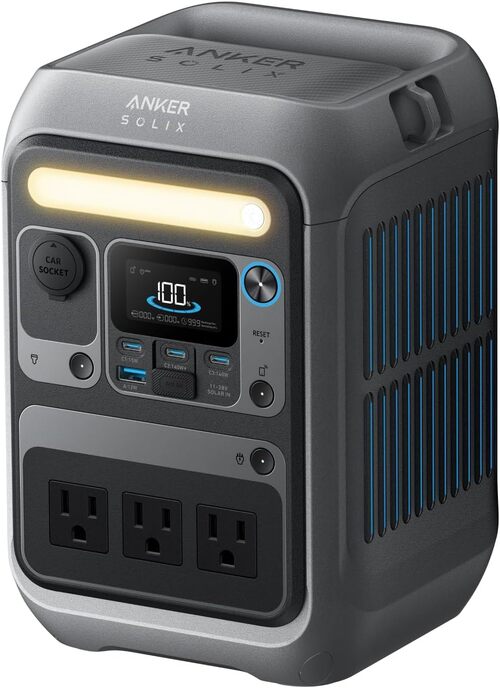
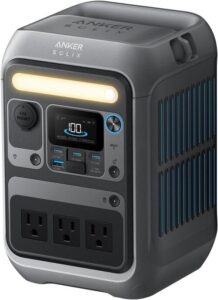
The Anker SOLIX C300 is the Anker pick for buyers who care more about clean small-device power than big headline capacity. It fits the compact role well because it gives you a real LiFePO4 portable power station with AC outlets, high-output USB-C, app control, and a built-in light without jumping into a bulky 1kWh box.


Day to day, the Anker SOLIX C300 makes the most sense for car camping, laptop work, router backup, drone batteries, and short fridge or cooler duty. That said, its 288Wh battery is intentionally limited. The catch: it’s a smart small backup, not a serious appliance-running station.

Capacity288Wh
AC Output300W continuous, 600W surge (pure sine reported by customer testing)
Solar Input100W max via XT60-style solar input
AC Charging~1.1h full / ~50 min to 80%, up to 330W
Weight9 lb (4.1 kg)
Best EdgeBest compact USB-C setup among the Anker picks
Main TradeoffSmall battery and 300W ceiling limit appliance backup
Best Anker 1kWh Pick

Anker SOLIX C1000 Gen 2 Review: Fast-Charging Backup Power That Actually Feels Useful

Anker SOLIX C1000 Gen 2 Review: Fast-Charging Backup Power That Actually Feels Useful

Get it now:

Check latest price

What to know

  • 1,024Wh LiFePO4 battery fits short outages, CPAP, routers, and fridge cycling
  • 2,000W AC output with 3,000W surge handles many kitchen and RV loads
  • 49-minute fast AC recharge is excellent for storm-prep top-offs
  • 600W solar input gives it stronger off-grid recovery than small units
  • UPS-style backup under 10 ms suits routers, modems, and many CPAP setups

Best if

  • You need a 1kWh Anker station for fridge support, CPAP, Starlink, and RV basics
  • You’re topping up from wall power or a generator during short charging windows
  • You want strong inverter headroom without jumping to a 50 lb power station

Skip if

  • You want built-in expansion for multi-day outage backup
  • Fast-charge fan noise would bother you in a bedroom or quiet office
  • You mostly power phones and laptops, where the C300 is easier to carry

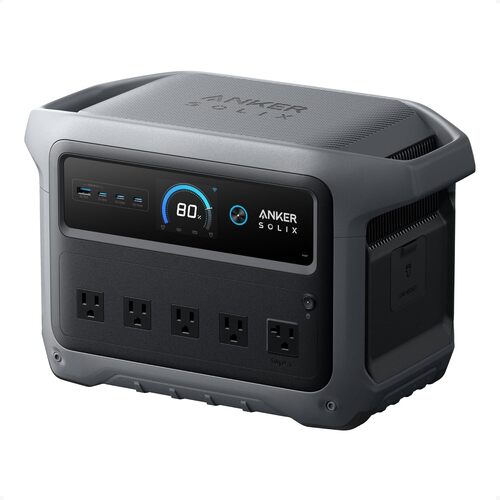
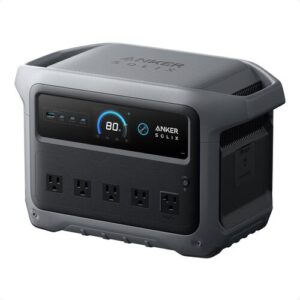
The Anker SOLIX C1000 Gen 2 is the Anker option to pick when the C300 feels too small but a heavy home-backup station feels unnecessary. It gives this comparison a strong middle lane: enough battery for essentials, enough inverter power for real appliances, and fast enough AC charging to make generator-assisted outage prep practical.

Here’s the useful part: the Anker SOLIX C1000 Gen 2 can cover fridge cycling, CPAP, Starlink, routers, laptops, RV basics, and short bursts from higher-draw gear without becoming a 50 lb box. Worth knowing, though, it doesn’t expand. Longer outages still need solar, generator top-offs, or a larger system.

Capacity1,024Wh
AC Output2,000W continuous, 3,000W surge (sine-wave behavior reported)
Solar Input600W max via XT60-style solar input
AC Charging~49 min full, up to 1,600W
Weight24.9 lb (11.3 kg)
Best EdgeFastest full AC recharge among the larger-capacity picks
Main TradeoffNo expansion despite strong 1kWh-class output
Best EcoFlow Tiny Backup Pick

EcoFlow RIVER 3 Review: A Tiny LiFePO4 Backup for Routers, Laptops, CPAP, and Camping

EcoFlow RIVER 3 Review: A Tiny LiFePO4 Backup for Routers, Laptops, CPAP, and Camping

Get it now:

Check latest price

What to know

  • 245Wh LiFePO4 battery is best for electronics, not heavy appliances
  • 300W AC output with 600W X-Boost covers small backup loads
  • Fast AC recharge gets it ready again in about one hour
  • 110W solar input works for slow camp or emergency top-ups
  • Sub-8 lb body is the easiest carry in this comparison

Best if

  • You’re backing up routers, phones, tablets, lights, and a small laptop setup
  • You prefer the lightest EcoFlow option for car camping or emergency kits
  • You like EcoFlow app control in a small LiFePO4 power station

Skip if

  • You need meaningful refrigerator runtime or high-watt kitchen appliance support
  • You’d rather have more AC headroom than a tiny carry weight
  • You want a larger expandable system for RV or blackout prep

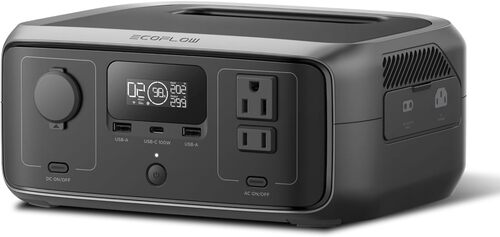
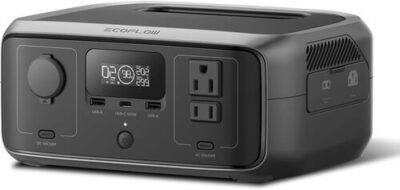
The EcoFlow River 3 is the tiny EcoFlow pick for people who want a quiet safety net, not a full backup plan. It makes sense if your real problem is keeping a router, laptop, phone, light, camera, or small desk setup alive during brief outages or travel days.


Compared with the larger units here, the EcoFlow River 3 wins on simplicity and carry weight. It’s easy to move, easy to store, and much less annoying than dragging out a bigger battery for small electronics. Just know the size is the limitation. It’s not the EcoFlow model for long fridge runtime, kitchen appliances, or RV-heavy loads.

Capacity245Wh
AC Output300W continuous, 600W X-Boost
Solar Input110W max via EcoFlow solar input / XT60-style adapter
AC Charging~1h full, up to ~320W
Weight7.8 lb (3.5 kg)
Best EdgeSmallest and easiest-to-carry unit in the comparison
Main TradeoffShortest runtime and weakest appliance coverage
Best EcoFlow Bigger Battery Pick

EcoFlow Delta 2 Max Review: Fast-Charging Backup for Blackouts, RVs, and Camping

EcoFlow Delta 2 Max Review: Fast-Charging Backup for Blackouts, RVs, and Camping

Get it now:

Check latest price

What to know

  • 2048Wh LiFePO4 battery gives much longer fridge and CPAP runtime
  • 2400W AC output handles many appliances, tools, and RV loads
  • Expandable up to 6144Wh with two extra batteries
  • 1000W dual solar input supports serious RV or blackout recovery
  • 50.7 lb weight makes wheels or a cart worth considering

Best if

  • You’re powering a fridge, CPAP, router, fans, and lights during longer outages
  • You already plan to build around solar panels or add-on batteries
  • You value EcoFlow app controls, fast AC charging, and expandable capacity

Skip if

  • You need something easy to carry one-handed around camp
  • You want the simplest small backup box with minimal setup cost
  • You can’t tolerate firmware, app, or cable-matching complexity

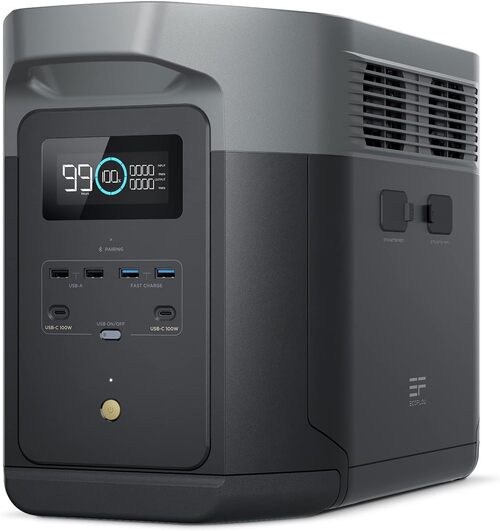
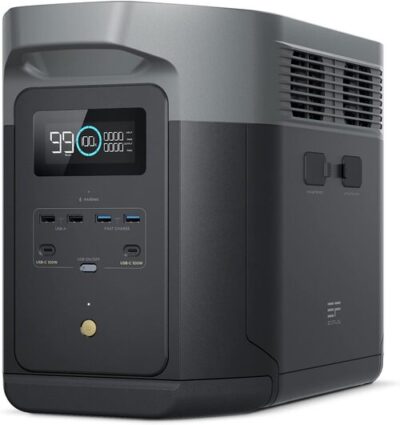
The EcoFlow Delta 2 Max is the EcoFlow pick for buyers who already know a tiny station won’t be enough. It earns the bigger-battery badge because it gives you real 2kWh-class backup, stronger AC output, dual solar input, app control, and expansion support in one system.


The real benefit shows up during outages and RV use: the EcoFlow Delta 2 Max can support refrigerators, CPAP machines, routers, lights, fans, tools, and longer backup windows much better than the compact models. To be fair, that extra capability comes with extra bulk. At about 50 lb, it’s more of a movable backup appliance than a casual carry-around battery.

Capacity2048Wh (expandable to 6144Wh)
AC Output2400W continuous, 4800W surge / 3400W X-Boost
Solar Input1000W max via dual XT60i / MC4 adapter inputs
AC Charging~1-1.5h full, up to 1,800W
Weight50.7 lb (23 kg)
Best EdgeLargest battery and only high-capacity expandable setup here
Main TradeoffHeaviest unit, with added cost for solar and expansion

Product Comparison

Feature Anker SOLIX C300 Review: Compact LiFePO4 Power for Camping, Travel, and Short Outages Anker SOLIX C1000 Gen 2 Review: Fast-Charging Backup Power That Actually Feels Useful EcoFlow RIVER 3 Review: A Tiny LiFePO4 Backup for Routers, Laptops, CPAP, and Camping EcoFlow Delta 2 Max Review: Fast-Charging Backup for Blackouts, RVs, and Camping
Product Image
Anker SOLIX C300 Review: Compact LiFePO4 Power for Camping, Travel, and Short Outages
Anker SOLIX C1000 Gen 2 Review: Fast-Charging Backup Power That Actually Feels Useful
EcoFlow RIVER 3 Review: A Tiny LiFePO4 Backup for Routers, Laptops, CPAP, and Camping
EcoFlow Delta 2 Max Review: Fast-Charging Backup for Blackouts, RVs, and Camping
Price $299.99 $229.99 $799 $449.99 $239 $196.32 $1399.99 $899
Rating
4.6 / 5
4.7 / 5
4.2 / 5
4.3 / 5
Category Portable Power Stations Portable Power Stations Portable Power Stations Portable Power Stations
Brand Anker Anker EF ECOFLOW EF ECOFLOW
Model / SKU Anker SOLIX C300 / A1722 (ASIN: B0D62GMQ3F) Anker SOLIX C1000 Gen 2 / A1763 (ASIN: B0FN7MSY4L) EcoFlow RIVER 3 / EFR705 (ASIN: B0DB1S36YP) DELTA2 Max / EFD350 (ASIN: B0C4DW17PD)
Battery capacity 288 Wh 1,024 Wh 245 Wh 2048 Wh
Battery chemistry LiFePO4 (LFP) LiFePO4 (LFP) LiFePO4 (LFP) LiFePO4 (LFP)
Cycle life 3,000 cycles (claimed) 4,000 cycles to at least 80% capacity (claimed) 3,000+ cycles (claimed) 3000 cycles to 80% capacity (claimed)
Expandable battery No No (customers note this model does not support expansion batteries) No Yes — supports up to 2 expansion batteries (up to 6144 Wh total)
AC output 300 W continuous (customer testing reports pure sine wave) 2,000 W continuous (sine-wave behavior reported by customer testing; pure sine not explicitly listed in provided specs) 300 W continuous (pure sine wave based on owner feedback) 2400 W continuous (120V AC; pure sine wave not specified in supplied data)
Surge output 600 W peak 3,000 W peak 600 W peak / X-Boost 4800 W starting wattage (3400 W via X-Boost for some high-wattage appliances)
AC outlets 3 × 120V AC outlets Not specified (10 total ports claimed) 2 × 120V AC outlets 6 × 120V AC outlets
USB-C ports 3 × USB-C (2 × 140W two-way, 1 × 15W) 2 × USB-C (up to 140W reported by owners) 1 × USB-C (100W PD output; no USB-C input) 2 × USB-C (100W PD mentioned in customer feedback)
USB-A ports 1 × USB-A (12W) Not specified (USB-A support reported by owners) 2 × USB-A 4 × USB-A (2 standard + 2 fast-charge mentioned in customer feedback)
12V car socket 1 × 12V car socket (120W listed) 1 × 12V/10A car port (customer-reported) 1 × 12V/10A car port 1 × 12V car port
Max solar input 100 W (11–28V, 8.2A; XT60-style solar input mentioned by users) 600 W (60V max, MPPT behavior implied by solar charging use) 110 W (MPPT, EcoFlow solar input cable / adapter may be needed) 1000 W (dual 500 W inputs; XT60i / MC4 adapter setup may be needed)
Max AC input 330 W (fast AC charging; customer reports around 320W+ input) 1,600 W (HyperFlash fast charging enabled in the Anker app) Approx. 250 W (estimated from 245Wh / 1-hour fast recharge) 1800 W (fast AC charging, adjustable in app)
AC recharge time 80% in about 50 minutes; roughly 1.1 hours full in fast AC mode 49 minutes (fast mode) About 1 hour About 1-1.5 hours (fast mode; varies by input setting and starting charge)
Solar recharge time About 3.5–4.5 hours with a 100W panel in strong sun About 1.8 hours with up to 600W solar (ideal conditions) About 2.6 hours with 110W solar input (ideal sun) About 2.5-3.5 hours with full 1000 W solar in ideal sun (real-world conditions vary)
UPS / EPS support Yes — UPS-style use reported (firmware/output-memory behavior matters for unattended restart) Yes — under 10 ms switchover (claimed) Yes — under 20ms switchover (EPS-style backup) Yes — EPS-style pass-through support (customer feedback is mixed for critical unattended loads)
App support Yes — Anker app with Wi-Fi and Bluetooth Yes — Anker app with Wi-Fi and Bluetooth Yes — EcoFlow app (Wi-Fi + Bluetooth) Yes — EcoFlow app (Wi-Fi / Bluetooth control and monitoring)
Built-in light Yes — front LED light bar No No No (not specified in supplied product data or customer feedback)
Weight 4.1 kg / about 9 lb 24.9 lb 7.8 lb 23 kg / about 50.7 lb
Best for Weekend car camping, portable fridge use, drone/laptop charging, routers, CPAP backup, classroom power, short outages CPAP backup, routers and Starlink, short blackouts, fridge backup, RV camping, van life, truck camping, remote work, and small-appliance use Wi-Fi router backup, laptops, CPAP without humidifier, car camping, road trips, mini fridges, small lights, mobile work, short outages Home outage backup, refrigerators, CPAP machines, Wi-Fi routers, RVs, camping, van life, sailboat work, hurricane prep, and generator-assisted emergency systems
Buy Now View Deal View Deal View Deal View Deal

Final Verdict

Choose Anker if your power station needs to move often. The Anker SOLIX C300 is the better small-device station, while the Anker SOLIX C1000 Gen 2 is the best Anker pick for buyers who want meaningful backup power without crossing into heavy-station territory.

Choose EcoFlow if your setup may grow. The River 3 Plus is a small UPS-style battery with expansion potential, while the Delta 2 Max is the better choice for RVs, refrigerator backup, solar-supported outages, and longer emergency use.

For most buyers, I’d choose the Anker SOLIX C1000 Gen 2 if portability still matters. I’d choose the EcoFlow Delta 2 Max if the station will mostly stay in a garage, RV, office, or blackout corner. That’s the real tie-breaker: Anker is easier to live with; EcoFlow is easier to build around.

Want a third brand in the mix? Read Jackery versus EcoFlow for camping and backup.

Frequently Asked Questions

Is Anker better than EcoFlow for power stations?

Anker is better if you want a portable station that feels easier to move and use day to day. The Anker SOLIX C1000 Gen 2 is especially strong because it gives you 1,024Wh capacity, 2,000W output, and fast AC charging at 24.9 lb. EcoFlow is better if you want expansion, higher solar input, and a larger backup setup, especially with the Delta 2 Max.

Which Anker vs EcoFlow power station is best for camping?

For light camping, the Anker SOLIX C300 is the easiest pick because it weighs about 9 lb and has strong USB-C charging for laptops, phones, lights, and drone batteries. For bigger car-camping loads, the Anker SOLIX C1000 Gen 2 makes more sense because it has 2,000W output. EcoFlow becomes more attractive if solar charging or expandable runtime matters during longer trips.

Which one is better for home backup?

The EcoFlow Delta 2 Max is the best home-backup choice in this group. It has 2,048Wh capacity, 2,400W AC output, six AC outlets, expansion support up to 6,144Wh, and up to 1,000W solar input. The Anker SOLIX C1000 Gen 2 is still a strong short-outage station, but the Delta 2 Max has more runtime for fridges, fans, routers, and blackout essentials.

Can Anker or EcoFlow run a refrigerator?

Yes, but choose the right size. The Anker SOLIX C1000 Gen 2 can handle many refrigerator backup jobs for shorter outages thanks to its 1,024Wh battery and 2,000W output. The EcoFlow Delta 2 Max is better for longer fridge backup because it has 2,048Wh capacity. The Anker C300 and EcoFlow River 3 Plus are better for small coolers and electronics, not full-size fridge backup.

Which brand charges faster from the wall?

Anker has the stronger wall-charging story in this comparison. The Anker SOLIX C300 reaches 80% in about 50 minutes, while the Anker SOLIX C1000 Gen 2 can fully recharge in about 49 minutes in fast mode. EcoFlow is still quick, with the River 3 Plus charging in about an hour and the Delta 2 Max taking about 1–1.5 hours depending on settings.

Which brand is better for solar charging?

EcoFlow is better for solar charging in this matchup. The Delta 2 Max supports up to 1,000W solar input through dual inputs, while the River 3 Plus supports up to 220W. Anker is still competitive with the C1000 Gen 2 at up to 600W, but the C300 is capped at 100W. For solar-heavy RV or outage use, EcoFlow has the stronger ceiling.

Can these power stations run a CPAP overnight?

Yes, but the compact models are better for light CPAP use without humidifier or heated tube settings. The Anker SOLIX C1000 Gen 2 is the best balance here because its 1,024Wh battery gives much more room than the C300 or River 3 Plus without weighing 50 lb. The EcoFlow Delta 2 Max is best if you need multiple nights or want to run other essentials too.

Are Anker and EcoFlow power stations better than gas generators?

For indoor use, camping, apartments, CPAP backup, router backup, and short outages, yes. Anker and EcoFlow power stations are quiet, battery-powered, and don’t produce exhaust. A gas generator still wins for multi-day runtime because you can refuel it. For longer emergency planning, compare batteries with fuel-based backup in our portable power station vs gas generator guide.

×

About Solar Power Picks

Portable Solar Power, Backup Power, and Off-Grid Gear Guides

Your trusted source for honest, in-depth product reviews and comparisons.

Quick Links

  • Best Picks
  • Reviews
  • Guides
  • Comparisons
  • Calculator
  • Privacy policy
  • Favorites

Categories

  • Portable Power Stations

© 2026 Solar Power Picks. All Rights Reserved.

We may earn a commission when you purchase through links on our site. Learn more