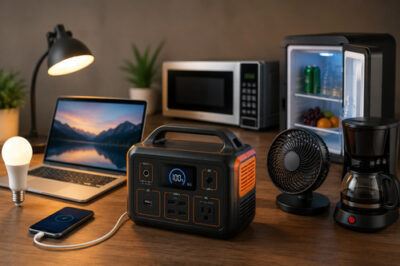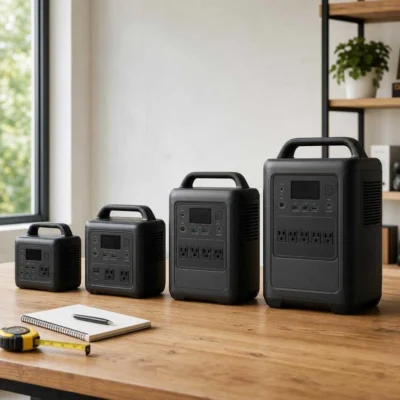
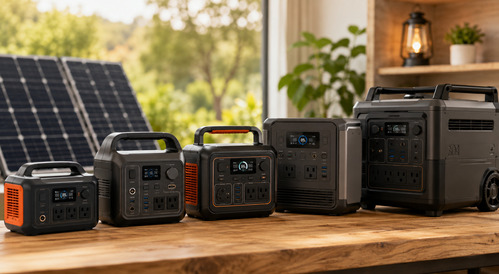
What size portable power station do I need? Start with the devices that must run together, total their running watts, check the largest startup surge, and calculate the watt-hours needed for the planned time. Add conversion loss and a reserve only once. A phone-and-router kit may fit below 500Wh; a refrigerator or multi-load outage plan can require 1–3kWh or more.
A candidate must pass output, surge, energy, recharge, and handling. A large battery that fails one of the first two gates still cannot run the load.
Gate 1: Build One Simultaneous-Load Group
Do not add every appliance you own. Add the devices that could be on at the same moment. A refrigerator, router, two lights, and a laptop form one realistic outage group; a microwave may be scheduled separately so it does not inflate the always-on requirement.
| Load | Planning watts | Run together? |
|---|---|---|
| Router | 15W measured | Yes — continuous |
| Two LED lamps | 18W total | Yes — evening |
| Laptop charger | 65W label maximum | Sometimes |
| Refrigerator | Use measured/label data | Cycles, but surge matters |
| Microwave | Use input watts, not cooking watts | Schedule separately |
Measure uncertain loads with a suitable plug-in energy meter when practical. Nameplates can describe a maximum rather than the usual draw, while compressor loads change with room temperature, door openings, and control cycles.
Gate 2: Make the Inverter Clear Running and Starting Watts
Continuous AC output must exceed the highest simultaneous running load. Then check the time-rated surge specification against motors and compressors. “Surge” is not extra energy and does not authorize a load to run above the continuous rating.
- ✅ Add running watts for devices used at the same time.
- ✅ Check each compressor, pump, and motor for startup demand.
- ⚠️ Treat boost modes as model-specific; they may reduce voltage or exclude some appliances.
- ❌ Never use the headline peak number as the continuous ceiling.
If the exact startup figure is unavailable, ask the appliance manufacturer or measure with equipment capable of capturing inrush. Guessing a universal multiplier is less reliable than testing the real pairing during the return period.
Gate 3: Convert the Schedule into Watt-Hours
Watts determine whether equipment can run; watt-hours estimate how long. For a steady AC load, a transparent planning equation is:
Wh ≈ running watts × hours ÷ efficiency ÷ (1 − reserve)
Use inputs you can defend. Efficiency varies with inverter design and load, while reserve reflects how much energy you deliberately leave unused.
| Scenario item | Energy calculation | Subtotal |
|---|---|---|
| Router | 15W × 8h | 120Wh |
| Lights | 18W × 5h | 90Wh |
| Laptop | 65W × 3h | 195Wh |
| Cycling refrigerator | Use measured Wh over a representative period | Example: 500Wh |
| Load-side total | 120 + 90 + 195 + 500 | 905Wh |
At 85% modeled AC efficiency and a 15% reserve, that 905Wh load-side target becomes about 1,253Wh of rated capacity. The number is a planning result, not a promised runtime; ambient temperature, battery condition, inverter idle draw, and appliance cycling remain relevant.
Run Your Own Sizing Case
The calculator below models one simultaneous load group. Enter average watts for the period—not the sum of unrelated appliance nameplates—and test surge separately.
Portable Power Station Size Estimator
Use one load group and one time window. The result includes your chosen efficiency and reserve.
Planning arithmetic only. Verify continuous output, surge duration, ports, transfer behavior, environmental limits, and the exact appliance load.
Gate 4: Prove You Can Refill It During the Real Outage
A 2kWh station is only a one-cycle resource unless it can recharge. Compare daily load energy with energy that can actually reach the battery from the wall, vehicle, solar array, or generator window. Solar-panel nameplate watts are not daily watt-hours.
| Recharge path | Planning question | Common constraint |
|---|---|---|
| Wall AC | How long from the expected starting state? | Circuit and adjustable input limit |
| Vehicle socket | How many Wh arrive during the drive? | Often a slow source |
| Alternator charger | Is installation and current draw approved? | Vehicle-specific design |
| Solar | Do voltage, current, connector, and daily sun align? | Weather and partial shade |
| Fuel generator | Can input watts be limited to the generator? | Outdoor-only operation and fuel |
For solar, use the power station’s exact PV voltage window and maximum input current, not only its advertised watt limit. A panel string can be under the watt ceiling yet exceed cold-weather open-circuit voltage.
Gate 5: Reject the Battery You Cannot Place or Move
Capacity adds mass. Decide whether the station stays beside a refrigerator, moves between floors, rides in a vehicle, or must be carried to a shelter. Dimensions, wheel design, lifting points, noise, cord clearance, and storage temperature can matter more than another 200Wh.
A Final Worksheet Before You Buy
- Record loads: measured running W, startup W, operating hours, and whether loads overlap.
- Calculate energy: Wh for each schedule, then add one documented efficiency and reserve allowance.
- Match sources: model AC, DC, vehicle, and solar recharge energy for a bad-weather day.
- Check interfaces: outlets, voltage, waveform, grounding instructions, transfer mode, and adapters.
- Commission: test the exact load group, source transition, alarms, and recharge plan while returns are possible.
Use the separate simultaneous-watts worksheet if output is still unclear, or the runtime formula lab when the station is already chosen.
Worked Case: An Eight-Hour Home-Essentials Window
Assume a measured 45W average refrigerator load across the chosen window, a 15W router, 20W of lighting for four hours, and a 60W laptop for three hours. Load-side energy is 360Wh + 120Wh + 80Wh + 180Wh, or 740Wh. At 85% path efficiency with a 15% reserve, the rated-capacity model becomes about 1,024Wh.
The inverter calculation is separate. If the refrigerator needs a documented 900W start while the router and lights are on, the startup moment is roughly 935W before margin. A 1kWh battery with only 600W surge capability fails; a station with enough output but 500Wh capacity starts the fridge yet misses the duration.
| Candidate | Output gate | Energy gate | Decision |
|---|---|---|---|
| 600W / 1,200W surge / 1,024Wh | Pass only if 900W duration fits | Pass modeled window | Verify exact surge duration |
| 1,800W / 2,400W surge / 512Wh | Pass | Fail duration | Too little energy |
| 300W / 600W surge / 2,048Wh | Fail startup | Pass duration | Wrong inverter |
| 1,800W / 2,400W surge / 1,024Wh | Pass on entered data | Pass modeled window | Commission exact pair |
Worked Case: Vehicle Camping with a Daily Recharge Loop
A 12V cooler using 350Wh/day, two laptops using 220Wh/day, lights and phones using 100Wh/day, and station overhead of 60Wh/day create a 730Wh daily budget. A 1kWh station may cover the day, but only if the vehicle or solar plan replaces enough energy before the next cycle.
Suppose the vehicle contributes 250Wh during necessary driving and solar contributes 300Wh on the modeled poor-sun day. The daily deficit is 180Wh. After three days, that deficit reaches 540Wh; the plan needs more delivered energy, less load, more starting capacity, or a scheduled wall-charge stop.
Write load Wh/day and delivered charge Wh/day on the same page. A 400W panel does not guarantee 400W—or any particular daily Wh—at the battery.
When Portable Stops Being the Right Category
If the accepted load group needs 240V, hardwired circuits, an automatic transfer system, several days of heavy HVAC, or more battery modules than can be safely moved and installed as intended, the solution may no longer be a portable station. A listed home-backup system or generator-plus-battery design deserves a separate professional review.
Do not force a portable product into home wiring because its watt number seems large. Connection method, neutral/ground behavior, overcurrent protection, transfer equipment, conductor sizing, environmental rating, and code requirements remain system-level questions.
Keep a Change Log After Commissioning
- Record the station model, firmware, battery modules, and charge limits.
- Record every essential load, measured Wh, observed peak, and test temperature.
- Record cables, adapters, solar-string design, and transfer equipment.
- Repeat the model when an appliance or operating schedule changes.
- Retest after a protective trip instead of merely adding a larger margin.
The result should be reproducible by another household member. If the worksheet depends on remembered assumptions, it is not finished.
Size the Recharge Path with the Same Discipline
A station that covers one outage day is not automatically a multi-day solution. Convert each recharge source into a conservative delivered-energy budget. For wall charging, check the accepted AC input and the time available before the next outage window. For a vehicle, use only the manufacturer-approved cable and the power the socket can safely provide. For solar, verify array voltage, current, connectors, and the station’s input window before estimating daily watt-hours.
Suppose the accepted load group needs 900Wh per day. A solar array that delivers 550Wh on the planning day and necessary vehicle travel that contributes 150Wh leave a 200Wh daily deficit. A larger battery delays the shortfall but does not fix the daily balance. The durable choices are to reduce the load, increase dependable recharge, add a scheduled charging source, or shorten the required autonomy.
| Recharge question | Number to record | Why it matters |
|---|---|---|
| Wall outlet | Accepted W and available hours | Defines fastest routine recovery |
| Vehicle | Delivered W during necessary driving | Avoids assuming the car is an unlimited source |
| Solar | Conservative delivered Wh/day | Captures weather, angle, and conversion |
| Generator | Approved charging setup and runtime | Separates fuel plan from battery capacity |
Commission the Plan Before It Becomes an Emergency
Charge the station, connect the exact essential group, reproduce the expected startup order, and run long enough to observe cycling and thermal behavior. Record starting and ending state of charge, elapsed time, energy shown by any trustworthy meter, alarms, fan behavior, and recharge time. Stop if plugs, cables, or the unit behave abnormally.
Then compare the measurement with the worksheet. If the station used 35% of its battery during a four-hour test when the model predicted 25%, do not average away the gap. Find the omitted load, idle demand, conversion assumption, or appliance cycle. A sizing worksheet earns confidence through a repeatable commissioning test—not through a bigger marketing number.
Cooling needs a scenario model: Before placing an AC in the load group, use the air-conditioner circuit and runtime-band lab for voltage, startup evidence, duty cycle, weather, and room-side cooling fit.
Bottom Line: Choose a System, Not a Battery Number
The answer to “what size portable power station do I need?” is the smallest system that passes all five gates with documented margin. Output and surge decide whether it starts the load; watt-hours and recharge decide whether the plan lasts.
Save the worksheet with the exact model manuals and repeat the commissioning test after firmware, appliance, cable, or battery changes. That record is more useful than a generic capacity chart.