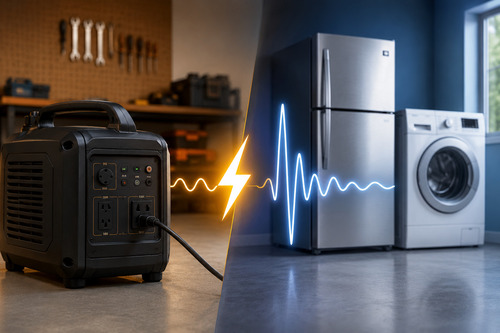
Running watts vs starting watts describes two moments in a motor-driven appliance. Running watts are the sustained demand after startup; starting watts are the brief extra demand while a compressor, pump, or motor accelerates. A source must satisfy both the continuous requirement and the surge level for the required duration.
Watch the First Seconds as a Timeline
Different equipment produces different shapes and durations. A refrigerator compressor, well pump, circular saw, and inverter-driven mini-split should not share one universal surge multiplier.
Match Each Number to the Source Limit
| Appliance evidence | Power-source evidence | Question answered |
|---|---|---|
| Running input W | Continuous output W | Can it stay on? |
| Starting/inrush W | Surge/peak W | Can it begin? |
| Startup duration | Allowed surge duration | Can support last long enough? |
| Voltage/frequency/waveform | Output characteristics | Is supply compatible? |
| Restart behavior | Protection and restoration behavior | Will it recover correctly? |
Manufacturers may use “peak,” “surge,” “starting,” or proprietary mode names differently. Read the conditions and duration, not only the largest number on the product page.
Why a Startup Can Fail Even Below the Peak Label
Duration mismatch
The station may advertise a high instantaneous peak while the motor needs elevated power for longer.
Other loads are already running
Router, lights, chargers, or a second compressor consume part of the available output before startup.
Voltage drops or boost mode changes voltage
Some enhancement modes do not deliver normal output conditions and may not suit sensitive or motor loads.
Protective logic intervenes
Overcurrent, temperature, short-circuit, or low-battery protection can stop output even when a simple watt comparison appears close.
Build a Pass/Fail Startup Record
| Test item | Pass | Fail / investigate |
|---|---|---|
| Cold start | Starts repeatedly from normal rest condition | Trip, stall, repeated attempt |
| Warm restart | Starts after expected cycle delay | Cannot restart under pressure/load |
| Other essential loads | Remain stable during startup | Lights dim, output drops, devices reset |
| Restoration | Returns in intended state | All compressors restart together |
| Battery at reserve boundary | Behavior matches plan | Unexpected early shutdown |
Repeated failed starts can stress the appliance and source. Stop, document the event, and resolve the mismatch.
Soft Starters and Variable-Speed Drives Change the Shape
A manufacturer-approved soft starter may reduce motor-start demand in some applications. Variable-speed or inverter-driven appliances can ramp differently from fixed-speed motors. Neither label guarantees compatibility with every portable station.
Hardwired HVAC, pumps, and 240V equipment also raise installation, transfer, and grounding questions. Do not reduce those decisions to a surge-watt chart.
Separate Startup Power from Startup Energy
A 1,200W startup lasting one second uses only about 0.33Wh, so it barely changes a large battery’s runtime. Yet it can determine whether the appliance runs at all. This is why capacity and output cannot substitute for each other.
Wh = watts × seconds ÷ 3,600
The small Wh result does not make the current or voltage event harmless; it only explains why surge is mainly an output problem.
For the broader load schedule, use the simultaneous-watts worksheet. Then calculate duration with the runtime formula lab.
Applying this to a basement pump? Use the storm-cycle sump-pump worksheet to combine exact startup evidence with float-controlled cycles, idle draw, reserve, and outlet wake behavior.
Commission Motors Under Realistic Conditions
- ✅ Use exact appliance and station manuals.
- ✅ Measure inrush with equipment designed to capture it.
- ✅ Include essential background loads during the start.
- ✅ Test source restoration and repeated cycling.
- ⚠️ Consider ambient temperature and compressor/pump pressure.
- ❌ Never backfeed wiring or bypass protection to force a start.
Four Startup Profiles That Should Not Share One Multiplier
| Equipment type | Typical pattern | Evidence to seek |
|---|---|---|
| Refrigerator compressor | Brief inrush plus cycling restarts | Inrush and restart behavior |
| Well or sump pump | Motor start under hydraulic load | Locked-rotor/start data and voltage |
| Circular saw | Operator-controlled starts under changing load | Measured peak and duty cycle |
| Inverter-driven HVAC | Electronic ramp and control logic | Exact input and backup compatibility |
| Resistive heater | Little motor surge; high steady demand | Continuous input watts |
The heater demonstrates the opposite problem: startup may be easy, but continuous energy demand is severe. Do not treat every difficult battery load as a surge problem.
Restoration Can Start More Than One Motor
During normal operation, a fridge and freezer may cycle at different times. After a source interruption, both controls may request cooling together. Add any loads that remain active during restoration and test the actual sequence with safe fallback power available.
Battery State Can Change the Same Inverter Test
A station may start a motor when full but trip closer to its low-battery boundary because internal voltage and protection behavior differ. Temperature and simultaneous DC loads can also affect the result. Commission at a realistic lower state of charge while preserving the planned reserve.
- Test from full charge and near the planned reserve—not to zero.
- Repeat under the expected hot or cold operating environment within manual limits.
- Include the station’s actual output mode and firmware.
- Record peak, duration, trip code, and battery percentage.
- Do not infer a pass for a related appliance model.
Translate a Failed Start into the Next Decision
A failure is useful evidence. Preserve it rather than replacing the analysis with a larger guessed multiplier.
Read the Manual’s Surge Language Literally
Manufacturers may publish “peak,” “surge,” “boost,” or mode-specific output without giving the same duration or behavior. A 2,400W peak for milliseconds is not interchangeable with 2,400W for several seconds, and a temporary mode that lowers voltage is not suitable for every appliance. Record the exact wording, duration, waveform or voltage behavior, and excluded load types.
| Published phrase | Missing question | Buyer response |
|---|---|---|
| 2,400W surge | For how long and at what voltage? | Find the manual or obtain written support data |
| Power-lifting mode | Does it alter voltage or waveform? | Use only with explicitly compatible loads |
| Motor support | Which start profile was tested? | Match evidence to the exact motor |
| Overload protection | Trip threshold and reset behavior? | Do not treat protection as usable output |
Do Not Solve Repeated Trips with Repeated Starts
Each stalled or failed motor start can heat windings, stress connectors, and consume battery energy. After a protective trip, disconnect the load, inspect the event code and connections, and identify whether continuous watts, startup peak, voltage, cable, temperature, or output mode is responsible. Repeatedly pressing reset is not a commissioning method.
If reliable measured startup sits close to the station boundary, choose meaningful headroom or an approved motor-start solution. The goal is repeatable operation across realistic battery states and temperatures, not one successful start captured under ideal conditions.
Save the exact meter model and sampling method with the result. A slow display can miss a short inrush that faster instrumentation captures, so two apparently conflicting readings may describe different measurement windows.
Bottom Line: Two Ratings, One Complete Event
Running watts vs starting watts is not a choice between two sizing methods. Continuous output must support the running state, while surge output and duration must support the startup state under realistic conditions.
Obtain the missing duration and inrush evidence, then test without repeated trips. If compatibility remains uncertain, choose more documented margin or a system designed for that motor load.