Anker SOLIX F3000 Review: Big Backup Power That Still Moves
At a Glance
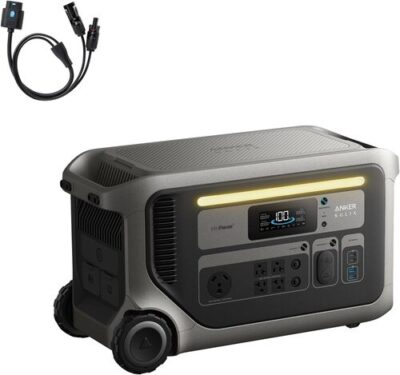
KEY FEATURES
- Battery: 3,072Wh capacity, chemistry not specified in the provided listing, cycle life not specified
- AC output: 3,600W continuous; surge output not specified in the provided listing
- Ports: 11 total outlets/outputs listed; exact AC, USB-C, and USB-A counts not specified; reviews mention AC outlets, USB ports, 12V car port, and 30A Anderson output
- Recharge: up to 3,600W generator/pass-through charging; up to 2,400W solar input; up to 6,000W combined generator + solar recharging
- Smart features: Anker app support, Wi-Fi/Bluetooth setup reported by customers, pass-through charging, power-saving modes, charge-rate controls
- Best for: RV camping, van life, refrigerator backup, hurricane prep, enclosed work trailers, and outage essentials
PROS
- 3,072Wh LFP and 3,600W output fit substantial 120V loads.
- Up to 2,400W dual-input solar supports fast daytime recovery.
- Wheeled form is more mobile than larger home-backup platforms.
- Expansion and paired-unit options create a growth path.
CONS
- Single unit is 120V; 240V requires additional system hardware.
- Roughly 90 lb despite the portable format.
- Solar channels have separate limits that require array design.
- App, pass-through, UPS, and restoration need commissioning.
Editor's Choice
Based on exact documentation and qualitative exact-ASIN owner evidence; no hands-on test or population-rate claim
⚡ Can the Anker SOLIX F3000 Run It?
Choose a common device and see the estimated runtime, whether the inverter can handle it, and how long the power station may take to recharge.
This Anker SOLIX F3000 review breaks down what you actually get from a 3,072Wh power station — how it performs for outages, RV trips, camping, and the less glamorous job of keeping a fridge cold when the power drops. It sits in our 3000W high-output roundup for buyers who need that muscle.
Picture this: the lights flicker, the fridge starts warming up, and your phone is already low. You don’t necessarily need to power every circuit in your house. You need the essentials to keep running without dragging a loud gas generator onto the porch.
The F3000 sits in that middle ground. From what owners report, it’s less about replacing a full home standby generator and more about giving you a quiet, high-capacity backup for fridges, TVs, RV air conditioners, lights, coolers, and trailer setups. Our fridge runtime breakdown models how long 3kWh actually lasts on a compressor cycle.
RV-first buyer
Values the wheeled form, 120V high output, substantial solar, pass-through use, and movement between campsite and storage.
Home-first buyer
Values expansion, standby efficiency, optional integration, and may eventually pair units for 240V loads.
The Anker SOLIX F3000 occupies a useful middle ground: materially more storage and output than a common 1kWh station, but less home-infrastructure scale than an F3800. Anker documents 3,072Wh, 3,600W output, dual solar inputs up to 2,400W, pass-through charging at full output, expansion, and a paired-unit route to 240V. The key question is not whether the specification is large. It is whether a single 120V unit fits the buyer’s RV and essential-load plan or whether the eventual system cost approaches a larger split-voltage platform.
The owner set describes high-watt appliances, refrigerators, RV and outage use, solar charging, runtime, app control, portability, and support. Cautions include UPS behavior, charging, fan noise, shipping, software, and isolated faults. These qualitative records guide commissioning and do not establish a failure rate.
| F3000 path | What one unit supplies | Hidden next decision |
|---|---|---|
| RV base | 3,600W 120V output and 3,072Wh storage | Inlet compatibility, converter behavior, tie-down, and solar array |
| Home essentials | Refrigerator, communications, selected kitchen and motor loads | Transfer method, energy schedule, and restoration test |
| 240V growth | Requires the documented paired-unit ecosystem | Second station, hub/cables, load balance, space, and total cost |
| Longer duration | Expansion batteries add stored energy | Weight, cable protection, charging time, and diminishing portability |
Runtime should be planned as daily watt-hours. A refrigerator’s compressor cycles, a pump starts briefly, and an induction cooker draws heavily for minutes; nameplate watts alone do not describe the day. Measure each priority load, create a start order, and reserve energy for overnight essentials. The 3,600W inverter gives useful headroom, but simultaneous loads and startup events still need a real drill.
Dual solar inputs are useful only when each array is valid. Do not combine their limits or assume one string design can be moved between ports. Track voltage, current, connector, polarity, orientation, shade, and cable loss separately. Under realistic sun, daily harvested watt-hours matter more than a short peak.
Movement is a system decision too. The F3000 is wheeled but still roughly 90 pounds. Check door thresholds, stairs, vehicle lift height, handle clearance, and a tie-down point. If it will remain in one room, compare whether a fixed backup platform offers better integration; if it moves regularly, the F3000’s hybrid design earns more of its value.
Evidence-led verdict: the F3000 is strongest for buyers who genuinely split time between RV/mobile use and home essentials. A home-only buyer needing 240V from day one should compare the complete paired-unit price with a native split-voltage system.
F3000: The Hybrid RV-and-Home Proposition
For this Anker SOLIX F3000 review, the short take is simple: if you want serious 120V backup power that can still roll around a garage, campsite, or RV pad, this power station works. It has enough capacity for fridge backup, enough output for demanding appliances, and enough recharge flexibility to pair with solar or a fuel generator. That said, the weight is real, the app experience is not perfect for everyone, and solar buyers should double-check panel voltage limits before building a full setup.
Wheels Make 90 Pounds Relocatable, Not Light
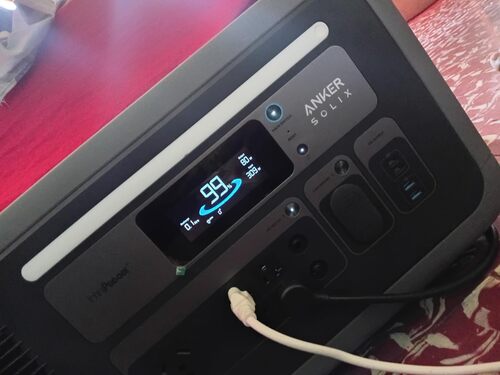
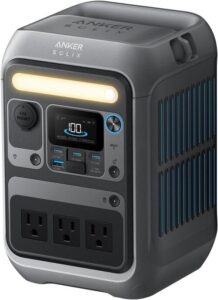
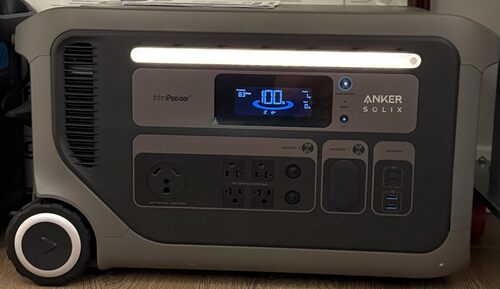
The F3000 looks and feels like a large portable power station, not a small camping battery. Owners describe a clean black finish, a solid body, and a shape that stores more easily than some taller home-backup units. In practice, the built-in wheels and pull handle matter more than the styling because this thing weighs just over 91 lb. Indoor placement rules are covered in our indoor power station safety primer.
That said, several buyers still call it manageable. It can roll from a garage to a patio, across a campsite, or into an RV setup without feeling like dead weight. The catch is lifting it into a truck bed or carrying it up stairs — that’s a two-hand, think-before-you-move-it job.
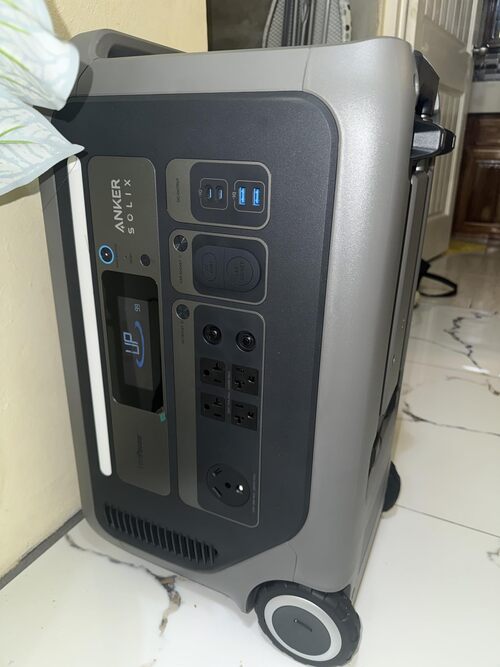
Port placement gets mixed feedback. The AC outlets are useful, but some owners say bulky chargers can block nearby outlets because the spacing is tight. Worth knowing, inputs on the side and rear may force the unit to sit a few inches away from a wall, which can be annoying in a van, trailer, or tight storage bay.
Quick design read:
- Strength: Wheels make the heavy body much easier to move
- Strength: Compact shape for the capacity class
- Strength: Solid, clean-looking build
- Watch-out: AC outlets can feel cramped with large plugs
- Watch-out: Side and rear inputs need clearance
- Limitation: Not realistic for frequent lifting
A 3,072Wh Daily Energy Schedule
The Anker SOLIX F3000 portable power station has a 3,072Wh battery, which is a big step up from the 1kWh and 2kWh units many campers start with. In real use, that means you can think in terms of fridge hours, RV air-conditioner sessions, trailer lighting, or multiple days of electronics — not just phone charges.
Here’s the thing: you don’t get every listed watt-hour through the AC outlets. Inverter loss, standby draw, battery reserve, heat, and appliance cycling all matter. For planning, a conservative usable AC figure is about 2,190Wh after efficiency loss and a 15% reserve.
Real-World Math — At 0.84 AC efficiency, the listed 3,072Wh delivers roughly 2,580Wh through the AC outlets. Subtract a 15% reserve, and you’re working with about 2,190Wh of practical AC energy.
These are planning estimates, not promises. Real runtime depends on inverter efficiency, ambient temperature, battery age, appliance cycling, and whether you’re using AC or DC output.
Owners using it for refrigerators and TVs tend to be happy with the runtime. One recurring theme is reduced battery anxiety — especially from people upgrading from older Goal Zero-style units or smaller stations. To be fair, heavy heat-making appliances can drain even a large battery quickly, so a kettle or hair dryer is a “use it briefly” load, not an all-day plan.
One 120V Unit, Two-Unit 240V Ambitions
The F3000 has a 3,600W AC output rating, which gives it far more breathing room than a typical camping power station. In practice, owners report using it for refrigerators, TVs, RV air conditioners, mini fridges, lights, coolers, and work-trailer gear.
At the same time, 240V expectations need a reality check. The listing says you can pair two power stations for 240V output, but a single F3000 is not the same as a built-in split-phase home-backup system. If your goal is central AC, a well pump, or a hardwired home panel setup, you’ll need to plan the full system — not just buy the battery.
Worth Knowing — Continuous output is the real number to plan around. A surge rating, when listed, only helps for brief startup spikes — not long heating loads or 240V appliances.
Customers who use the F3000 for RV life seem especially pleased. One owner reported running an RV air conditioner for more than four hours, while another liked that it handled their RV AC startup without drama. Honestly, that’s where a 3,600W station starts to make sense: not for charging phones, but for loads that smaller units simply won’t touch.
Dual Solar Inputs and the Recovery Stack
Charging is one of the more interesting parts of the F3000. You get up to 3,600W pass-through charging with a 120V generator, up to 2,400W solar input, and up to 6,000W when combining generator and solar in ideal conditions. In practice, that makes it much more outage-friendly than slow-charging batteries that need most of a day to refill.
That said, the fastest numbers need the right setup. A normal user may not always have the solar array, generator output, cabling, sun angle, and temperature needed to see peak charging. The upside is that owners do report successful charging from gas generators and solar setups, especially for camping and RV use.
AC Recovery — F3000 Circuit Requirements
AC and generator charging are big strengths here. Buyers who pair the unit with a fuel generator like that it can act as a quieter buffer: run appliances from the battery, recharge with the generator, and avoid listening to the engine all day.
Solar Recovery — Two Input Windows to Design
Solar is powerful but not foolproof. One detailed owner called out the high-PV and low-PV limits, including a concern that some Anker panel pairings may run close to voltage limits in cold weather or clip wattage on certain configurations. Worth knowing, the F3000 can be excellent with solar, but you should size panels by voltage, amps, and watts — not just by the brand name on the box.
Adapter Check — Before buying panels, check the F3000’s PV voltage limits and connector requirements. If you plan to use third-party panels, confirm the cable type and make sure cold-weather open-circuit voltage stays safely under the input ceiling.
Vehicle Recovery — Alternator Hardware and Cable Route
Car charging is more of a backup trickle than a main plan. With a battery this large, 12V charging can take well over a day. In real use, vehicle charging is handy for topping up while driving, but solar or generator input is what makes the F3000 practical for multi-day off-grid use.
RV, Home, and Direct-Load Connection Choices
The provided listing says the F3000 has 11 total outlets or outputs, while customer feedback mentions AC outlets, USB ports, a 12V car port, and a 30A Anderson output. RV and trailer owners seem to appreciate the DC side, especially when powering camping lights, coolers, distribution blocks, and extra chargers.
On the flip side, the exact port layout has a few annoyances. Buyers mention AC outlets being too close together, USB ports not being individually controllable, and side/rear inputs creating wall-clearance issues. In practice, the ports are useful, but the physical spacing could be better for bulky wall bricks and tight van builds.
Pro Tip — If you’re building an RV or trailer setup, sketch your cable paths before mounting or storing the F3000. The side and rear inputs can matter as much as the front-facing outlets.
Low Idle Draw Does Not Remove Cooling Needs
Customer feedback generally suggests the F3000 is quiet for its size. Owners mention using it for camping, RVs, and home backup without the constant noise you’d expect from a gas generator. In practice, that quiet operation is one of the main reasons to buy a power station this large.
The fans may still ramp up during fast charging or heavier AC loads. That’s normal for a high-output inverter and battery system. For indoor use, it’s best suited to garages, living rooms, RVs, trailers, and utility areas; for bedrooms, light loads should be fine, but fast charging next to your bed is probably not the move.
Configure Standby, Pass-Through, and Time-of-Use Modes
Most buyers describe the F3000 as easy to set up and simple to operate. The app gets praise for charge-rate settings, output control, power-saving modes, and general monitoring. You can use the unit without the app, but some helpful controls appear to live there.
The catch is consistency. A few owners report Wi-Fi pairing trouble, firmware update failures, limited remote monitoring expectations, or frustration that certain controls depend on the app. To be fair, many others say the app is smooth and useful, so this feels like a weak spot for some setups rather than a universal problem.
What the display shows:
- Available: Battery percentage
- Available: Input watts
- Available: Output watts
- Available: Charging status
- Available: Basic power information
- Limited: Detailed per-port solar input visibility is limited in customer feedback
- Limited: Remote status expectations may not match every buyer’s use case
What the app lets you do:
- Available: Turn outputs on or off remotely
- Available: Adjust charging behavior
- Available: Use power-saving modes
- Available: Update firmware
- Limited: Set deeper port behavior for some outputs
- Limited: Pairing can be fussy for some users
- Not confirmed: Charge/discharge limit support is not clearly confirmed in the provided listing
For beginners, the Anker SOLIX F3000 battery feels approachable. You plug things in, watch the watts, and learn quickly how much each appliance costs in battery life. Worth knowing, if you hate apps or need guaranteed offline control for every setting, this may not be your favorite interface.
Expansion Turns a Portable Station Into a System
The provided product listing does not state the battery chemistry, so I would not label it LiFePO4 or NCM from this data alone. That matters because chemistry affects cycle life, storage recommendations, weight, and long-term daily-use expectations. The F3000 does come with a listed 5-year warranty, which is reassuring for a power station in this price class.
Customers do not raise a pattern of overheating, swelling, smoke, or fire concerns in the feedback provided. Reliability feedback is mostly positive, though not spotless. A few buyers report serious failures, including a unit that stopped charging from AC and another that struggled with updates and app behavior.
Long-Term Ownership — Because the cycle life is not specified in the provided listing, don’t assume a daily-use lifespan from the Amazon page alone. If you plan to cycle it heavily for RV living or off-grid backup, verify the battery chemistry and cycle rating from Anker’s current documentation before buying.
Support feedback is split. Some customers say Anker replied quickly and solved installation problems, while others describe unanswered emails, phone-support frustration, and disappointing handling of solar-panel compatibility issues. That mixed experience is worth factoring in because this is not a cheap impulse buy.
Best Practice — For storage, leave the unit around 50-80% charge and top it off every few months. Even when chemistry is unclear, avoiding long storage at 0% or 100% is a safer habit for battery health.
F3000 Home-versus-RV Fit Matrix
You’ll probably be happy if you want:
- A high-capacity power station for fridge and electronics backup
- RV or van-life power without running a generator all night
- A battery that can pair with solar or a gas generator
- Enough output for microwaves, kettles, tools, and RV AC use in short bursts
- Wheels and a pull handle instead of a lift-only box
You might want to skip it if you need:
- A lightweight battery you can carry casually
- Built-in 240V split-phase output from one unit
- A fully unattended whole-home backup setup
- Simple solar buying with no voltage or clipping homework
- App-free control over every advanced feature
Different tool, different job. The F3000 is a strong fit for serious portable backup, but it is not a magic replacement for a hardwired standby generator.
Pros & Cons Analysis
Based on documented specifications and owner feedback
Pros
- A credible hybrid role — The F3000 can move between RV, campsite, workshop, and home-essential use without surrendering 3kWh-class storage.
- High 120V output — The 3,600W inverter provides useful room for appliances and motors when load order is verified.
- Solar recovery matches the battery class — Up to 2,400W across two inputs can replenish substantial energy in favorable conditions.
- Standby and pass-through features support backup — Low-idle and full-output pass-through claims address practical long-duration deployment questions.
- Growth options are broad — Expansion batteries and paired-unit 240V support allow a phased system rather than immediate replacement.
Cons
- Growth can erase the portability advantage — A second station, expansion batteries, hubs, and panels quickly become stationary infrastructure.
- One-unit voltage is a firm boundary — A single F3000 should not be purchased under the assumption that it directly powers every 240V household load.
- Movement still requires planning — Wheels do not solve stairs, loading height, rough terrain, or vehicle restraint.
- Input architecture needs documentation — Two solar lanes, AC, generator, and optional vehicle charging each require their own compatibility test.
- Owner evidence calls for an acceptance week — Software, noise, UPS, charging, shipping, and support records should be collected before relying on it.
Our Verdict
If you came to this Anker SOLIX F3000 review wondering whether it’s “too much” or “not enough,” the answer depends on your use case. For RV owners, outage prep, fridge backup, enclosed trailers, and camping setups where weight is manageable, the Anker SOLIX F3000 portable power station makes a lot of sense. It has real output headroom, strong battery capacity, useful generator pairing, and enough solar input to support longer off-grid stays.
That said, don’t buy it blind. Solar compatibility deserves careful checking, the app may not satisfy everyone, and 91.49 lb is still heavy even with wheels. If you want quiet, movable backup for essentials rather than a full whole-house system, the F3000 is a solid pick — just plan the accessories as carefully as the battery itself.
Frequently Asked Questions
How long can the Anker SOLIX F3000 run a refrigerator?
Anker claims it can run a 190W fridge for up to 42 hours, and customers do report strong fridge backup performance. Real runtime depends heavily on how often your fridge compressor cycles, room temperature, and what else is plugged in.
Can the Anker SOLIX F3000 run an RV air conditioner?
Yes, customers report using it with RV air conditioners, including one owner who said it ran an RV AC for more than 4 hours. Larger AC units and compressor startup loads still need to be checked against the 3,600W output rating.
Is the Anker SOLIX F3000 too heavy for camping?
It weighs 91.49 lb, so it is not something most people will casually lift. The wheels and suitcase-style handle help a lot, and buyers using it for car camping, RVs, festivals, and trailers generally find it manageable.
Does the Anker SOLIX F3000 support solar charging?
Yes. The listing claims up to 2,400W solar input, with customer feedback pointing to dual solar inputs. One detailed owner warns that panel voltage limits and wattage clipping need careful planning, especially with Anker's own panels.
Can it run a microwave, kettle, or hair dryer?
The 3,600W output gives it enough headroom for many 120V high-draw appliances, including microwaves, kettles, and hair dryers when used one at a time. Runtime drops quickly with those loads, so they are best used briefly.
Does the app work well?
Many owners like the app for monitoring and changing settings, but a few report Wi-Fi pairing trouble, firmware update issues, and frustration with remote monitoring expectations. You can use the unit without the app, but some deeper controls appear to live there.
Does it work for home backup during outages?
It works well for essential backup — fridge, TVs, lights, electronics, small appliances, and some RV-style loads. For whole-home backup, 240V loads, or unattended outage coverage, you may need extra hardware, expansion batteries, or a second unit.
Can the Anker SOLIX F3000 charge from a gas generator?
Yes. The listing highlights 3,600W pass-through charging from a 120V generator, and customers report pairing it successfully with gas generators during camping and outage use.
Are the AC outlets spaced well?
Not perfectly. Multiple buyers say the AC outlets are close together, so large wall chargers can block neighboring outlets.
What is the warranty?
The provided product details list a 5-year warranty. Customer support feedback is mixed: some buyers praise Anker's help, while others describe trouble getting responses or resolving return issues.
Technical Specifications
| Brand | Anker SOLIX |
|---|---|
| Model / SKU | Anker SOLIX F3000 / A1782 (ASIN: B0F8BC2LFS) |
| Battery capacity | 3,072 Wh |
| Battery chemistry | LiFePO4 (LFP) |
| Cycle-life rating | 4,000 cycles to 80% remaining capacity |
| Expandable capacity | Yes — expandable up to 24kWh (exact expansion-battery count not specified) |
| Continuous AC output | 3,600 W continuous |
| Surge / peak output | 4,860W SurgePad; 7,200W AC surge |
| AC voltage, frequency, and waveform | 120V AC; frequency and waveform not published in the current exact-model source set |
| AC outlets | 4 × NEMA 5-20R plus 1 × NEMA TT-30R |
| High-current, RV, or 240V output | 1 × NEMA TT-30R; 240V output requires two F3000 units in parallel |
| USB-C outputs | 2 × USB-C, 100W maximum each |
| USB-A outputs | 2 × USB-A, 12W maximum each |
| 12V / DC outputs | 1 × 120W car socket plus 1 × 402W Anderson output |
| Maximum solar input | 2,400 W |
| Solar input range and connector | High-PV: 11–165V, 1,600W maximum; Low-PV: 11–60V, 800W maximum |
| Maximum AC input | 1,800W from a standard AC outlet; up to 3,600W through supported generator or EV charging |
| AC recharge time | Not published for this exact model in the current source set |
| Solar recharge estimate | Approximately 1.5 hours at the full 2,400W solar input under suitable conditions |
| UPS / EPS support and transfer time | UPS support with 20ms transfer time |
| App / connectivity | Yes — Anker app |
| Operating temperature / weather rating | Charge: 32–104°F (0–40°C); exact discharge range and ingress rating not published in the current source set |
| Dimensions | 25.6 × 11.8 × 14.8 in (651 × 300 × 377 mm) |
| Weight | 91.49 lb |
| Warranty | 5-year manufacturer warranty |