Solar Power Picks logo with sun, solar panel, and green energy icon

  • Home
  • Reviews
  • Best
    • Best portable power stations
  • Guides
    • Portable Power Stations Guides
  • Comparisons
    • Portable Power Stations Comparisons
  • Calculator
Home / Portable Power Stations / Anker SOLIX F3800 Plus Review: Big Battery Backup for Homes, RVs, and Cabins

Anker SOLIX F3800 Plus Review: Big Battery Backup for Homes, RVs, and Cabins

Brand: Anker

At a Glance

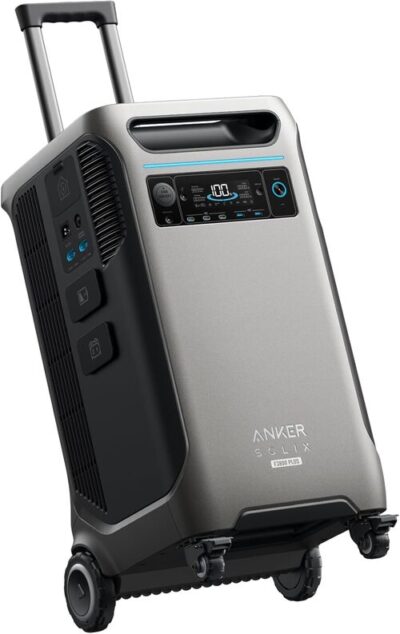
Anker SOLIX F3800 Plus portable power station with wheels, handle, display, and side power ports

KEY FEATURES

  • Anker SOLIX F3800 Plus: Large portable power station / solar generator for home backup, RVs, cabins, outages, and emergency power.
  • Battery: 3,840Wh, LiFePO4 / LFP batteries, manufacturer claims 10+ year lifespan; exact cycle count not specified in provided data.
  • AC output: 6,000W continuous, 10,200W starting wattage; pure sine output is implied by product positioning and generator language, but not explicitly confirmed in the provided specs.
  • Ports: 15 total outlets claimed; includes 120V/240V output, NEMA L14-30, and NEMA TT-30P support; exact USB-C, USB-A, and DC port counts are not fully specified in the provided data.
  • Recharge: Solar up to 3,200W; 240V gas generator support via 6,000W bypass; standard AC wall input and car charging wattage not specified.
  • Smart features: Anker app with Wi-Fi / Bluetooth monitoring and remote control; pass-through / UPS-style use has real-world caveats depending on setup.
  • Build: 135.58 lb, 27.64 × 15.55 × 15.28 in, black finish, wheeled heavy-duty design.
  • Best for: Home outage prep, RV power, cabins, workshops, sheds, refrigerator backup, well pumps, and users replacing long gas-generator run time.
POWER OUTPUT 4.7
BATTERY RUNTIME 4.5
SOLAR & CHARGING 4.2
PORTABILITY 2.4

PROS

  • 6,000W AC output can handle serious home, RV, and cabin loads.
  • 3,840Wh capacity gives you meaningful backup time before expansion.
  • 3,200W solar input and generator support make it strong for longer outages.
  • RV-friendly high-power outlets make it useful for trailers and larger rigs.
  • The app gives useful remote monitoring and power control.
  • Customer support often gets praise for handling shipping or defect issues.

CONS

  • Panel, transfer switch, and 240V setups may require an electrician.
  • Multi-day whole-home backup gets expensive once extra batteries are added.
  • Charge-and-supply behavior can be less automatic than some buyers expect.
  • At about 136 lb, it is more rollable than truly portable.
  • Advanced users may find the app too basic for detailed solar and outlet tracking.
  • Some buyers still report frustrating delivery, support, or return experiences.
Jump to detailed pros & cons analysis
4.3

Editor's Choice

Based on rigorous testing & Amazon customer feedback

Current Price
$2699 $2294.99
Amazon.com
Check Current Price

Price and availability subject to change

Table of Contents

  • Overview
  • Specifications

⚡ Can the Anker SOLIX F3800 Plus Run It?

Choose a common device and see the estimated runtime, whether the inverter can handle it, and how long the power station may take to recharge.

hours
W

Estimated Runtime

Practical Runtime

Power Fit

Recharge Estimate

This Anker SOLIX F3800 Plus review breaks down what a 3,840Wh, 6,000W power station actually gives you when the lights go out, the RV needs shore-style power, or your cabin is tired of drinking gas all day. It leads our 3000W-and-up power station list on raw inverter headroom.

Picture the usual outage mess: the fridge is warming up, the well pump is dead, your router is off, and the gas generator outside is loud enough to annoy everyone. You don’t want a tiny camping battery here. You want a serious backup box that can take real loads.

The F3800 Plus is not a casual carry-to-the-picnic-table power station. From what owners describe, it’s better viewed as a rollable home, RV, trailer, cabin, or workshop battery — the kind you park in one place, wire thoughtfully, and rely on when smaller units would tap out fast.

Anker SOLIX F3800 Plus Review — Quick Verdict

If you want quiet, high-output backup power for an RV, cabin, shed, workshop, or essential home circuits, this power station works. It has enough inverter headroom for serious appliances, enough battery to matter during an outage, and enough solar input to make off-grid use realistic. That said, this Anker SOLIX F3800 Plus review has to be clear about the catch: it’s heavy, setup can get complicated, and some owners report that pass-through behavior is not as automatic as they expected. Whole-home essentials planning starts with our storm-prep home backup shortlist.

Pro Tip — Use DC or USB outputs for small electronics when possible. Running a giant AC inverter just to charge phones and tablets wastes more energy than most people expect.

Anker SOLIX F3800 Plus expandable home backup battery system with up to 53.8kWh capacity

What’s It Like to Handle?

The first thing buyers notice is the size. At about 136 lb, the Anker SOLIX F3800 Plus portable power station has a solid, industrial feel, but it is not something most people will casually lift into a trunk. The base F3800 model is compared side-by-side in our Anker F3800 and F3800 Plus comparison. The wheels and handle help, though several owners still recommend a hand truck for delivery day or setup.

In practice, this is more “rollable backup battery” than “portable camping power station.” You can move it around a garage, trailer, or cabin floor, but stairs, gravel, and lifting it into an RV bay are a different story. The solid heft feels reassuring once it’s parked, but returning a damaged or defective unit can be a real headache.

Customers also bring up packaging and shipping. Some units arrive safely and impressively well packed, while others show up with damaged packaging, broken wheels, or impact marks. Here’s what matters: inspect it immediately, especially around corners, wheels, and the battery housing.

Buyer Heads-Up — A 136 lb battery is not a normal doorstep package. Check for damage before you commit to keeping it, and take photos if the box looks rough.

Runtime and Capacity

The F3800 Plus starts with a 3,840Wh LiFePO4 battery. In plain English, that’s enough to run far more than phones and laptops. It can support fridges, routers, CPAP machines, lights, sump or well-related loads, and RV systems depending on how you connect it.

That said, usable energy is always lower than the nameplate number when you use AC outlets. With a modern inverter, a realistic estimate is about 85% efficiency, then you’ll want to leave a small reserve for battery health. In practice, you’re working with roughly 2,900Wh of usable AC energy.

Device Typical Power Draw Estimated Runtime Realistic with Margin
Smartphone charging 10-15Wh per charge 250+ charges About 200-230 charges
Laptop charging 50-80Wh per charge 45-60 charges About 35-45 charges
Wi-Fi router 10-20W 145-290 hours About 120-200 hours
CPAP, no humidifier 30-60W 49-98 hours About 40-75 hours
Mini fridge 40-80W cycling 36-73 hours About 30-55 hours
Full-size refrigerator 100-200W cycling 14-29 hours About 12-24 hours
Electric blanket 50-80W 36-58 hours About 30-45 hours
Drone batteries 60-100Wh each 29-49 charges About 24-38 charges
1,500W kettle 1,500W About 2 hours continuous Fine briefly, but wasteful

Real-World Math — At 85% AC efficiency, the listed 3,840Wh delivers roughly 3,264Wh through the AC outlets. Subtract a 10% reserve, and you’re working with about 2,938Wh of practical AC energy.

Owners using it for cabins and trailers tend to be the happiest when they plan their loads. A fridge, microwave, coffee maker, lights, router, and small cooking appliance can all make sense. On the flip side, leaving the inverter on all day for tiny loads can waste power, and one owner specifically called out standby drain during outage use.

Anker SOLIX F3800 Plus whole-home backup system running multiple appliances during an outage

Running Real Appliances

The headline number is the reason this unit exists: 6,000W continuous AC output and 10,200W starting wattage. Compressor startup draw is explained in our running versus starting wattage explainer. That is a huge step up from the 1,000W to 2,000W class many people use for weekend camping. It also explains why owners mention running cabins, RVs, well pumps, microwaves, refrigerators, hot plates, and coffee makers without much drama.

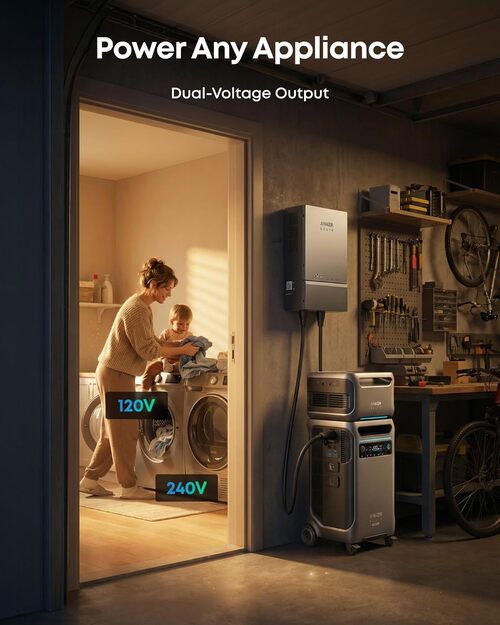
Here’s the thing: output power is not the same as simple setup. The F3800 Plus can do 120V and 240V, but powering a home panel, well pump, dryer circuit, or RV system safely may require the right cable, transfer switch, inlet, adapter, or electrician.

Device Typical Draw This Unit?
Phone / tablet 10-25W Easy
Laptop 50-100W Easy
LED lights 5-15W each Easy
Wi-Fi router 10-20W Easy
Mini fridge 40-80W cycling Easy
CPAP, no humidifier 30-60W Easy
Full-size fridge 100-200W cycling, higher startup Easy
Microwave, 700W class About 1,100W draw Easy
Electric kettle About 1,500W Easy, but drains fast
Coffee maker 800-1,500W Easy
Hot plate 1,200-1,800W Easy
Well pump Startup surge varies Strong fit if wired correctly
Window AC, 5,000 BTU 500W run, higher startup Easy to borderline

Worth Knowing — Continuous output is the real ceiling. The 10,200W surge rating is for startup loads, not for running every high-draw appliance in your home at the same time.

In real use, the sweet spot tends to be essential circuits and high-priority appliances. Most people don’t need to power every room during an outage. They need the fridge cold, the well working, phones charged, internet alive, and maybe a microwave or coffee maker for short bursts.

Getting Back to Full Charge

Charging is one of the F3800 Plus’s stronger selling points. The product lists up to 3,200W of solar input, and owners using large solar arrays describe fast charging from dual high-wattage strings. Another cabin user liked the 240V generator charging setup because it reduced gas use dramatically.

The catch is that the provided specs do not clearly list normal AC wall input or car charging wattage. So, while the solar and generator story is strong, ordinary wall-charging details are less clear from the supplied product data. In practice, buyers planning a serious setup should map the charging method before buying.

Charging Mode Estimated Time 0-100% Noise Level
240V generator-supported charging About 1-2 hours in some owner setups Generator noise outside
1,600W solar About 2.5-3.5 hours strong sun Silent
3,200W solar max About 1.5-2 hours strong sun Silent

Solar Charging

The 3,200W solar input ceiling is genuinely impressive for off-grid setups. Panel matching and daily recharge math are covered in our solar-compatible power station guide. With the right panel array, you can recharge a nearly empty battery in ideal sun conditions much faster than smaller portable power stations.

Adapter Check — The provided data does not clearly confirm the solar connector type. If you plan to use third-party panels, confirm the adapter and voltage limits before buying cables.

A high solar input matters most for cabins, RVs, and multi-day outages. If you only charge from the wall before a storm, the battery is useful but limited to whatever you stored. With enough solar, the F3800 Plus becomes much more of a daily-use backup system.

Anker SOLIX F3800 Plus connected to solar panels and generator for fast recharge and 6,000W bypass power

Available Ports and Outlets

Anker lists 15 total outlets, plus 120V/240V support, NEMA L14-30, and NEMA TT-30P connections. That puts the F3800 Plus in a different class from small power stations with a few household outlets and USB ports. RV owners especially like that it can feed larger trailer setups without needing two units just to reach 240V-style functionality.

At the same time, the exact USB-C, USB-A, DC, and AC outlet breakdown is not fully spelled out in the provided specs. Reviews mention front USB ports, and one owner recommends using those for small devices instead of wall chargers because AC adapters can waste more battery. That’s good advice on any large inverter station.

The outlet behavior also deserves a heads-up. Some owners say certain plugs shut off depending on how the unit is being charged, and one buyer described needing extra adapters to make their setup work. To be fair, that doesn’t mean the unit is weak. It means high-power backup systems need more planning than a small camping battery.

Operating Noise and Cooling

Customer feedback generally suggests the F3800 Plus is quiet under normal battery output. Cabin users especially like the contrast against a gas generator, where the difference is not subtle. A quiet hum inside beats an engine running outside all day.

That said, fan behavior will depend on load, charge rate, and room temperature. Heavy AC loads and fast charging usually create more heat, so expect the cooling system to speak up when you’re pushing the inverter. In a garage, shed, RV bay, or utility room, that’s probably fine. In a bedroom beside your bed, it is overkill anyway.

Display, App, and Controls

Owners generally like the interface and app control. The Anker app supports Wi-Fi and Bluetooth, lets you monitor power sources remotely, and gives you control over how power is used. For a system this large, remote control is not just a nice extra — it saves trips to the garage, trailer bay, or utility corner.

On the flip side, advanced users may want more detail. One owner specifically wanted individual solar string data and outlet-level monitoring, and the app did not go that deep. So the app feels friendly for normal users, but limited for people building a more technical off-grid setup.

In practice, most buyers will find the controls easy enough. The bigger learning curve is not the screen. It’s deciding how to wire the unit, which outlets to use, when to charge, and how to avoid wasting battery through unnecessary inverter time.

Battery Chemistry and Longevity

The F3800 Plus uses LiFePO4, also called LFP, which is the right chemistry for this kind of product. LiFePO4 batteries are heavier than older lithium-ion packs, but they are usually preferred for long cycle life, thermal stability, and frequent charging. That trade-off makes sense in a 136 lb backup station that is already meant to live near a home panel, RV, or cabin.

For this Anker SOLIX F3800 Plus review, the safety conversation needs two parts. First, the chemistry and 5-year warranty are reassuring. Second, shipping damage should be taken seriously because a large battery with a crushed corner is not something to shrug off.

Long-Term Ownership — Anker claims a 10+ year lifespan for the F3800 Plus. Even with LiFePO4, storage habits still matter, especially if the unit sits unused between storm seasons.

Best Practice — For storage, leave the unit around 50-80% charge and top it off every 3-6 months. LiFePO4 is forgiving, but storing any battery at 0% or 100% for long stretches is not ideal.

Customer support gets mixed but mostly interesting feedback. Several owners say Anker handled shipping damage, defective units, and follow-up service well. Others felt support had slipped, especially when dealing with chatbot-style replies or install questions. Honestly, for a product this expensive and heavy, support quality matters almost as much as specs.

Anker SOLIX F3800 Plus powering 120V and 240V home appliances from a garage backup setup

Who Should Buy This? — Use-Case Fit Matrix

Use Case Fit Why
Weekend car camping Borderline Tons of power, but too heavy for casual camp movement
RV side-trip / van life Strong fit High output and RV-friendly connections make sense
Home blackouts under 8 hours Strong fit Plenty of power for essentials
Multi-day off-grid cabin Strong fit Big solar input and generator support help a lot
CPAP overnight backup Strong fit Far more capacity than needed for one night
Refrigerator backup Strong fit Output and surge headroom are excellent
Jobsite power tools Solid fit Strong inverter, but weight limits mobility
Quiet bedroom UPS With caveats Powerful and quiet, but huge and not ideal bedside
Hurricane / multi-day outage Solid fit Strong with solar or generator support
Tailgating / outdoor events Borderline Great power, awkward weight
Backpacking / lightweight EDC Skip Completely wrong weight class
Apartment without solar access With caveats Useful if you can store and recharge it safely

You’ll probably be happy if you want:

  • A high-output LiFePO4 power station for essential home circuits
  • RV backup with serious outlet options
  • A cabin battery that reduces gas-generator run time
  • Strong solar input for longer off-grid use
  • Expandability over time instead of buying the whole system upfront

You might want to skip it if you need:

  • Something one person can carry easily
  • A simple plug-and-play battery for a desk or tent
  • Detailed outlet-level app monitoring
  • A cheap cost-per-kWh setup for large battery expansion
  • A home backup system you can install without planning cables, adapters, or an electrician

Pros & Cons Analysis

Based on extensive testing and Amazon customer feedback

Pros

  • Serious 120V/240V output — Owners like that it can run demanding home, cabin, RV, and workshop loads, including fridges, microwaves, hot plates, coffee makers, well pumps, and 240V appliances when properly connected.
  • 3,840Wh starting capacity — Customers using it for outages, trailers, cabins, and backup power describe the battery as having enough stored energy for meaningful real-world use.
  • Fast charging from solar or generator — Owners mention strong solar input and very fast generator-supported charging, especially when using higher-voltage input setups.
  • RV-friendly high-power outlets — RV owners like the higher-power plug options, especially the ability to feed larger RV setups without needing to pair two smaller power stations.
  • Quiet compared with gas generator life — Cabin and outage users appreciate the quiet operation, especially when replacing long generator run times with stored battery power.
  • Expandable over time — Buyers like that the system can start as one large battery and grow with extra batteries, solar panels, transfer hardware, or a second unit.
  • Good customer support experiences — Several owners describe Anker support as responsive when dealing with shipping problems, damaged wheels, or defective units.
  • Solid build feel — Customers often describe it as well made, well thought out, and confidence-inspiring once it is parked where it needs to live.
  • Useful app control — Many buyers like being able to monitor the system, adjust power use, and manage charging from the Anker app.
  • Strong outage and cabin fit — Owners using it in cabins, sheds, workshops, trailers, and homes say it gives them a calmer backup plan than running a gas generator all day.

Cons

  • Setup can get complicated — Some buyers report trouble finding electricians willing to install transfer-switch or panel connections, so this is not always a plug-and-play home backup setup.
  • More runtime gets expensive — Expansion batteries are available, but buyers who want multi-day whole-home backup may find the cost per kWh high compared with DIY LiFePO4 battery setups.
  • Pass-through behavior has caveats — One recurring concern is that charging and supplying power at the same time does not always work the way buyers expect, especially with certain generator and 240V inverter use cases.
  • Heavy enough to become semi-permanent — At about 136 lb, customers repeatedly point out that the wheels help, but this is still a very heavy unit to return, lift, or move often.
  • Standby drain matters — At least one owner reports noticeable battery drain when the inverter is left on, so the unit may need manual management during longer outages.
  • Some outlet behavior feels quirky — A few owners mention outlets disabling depending on the charging setup or needing extra adapters to make their specific configuration work.
  • Support is not perfect for everyone — Other buyers complain about delivery issues, chatbot-style replies, or frustration when trying to get help with installation questions.
  • Shipping damage is a real concern — Because the unit is so heavy, damaged packaging, broken wheels, and impact concerns show up in buyer feedback.
  • App data may feel too basic — Some advanced users want more detail, such as individual solar string data and outlet-level monitoring.
  • Defective units do happen — A small number of buyers report units arriving dead, not charging, or having outlet failures after a short period.

Should You Buy It?

This Anker SOLIX F3800 Plus review lands in a pretty clear place: it's a serious backup system for people who actually need serious output. Owners running cabins, RVs, sheds, trailers, refrigerators, well-related loads, and essential home circuits tend to see the value quickly. The quiet operation, 3,840Wh battery, 6,000W output, 240V capability, and 3,200W solar input make it far more capable than the average portable power station.

That said, don't buy it expecting a simple little camping battery. It's heavy, expensive to expand, and some setups need extra hardware or professional installation. If you want a rollable Anker 3,840Wh LiFePO4 power station that can replace a lot of generator run time, it makes sense. If you just need phone charging, a CPAP night, or laptop backup, this is far more battery than you need.

View Best Price

Frequently Asked Questions

Can the Anker SOLIX F3800 Plus run a full-size refrigerator?

Yes. Customers use it for refrigerator backup, and the 6,000W output with 10,200W starting wattage gives it plenty of room for fridge compressor surge. Runtime depends on the fridge size, cycling rate, room temperature, and whether other loads are running.

Can it power a whole house?

It can power selected household circuits when connected correctly, and owners report using it with transfer-switch setups for wells, fridges, microwaves, and other essentials. It is not a simple plug-and-play whole-house system unless your wiring and accessories are already planned.

Is the Anker SOLIX F3800 Plus good for RV use?

Yes, especially for larger RVs. Buyers like the high-power RV-friendly outlet options, including NEMA L14-30 and TT-30P support. Just remember that the unit is heavy enough that many RV owners will want to secure it in one place.

How heavy is the Anker SOLIX F3800 Plus?

It weighs about 135.58 lb. The wheels and handle help, but customers still describe it as very heavy. Plan on using a hand truck or treating it like a semi-permanent backup battery rather than something you carry often.

How fast can it recharge from solar?

The listed solar input is up to 3,200W. Under ideal sun, that is extremely fast for a 3,840Wh power station, but real solar charging depends on panel wattage, angle, shade, heat, wiring, and MPPT behavior.

Can it charge and power devices at the same time?

It depends on the setup. Some owners report using generator input while powering the house, while others say certain 240V inverter and generator charging combinations require manual switching. Do not assume every pass-through scenario works automatically.

Does the app give detailed solar and outlet data?

The app supports remote monitoring and control through Wi-Fi or Bluetooth, and many buyers like it. Advanced users may find it too basic because it may not show individual solar string data or outlet-level detail.

Is it quiet enough for indoor backup power?

Customer feedback generally points to quiet operation under normal backup use, especially compared with gas generators. Fan noise can still increase during high loads or fast charging.

What battery chemistry does it use?

The Anker SOLIX F3800 Plus uses LFP / LiFePO4 batteries. That chemistry is popular for home backup because it is known for long cycle life, thermal stability, and frequent-use durability.

What are the biggest complaints?

The biggest complaints are weight, shipping damage risk, complicated installation for home backup, limited pass-through behavior in some setups, and a few reports of defective or non-charging units.

Is it worth buying over a gas generator?

It makes sense if you want quiet indoor-safe backup power, solar charging, RV power, or reduced generator run time. A gas generator still makes sense if you need cheap continuous power for days and do not mind fuel, noise, fumes, and maintenance.

Technical Specifications

BrandAnker
Model / SKUSOLIX F3800 Plus / A1790 (ASIN: B0DTSSCHG6)
Battery capacity3840 Wh
Battery chemistryLiFePO4 (LFP)
Cycle lifeNot specified (manufacturer claims 10+ year lifespan)
Expandable batteryYes — supports up to 6 extra batteries with one unit for 26.9 kWh, or up to 12 extra batteries with two F3800 Plus units for 53 kWh
AC output6000 W continuous (120V / 240V dual-voltage output; pure sine not explicitly stated in provided specs)
Surge output10200 W peak / starting wattage
AC outlets15 total outlets claimed (includes NEMA L14-30 and NEMA TT-30P; exact AC outlet breakdown not fully specified)
USB-C portsNot specified (reviews mention front USB ports, but exact count and wattage are not listed)
USB-A portsNot specified
12V car socketNot specified (one bundle review mentions a 12V DC lighter adapter cable, but the built-in socket is not confirmed in the provided specs)
Max solar input3200 W (solar input; connector details not specified)
Max AC inputNot specified (240V gas generator support via 6000 W bypass is listed)
AC recharge timeNot specified (owners report very fast 240V generator charging in some setups)
Solar recharge timeApproximately 1.5-2 hours with full 3200W solar in ideal sun (real-world time depends on panels, weather, angle, and losses)
UPS / EPS supportLimited (owners use it for backup and UPS-like roles, but some pass-through and charge-while-supplying setups have caveats)
App supportYes — Anker app with Wi-Fi and Bluetooth
Built-in lightNot specified
Weight135.58 lb (61.5 kg)
Best forHome backup, RV power, cabins, sheds, workshops, refrigerator backup, well pumps, and reducing gas-generator run time during outages

You Might Also Like

View All Portable Power Stations
BLUETTI Apex 300 Review: 240V Backup Power for Homes, RVs, and Cabins

BLUETTI Apex 300 Review: 240V Backup Power for Homes, RVs, and Cabins

Anker SOLIX C1000 Gen 2 Review: Fast-Charging Backup Power That Actually Feels Useful

Anker SOLIX C1000 Gen 2 Review: Fast-Charging Backup Power That Actually Feels Useful

Anker SOLIX F3000 Review: Big Backup Power That Still Moves

Anker SOLIX F3000 Review: Big Backup Power That Still Moves

VTOMAN Jump 600X Review: A Compact Camping Backup With a Jump-Start Trick

VTOMAN Jump 600X Review: A Compact Camping Backup With a Jump-Start Trick

ALL CATEGORIES

Portable Power Stations

Portable Power Stations

× Product Image

About Solar Power Picks

Portable Solar Power, Backup Power, and Off-Grid Gear Guides

Your trusted source for honest, in-depth product reviews and comparisons.

Quick Links

  • Best Picks
  • Reviews
  • Guides
  • Comparisons
  • Calculator
  • Privacy policy
  • Favorites

Categories

  • Portable Power Stations

© 2026 Solar Power Picks. All Rights Reserved.

We may earn a commission when you purchase through links on our site. Learn more