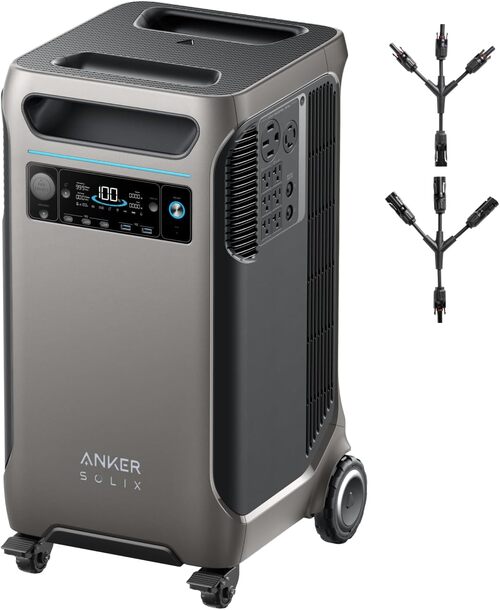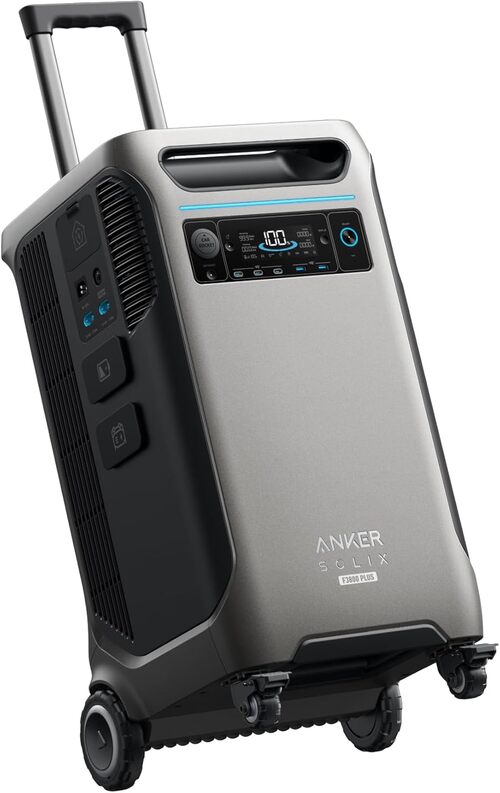
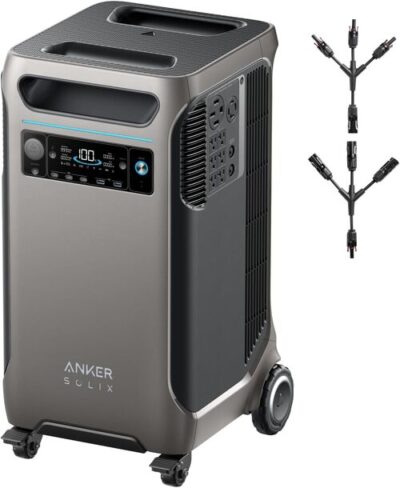
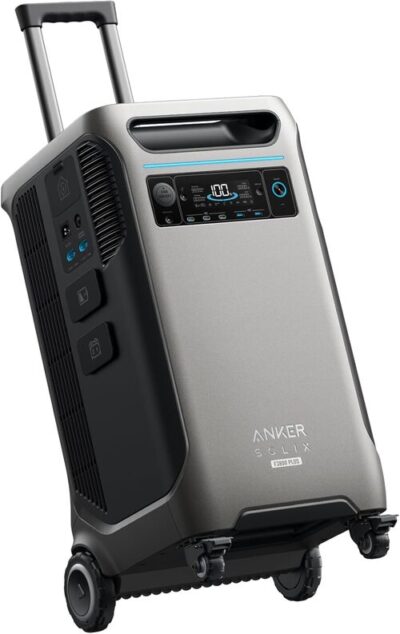
The Anker F3800 vs F3800 Plus comparison looks simple at first. Both have a 3,840Wh LiFePO4 battery, both deliver 6,000W AC output, and both are built for serious 120V / 240V backup. Start with our Anker SOLIX F3800 base model review.
But that’s exactly why the choice can feel annoying. Planning solar recharge? Pair this decision with our solar-panel-ready power station guide. If the base numbers are so close, what are you actually paying for with the F3800 Plus?
The answer comes down to system design. The standard F3800 is the cleaner pick for essential backup and RV-style power. The Plus adds features detailed in our Anker SOLIX F3800 Plus cabin review. The F3800 Plus is better if you care about higher solar input, generator-supported charging, and building a larger backup setup over time. If you’re still deciding what size class you need, start with our portable power stations hub first.
Start Here: The Real Difference
| Question | Better Pick | Why It Matters |
|---|---|---|
| Do you want the simpler 240V backup option? | Anker SOLIX F3800 | Same base battery and same 6,000W output |
| Do you want more solar input? | Anker SOLIX F3800 Plus | 3,200W solar beats 2,400W |
| Do you want RV and cabin flexibility? | Anker SOLIX F3800 Plus | Stronger outlet and charging story |
| Do you want the lowest sensible cost? | Anker SOLIX F3800 | The Plus only pays off if you use its extras |
| Do you need easy portability? | Neither | Both are over 130 lb |
Here’s the practical answer: buy the Anker SOLIX F3800 if you mostly want essential home backup, garage backup, or RV shore-style power. Buy the Anker SOLIX F3800 Plus if you’re building a larger solar, cabin, RV, or outage-prep system.
What Changes on the Plus Model?
The F3800 Plus does not radically change the core power station formula. You still get the same listed battery capacity and the same listed inverter output.
The upgrade is more about how the system can be used.
The Plus model gives you:
- Higher solar input
- More outlet flexibility
- Better fit for RV and cabin setups
- Larger two-unit expansion path
- 240V generator support through a 6,000W bypass setup
The standard F3800 still makes sense because the core performance is already strong. If you don’t need the Plus model’s system-level upgrades, the cheaper standard unit may be easier to justify.
Choose by Setup, Not Just Specs
| Buyer Type | Better Pick | Why |
|---|---|---|
| Essential home backup buyer | F3800 | Same battery and output may be enough |
| RV owner | F3800 Plus | More RV-friendly outlet story |
| Cabin owner | F3800 Plus | Better solar and generator support |
| Short outage prep | F3800 | Lower-cost route if expansion isn’t needed |
| Long outage prep | F3800 Plus | Higher solar input matters more |
| Well pump / sump pump backup | Tie | Same listed output and surge rating |
| Solar-heavy setup | F3800 Plus | 3,200W input gives more recovery room |
| Buyer worried about weight | Tie | Both are heavy rollable systems |
For most backup buyers, the decision is not about whether the Plus is “more powerful.” It’s about whether your setup benefits from the added solar, outlet, and expansion flexibility.
Runtime Reality: Same Battery, Similar Limits
Both models start with a 3,840Wh battery, so runtime is more similar than the product names suggest.
Using a practical AC estimate, the standard F3800 gives roughly 2,868Wh after inverter losses and a small reserve. The F3800 Plus lands around 2,938Wh using a slightly higher efficiency estimate. In real use, that difference is not huge.
What matters more is load size. A fridge cycling on and off is very different from a heater pulling 1,500W nonstop.
| Load | Typical Draw | F3800 Estimate | F3800 Plus Estimate |
|---|---|---|---|
| Wi-Fi router | 10-20W | ~143-286 hours | ~147-294 hours |
| LED lights | 20W | ~143 hours | ~147 hours |
| CPAP without humidifier | 40-60W | ~48-72 hours | ~49-73 hours |
| Electric cooler | 40-80W average | ~36-72 hours | ~37-73 hours |
| Full-size fridge | 100-200W average | ~14-29 hours | ~15-29 hours |
| Microwave | 1,000-1,500W | Short bursts only | Short bursts only |
| Space heater | 1,500W | About 2 hours | About 2 hours |
These are estimates, not measured test results. Compressor appliances can swing widely because they cycle.
Where the 6,000W Inverter Helps
Both units list 6,000W continuous AC output and 10,200W starting wattage. That is the big reason either model makes sense for home backup and RV power.
That output gives you room for:
- Refrigerators and freezers
- Well pumps and sump pumps
- RV power setups
- Microwaves and coffee makers in short bursts
- Shop tools
- Some 240V appliances
- Transfer-switch backup loads
However, output is not the same thing as runtime. A 6,000W inverter can run serious gear, but the 3,840Wh battery can still drain fast.
So don’t think of either model as a normal whole-home battery unless you add expansion packs. Think of them as high-output backup stations for priority loads.
Power output result: tie. The F3800 Plus does not win on inverter output because both models list the same 6,000W continuous rating.
Charging and Solar: The Plus Pulls Ahead
Charging is where the two models separate more clearly.
The standard Anker SOLIX F3800 has the clearer wall-charging story in the supplied data. Owners report AC charging around 1,800W, with full recharges often landing around 2-3 hours when the battery is warm and charge settings allow it.
The F3800 Plus has less clearly stated standard AC wall input in the provided data. Instead, its stronger charging story is built around solar and generator-supported use.
The solar difference is important:
| Charging Path | F3800 | F3800 Plus |
|---|---|---|
| Max solar input | 2,400W | 3,200W |
| Standard AC input | About 1,800W reported | Not clearly specified |
| Generator support | Not emphasized | 240V generator support via 6,000W bypass listed |
| Best charging use case | Home pre-charge and solar backup | Solar-heavy and generator-supported backup |
If you only charge from the wall before storms, the F3800 is probably fine. If you want to recover energy during long outages, the Plus has the stronger setup.
Before buying panels, confirm voltage, amperage, connector type, and adapter compatibility. Solar input numbers only help if your panels actually match the power station’s limits.
Moving These Around Is the Same Problem
The F3800 weighs 132.28 lb. The F3800 Plus weighs 135.58 lb.
That 3.3 lb difference does not matter in real life. Both are rollable backup systems, not normal portable camping batteries.
Use this weight context:
| Weight Class | What It Feels Like |
|---|---|
| Under 10 lb | Grab-and-go power |
| 10-30 lb | Easy car camping and room-to-room use |
| 30-50 lb | Movable, but not fun |
| 50+ lb | Semi-portable backup power |
| 100+ lb | Wheels matter more than handles |
Both Anker units belong in the last category. They can move across smooth floors, but stairs, gravel, truck beds, and returns are a different story.
Plan the storage location before delivery. A garage, utility room, RV bay, cabin corner, or backup panel area makes more sense than a closet upstairs.
Portability result: tie, with a tiny edge to the standard F3800. In practice, both need the same handling plan.
Battery Chemistry: Good News for Both
Both power stations use LiFePO4, also called LFP. That’s the right chemistry for this kind of large backup battery.
| Battery Type | Why It Matters | Tradeoff |
|---|---|---|
| LiFePO4 / LFP | Better for frequent cycling and long-term ownership | Heavier |
| NMC / lithium-ion | Often lighter in small units | Usually shorter cycle life |
The supplied data does not list a specific cycle-life number for either model. Both are marketed around a 10-year lifespan, and both list a 5-year warranty.
That said, battery care still matters. Avoid storing either unit at 0% for long periods. For normal storage, keeping the battery around 50-80% is usually a safer habit, then topping off before storms.
Cold weather is also worth watching. Owner feedback around the F3800 points to charging slowdowns in cold conditions. Unless Anker confirms different behavior for the Plus, treat both as batteries that prefer moderate temperatures.
App, Outlets, and Day-to-Day Use
The app experience is similar because both use the Anker app with Wi-Fi and Bluetooth. You can monitor power, adjust charge settings, update firmware, and check system behavior remotely.
That’s useful when the unit sits in a garage, RV bay, or utility corner.
The bigger difference is outlet layout. The standard F3800 gives you strong high-power support with NEMA 14-50 and L14-30 use cases. The F3800 Plus lists 15 total outlets and includes RV-friendly support such as L14-30 and TT-30P.
That gives the Plus a more flexible plug-in story, especially for RV owners.
However, the supplied data does not fully specify USB-C, USB-A, DC, or car-socket details for either model. So don’t buy either unit based on phone-charging ports. Buy them for high-output AC, 240V use, solar, and backup integration.
Value: Don’t Pay for Upgrades You Won’t Use
The F3800 Plus is only the better value if you’ll use what makes it different.
If your plan is simple — charge from the wall, run a fridge, power a router, keep lights on, and maybe feed a transfer switch — the standard F3800 may be the smarter buy.
If your plan includes solar recovery, RV use, cabin loads, generator charging, and long-term expansion, the Plus starts to make more sense.
| Value Factor | F3800 | F3800 Plus |
|---|---|---|
| Lower likely upfront cost | Better | Worse |
| Same base capacity | Yes | Yes |
| Same inverter rating | Yes | Yes |
| Better solar ceiling | No | Yes |
| Better expansion path | Good | Better |
| Better RV flexibility | Good | Better |
| Best for simple backup | Yes | Not necessary |
| Best for larger systems | Limited | Yes |
Current prices change too often to lock in a fair $/Wh number here. Before publishing, divide the live price by 3,840Wh, then compare the result against features, not just capacity.