AFERIY P210 Review: A Quiet 2048Wh Backup Station for RVs, Outages, and Off-Grid Weekends
At a Glance
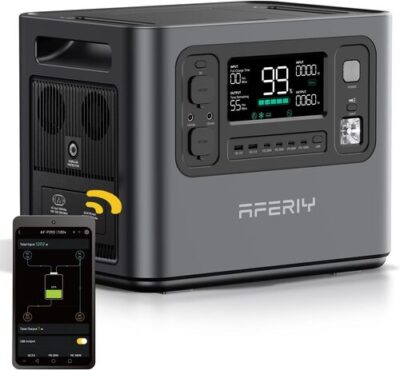
KEY FEATURES
- AFERIY P210: portable power station / battery generator for home backup, RV use, camping, off-grid cabins, and outage prep
- Battery: 2048Wh LiFePO4, claimed 3500+ cycle life
- AC output: 2400W continuous, 4800W surge, pure sine wave
- Ports: 6 AC outlets, 4 USB-C ports including 100W and 20W outputs, 2 USB-A ports, 12V car outlet, 2 DC5521 ports, 12V/25A XT60 DC output
- Recharge: AC up to about 1100W with adjustable charge rates, solar up to about 500W based on owner reports, car charging supported with the right cable
- Smart features: app control, live input/output monitoring, adjustable charge settings, UPS/pass-through support with less than 10ms claimed switchover
- Build: listed at 54 lb, 15.43" × 10.98" × 12.72", ABS body, fixed side handles, included dust cover and cable pouch
- Best for: short blackouts, RV power, camping, CPAP backup, fridge backup, Starlink, ham radio, power tools, and off-grid weekend cabins
PROS
- 2,048Wh LFP battery and 2,400W pure-sine output at a value price.
- Broad AC, USB-C, USB-A, 12V, and XT60 output selection.
- Adjustable AC charging, 500W solar, app, and UPS functions.
- Long seven-year stated warranty.
CONS
- 500W solar ceiling is modest for a 2,048Wh battery.
- At 22kg, it is a base-camp or home station rather than luggage.
- App, UPS recovery, charging, and support should be tested early.
- Warranty value depends on seller eligibility and documentation.
Editor's Choice
Based on exact documentation and qualitative exact-ASIN owner evidence; no hands-on test or population-rate claim
⚡ Can the AFERIY P210 Run It?
Choose a common device and see the estimated runtime, whether the inverter can handle it, and how long the power station may take to recharge.
Picture this: the power cuts out, your fridge starts warming up, the router is dead, and your phone is already low. Or maybe you’re in an RV, trying to run Starlink, lights, a small fridge, and a coffee maker without firing up a gas generator at night.
The AFERIY P210 isn’t a whole-home backup system. In practice, it’s better viewed as a quiet, high-capacity battery for real essentials — fridges, CPAP machines, laptops, fans, routers, TVs, small appliances, tools, and weekend off-grid comfort.
The AFERIY P210’s appeal is straightforward: 2,048Wh of LFP storage, 2,400W pure-sine output, a broad port set, app support, under-10ms UPS specification, and a seven-year warranty at a value-oriented price. The defensible buying question is whether the buyer is willing to commission a budget platform as carefully as a premium one. A long warranty headline is useful only when the exact seller, region, serial, procedure, and evidence are preserved.
The large owner set covers refrigerators, pumps, cooking devices, tools, camping, outage backup, solar, runtime, UPS, app setup, fan noise, shipping condition, faults, and support. Many accounts describe good value and successful high-load use; others describe setup, software, charging, or remedy friction. This is qualitative evidence for a test plan, not a population failure rate.
| P210 claim | Useful interpretation | Acceptance proof |
|---|---|---|
| 2,400W AC | Strong 120V appliance and tool headroom | Repeated startup with intended combined loads |
| 2,048Wh | Several hours of moderate use, not fixed appliance runtimes | Measured full-cycle watt-hours and reserve |
| 500W solar | Meaningful daytime recovery with a valid array | Cold Voc, current, polarity, connector, and logged input |
| UPS under 10ms | Potential continuity for compatible equipment | Exact-load interruption, shutdown, and restoration drill |
| Seven-year warranty | Long stated remedy period | Eligible seller, registration, serial, receipt, and documented procedure |
The solar ceiling is modest compared with the battery and inverter. At 500W nameplate input, a full recharge already requires several favorable sun-hours before conversion loss or active loads. The 11.5–50V, 20A boundary is more important than panel wattage. Calculate cold Voc and operating current, verify XT90 wiring and polarity, and record daily harvested watt-hours.
UPS use requires more than observing a quick transfer once. Test the intended router, computer, refrigerator controller, or medical-adjacent equipment; then continue through reserve, shutdown, and utility restoration. Some devices require a dedicated UPS regardless of the P210’s transfer specification. Never make an untested portable station the sole power source for critical medical care.
Evidence-led verdict: the P210 is attractive hardware value for a buyer willing to perform a formal acceptance week. Buyers who value effortless app behavior and a mature service path more than capacity per dollar should price that ownership model explicitly.
P210: A Budget Two-Kilowatt-Hour Acceptance Test
If you want a large battery station for RV life, outage prep, camping, or a quiet indoor backup, the P210 does a lot right. It has real capacity, a strong 2400W inverter, fast AC charging, and a port lineup that fits mixed gear instead of just phones and laptops. For this AFERIY P210 review, the big caveat is UPS mode: battery-only output can handle far more than the plugged-in UPS/pass-through mode, which some owners found limiting or unreliable for critical appliances. EcoFlow alternatives at this capacity are compared in our Pecron and EcoFlow value breakdown.
Forty-Eight Pounds Belongs at Base Camp
The P210 has the solid heft you expect from a 2048Wh LiFePO4 station. Customers describe it as compact for the capacity, but no one should confuse this with a grab-and-go power bank. At around 50 lb class, it’s portable in the RV, garage, boat, cabin, and car-camping sense.
That said, the fixed side handles help. Owners mention moving it around the house, loading it into vans, placing it on carts, and even using rolling dollies to avoid bending. Honestly, that’s the right mindset with this kind of power station: carry it when needed, but park it where it works.
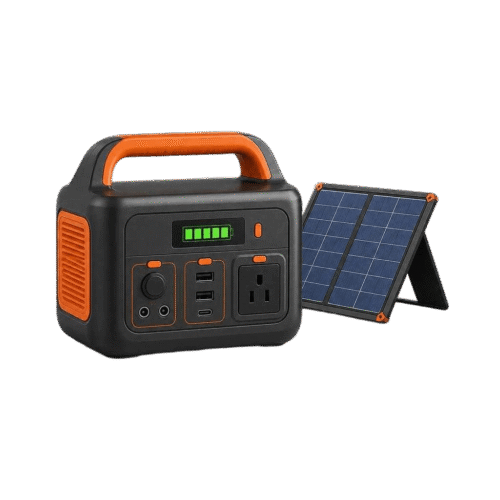
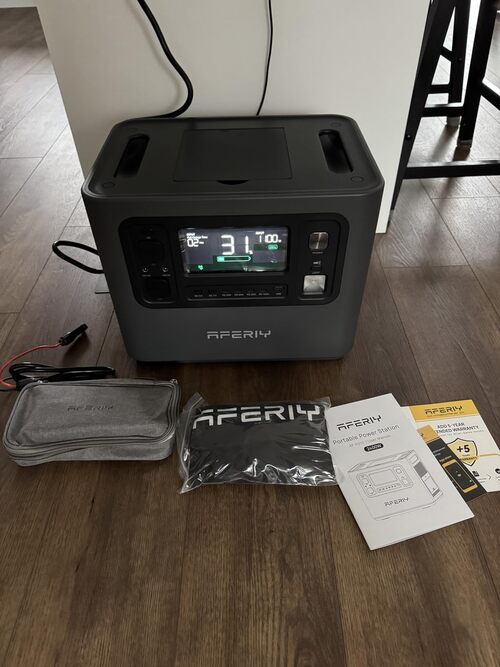
The body is mostly practical rather than fancy. You get a large front screen, covered ports, top cable storage, a dust cover, and a fairly boxy shape that sits neatly under a desk, in an RV bay, or near a breaker-panel-style backup setup. On the flip side, side-mounted outlets can be annoying if the station is squeezed between seats or furniture.
Buyer Heads-Up — Treat the P210 like a small appliance, not a lightweight gadget. It’s manageable for many adults, but a cart makes regular indoor movement much easier.
Allocate 2,048Wh Across Essential Loads
The AFERIY 2048Wh LiFePO4 power station has enough battery to be useful in real situations. In practice, owners use it for overnight RV loads, full-size fridges, CPAP machines, TVs, routers, Starlink, fans, coffee makers, and off-grid cabin routines. You’ll still want realistic expectations, though, because AC inverter losses and standby draw eat into the nameplate capacity.
For calculator-style planning, assume about 0.83 AC efficiency and a 10% reserve. That gives you roughly 1,530Wh of practical AC energy before you start pushing the battery harder than most owners should for daily use. DC and USB loads usually do better because they skip the AC inverter.
| Device | Typical Power Draw | Estimated Runtime | Realistic with Margin |
|---|---|---|---|
| Smartphone charging | 10-15Wh per charge | 120-160 charges | About 100-130 charges |
| Laptop | 50-80Wh per charge | 21-34 charges | About 18-26 charges |
| Wi-Fi router | 10-20W | 76-153 hours | About 65-100 hours |
| CPAP machine, no humidifier | 30-60W | 25-51 hours | About 20-40 hours |
| CPAP with humidifier | 50-90W | 17-31 hours | About 14-24 hours |
| Mini fridge | 40-80W cycling | 19-38 hours | About 16-30 hours |
| Full-size refrigerator | 100-200W cycling plus surge | 7-15 hours | About 6-13 hours |
| Electric blanket | 50-80W | 19-31 hours | About 16-25 hours |
| Starlink and router setup | 60-120W | 12-25 hours | About 10-20 hours |
| 1500W kettle or heater | 1500W | About 1 hour theoretical | Brief bursts only |
Real-World Math — At 0.83 AC efficiency, the listed 2048Wh battery delivers roughly 1700Wh through the AC outlets. Subtract a 10% reserve, and you’re working with about 1530Wh of practical AC energy.
Worth knowing, some owners report better experiences when running DC loads directly. A 12V fridge, diesel heater, Starlink Mini, or radio setup can be a smarter match for the XT60, car outlet, or USB-C ports than leaving the AC inverter running all day.
The 2,400W Inverter Needs a Startup Order
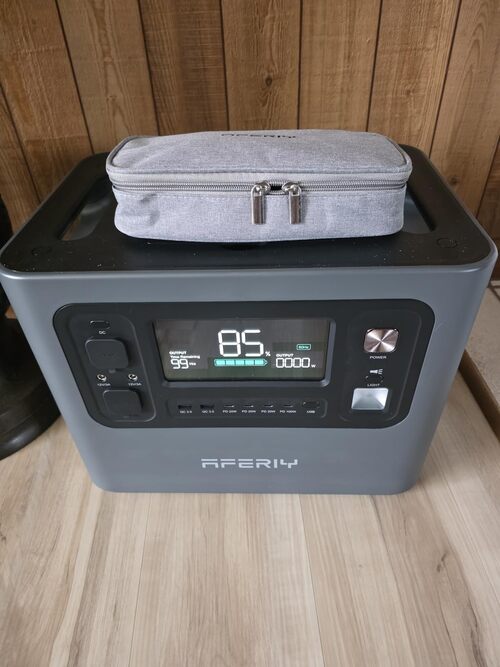
The catch is runtime. A coffee maker or microwave may run fine, but high-wattage heat loads turn a big battery into a short-session battery. Also, UPS mode is different from battery-only mode, and several customers found the live pass-through limit closer to 1200W.
| Device | Typical Draw | This Unit? |
|---|---|---|
| Phone / tablet | 10-25W | Easy |
| Laptop | 50-100W | Easy |
| LED lights | 5-15W each | Easy |
| Wi-Fi router | 10-20W | Easy |
| Mini fridge | 40-80W cycling | Easy |
| CPAP, no humidifier | 30-60W | Easy |
| CPAP, humidifier on | 50-90W | Easy |
| Full-size fridge | 100-200W cycling, 600W surge | Easy |
| Starlink | 50-100W | Easy |
| Microwave, 700W class | About 1100W draw | Easy |
| Coffee maker | 850-1400W | Easy, but drains fast |
| Toaster oven | 1200-1800W | Briefly only |
| Hair dryer | 1500-1875W | Briefly only |
| Window AC, 5000 BTU | 500W run, 1100W surge | Borderline |
| Corded power tool | 600W run, high surge | Easy to borderline |
| Large air compressor | High surge | Borderline |
Worth Knowing — Continuous output is the real ceiling. The 4800W surge rating only lasts a short time — useful for starting compressors, not for running a giant load continuously.
In practice, the sweet spot is appliances under about 1500W and mixed loads under 1000W. You can run a fridge, router, lights, and a TV for a practical outage setup. Trying to treat it like a full 15A household circuit while plugged into UPS mode is where disappointment starts.
Fast Wall Recovery, Modest Solar Ceiling
AC charging is one of the P210’s stronger everyday features. Owners repeatedly describe fast wall charging, with high-rate AC charging landing around the two-hour mark. At the same time, people who cycle the unit daily often prefer slower settings like 300W or 500W to keep heat down and treat the LiFePO4 pack gently.
Solar is useful, but it’s not the star of the show. Customer feedback points to about a 500W solar ceiling, and some owners mention the voltage cap making panel matching less simple than expected. In practice, 200W to 400W of panels feels more realistic for many campers unless you already understand solar wiring.
| Charging Mode | Time, 0% to 100% | Noise Level |
|---|---|---|
| Low AC charge, 300W | About 7 hours | Quiet |
| Medium AC charge, 500W | About 4-5 hours | Quiet to moderate |
| Higher AC charge, 900W | About 2.5 hours | Moderate |
| Fast AC charge, 1100W | About 2 hours | Noticeable fan possible |
| Car, 12V | About 20+ hours | Silent, aside from vehicle |
| 100W solar | About 22-28 hours strong sun | Silent |
| 200W solar | About 11-14 hours strong sun | Silent |
| 400W solar | About 5.5-7 hours strong sun | Silent |
| 500W solar max | About 4.5-6 hours strong sun | Silent |
AC Charging — Select the Rate and Circuit Together
AC charging is fast for the class. Here’s the thing: fast charging is best when you’re preparing for an outage, refilling from a generator, or topping off during a short window. For storage and daily cycling, slower charge rates make more sense.
Solar Charging — 11.5–50V Is the Design Boundary
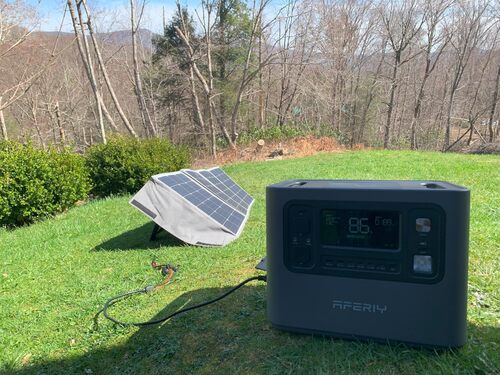
With solar, the P210 works best for people who are willing to check panel voltage, cable type, and real wattage. Some owners get solid results, including strong output from AFERIY panels and third-party setups. On the flip side, one recurring complaint is that maxing out the 500W solar input is harder than just buying any random panel pair.
Adapter Check — Third-party solar can work, but check the connector and voltage before buying panels. A simple MC4-to-XT90-style adapter may solve the cable problem, but it will not fix a panel-voltage mismatch.
Car Charging — A Slow Emergency Route
Car charging is helpful for road trips, but it’s not a fast refill method. Use it as a slow top-up between campsites, not your main plan for recovering a 2048Wh battery after a long night.
Thirteen Connections and Their Shared Budgets
The port mix is a major reason people like this station. You get six AC outlets, four USB-C ports, two USB-A ports, a 12V car outlet, two DC5521 ports, and a 12V/25A XT60 output that stands out for higher-draw DC gear. That XT60 port is especially useful for overland fridges, Starlink-style setups, and 12V equipment that benefits from avoiding AC inverter losses.
That said, layout still matters. Some owners find the side outlets awkward in tight vehicle spaces, and bulky wall adapters can crowd nearby plugs. The top storage compartment is handy for cables, though a few users wish it were large enough for more accessories and paperwork.
Pro Tip — Use DC output when your device supports it. A fridge or Starlink setup on DC can stretch runtime compared with running an AC brick through the inverter.
Below-60dB Is Not a Silent-Under-All-Loads Promise
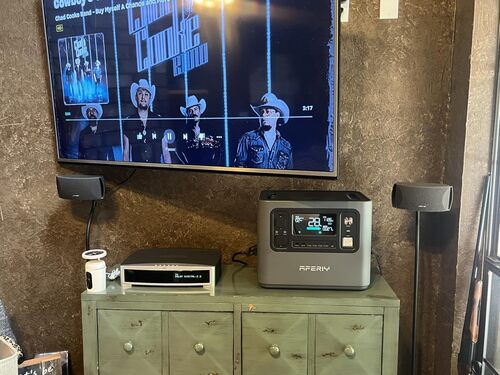
The P210 is quiet under light and moderate loads. Owners often describe it as much quieter than gas generators and quieter than other power stations they’ve tried. For RV nights, bedroom CPAP backup, living-room TV backup, and home-office use, feedback generally sounds positive.
At the same time, the fan can still come on during charging or heavier AC use. You may hear a soft whoosh rather than a harsh buzz, but it’s still a 2048Wh unit with a powerful inverter and charger inside. In real use, it’s best placed a few feet away from your pillow if you’re sensitive to fan noise.
Local Control First, App as a Verified Convenience
The display is large and easy to read, with battery percentage, input watts, output watts, and time estimates. Customers like being able to see how much power an appliance is drawing in real time. On the flip side, a repeated gripe is that the display does not fully turn off during operation, which can be annoying in a dark room.
The app adds useful control without making the unit feel complicated. You can monitor power, adjust charging behavior, and change settings that are not obvious from the buttons alone. That said, some buyers had to learn that the working app may be called BrightEMS, which is not exactly intuitive.
For beginners, the AFERIY P210 portable power station is still fairly easy to use. Plug it in, charge it, turn on the output section you need, and watch the screen. In practice, the app is more of a helpful control panel than a requirement.
Seven-Year Warranty Meets a Documentation Workflow
The P210 uses a LiFePO4 battery, which is the right chemistry for this kind of product. LiFePO4 is heavier than older lithium-ion packs, but it is generally preferred for long cycle life, safer thermal behavior, and frequent use. For RV owners, cabin users, and people who expect to cycle the station weekly, that matters.
AFERIY claims 3500+ cycles and offers an extended warranty path. Many owners like that, and plenty report quick warranty-registration responses. To be fair, others found the registration process clunky, especially when extra information was requested or when accessory expectations were unclear.
Long-Term Ownership — 3500+ claimed cycles means this battery is built for repeated use, not just emergency storage. Weekly cycling could last for years before noticeable aging becomes the main issue.
Cold weather is the one chemistry caveat. LiFePO4 batteries should not be charged below freezing unless the system has proper low-temperature protection and warming. If you’re living in an RV through winter, keeping the station inside the heated space is the safer move.
Best Practice — For storage, leave the unit around 50-80% charge and top it off every 3-6 months. LiFePO4 handles deep cycles well, but long-term storage at 0% or 100% is still hard on the battery.
UPS mode deserves a special mention. Many owners use it successfully for PCs, routers, TVs, RV systems, and small backup loads. On the flip side, a few report random AC outlet shutoffs, charge-state quirks, or disappointment with the lower plugged-in output limit, so I would not rely on it unattended for a freezer full of food without testing your exact setup first.
P210 Value-versus-Support Matrix
| Use Case | Fit | Why |
|---|---|---|
| Weekend car camping | Strong fit | Big battery, many ports, quiet operation, and enough output for cooking bursts |
| RV side-trip / van life | Strong fit | Great capacity and 2400W output, especially if kept inside and charged from AC or solar |
| Home blackouts under 8 hours | Strong fit | Easily covers router, TV, lights, phones, and many refrigerator setups |
| Multi-day off-grid cabin | Solid fit | Works well if paired with solar or generator charging, but 500W solar input limits recovery speed |
| CPAP overnight backup | Strong fit | Enough capacity for multiple nights depending on humidifier use |
| Refrigerator backup | Solid fit | Handles fridge surge well, but test runtime with your actual appliance |
| Jobsite power tools | Solid fit | Strong inverter, though air compressors and big surge tools can be borderline |
| Quiet bedroom UPS | With caveats | Quiet enough, but display behavior and UPS reliability complaints matter |
| Hurricane / multi-day outage | Solid fit | Very useful with solar or generator support, but not a whole-home battery |
| Tailgating / outdoor events | Solid fit | Plenty of AC and USB ports, but weight makes a wagon smart |
| Backpacking / lightweight carry | Skip | Too heavy for anything beyond vehicle-based travel |
| Apartment without solar access | Strong fit | Fast AC charging makes it useful even without panels |
The P210 Value Case Holds When
- A large LiFePO4 station for RVs, camping, boats, or off-grid weekends
- A quiet backup for fridge, router, TV, CPAP, and phone charging
- A powerful inverter that can handle coffee makers, microwaves, and tools in short bursts
- Adjustable AC charging instead of one fixed wall-charge speed
- A value-focused alternative to bigger-name 2048Wh stations
Pay More for a Different Ownership Model When
- A lightweight power station for carrying long distances
- Full 2400W output while plugged in as a UPS
- A hands-off critical backup for a freezer or medical device without testing
- Very high solar input for fast off-grid recovery
- A polished app and manual experience with no tinkering
Pros & Cons Analysis
Based on documented specifications and owner feedback
Pros
- Strong hardware value — Two kilowatt-hours and a 2,400W inverter cover many home, RV, camp, and worksite essentials.
- Port coverage reduces adapters — High-power USB-C, AC, car, DC5521, and XT60 outputs support mixed equipment.
- Charging rate can match the setting — Adjustable AC input lets the buyer balance speed, branch-circuit headroom, heat, and noise.
- LFP and long warranty support regular use — The chemistry and stated remedy period suit buyers planning repeated backup cycles.
- Owner use cases are extensive — The supplied evidence supports appliances, tools, refrigeration, camping, solar, and outage roles.
Cons
- Solar can lag the daily load — A 500W ceiling requires disciplined energy use when the station supports multi-kilowatt appliances.
- Acceptance testing is part of the bargain — App, charging, UPS, noise, output, and restoration should be proven during the return window.
- Weight limits spontaneous movement — A 22kg station needs a designated location, lifting plan, and cable protection.
- Support evidence is mixed — Precise records and early contact matter more than the seven-year headline alone.
- Port count is not simultaneous unlimited power — AC, DC, and USB groups have shared limits that must be respected.
Our Verdict
This AFERIY P210 review comes down to one simple point: the hardware is strong for the money, but the best buyers will understand its limits. The 2048Wh battery, 2400W pure-sine inverter, fast AC charging, quiet operation, and useful DC options make it a genuinely useful backup station for RVs, blackouts, camping, cabins, and home essentials.
That said, don't buy it expecting a perfect UPS or a lightweight solar-first setup. Buy it because you want a powerful LiFePO4 battery station that can run real appliances, recharge quickly from AC, and cover the practical stuff when the grid goes down. For that job, the P210 makes a lot of sense.
Frequently Asked Questions
Can the AFERIY P210 run a full-size refrigerator?
Yes, many owners use it for refrigerator backup. Runtime depends on the fridge, room temperature, door openings, and compressor cycling, but buyers commonly report it working well for outage use. Leave extra margin because startup surge and inverter losses reduce real runtime.
How long will the AFERIY P210 run a CPAP machine?
For a CPAP without heated humidification, expect roughly one to three nights depending on pressure settings and accessories. With humidity and a heated tube turned on, runtime drops, but customers still report multi-night use in lighter setups.
Can it run a microwave, coffee maker, or toaster oven?
Yes, the 2400W inverter can handle many kitchen appliances one at a time. Customers mention coffee makers, microwaves, induction cooking, and toaster ovens, but these loads drain the battery quickly and should not all be run together.
How fast does the AFERIY P210 recharge from AC power?
Owners commonly describe full AC charging at the highest setting in roughly two hours. The unit also supports slower charge rates, which many long-term users prefer for lower heat and gentler battery care.
How much solar input does the AFERIY P210 support?
Customer feedback points to a maximum solar input around 500W, with a voltage limit that can make panel matching tricky. Third-party panels can work, but you may need the right MC4-to-XT90 or compatible adapter cable.
Does the UPS mode work reliably?
Many owners have good results using it for computers, RV power, routers, TVs, and small backup loads. That said, some report random AC outlet shutoffs or a lower live-load limit around 1200W in UPS mode, so it is not the safest choice for unattended critical freezer or medical backup.
Is the AFERIY P210 pure sine wave?
Yes, the product is listed as pure sine wave, and owners use it with sensitive electronics such as laptops, ham radio gear, routers, TVs, and computers.
Is the AFERIY P210 quiet enough for indoor use?
Yes for most people. Customers often describe it as very quiet under light to moderate loads, though the fan can become more noticeable during heavy AC output or fast charging.
Is the app required?
No, the basic buttons and screen are enough for normal use. The app is helpful for adjusting charge rates, checking input and output watts, setting limits, and controlling outputs remotely. Some users note that the working app may appear as BrightEMS.
Can you use third-party solar panels?
Yes, but panel matching matters. Owners mention using third-party panels successfully when the voltage, wattage, and connector setup match the station. Plan on checking the solar voltage cap and buying an adapter if your panels do not plug in directly.
How heavy is the AFERIY P210?
The listed weight is 54 lb, while many customers describe it as roughly a 50 lb class power station. It is portable in the car-camping or RV sense, not something most people will want to carry long distances.
What are the biggest drawbacks?
The biggest trade-offs are weight, the UPS live-load limitation, solar input limits, occasional app/setup confusion, display behavior, and mixed support experiences around warranty registration or accessories.
Technical Specifications
| Brand | AFERIY |
|---|---|
| Model / SKU | P210 (ASIN: B0DRYQSXWV) |
| Battery capacity | 2048 Wh |
| Battery chemistry | LiFePO4 (LFP) |
| Cycle-life rating | 3500+ cycles |
| Expandable capacity | No |
| Continuous AC output | 2400 W continuous (pure sine wave) |
| Surge / peak output | 4800 W peak |
| AC voltage, frequency, and waveform | 120V AC, pure sine wave; frequency not published for this exact model |
| AC outlets | 6 × 120V AC outlets |
| High-current, RV, or 240V output | No dedicated RV, 30A, 240V, or other high-current AC outlet published for this exact model |
| USB-C outputs | 4 × USB-C (includes 100W and 20W outputs) |
| USB-A outputs | 2 × USB-A |
| 12V / DC outputs | 1 × 12V car outlet; 2 × DC5521 ports, 1 × 12V/25A XT60 output |
| Maximum solar input | About 500 W |
| Solar input range and connector | Not published for this exact model in the current source set; exact PV voltage/current window and connector are unavailable |
| Maximum AC input | 1100 W |
| AC recharge time | About 2 hours (high AC charge setting) |
| Solar recharge estimate | Planning estimate: about 4-6 hours with maximum solar in strong sun (real time depends on panels, voltage, and weather) |
| UPS / EPS support and transfer time | Yes — less than 10ms manufacturer-rated switchover |
| App / connectivity | Yes |
| Operating temperature / weather rating | Not published for this exact model in the current source set |
| Dimensions | 15.43" × 10.98" × 12.72" |
| Weight | 54 lb |
| Warranty | Not published for this exact model in the current source set |