
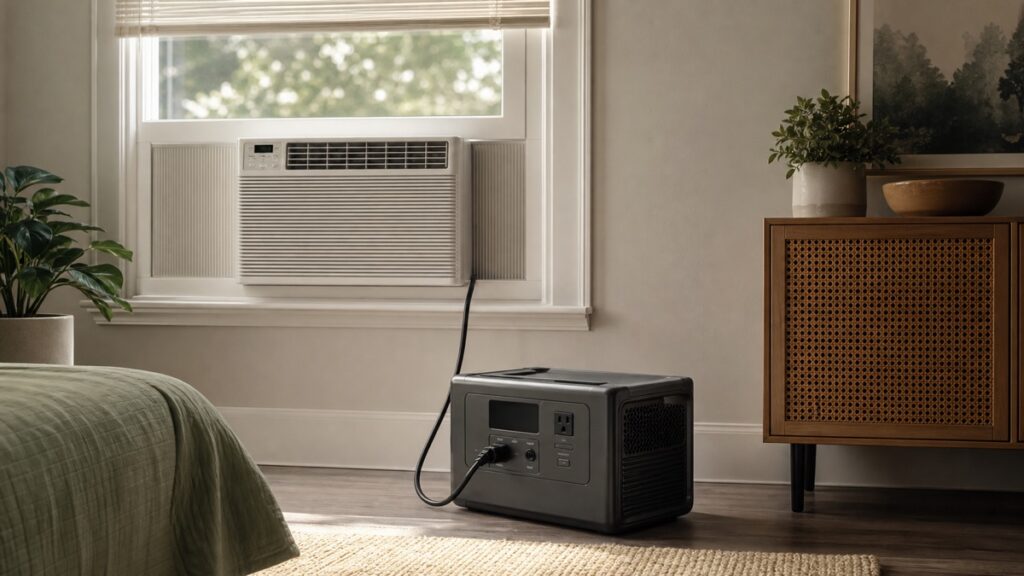
A portable power station can run some room air conditioners, but “how many BTUs?” and “how many watts?” are different questions. BTU capacity describes cooling output. The station must satisfy the exact AC’s voltage, plug, continuous input, documented startup behavior, and runtime under the weather scenario. A station can start an AC yet run it for too little time—or store enough energy but fail the first compressor event.
Room area, insulation, sun, people, ceiling, climate, and BTU capacity matter.
Voltage, watts, current, startup, outlet, battery energy, temperature, and duty cycle matter.
Cooling Load and Electrical Load Are Separate Questions
Choosing an undersized AC can create long or continuous compressor operation, reducing battery runtime and comfort. Choosing an oversized unit can also produce undesirable cycling or humidity control. Frigidaire’s room-size chart is useful as a general starting point, but the manufacturer explicitly notes that it does not account for factors such as vaulted ceilings and insulation and recommends professional help when needed.
Once the room-side sizing is reasonable, move to the electrical nameplate. Record exact model, input voltage, rated amps or watts, plug/circuit requirement, operating modes, and any documented startup or current-limiting behavior. Never derive electrical watts directly from BTUs. Efficiency ratings connect cooling and electrical performance under defined test conditions; they do not replace the exact input label for station compatibility.
Do not multiply running watts by two, three, or another universal factor. Enter a startup value only when the exact AC manufacturer documents it or a qualified person measures the event with suitable equipment. “Inverter compressor” is not by itself a numeric startup specification.
Model the Exact Air Conditioner and Weather Scenario
The tool shows 25%, 50%, 75%, and 100% compressor-duty scenarios rather than a single runtime. Average draw is the running input during the active share plus fan/standby draw during the remaining share, with any simultaneous loads added. The energy available to those loads is reduced by the entered conversion efficiency and reserve.
For a variable-speed AC, “duty cycle” is a simplification: the compressor may modulate rather than switch fully on and off. Use the bands as planning brackets and replace them with observed station draw during controlled commissioning. The exact model and conditions remain decisive.
Starting Behavior Must Come From the Model, Not a Multiplier
If startup is unknown, the calculator returns caution even when running watts fit. A station’s peak or surge rating also needs duration and mode context. Some “power lifting” modes reduce voltage and may not be appropriate for an AC compressor. Use the standard output specification unless both manufacturers document another compatible behavior.
After a startup candidate passes on paper, test first at moderate ambient conditions and a moderate set point. Watch the complete cycle: fan start, compressor start or ramp, stabilized draw, thermostat transition, restart, and grid-loss/recovery behavior if automatic backup is required.
Runtime Expands and Contracts With Duty Cycle
Air-conditioner draw is weather-dependent. A station tested on a mild evening may appear to provide long runtime, while the same room during a sunny heat wave keeps the compressor operating much more often. Open doors, poor window sealing, uninsulated walls, high humidity, added occupants, cooking, and a low set point can all shift the scenario.
| Scenario | Why duty can change | Planning response |
|---|---|---|
| Mild night | Lower outdoor and solar heat load | Use the low-duty band only after observation. |
| Sunny afternoon | Window and envelope heat gain | Plan near the higher-duty bands. |
| Outage shelter room | One sealed room rather than whole home | Reduce the cooled volume safely and shade windows. |
| Very hot start | AC must pull down room temperature | Expect high initial duty before cycling settles. |
| Poor installation | Hot-air leakage or blocked airflow | Correct installation; do not compensate only with battery. |
Measure stabilized input across multiple compressor states, not a single display snapshot. Keep the station within its temperature and ventilation limits. If the station or AC derates or faults in heat, the paper runtime is irrelevant.
Confirm voltage, plug, fan behavior, compressor start or ramp, and the station’s peak response.
Record stabilized draw, compressor-off draw, restart behavior, and whether eco settings interfere.
Compare Wh decline, duty behavior, room comfort, station temperature, and any derating with the conservative band.
Convert those observations into an outage operating rule. Define the room that will be cooled, the set-point range, doors and windows that remain closed, nonessential station loads that stay off, the minimum battery reserve, and the condition that triggers relocation. A successful mild-weather demonstration is not permission to assume identical performance during a heat emergency.
If the first cycle consumes more energy than the selected band predicts, keep the observed value rather than adjusting efficiency upward to make the estimate fit. If the room never reaches a stable temperature, the cooling-side plan needs attention even when the electrical connection remains within limits.
BTU Ratings Do Not Replace the Electrical Nameplate
One official example makes the distinction concrete. LG’s LW2217IVSM specification lists 22,000 BTU of cooling, 230/208V input, 2,190W at either listed voltage, and rated current of 11.6/10.5A. The BTU number addresses room cooling; the voltage, watts, current, plug, and circuit determine electrical fit. This model also illustrates why a 120V-only station is excluded before battery size is considered.
This is not a recommendation to run that AC from a portable station, nor a startup specification. It is a nameplate-reading example from an official product sheet. A smaller 120V window unit, portable dual-hose unit, inverter window unit, RV air conditioner, mini-split, and central system each require their own documentation and connection analysis.
Use the Frigidaire room-size chart as general cooling context, then confirm the chosen exact AC with the manufacturer or HVAC professional. Never calculate electrical watts from a BTU table alone.
A 240V Air Conditioner Changes the Station Shortlist
A 208/230/240V unit requires a station or approved system that supplies its exact voltage and connection. Even among 240V-capable stations, outlet behavior differs. EcoFlow says the US DELTA Pro 3 uses selectable 120V and 240V outlet groups rather than energizing both simultaneously. Anker says the US F3800’s 240V ports do not operate while its three 120V ports are in UPS mode.
Voltage → exact receptacle/approved connection → continuous watts and current → documented startup magnitude and duration → mode/UPS behavior → usable energy → heat and runtime commissioning.
If the air conditioner is hardwired, part of a building system, or served by a transfer device, this is no longer a simple direct plug-in exercise. Use an approved home-backup configuration and qualified installation. Never backfeed a panel through a receptacle. The 120V-versus-240V circuit guide covers the voltage topology in more detail once published.
Commission Cooling in Controlled Steps
- Verify the identity. Record exact AC and station models, regional manuals, firmware, voltage, plug, circuit, and output mode.
- Start with fan-only mode. Confirm connection and baseline draw without invoking the compressor.
- Request moderate cooling. Observe the first compressor event and stabilized operation without other station loads.
- Observe a full cycle. Record ramp/start, run, thermostat transition, off-state draw, and restart.
- Add only planned loads. Keep combined continuous and startup demand inside every outlet and inverter limit.
- Test realistic heat. Increase conditions gradually while maintaining station ventilation; stop on warning, heat, odor, damaged connection, or fault.
- Test outage transfer separately. If required, use the documented UPS/EPS path and verify both loss and restoration with acceptable consequences.
- Log battery decline. Compare observed Wh per hour with the tool’s bands and retain a reserve.
Do not use life-threatening heat conditions as an experiment. People who are medically vulnerable to heat need an emergency plan beyond one portable battery and room AC, including a safe alternate location and local emergency guidance.
Bottom Line: Plan With Runtime Bands, Not One Number
A portable station is a plausible AC candidate only when the exact circuit and startup evidence pass. Then model energy at several duty levels, commission under controlled conditions, and plan from the conservative observed band. Battery capacity cannot fix a voltage mismatch or failed startup; inverter surge cannot fix an undersized cooling appliance or poorly sealed room.
Use the general station-sizing guide for other loads and the general runtime guide for the underlying energy math. Keep this AC scenario model because cooling demand changes with the room and weather.

Leave a Reply