BLUETTI Elite 100 V2 Review: Fast 1kWh Backup Power That Travels Well
At a Glance
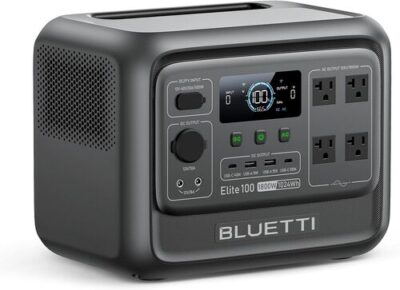
KEY FEATURES
- Battery: 1024Wh LiFePO4 battery, rated for 4000+ cycles.
- AC output: 1800W continuous, 3600W surge, with 2700W lifting power listed by BLUETTI.
- Ports: 11 total ports, including 4 AC outlets, USB outputs, 12V car output, and DC5521-style barrel outputs mentioned by owners.
- Recharge: AC up to 1200W TurboBoost, solar up to 1000W, car charging supported with optional Charger 1 for faster vehicle charging.
- Smart features: Wi-Fi, Bluetooth, app control, firmware updates, charge settings, and ≤10ms UPS backup.
- Best for: weekend camping, fridge backup, CPAP backup, home office UPS, road trips, portable coolers, radios, and emergency electronics.
PROS
- 1,024Wh and 1,800W in a roughly 25.3-pound chassis.
- Up to 1,000W DC input within the exact electrical window.
- 140W and 100W USB-C outputs suit modern mobile equipment.
- Fast AC charging and UPS functionality.
CONS
- No expansion-battery path for longer outages.
- Power Lifting does not equal higher pure continuous output.
- High solar input requires careful 12–60V array design.
- UPS, app, and restoration need exact-load commissioning.
Editor's Choice
Based on exact documentation and qualitative exact-ASIN owner evidence; no hands-on test or population-rate claim
⚡ Can the BLUETTI Elite 100 V2 Run It?
Choose a common device and see the estimated runtime, whether the inverter can handle it, and how long the power station may take to recharge.
Picture this: the power flickers, your router drops, your fridge starts warming up, and your laptop is halfway through a work call. Or maybe you’re packing for a weekend trip and want a cooler, heated blanket, phones, lights, and a laptop covered without firing up a gas generator.
The BLUETTI Elite 100 V2 isn’t trying to power your whole house. In practice, it’s a compact 1kWh backup battery for the stuff people actually worry about: food, communication, medical equipment, work gear, camping comfort, and short outages.
The BLUETTI Elite 100 V2 competes on density and input flexibility. It stores 1,024Wh, supplies 1,800W AC, carries high-power USB-C, accepts up to a documented 1,000W through its DC input, and remains in a one-person 25-pound class. That combination fits mobile work, compact RV and van installations, camping, and short home backup particularly well.
Owner evidence spans mobility, small and high loads, solar, UPS use, app behavior, runtime, support, and occasional charging or fault complaints. The accounts help identify what to test, not how often a problem occurs. The correct acceptance week includes full AC and DC charge cycles, every port, the intended UPS load, a controlled discharge, app pairing, and recovery after power returns.
| Input route | Documented opportunity | Design check |
|---|---|---|
| AC | Fast recharge with adjustable app behavior | Branch circuit, heat, fan, and chosen charge mode |
| Solar/DC | Up to 1,000W within 12–60V and current limit | Cold Voc, current, connector, polarity, cable loss |
| Vehicle | Mobile recovery with compatible hardware | Alternator capacity, cable route, ignition and thermal behavior |
| USB-C | 140W plus 100W device charging outputs | Cable e-marker and device charging profile |
A 1,800W inverter means appliance compatibility must be separated from runtime. A short microwave event may be reasonable; sustained heating can drain 1,024Wh rapidly. Power Lifting modes may support selected resistive devices by adjusting voltage, but they do not certify sensitive electronics or create extra battery energy. Measure average power and startup, then preserve a reserve for overnight essentials.
Compare the Elite 100 V2 only after adding panels, charger, cables, cases, and any fixed mounts.
If those additions make the system stationary, a heavier expandable platform may offer better long-duration value. If the box moves weekly, its weight advantage remains meaningful.
The broad DC voltage window is a genuine differentiator. It is also where mistakes become expensive. Never select a panel array from watts alone. Use the exact manual to calculate cold-corrected string voltage, current, series/parallel layout, connector and polarity. A nominal 1,000W array that violates voltage or current is not compatible.
- Weigh the complete travel kit, not only the station.
- Test both high-power USB-C ports with rated cables.
- Measure solar input through a representative day.
- Run UPS loss, low-battery, and restoration drills.
- Save firmware, settings, serial, seller, and charging logs.
Evidence-led verdict: the Elite 100 V2 is strongest for buyers who will use its low weight, high-power USB-C, and unusually capable DC input. Choose an expandable platform instead when runtime growth matters more than moving the base unit.
Elite 100 V2: A Compact 1kWh Input Specialist
If you want quiet 1kWh backup power for camping, fridge support, CPAP use, and short home outages, the Elite 100 V2 works well. It has a strong 1800W inverter, very fast wall charging, good solar potential, and a compact shape that’s easier to pack than many older 1kWh units. That said, this BLUETTI Elite 100 V2 review would not be honest without calling out the quirks: Eco mode needs checking, the app can feel clunky, and a few owners had early reliability or firmware issues.
A 25.3-Pound Station That Still Provides 1,800W
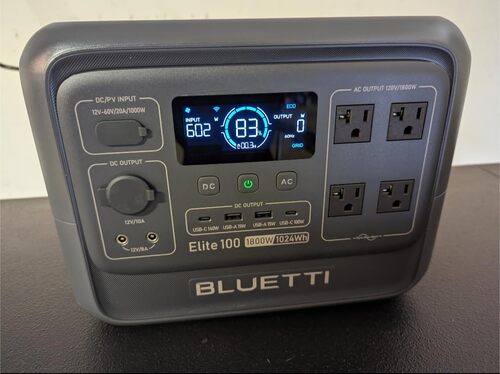
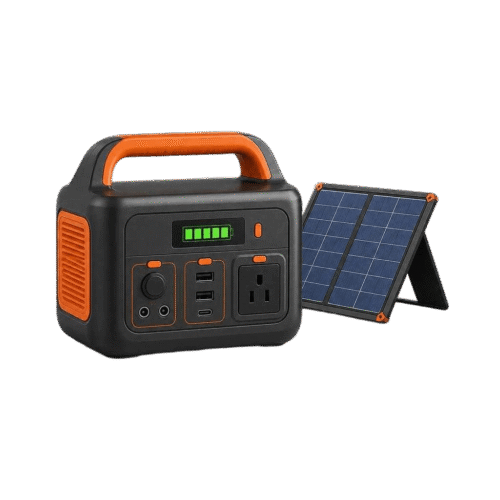
The Elite 100 V2 has the kind of shape that makes sense in a vehicle. Instead of a tall cooler-style body, it uses a compact rectangular footprint with a hidden handle, front-facing ports, and a side display that owners tend to like.
At 25 lb, it’s portable in the real-world sense — you can move it from the house to the truck, from the truck to the campsite, or from the closet to the home office. That said, nobody should confuse this with a backpacking battery. One buyer even mentioned using a bag and cart because 25 lb still feels like 25 lb when you’re carrying it around.
The build gets a lot of positive comments. Owners describe it as sturdy, well-packed, and cleanly finished, though there are a few complaints about damaged cases and a possible weak point in the plastic shell if you set it down hard.
Buyer Heads-Up — Compact does not mean tiny. The online photos may make it look smaller than it feels in person, so plan space for a 12.6″ × 8.5″ × 9.8″ box that weighs about as much as a small dog.
Use 1,024Wh Where Portability Pays
The Elite 100 V2 has a 1024Wh LiFePO4 battery. In plain English, that’s enough to run small electronics for a long time, a fridge for part of a day, or a CPAP setup through the night with room to spare. Overnight CPAP draw is covered in our overnight sleep-apnea power draw notes.
Here’s the thing: usable runtime is not the same as the number printed on the box. Through AC outlets, inverter losses and a small reserve matter. Using an 85% AC efficiency estimate and a 10% reserve, you’re working with roughly 783Wh of practical AC runtime.
| Device | Typical Power Draw | Estimated Runtime | Realistic with Margin |
|---|---|---|---|
| Smartphone charging | 10–15Wh per charge | 60–85 charges | About 50–70 charges |
| Laptop | 50–80Wh per charge | 10–16 charges | About 8–13 charges |
| Wi-Fi router | 10–20W | 39–78 hours | About 30–60 hours |
| CPAP, no humidifier | 30–60W | 13–26 hours | About 10–22 hours |
| CPAP, humidifier on | 50–90W | 8–16 hours | About 7–13 hours |
| Mini fridge | 40–80W cycling | 10–20 hours | About 8–16 hours |
| Full-size refrigerator | 100–200W cycling | 4–8 hours | About 3–7 hours |
| Electric blanket | 50–80W | 10–16 hours | About 8–13 hours |
| Portable cooler | 35–70W cycling | 11–22 hours | About 9–18 hours |
| 1500W kettle or heater | 1500W | About 30 minutes | Brief use only |
Real-World Math — At 0.85 AC efficiency, the listed 1024Wh battery delivers roughly 870Wh through the AC outlets. Subtract a 10% reserve, and you’re working with about 783Wh for practical runtime.
In real use, owners are getting meaningful results. Some run CPAP machines overnight, some keep routers and home office gear alive through outages, and others use it for portable fridges in trucks or campsites.
On the flip side, high-draw heat appliances drain it fast. A 1500W heater, kettle, or vacuum may run, but it will chew through the battery in a hurry.
Power Lifting Does Not Rewrite the Energy Budget
Worth knowing, compressor loads are where things get more complicated. A fridge or AC unit may pull only a few hundred watts while running, but it can demand much more for a few seconds at startup.
| Device | Typical Draw | This Unit? |
|---|---|---|
| Phone / tablet | 10–25W | Easy |
| Laptop | 50–100W | Easy |
| LED lights | 5–15W each | Easy |
| Wi-Fi router | 10–20W | Easy |
| CPAP, no humidifier | 30–60W | Easy |
| CPAP, humidifier on | 50–90W | Easy |
| Mini fridge | 40–80W cycling | Easy |
| Full-size fridge | 100–200W cycling, higher startup surge | Easy with caveats |
| Pellet stove | 110–410W | Easy |
| Drone battery charger | 60–100W | Easy |
| Microwave, 700W class | Around 1100W draw | Borderline |
| Air fryer | 1200–1700W | Briefly only |
| Electric kettle or heater | 1500W | Briefly only |
| Hair dryer | 1875W | Trips inverter |
| Small window AC | 500W run, higher startup surge | Borderline |
| Corded drill or small compressor | 600W run, high surge | Borderline |
Worth Knowing — Continuous output is the real ceiling. The 3600W surge rating only lasts briefly — long enough to help with startup loads, not long enough to run oversized appliances.
In practice, the inverter looks strong for this size class. That said, some buyers had trouble with inductive loads before firmware updates, including small AC units and dehumidifiers that shook or showed strange wattage readings.
After updates, those same types of loads appear to behave much better for some owners. So if a compressor or motor acts weird, check firmware before assuming the hardware can’t handle it.
A 1,000W DC Window Changes the Solar Question
Charging speed is one of the Elite 100 V2’s biggest wins. BLUETTI lists a 1200W TurboBoost AC input, a 70-minute full recharge, 45 minutes to 80%, and up to 1000W solar input. Campers pairing panels will find useful context in our camping-focused power station list.
In practice, owners repeatedly mention fast wall charging. Some compare it favorably to older Jackery, EcoFlow, and BLUETTI units because it gets back to full quickly between outages or before a trip.
| Charging Mode | Time from Empty to Full | Noise Level |
|---|---|---|
| Quiet / lower AC mode | About 3–4 hours | Quiet |
| Standard AC | About 1.5–2 hours | Moderate |
| TurboBoost AC | About 70 minutes | Louder fan noise |
| Car 12V, typical | About 10–13 hours | Silent from the unit |
| BLUETTI Charger 1 vehicle charging | Much faster than basic 12V | Depends on vehicle setup |
| 100W solar | About 10–12 hours strong sun | Silent |
| 200W solar | About 5–6 hours strong sun | Silent |
| 1000W solar maximum | About 70–90 minutes ideal sun | Silent |
Adapter Check — The provided data lists a solar charging cable but does not clearly specify the connector type. If you already own third-party panels, check the plug and voltage range before buying adapters.
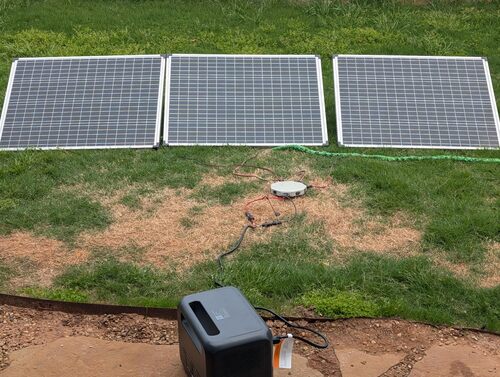
Solar support is especially interesting here. A 1000W solar ceiling is high for a 1024Wh unit, which means the BLUETTI Elite 100 V2 portable power station can recover quickly if you have enough panel wattage and strong sun.
The catch is setup. One owner reported that solar input stayed low until they enabled high-current PV mode in the app, so it pays to read the manual and check settings before judging solar performance.
Car charging is useful, but basic 12V charging is not fast. If road-trip charging matters, BLUETTI’s optional Charger 1 appears to be the better route.
Two High-Power USB-C Ports Reduce Adapter Clutter
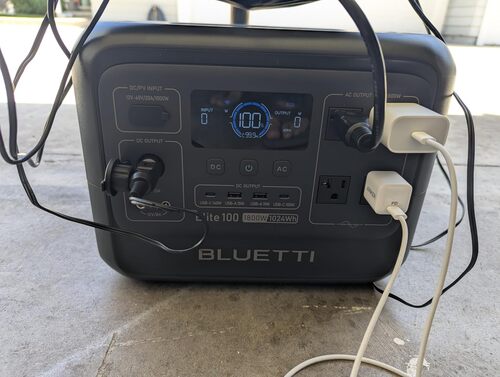
The Elite 100 V2 has 11 ports, including four AC outlets. Owners also mention USB outputs, 12V car output, and DC5521 barrel ports, which is one reason it works well for camping fridges, radio setups, astrophotography gear, tablets, phones, routers, and field electronics.
In practice, front-facing ports make life easier. You can place the unit against a wall, under a desk, in a van, or near a camp table and still get to the outlets without turning the whole battery around.
That said, not every detail is perfect. Buyers mention that it does not include a cigarette-lighter charging cable, and some wish it had a built-in light like smaller BLUETTI models.
Charging Mode Determines Heat and Sound
The Elite 100 V2 is quiet under light loads. Owners using it for camping, routers, small electronics, radios, portable coolers, and office backup often describe it as stealthy or barely noticeable.
At the same time, fan noise is not zero. The fans ramp up during fast AC charging and heavier input loads, and one owner placed Turbo mode around the mid-to-high 40 dB range. That is still manageable for many homes, but it is not the same as silent bedroom operation.
For indoor use, the big advantage is no fuel, no fumes, and no generator startup routine. You can keep it in a bedroom, home office, apartment, RV, or truck without the smell and hassle of gas power.
Pro Tip — Use fast AC charging during the day, then switch to a quieter charging mode at night. The battery fills quickly when you need speed, but lower modes are easier to live with indoors.
Tune UPS and Standby Behavior Before Deployment
The display gets strong marks from owners. It is bright, readable, and useful for checking battery percentage, input watts, output watts, and runtime estimates.
The app is more mixed. Some buyers like the Wi-Fi and Bluetooth control, firmware updates, charge settings, and remote monitoring. Others call it clunky, mention pairing trouble, or dislike that the unit cannot be powered on remotely once it is fully off.
Here’s what matters: the app is useful, but you should not treat it as optional fluff. Firmware updates fixed real user problems, and app settings affect solar input, Eco mode, and charging behavior.
To be fair, beginners can still use the unit from the physical buttons. But if you are using it for CPAP, sump pump backup, UPS duty, or solar charging, spend time with the settings before relying on it.
A Portable LFP Station Still Needs Storage Discipline
The BLUETTI Elite 100 V2 uses a LiFePO4 battery rated for 4000+ cycles. That is a good chemistry choice for people who plan to use the unit often, leave it ready for backup duty, or cycle it during camping and off-grid trips.
LiFePO4 is usually heavier than older NCM lithium-ion, but it tends to bring better cycle life and thermal stability. In real terms, this is the chemistry you want when the battery is not just a weekend toy.
Long-Term Ownership — 4000+ cycles means this battery is built for frequent use. Even weekly cycling could take many years before cycle wear becomes the main concern.
Warranty and service feedback is mixed but better than many worst-case stories. Several owners with dead units, damaged shells, CPAP problems, or firmware issues say BLUETTI support helped with replacements, settings, labels, or refunds.
The main caution is reliability. A few units arrived dead, failed after days, or stopped powering on after months. That does not erase the positive feedback, but it does mean you should test the unit hard while you are still inside the return or warranty window.
Best Practice — After delivery, charge it fully, update firmware, turn off Eco mode for critical backup loads, run a fridge or CPAP-style test, and verify the app before storing it for emergencies.
Cold weather also deserves care. Like most lithium batteries, it should not be charged while frozen. Store it indoors when possible, and avoid leaving it in a freezing vehicle before charging.
Elite 100 V2 Mobility-versus-Input Matrix
| Use Case | Fit | Why |
|---|---|---|
| Weekend car camping | Strong fit | Compact shape, 1024Wh capacity, and useful DC outputs work well for coolers and electronics. |
| RV side trips / van life | Strong fit | Good size for small appliances, diesel heaters, fridges, and quick AC recharge. |
| Home blackouts under 8 hours | Strong fit | Great for routers, laptops, lights, recliners, CPAP, and partial fridge backup. |
| CPAP overnight backup | Strong fit | Capacity is enough for most overnight setups, especially with humidifier settings managed. |
| Refrigerator backup | Solid fit | Many owners run fridges, but runtime depends heavily on fridge age and cycling. |
| Home office UPS | Solid fit | Fast switchover and large capacity help routers, PCs, and monitors stay on. |
| Jobsite power tools | Solid fit | Works for many basic tools, but large motors and compressors can be borderline. |
| Multi-day off-grid cabin | With caveats | Works best with solar or generator recharging because 1024Wh is not huge for multi-day loads. |
| Hurricane / long outage prep | With caveats | Good as part of a setup, not enough as your only whole-home backup. |
| Sump pump backup | With caveats | Inverter power may be enough, but Eco mode and startup behavior must be tested carefully. |
| Apartment backup | Strong fit | Quiet, fume-free, compact, and fast to recharge from the wall. |
| Backpacking | Skip | Too heavy for carry-on-foot power. |
You’ll probably be happy if you want a compact 1024Wh power station for camping, road trips, and short outages; a LiFePO4 battery you can use often without worrying about short cycle life; fast AC charging for outage prep; backup power for CPAP, routers, laptops, lights, and portable fridges; and a quieter alternative to running a generator at night.
You might want to skip it if you need a full home backup system, true expansion battery support, a built-in light for camping, a sub-15 lb power station, a completely app-free setup for advanced settings, or a mission-critical sump pump backup without careful testing first.
Pros & Cons Analysis
Based on documented specifications and owner feedback
Pros
- Excellent energy-to-weight balance — The station offers 1kWh-class storage without moving into a 35- or 45-pound chassis.
- DC input can shorten off-grid recovery — A valid high-power array can replace a large fraction of the battery in favorable conditions.
- USB-C reduces conversion steps — High-power native ports serve laptops and creator devices without running the AC inverter.
- Output covers common mobile loads — The 1,800W boundary suits many campsite, van, tool, and outage devices after startup testing.
- Owner scenarios are broad — The evidence supports mobile work, camping, appliances, solar, UPS, and electronics roles.
Cons
- Capacity cannot grow — A buyer needing multi-day energy must add a separate system rather than a supported expansion battery.
- Input power invites array mistakes — Voltage, current, cold weather, connector, polarity, and cable loss matter more than panel nameplate watts.
- High loads shorten duration — A compact 1,024Wh battery can accept appliances that consume its usable energy quickly.
- Fast charging has a thermal profile — Circuit quality, ambient temperature, fan sound, and chosen charge rate should be tested.
- Software is part of acceptance — App, firmware, UPS, standby, and output restoration need written baseline settings.
Our Verdict
The simple takeaway from this BLUETTI Elite 100 V2 review is that this is a strong 1kWh power station with unusually fast charging, useful output, and a compact body. It shines for camping, home office backup, CPAP use, portable fridges, short outages, and people who want quiet power without dragging out a gas generator.
That said, it is not a perfect set-it-and-forget-it emergency box. You should update firmware, check Eco mode, test your critical loads, and make sure the app works before trusting it during a storm. Do that, and the BLUETTI Elite 100 V2 is easy to recommend for buyers who want a fast-charging LiFePO4 power station that can handle real appliances without becoming a 60 lb monster.
Frequently Asked Questions
How long will the BLUETTI Elite 100 V2 run a refrigerator?
For many full-size refrigerators, expect roughly 6-10 hours depending on compressor cycling, room temperature, fridge age, and whether defrost mode kicks in. Some owners report getting through short outages successfully, while one real-world fridge test landed around 7.5 hours during warm weather.
Can the BLUETTI Elite 100 V2 run a CPAP machine overnight?
Yes, customer feedback suggests it can run many CPAP setups overnight, and some owners report two nights depending on humidifier and heated hose settings. For best runtime, turn off or lower humidification if your therapy allows it.
Can it run a microwave, kettle, air fryer, or heater?
The 1800W inverter can run many high-draw appliances briefly, and owners mention air fryers, heaters, and heavy loads working. However, those loads drain the 1024Wh battery quickly, so this is better for short bursts than long cooking or heating sessions.
How fast does the BLUETTI Elite 100 V2 recharge from the wall?
BLUETTI lists up to 1200W AC TurboBoost charging and about 70 minutes for a full recharge. Owners consistently describe wall charging as very fast, though the fans are more noticeable in faster modes.
How much solar input can it accept?
The listed maximum solar input is 1000W. In real use, your solar result depends on panel wattage, wiring, sun angle, cloud cover, temperature, and app settings. One owner reported needing high-current PV mode to raise input from around 123W to about 260W on a larger setup.
Does the UPS feature work well?
Many owners use it successfully for routers, computers, CPAP machines, stereo gear, and home office backup. That said, check Eco mode and UPS settings before trusting it with critical loads, because Eco mode caused serious trouble for at least one sump-pump user.
Is the BLUETTI Elite 100 V2 quiet?
Under light loads, customers generally describe it as very quiet. Fan noise becomes more noticeable during fast AC charging or higher charging and output loads.
Does the app work reliably?
The app gives useful control over charging behavior, firmware updates, Wi-Fi, Bluetooth, and monitoring. Feedback is mixed, though: some owners like it, while others call it clunky or report pairing problems.
Does it have a built-in light?
No built-in light is listed in the provided specs, and at least one owner specifically wished it had one for camping and plugging devices in after dark.
Is the battery expandable?
No true expansion battery port is listed, and one owner specifically wished it had expansion support. You may be able to feed power through DC input from external batteries, but that is not the same as a supported expansion battery system.
What are the biggest complaints?
The most common drawbacks are app quirks, Eco mode confusion, fan noise during fast charging, no built-in light, no included car charging cable, no true expansion port, and some reliability cases involving dead or defective units.
Technical Specifications
| Brand | BLUETTI |
|---|---|
| Model / SKU | Elite 100 V2 (ASIN: B0F42CSQWG) |
| Battery capacity | 1024 Wh |
| Battery chemistry | LiFePO4 (LFP) |
| Cycle-life rating | 4000+ cycles |
| Expandable capacity | No (no true expansion battery port listed) |
| Continuous AC output | 1800 W continuous |
| Surge / peak output | 3600 W peak (2700W lifting power also listed) |
| AC voltage, frequency, and waveform | 120V AC, pure sine wave; frequency not published for this exact model |
| AC outlets | 4 × 120V AC outlets |
| High-current, RV, or 240V output | No dedicated RV, 30A, 240V, or other high-current AC outlet published for this exact model |
| USB-C outputs | Not published for this exact model in the current source set |
| USB-A outputs | Not published for this exact model in the current source set |
| 12V / DC outputs | Yes |
| Maximum solar input | 1000 W (MPPT / solar charging cable included; connector details not specified) |
| Solar input range and connector | Not published for this exact model in the current source set; exact PV voltage/current window and connector are unavailable |
| Maximum AC input | 1200 W (TurboBoost AC charging) |
| AC recharge time | About 70 minutes full charge (45 minutes to 80% also listed) |
| Solar recharge estimate | Planning estimate: about 70 minutes at maximum 1000W solar input under ideal conditions |
| UPS / EPS support and transfer time | Yes — ≤10ms UPS backup (check Eco mode before critical use) |
| App / connectivity | Yes — Wi-Fi and Bluetooth app control |
| Operating temperature / weather rating | Not published for this exact model in the current source set |
| Dimensions | 12.6" × 8.5" × 9.8" |
| Weight | 25 lb |
| Warranty | Not published for this exact model in the current source set |