EcoFlow Delta 2 Review: Fast-Charging Backup Power for Outages, Camping, and RVs
At a Glance
KEY FEATURES
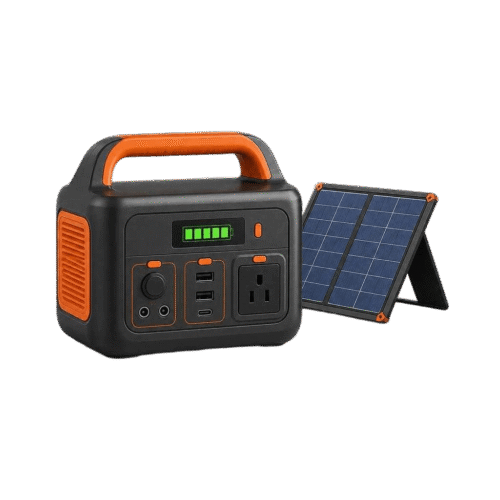
- EcoFlow DELTA 2: Portable power station / solar generator for home backup, camping, RVs, off-grid cabins, and short outage support.
- Battery: 1024Wh LiFePO4 (LFP), rated for 3000+ cycles.
- AC output: 1800W continuous, 2700W surge; pure sine wave reported by owners and customer testing.
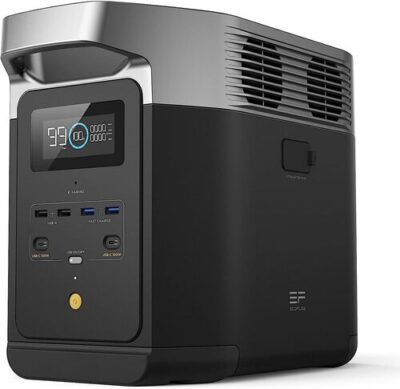
- Ports: 6 × AC outlets, 2 × USB-C (100W max), 4 × USB-A, 1 × 12V car port, 2 × DC5521 ports.
- Recharge: AC 0-80% in about 50 minutes and 0-100% in about 80 minutes; solar up to 500W via XT60i input; car charging supported.
- Smart features: EcoFlow app, Wi-Fi, Bluetooth, firmware updates, adjustable charge speed, charge/discharge limits, EPS-style backup mode, pass-through use.
- Build: 27 lb, 15.7 × 8.3 × 11.3 inches, black finish, fixed side handles.
- Best for: Fridge backup, camping, RV weekends, router/TV/fan backup, CPAP use, drone charging, small off-grid cabins, and generator fuel-saving setups.
PROS
- Balanced 1,024Wh LFP battery, 1,800W inverter, and 27 lb weight.
- Fast AC charging and configurable input rate through the EcoFlow app.
- Up to 500W solar plus optional extra batteries for longer runtime.
- Mature ecosystem with broad owner use across camping and outage loads.
CONS
- Fast charging and heavy loads can produce noticeable fan noise.
- EPS behavior is not a substitute for a dedicated computer-grade UPS.
- Solar setup may require the correct XT60/XT60i adapter cable.
- Newer 1kWh competitors may be lighter, faster, or cheaper at current prices.
Editor's Choice
Based on exact documentation and qualitative exact-ASIN owner evidence; no hands-on test or population-rate claim
⚡ Can the EcoFlow Delta 2 Run It?
Choose a common device and see the estimated runtime, whether the inverter can handle it, and how long the power station may take to recharge.
Picture this: the power flickers, the fridge is full, your phone is low, and the gas generator is still buried in the garage. You don’t need to run the whole house. You just need the essentials to keep going without fumes, extension cords through a window, or a midnight engine rumble outside.
The EcoFlow Delta 2 isn’t trying to replace a full home battery. In practice, it works best as a quiet backup box for refrigerators, routers, fans, laptops, CPAP machines, camping gear, drone batteries, and short kitchen appliance runs.
The EcoFlow DELTA 2 remains relevant because its fundamentals are balanced: 1,024Wh of LFP storage, 1,800W continuous AC output, 500W solar input, a 27-pound enclosure, app control, and optional extra batteries. It is large enough for refrigerators, coffee equipment, many power tools, CPAP, communications, and camping loads, yet small enough for one person to move. Newer stations may charge faster, weigh less, or offer different ports, but maturity gives DELTA 2 an unusually broad owner record.
That record does not say the station is universally reliable or that a device will run for a fixed number of hours. It does consistently identify the decisions that matter: fast AC charging versus fan noise, one-kilowatt-hour runtime versus a capable inverter, solar-cable compatibility, app/firmware configuration, EPS rather than computer-grade UPS expectations, and mixed service experiences when hardware fails. Those are ownership variables a new review should surface rather than hiding behind a score.
The 1,800W inverter is generous relative to a 1,024Wh battery. That makes the DELTA 2 a good generalist but creates the same power-versus-energy trap as other compact stations. A microwave may run and still consume a noticeable share of the pack in minutes. A refrigerator uses less average power but can produce a difficult compressor start. A router and CPAP may run far longer, but humidification and AC conversion change the estimate. Measure average watts and startup separately.
| Operating mode | Why choose it | What to watch |
|---|---|---|
| Fast wall charge | Short grid or generator window | Fan noise, heat, and branch-circuit loading |
| Reduced AC input | Bedroom, office, or routine cycling | Longer recovery time |
| Solar up to 500W | Camping and multi-day outage resilience | Exact voltage/current window, cable, shade, and daily harvest |
| EPS pass-through | Continuity for tolerant household loads | Transfer, firmware, deep-discharge recovery, and output persistence |
EcoFlow’s fast wall charging is one of the platform’s defining advantages. Owner reports also make the acoustic tradeoff clear: high input wakes the fans. Use the app to cap charging when time allows, especially near sleeping areas. If a generator is the source, confirm stable voltage and frequency and test the setup in advance; a fast-charging station can place a large step load on a small generator.
Solar compatibility deserves more than “up to 500W.” Match array cold Voc, operating voltage, current, connector, and polarity to the exact manual. Some owners needed an additional MC4-to-XT60/XT60i cable or extension arrangement. Keep connectors dry, avoid excessive voltage in series strings, and use daily watt-hours as the result. A panel briefly showing 400W may still fail to replenish a large continuous load over a cloudy day.
Keep the base DELTA 2
Best when 1kWh covers measured camping, workstation, CPAP, refrigerator, and short outage missions.
Add an extra battery
Best when output is sufficient but runtime is not, and the tethered footprint will remain mostly stationary.
Move to a larger station
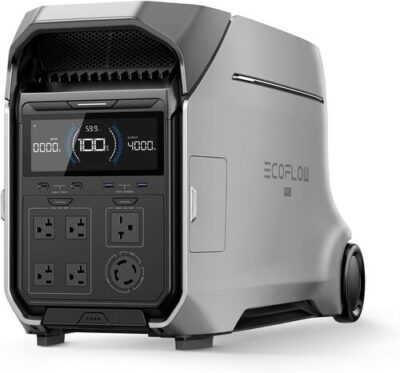
Best when higher solar, more runtime, different high-current outlets, or integrated wheels matter from day one.
The mature platform also makes service discipline important. Preserve purchase proof, serial numbers, firmware version, app logs, and a simple video of any fault. Do not open the enclosure. For long storage, follow the exact manual, keep the battery away from temperature extremes, and schedule periodic checks rather than trusting a year-old percentage display.
Verdict: DELTA 2 is still a strong 1kWh generalist when the buyer values a mature ecosystem and can manage fan noise and configuration. It is not automatically the best value against every newer 1kWh station, so compare current price, expansion needs, solar design, and warranty path.
DELTA 2 in 2026: A Mature Platform With Known Tradeoffs
If you want fast backup power for blackouts, camping, RV trips, or a fridge-saving emergency setup, the EcoFlow Delta 2 does what most buyers expect. It charges very quickly, has a strong 1800W inverter, and feels more useful than smaller power stations that only handle phones and laptops. That said, this EcoFlow Delta 2 review wouldn’t be honest without the trade-offs: fast charging gets noisy, solar setup may need extra cables, and the EPS mode is not a true replacement for a dedicated computer UPS.
Pro Tip — Use slower AC charging through the app when you’re indoors and want less fan noise. Save fast charging for storm prep and quick generator top-offs.
Twenty-Seven Pounds and a Very Busy Port Layout
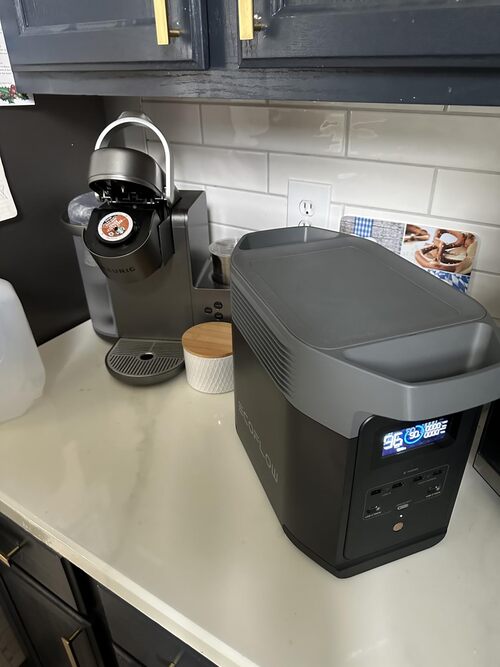
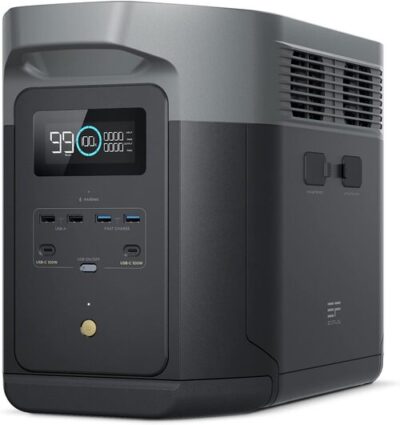
At 27 lb, the Delta 2 has a solid heft without feeling like a two-person lift. You can carry it from a closet to the kitchen, from the car to a campsite, or from an RV storage bay to a picnic table without much drama. Honestly, that weight feels reasonable for a 1024Wh LiFePO4 power station.
The fixed side handles are practical, though they do make the box wider than it would be with recessed grips. Owners like the tight assembly, rubberized lower edges, and sturdy feel, but one long-term user reported handle-area housing damage after about a year and a half. That’s not a common theme, but it’s worth keeping in mind if you plan to move it constantly.
In practice, the display is one of the better everyday touches. It shows battery percentage, input watts, output watts, and time remaining in a way that’s easy to read at a glance. The rear AC outlet layout works well for semi-permanent backup setups, though it’s less convenient if you’re always plugging and unplugging gear.
One Kilowatt-Hour Across Camping and Outage Loads
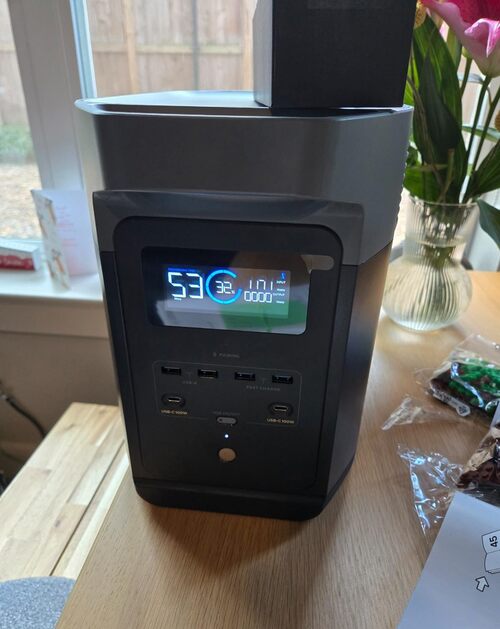
The EcoFlow Delta 2 has a 1024Wh battery — enough to keep small electronics running for a long time, or larger appliances running for shorter, more practical windows. That number sounds simple, but AC inverter losses, idle draw, battery reserve settings, and device cycling all matter.
Here’s the thing: a fridge is not the same as a space heater. A fridge cycles on and off, while a heater pulls hard the entire time. That’s why owners can get useful overnight refrigerator support but only a short run from high-watt heat loads.
| Device | Typical Power Draw | Estimated Runtime | Realistic with Margin |
|---|---|---|---|
| Smartphone charging | 10-15Wh per charge | About 55-80 charges | About 45-70 charges |
| Laptop | 50-80Wh per charge | About 10-16 charges | About 8-13 charges |
| Wi-Fi router | 10-20W | About 38-76 hours | About 30-60 hours |
| CPAP machine, no humidifier | 30-60W | About 13-25 hours | About 10-22 hours |
| Mini fridge | 40-80W cycling | About 10-19 hours | About 8-16 hours |
| Full-size refrigerator | 100-200W cycling plus surge | About 5-11 hours | About 5-9 hours |
| Electric blanket | 50-80W | About 10-15 hours | About 8-12 hours |
| Drone batteries | 60-100W per charger | Multiple packs at once | Strong fit for field charging |
| 1500W kettle | 1500W | Around 30 minutes max | Briefly only |
Real-World Math — At 0.83 AC efficiency, the listed 1024Wh battery delivers roughly 850Wh through the AC outlets. Subtract a 10% battery reserve, and you’re working with about 765Wh of practical AC energy.
In real use, owners tend to be happiest when they size it for essentials. A router, TV, fan, laptop, CPAP, or fridge makes sense. On the flip side, a space heater or full-size air conditioner will chew through the battery fast even if the inverter starts the load.
The 1,800W Generalist and Its Startup Limits
That said, surge power and battery capacity are different things. The inverter may start a microwave or coffee maker, but the battery percentage drops quickly while those appliances run. The sweet spot tends to be short high-watt bursts and longer low-to-medium loads.
| Device | Typical Draw | This Unit? |
|---|---|---|
| Phone / tablet | 10-25W | Easy |
| Laptop | 50-100W | Easy |
| LED lights | 5-15W each | Easy |
| Wi-Fi router | 10-20W | Easy |
| Mini fridge | 40-80W cycling | Easy |
| CPAP, no humidifier | 30-60W | Easy |
| Full-size fridge | 100-200W cycling, 600W surge | Easy |
| Coffee maker / Keurig | 1000-1500W short burst | Briefly only |
| Microwave, 700W class | About 1100W draw | Briefly only |
| Electric kettle, 1500W | 1500W | Briefly only |
| Hair dryer, 1875W | 1875W | Borderline |
| Corded drill | 600W run, 1500W surge | Easy |
Worth Knowing — Continuous output is the real ceiling. The 2700W surge rating only lasts briefly — long enough to help start a compressor, not long enough to treat the unit like a 2700W generator.
Fast AC, 500W Solar, and Vehicle Options
Charging speed is one of the big reasons buyers choose this unit. EcoFlow lists 0-80% in about 50 minutes and 0-100% in about 80 minutes from AC power, and owners often say the fast charging is not just marketing. The larger sibling is covered in our Delta 2 Max 2048Wh sibling review.
The catch is noise. During high-speed AC charging, the fans can sound like a strong whoosh from across the room. In practice, the app’s lower charge-rate settings are the smarter choice at night, in an office, or anywhere quiet.
| Charging Mode | Time from 0% to 100% | Noise Level |
|---|---|---|
| Eco mode AC, around 200W | About 5-6 hours | Quiet, similar to a desktop computer |
| Moderate AC, around 500W | About 2 hours | Moderate |
| Fast AC, up to 1200W | About 80 minutes | Loud, fan clearly noticeable |
| Car charging, 12V | About 10-12 hours | Silent from the unit |
| 500W max solar | About 2.5-4 hours strong sun | Silent |
AC Charging — EcoFlow Delta 2 Review: Fast-Charging Backup Power for Outages, Camping, and RVs
Fast AC charging is excellent during outage prep. Worth knowing, it also pairs well with a gas generator because you can run the generator for a shorter window, refill the battery quickly, then shut the engine off overnight.
Solar Charging — EcoFlow Delta 2 Review: Fast-Charging Backup Power for Outages, Camping, and RVs
Adapter Check — If you use third-party solar panels, plan around the XT60i input and MC4 adapter needs. A few owners had charging problems caused by cable fit, not by the power station itself.
Car Charging — EcoFlow Delta 2 Review: Fast-Charging Backup Power for Outages, Camping, and RVs
Car charging works, but it’s more of a road-trip top-off than a fast refill. In practice, it’s handy for keeping the unit ready while driving to a campsite, not for recovering a fully empty battery quickly.
Why Connection Choice Changes Runtime
The EcoFlow Delta 2 portable power station gives you a busy port layout: 6 AC outlets, 2 USB-C ports rated up to 100W, 4 USB-A ports, a 12V car socket, and DC barrel outputs. That makes it easy to run a TV, router, phone chargers, camera gear, and a few small appliances without packing a separate power strip.
At the same time, the rear AC placement is a mixed bag. It’s great if the unit lives under a desk or behind an entertainment center, because cords stay tucked away. On the flip side, it’s less convenient on a campsite table where you may want every outlet facing forward.
The Price of Fast Charging Is Audible
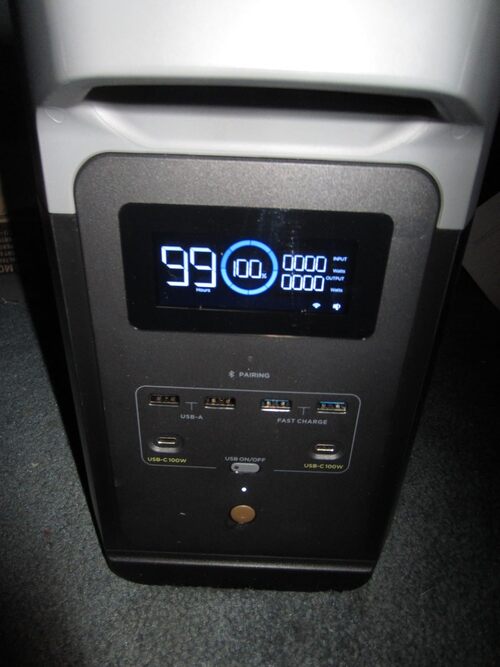
The Delta 2 is quiet under light DC loads and moderate AC use. Customer feedback generally suggests the fan noise is manageable for routers, laptops, phones, lights, and low-draw cabin gear.
The fan becomes more noticeable during fast charging or heavier AC loads. Some owners barely care, while others find the sudden ramp-up annoying in a bedroom or home office. To be fair, the app’s adjustable charge speed helps a lot — slow it down, and the unit becomes much easier to live with indoors.
A Mature App Ecosystem With Configuration Memory
The screen is simple in the best way. You get battery percentage, live input watts, live output watts, estimated runtime, and basic warning icons without hunting through menus.
The app is where EcoFlow adds more control. You can adjust charge speed, set upper and lower battery limits, update firmware, and toggle outputs remotely. That said, a few owners mention Wi-Fi dropouts, firmware update trouble, or settings that take more than one try to save.
For beginners, the unit still feels easy to use. In practice, you can ignore most app extras at first, then use the deeper settings once you start caring about battery health, noise, and standby behavior.
LFP, Expansion, and Long-Term Storage
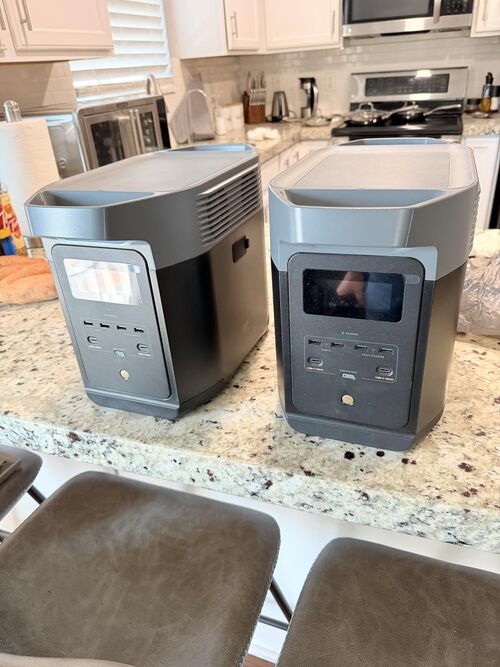
The EcoFlow 1024Wh LiFePO4 power station uses LFP battery chemistry, which is a major reason it makes sense for frequent backup use. Compared with older NCM lithium-ion packs, LiFePO4 is usually heavier, but it tends to offer better cycle life and better long-term stability.
EcoFlow claims 3000+ cycles, and that lines up with why owners use this as more than a closet-only emergency box. Some run it daily with solar, some keep it ready for outages, and others pair it with an extra battery for a small modular home backup setup.
Long-Term Ownership — 3000+ cycles means this battery is built for repeated use, not just occasional camping trips. Daily cyclers — RV users, cabin owners, and outage-prone households — should care more about LiFePO4 than saving a few pounds.
Warranty feedback is mostly positive, especially around support responsiveness and price adjustment experiences. Still, a few owners report failed units, used-looking replacements, repair shipping hassle, or repeated reset steps. That’s the honest risk with any app-connected power station: the hardware may be strong, but service experience can vary.
Best Practice — For storage, leave the unit around 50-80% charge and top it off every few months. LiFePO4 is forgiving, but storing any lithium battery empty or full for long stretches is asking for early capacity loss.
EPS support deserves a careful note. It can switch over during an outage, but buyers using sensitive computers should not treat it like a dedicated UPS. In practice, a real UPS between your workstation and the Delta 2 is the safer setup.
DELTA 2 Ownership Routes: Keep, Expand, or Size Up
| Use Case | Fit | Why |
|---|---|---|
| Weekend car camping | Strong fit | Good capacity, many ports, and portable enough for car-based trips. |
| RV side-trip / van life | Strong fit | Works well for lights, fans, laptops, small appliances, and solar top-offs. |
| Home blackouts under 8 hours | Strong fit | Great for routers, TV, lights, phones, fans, and fridge support. |
| Multi-day off-grid cabin | With caveats | Works best with solar, extra battery, or generator charging. |
| CPAP overnight backup | Strong fit | Plenty of capacity for most overnight use, especially without humidifier heat. |
| Refrigerator backup | Solid fit | Handles many fridges, but runtime depends heavily on cycling and temperature. |
| Jobsite power tools | Solid fit | Strong inverter, though dusty sites and heavy tools call for care. |
| Quiet bedroom UPS | Borderline | Fan behavior and EPS limitations may bother sensitive sleepers or computer users. |
| Hurricane / multi-day outage | With caveats | Useful for essentials, but you’ll want solar, generator support, or expansion. |
| Tailgating / outdoor events | Strong fit | Enough output for screens, speakers, lights, and food prep bursts. |
| Backpacking / lightweight EDC | Skip | At 27 lb, this is car-portable, not trail-portable. |
| Apartment without solar access | Solid fit | Fast AC charging makes sense even without panels. |
You’ll probably be happy if you want:
- A fast-charging 1024Wh portable power station for short blackouts
- A fridge, router, TV, fan, and phone backup that doesn’t need gasoline
- A camping or RV power box that can run more than small USB gear
- App-based control over charge speed and battery limits
- A LiFePO4 battery you can cycle often without babying it
You might want to skip it if you need:
- Whole-house backup for days without solar or generator support
- A silent bedroom UPS for a sensitive desktop computer
- A sub-15-pound power station
- Long runtime for heaters, kettles, or large AC units
- A fully app-free setup with every advanced control on the front panel
Different tool, different job. The Delta 2 is strong for essentials and short high-watt bursts, but it’s not magic. Size your loads honestly, and it makes a lot more sense.
Pros & Cons Analysis
Based on documented specifications and owner feedback
Pros
- A well-balanced generalist — Battery size, inverter power, weight, and port coverage align with common home, vehicle, camping, and work scenarios.
- Mature operating evidence — A large body of owner experience makes acoustic behavior, app strengths, load fit, and support expectations easier to understand.
- Fast charging is controllable — The owner can use maximum input when time is scarce and reduce it when circuit demand or noise matters more.
- The platform can gain runtime — Compatible extra batteries let an owner preserve the base inverter and controls when storage becomes the only limitation.
- Solar capacity is meaningful for 1kWh — A properly designed 500W array can materially extend camping and outage use without oversizing the portable system.
Cons
- Cooling is part of the experience — Maximum AC input and high output are audibly different from light loads, which matters in bedrooms, offices, and small RVs.
- EPS needs its own test plan — Transfer and recovery can depend on firmware, settings, battery limits, and the tolerance of the connected device.
- High output encourages short runtimes — The station can operate loads that consume a one-kilowatt-hour battery much faster than buyers expect.
- Expansion reduces mobility — An extra-battery cable and second enclosure turn a portable base into a more stationary system.
- Age changes the value comparison — Current price and warranty handling must be compared with newer EcoFlow, Anker, Jackery, and other 1kWh alternatives.
Our Final Take
This EcoFlow Delta 2 review comes down to one practical point: it's a genuinely useful middleweight power station for people who want fast charging, strong AC output, and LiFePO4 longevity without moving into 50-lb home-backup territory. It's especially good for outage-prone homes, RV owners, car campers, drone users, and anyone who wants to run a fridge, router, fan, laptop, TV, or small kitchen appliance without starting a gas generator.
That said, don't buy it expecting full-home backup. Buy it because you want a portable, expandable, fast-charging EcoFlow Delta 2 battery that covers the essentials and recharges quickly when power, solar, or a generator is available. For that job, the Delta 2 is an easy recommendation — just budget for the right cables, use slower charge mode when noise matters, and consider the extra battery if fridge runtime is your top priority.
Frequently Asked Questions
How long will the EcoFlow DELTA 2 run a refrigerator?
Most refrigerator runtime reports fall in the several-hours-to-overnight range depending on the fridge, room temperature, door openings, and battery reserve settings. A full-size refrigerator may run roughly 5-11 hours on the DELTA 2 alone, while pairing it with an extra battery can stretch that closer to a full day in some setups.
Can the EcoFlow DELTA 2 run a microwave or coffee maker?
Yes, many owners successfully run microwaves, Keurig-style coffee makers, and similar kitchen appliances for short bursts. The 1800W AC inverter is strong for this size class, but high-watt appliances drain the 1024Wh battery quickly.
How loud is the EcoFlow DELTA 2 when charging?
Fast AC charging is the loudest mode. Customers often say the fans are noticeable when charging near the maximum input, while slower charging through the app is much quieter and better for bedrooms, offices, or overnight use.
How long does the EcoFlow DELTA 2 take to recharge from the wall?
EcoFlow lists 0-80% in about 50 minutes and 0-100% in about 80 minutes from AC power. Owners generally confirm that fast charging is genuinely quick, but the trade-off is fan noise and heat.
Can the EcoFlow DELTA 2 charge from solar panels?
Yes. The DELTA 2 supports up to 500W solar input. Real output depends heavily on sun angle, weather, cable setup, and panel quality. Some owners get strong solar performance, while others mention needing extra MC4-to-XT60i cables or longer extension cables.
Does the EcoFlow DELTA 2 work as a UPS?
It has EPS-style backup support, but it should not be treated like a dedicated computer UPS. Some owners report that the switchover is not fast enough for sensitive computers, so a real UPS between your PC and the DELTA 2 is safer for workstation backup.
Is the EcoFlow DELTA 2 battery LiFePO4?
Yes. The DELTA 2 uses LiFePO4 battery chemistry and is rated for 3000+ cycles. That makes it better suited to frequent cycling than many older NCM lithium-ion power stations.
Is the EcoFlow app required?
The DELTA 2 can power devices without the app, but the app is needed for useful settings like charge limits, discharge limits, firmware updates, and charging speed control. Most users like the app, though some report Wi-Fi or firmware update issues.
Can the EcoFlow DELTA 2 run a CPAP overnight?
Yes, it is a strong fit for CPAP backup, especially without heated humidification. Runtime depends on your CPAP model and settings, but the 1024Wh battery gives plenty of headroom for most overnight use.
Is the EcoFlow DELTA 2 easy to carry?
For a 1024Wh LiFePO4 power station, it is reasonably portable at 27 lb. Most owners can move it around the house, car, or campsite, but it is not something you would want to carry long distances.
Does the EcoFlow DELTA 2 include solar cables?
The standard box includes the power station, AC charging cable, and manual. Some buyers report needing to buy separate MC4-to-XT60i or extension cables for their solar panel setup.
Technical Specifications
| Brand | EF ECOFLOW |
|---|---|
| Model / SKU | DELTA 2 / EFD330 (ASIN: B0B9XB57XM) |
| Battery capacity | 1024 Wh |
| Battery chemistry | LiFePO4 (LFP) |
| Cycle-life rating | 3000+ cycles |
| Expandable capacity | Yes — supports EcoFlow DELTA 2 Extra Battery or DELTA Max Extra Battery |
| Continuous AC output | 1800 W continuous |
| Surge / peak output | 2700 W peak |
| AC voltage, frequency, and waveform | 120V AC, pure sine wave; frequency not published for this exact model |
| AC outlets | 6 × 120V AC outlets |
| High-current, RV, or 240V output | No dedicated RV, 30A, 240V, or other high-current AC outlet published for this exact model |
| USB-C outputs | 2 × USB-C (100W max) |
| USB-A outputs | 4 × USB-A |
| 12V / DC outputs | 1 × 12V car port |
| Maximum solar input | 500 W (MPPT, XT60i-style input; MC4 adapter may be needed) |
| Solar input range and connector | MC4 connector |
| Maximum AC input | 1200 W (fast AC charging) |
| AC recharge time | 0-80% in about 50 minutes / 0-100% in about 80 minutes |
| Solar recharge estimate | Planning estimate: about 3-6 hours with high-watt solar in strong sun (real-world reports vary) |
| UPS / EPS support and transfer time | Yes — EPS-style backup support (not a dedicated computer UPS) |
| App / connectivity | Yes — EcoFlow app via Wi-Fi and Bluetooth |
| Operating temperature / weather rating | Not published for this exact model in the current source set |
| Dimensions | Not published for this exact model in the current source set |
| Weight | 27 lb |
| Warranty | Not published for this exact model in the current source set |