A complete off-grid solar kit is only complete for your property when its equipment, installation materials and design cover your actual loads. Panels, batteries and an inverter on a bundle page are a starting point—not proof that the package can run your house, recharge through winter or connect safely to its circuits.
Use this guide to compare fixed systems for a cabin, workshop or home. It is a purchasing checklist, not a wiring plan or a ranking of specific kits. If you want a movable battery and folding panels for individual appliances, start with what a portable solar generator includes; that is a different buying decision.
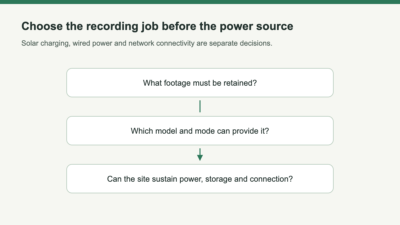
First decide what the system must keep running
Write a short operating brief before requesting prices. “Power a cabin” leaves too much unanswered: a summer weekend cabin with a propane stove is not the same load as an occupied winter home with electric heating and a well pump.
- Loads: list essential appliances, daily energy use, simultaneous demand and equipment that starts with a surge.
- Site: record location, seasonal occupancy, shading, mounting space and the proposed equipment location.
- Supply: specify fully off-grid operation, grid-connected backup or a separate stand-alone circuit. Do not let those be treated as interchangeable.
- Poor-weather plan: identify what can be switched off, how long essentials must run and whether a backup charging source will be available.
- Responsibility: name who designs, installs, commissions and supports the finished system.
Backup capability needs explicit confirmation even when batteries are included. Australia’s government solar design guidance explains that some grid-connected battery systems do not supply a property during an outage. That technical distinction matters elsewhere too; installation requirements must be checked locally.
Read the three ratings separately
A listing may headline “5kW” without making clear whether that is the panel array or the inverter. Ask for all three ratings below, with exact model numbers and quantities. They answer different questions.
| Rating | Useful question | Still needs checking |
|---|---|---|
| Array power, kW | How much panel nameplate capacity is included? | Seasonal daily energy, shading, orientation and the controller’s input limits. |
| Battery energy, kWh | How much energy is stored nominally? | Usable energy, reserve, losses, temperature limits and charge/discharge current. |
| Inverter output, kW or VA | What load can the AC supply support? | Continuous watts, timed surge, operating temperature, output voltage and battery support. VA and watts are not interchangeable. |
For a deliberately simplified example, a 100W appliance operating for five hours uses 500Wh, or 0.5kWh, before system losses. A 2,000W appliance operating for fifteen minutes also uses 0.5kWh, but needs much more instantaneous power. Equal energy use does not make the same inverter suitable for both.
Build the energy estimate from measurements or documented operating patterns, including cycling appliances and standby consumption. Use the existing battery-bank sizing guide for autonomy, usable capacity and reserve calculations. A single daily kWh total still does not establish pump startup capability or the required AC voltage.
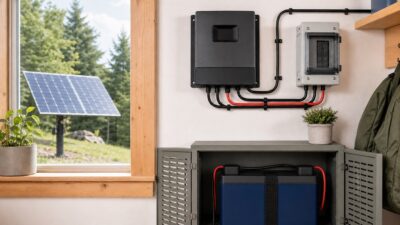
Ask for the parts list behind “complete”
Compare written bills of materials rather than photographs. For each line, ask whether it is supplied, supplied only in a particular package option, or excluded. Record quantities and the supported installation arrangement.
| Part of the system | What the quote should identify |
|---|---|
| Solar array | Exact panel model and quantity, planned strings, mounting arrangement and site assumptions. |
| Battery bank | Exact batteries and quantity, approved configuration, usable-energy assumptions, enclosure and monitoring. |
| Conversion and charging | Inverter, charge controller or integrated equivalent, supported battery settings and any backup charger. |
| Electrical installation materials | Specified conductors and lengths, connectors, overcurrent protection, disconnects, distribution equipment and the grounding/bonding design. |
| Mechanical installation | Racking, roof attachments or ground structure, weatherproofing, equipment supports and site-specific work. |
| Services and handover | Design documents, required approvals, installation, commissioning, settings record, warranty responsibilities and support contact. |
The US Department of Energy identifies mounting structures, wiring, disconnects, fuses and combiner boxes as balance-of-system hardware. These are real parts of an installation, not incidental extras. Their exact selection depends on the design; the checklist is not a prescription that every system uses identical hardware.
A preselected bundle can simplify purchasing. A custom kit can address unusual loads, mounting constraints or cable routes. Neither label replaces a documented design. Ask who takes responsibility if the panels, battery and inverter come from different manufacturers and a compatibility problem appears.
Require a compatibility answer, not just matching wattages
Have the supplier or qualified designer explain the following interfaces in writing. A larger headline number cannot compensate for a mismatch elsewhere.
Array to solar charger
The planned array must fit the exact charger’s voltage, current and operating-window limits, including site temperature conditions. Total panel watts alone cannot establish that. Use the solar charge-controller sizing guide to understand the questions, then require a model-specific string design. Victron’s MPPT installation documentation illustrates why configuration and installation requirements belong to the exact equipment, not a universal kit rule.
Battery to inverter and chargers
Confirm supported battery voltage, charge settings, continuous and startup current, and any required battery-management communication. Check the permitted battery configuration and the combined charging behavior when more than one source operates. Victron’s inverter/charger selection guidance explicitly connects inverter demand with battery capability, DC protection and system voltage. Matching a battery’s kWh to a daily energy target is only part of that decision.
Inverter to the loads
Require the correct AC voltage, frequency and configuration for the actual appliances and circuits. For a US property, “120V” and “120/240V split-phase” are not the same supply. Have motor starting, simultaneous loads and any transfer equipment checked as a complete system. Do not assume two standalone inverter outputs can be combined.
Make the supplier show a difficult month
A useful proposal explains both daily supply and recovery after poor weather. Ask for location-specific production assumptions, the effect of shading and the season when the property is occupied. A summer daily-energy estimate is not a winter reliability guarantee.
Then ask: after the battery has supplied the planned cloudy-day loads, can the system run today’s loads and restore the deficit in the expected recovery period? Additional battery capacity stores more energy, but does not create the charging energy needed to refill it.
Illustrative recovery budget—not a system size
Suppose daily demand is 3kWh and the battery has a 6kWh deficit to recover over two days. The energy budget must cover 3kWh/day for current use plus 3kWh/day for recovery: 6kWh/day delivered to those needs, before additional conversion losses and design margins. Actual available charging power and weather still limit recovery.
Agree on what happens when that recovery is not available: reduce discretionary loads, use a professionally integrated backup source, or accept a defined interruption. The winter solar guide explains the difference between panel operation in cold weather and enough usable daily energy. Do not accept “works in winter” as a complete supply plan.
Compare the installed scope before comparing the price
Request two totals: the supplied equipment package and the estimated installed, commissioned system. Require exclusions to be itemized. Freight, mounting work, cable routes, electrical distribution changes, design, approvals and labor can change the comparison substantially.
Also ask about ongoing responsibilities: inspections, monitoring, battery operating conditions, replacement availability and who handles warranty claims. An inexpensive package can be a poor fit if no installer will support its proposed configuration. Conversely, paying for a larger battery does not fix an unsuitable mounting site or an unsupported inverter interface.
For a property with an available grid connection, compare the complete off-grid proposal with a correctly designed grid-connected backup option. Do not assume that avoiding an electricity bill makes the off-grid system cheaper overall. This guide makes no universal price, payback or incentive claim.
Installation boundary: do not connect a kit to building wiring or backfeed an outlet based on a shopping checklist. Have a qualified installer determine the design, protection, transfer arrangement and applicable approval requirements. Follow the exact equipment manuals; this article deliberately does not provide conductor sizes, fuse values or a connection sequence.
Send the same brief to each supplier
Ask each supplier to return a dated proposal answering these questions:
- Which listed loads are supported, including simultaneous operation and startup, and which are excluded?
- What usable battery energy and poor-weather operating plan does the design assume?
- What location and seasonal production assumptions support the proposed array and recovery time?
- Which exact components, installation materials and services are included—and who verifies their compatibility?
- What remains to be designed or purchased locally, and who commissions and supports the finished system?
Choose between proposals only after those answers are comparable. If a supplier cannot identify the missing pieces or explain how the system meets your operating brief, keep that proposal out of the final shortlist. The next purchase should be a documented solution for your site, not simply the box with the largest wattage on its label.
Research note: This is a documentation-based buying guide, not a hands-on kit test. Linked technical sources were reviewed on October 26, 2026. Exact manuals and the site-specific professional design govern installation.