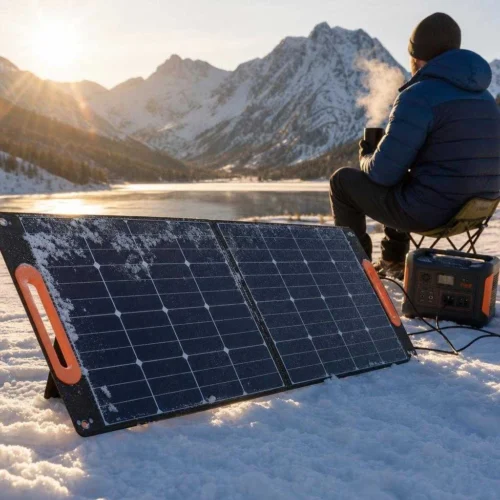
Yes — solar panels work in winter, and here’s the part that surprises people: for each hour of good sun, a cold panel actually produces slightly more power than the same panel in summer heat, because photovoltaic cells run more efficiently when they’re cold. What falls in winter isn’t the panel’s ability to make power — it’s the daily total. Shorter days, a low sun angle, heavier cloud, and the occasional blanket of snow all cut the number of usable sun hours, so a healthy panel simply has less sunlight to convert.
Two other realities shape a winter setup. Cloudy days still produce, but only at roughly 10-30% of rated output depending on how thick the cloud is. And partial shade hurts far more than its size suggests — because a panel’s cells are wired in series, shading one small cell can crater the output of the whole panel. Understand those three effects — cold helps, short days hurt, shade hurts most — and winter solar stops being a mystery.
Key Takeaways
- Cold is good, not bad — panels are more efficient when cold, so a clear, well-angled winter midday can push output right up toward the panel’s rating.
- Winter cuts totals, not ability — fewer peak sun hours (often 1-3 vs 5-6 in summer) mean lower daily energy even when each sunny hour is strong.
- Cloudy days work slowly — expect about 25-40% of rated output under bright overcast, and 10-20% or less under heavy cloud.
- Shade is the big one — series wiring means partial shade can halve output or worse; keep panels in clear sun.
- Tilt and clear snow — angling panels toward the low winter sun catches more light and helps snow slide off on its own.
Why Cold Helps Efficiency but Winter Cuts Your Totals
These two facts feel contradictory, so it’s worth separating them. A solar cell is a semiconductor, and semiconductors conduct more cleanly when they’re cool. Panels are rated at a cell temperature of 25C (77F), and most gain a small percentage of output for every few degrees below that — while losing output as they heat up on a summer roof. That’s why a crisp, sunny winter day, with the panel angled at the low sun, can deliver output right up near the nameplate rating. The cells love the cold.
The reason your winter energy still drops comes down to peak sun hours — the number of hours per day the panel effectively sees full-strength sunlight. In summer, much of the world gets 5-6 peak sun hours; in the depths of winter, that can fall to 1-3. The sun rises later, sets earlier, and sits low in the sky, so its light travels through more atmosphere and strikes the panel at a shallow angle. Multiply a strong-but-brief sunny window by far fewer hours and the daily harvest often lands 40-60% below a summer day, even though each individual sunny hour is excellent.
So the honest framing is this: winter doesn’t weaken your panel — it shortens its working day. On a real-world basis, expect a good rigid panel to hit a real-world factor around 0.7-0.85 of its rating in strong winter sun, and far less under overcast. That’s the same factor that governs summer output; winter simply hands the panel fewer hours to apply it. For the full breakdown of how nameplate watts turn into real daily energy, see our guide on how much power a solar panel actually produces.
Solar Panel Output by Condition
The single most useful mental model is a rough table of output as a share of the panel’s rated wattage, by sky and mounting condition. These are ballpark instantaneous figures for a healthy panel — your real numbers depend on latitude, tilt, cleanliness, and cell temperature.
| Condition | Output (% of rated) | What it means |
|---|---|---|
| Full summer sun, aimed at the sun | ~70-85% | The everyday best case; real-world factor after heat, wiring, and angle losses. |
| Clear, cold winter midday, tilted well | ~65-85% | Cold boosts the cells; the low sun angle gives some of it back. Strong per-hour output. |
| Bright / light overcast | ~25-40% | Diffuse light still works; charging continues, just slowly. |
| Heavy overcast / dark storm cloud | ~10-20% | A trickle rather than a stop; holds ground on a battery, won’t run big loads. |
| Snow-covered glass | ~0-10% | Effectively off until you clear it or it slides off. |
| Partial shade (one section shaded) | Drops sharply (often 50%+) | Series wiring means one shaded cell drags the whole panel down. |
Notice that snow cover and shade are the two conditions that don’t just trim output — they can nearly switch a panel off. Cloud, by contrast, dims output but rarely kills it.
Cloudy Days: What Solar Panels Really Do Without Direct Sun
A common worry is that panels need a clear, direct beam of sunlight to do anything. They don’t. Panels respond to daylight, including the scattered, diffuse light that reaches the ground through cloud. That’s why a panel keeps producing on an overcast day, and even reads a small output in open shade — there’s still light energy arriving, just less of it and from more directions.
How much you get depends on how thick the cloud is. Under bright, thin overcast, expect roughly 25-40% of rated output. Under heavy, dark storm cloud, it can fall to 10-20% or lower. Interestingly, some panels handle low light better than owners fear — in one flexible-panel field report, an owner said theirs kept putting out “great power, even in lower lights,” and it kept a 12V bank ticking over on dull days. That’s the realistic picture: cloudy days work, they just work slowly, and they’re plenty for trickle-charging a battery or topping up a portable power station rather than running heavy appliances.
The Outsized Impact of Partial Shade
If there’s one winter effect that catches people out, it’s shade. The intuition is that shading a tenth of a panel should cost you roughly a tenth of the output. In practice it costs far more, and the reason is how panels are wired. The cells inside a panel are connected in series, like links in a chain — the current that flows is limited by the weakest link. Shade one cell and you throttle the current for the entire string, not just that cell.
The effect can be dramatic. In one real owner report, shading a single 5-inch cell dropped that panel’s output to zero. More commonly, a chimney shadow, a roof vent, an antenna, or a bare winter branch falling across part of the array cuts output by half or more. Winter makes this worse in a specific way: the sun sits low, so shadows are long and sweep across panels for more of the short day. A rooftop obstruction that never shaded the array in high summer can clip it for hours in January.
Two practical defences help. First, site panels where nothing shades them during the low-sun midday window, even if that means accepting shade in the early morning or late evening when there’s little energy to lose anyway. Second, if partial shade is unavoidable, panels and controllers that handle it better — or splitting an array so a shaded panel doesn’t drag down its neighbours — soften the hit. Portable panels are handy here precisely because you can move them out of a shadow as the sun tracks; our roundup of the best portable solar panels covers options you can reposition through the day.
Snow, Tilt, and Keeping Panels Clear
Snow is a blunt problem: a panel with its glass fully covered produces almost nothing, because the light can’t reach the cells. The good news is that snow often clears itself. Panels tilted toward the low winter sun warm up as the dark glass absorbs light, and the bottom layer of snow melts just enough for the sheet to slide off. A steeper tilt both catches the low sun more squarely and sheds snow faster — which is why winter-optimised installs are angled more steeply than summer ones.
When snow doesn’t clear on its own and you want the output back, clear it gently. Use a soft-bristled brush or a foam roof rake designed for panels, and never a metal scraper or shovel edge — scratching the glass or nicking the surface causes permanent losses. And respect the cold itself only in the sense that panels put out higher voltage when cold; that’s harmless to the panel but means any charge controller must be sized with headroom for cold-weather voltage spikes, a point worth checking against your controller’s maximum input voltage.
Practical Tips to Get the Most From Winter Sun
Winter output is largely a game of capturing the few good hours you get. A handful of habits make a real difference:
- Tilt toward the low sun — a steeper winter angle (roughly your latitude plus 10-15 degrees) points the panel more squarely at the low sun and helps snow slide off. Adjustable mounts let you steepen for winter and flatten for summer.
- Keep the glass clear — brush off snow with a soft tool, and wipe away dust and grime, since every fraction of light counts when there’s little to spare.
- Guard against shade first — because partial shade hits so hard, siting for clear midday sun beats almost any other tweak. Trim branches and avoid mounting where vents or chimneys cast shadows.
- Oversize the array — if winter energy matters (off-grid cabins, RVs used year-round), fit more panel capacity than your summer math suggests so the shorter winter day still covers your needs.
- Preserve airflow — it still matters — even in winter, panels flat against a warm surface run hotter and lose a little edge; a small gap behind them keeps the cold-weather efficiency bonus intact.
- Move what you can — with portable panels, chase the sun and dodge shadows through the day rather than accepting a fixed, shaded angle.
Put those together and winter solar is entirely workable — you’re simply banking strong-but-brief sunny hours and protecting them from shade and snow. To see how a specific panel’s rating translates into real winter and summer output for your location, run the numbers through our solar panel output calculator and size your setup with the seasons in mind.

Leave a Reply