
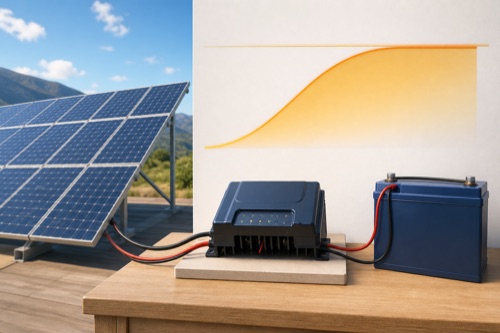
You can oversize solar panels on a charge controller only when the exact manufacturer permits it and the proposed array remains inside cold-corrected PV Voc, PV Isc/input current, battery-voltage-specific power, thermal, conductor, and protection limits. Approved excess watts may be clipped. Excess maximum voltage is not safe clipping.
An oversizing ratio describes only one part of the array. Before looking for extra morning yield, separate absolute voltage limits, input-current rules and the manufacturer’s permitted watts at your battery voltage. The gate checker below intentionally asks for all three quantities and the source of permission. It cannot turn a missing manual rule into a pass.
Can You Oversize Solar Panels on a Charge Controller by Watts Alone?
Why Excess Watts and Excess Voc Have Different Outcomes
A suitable MPPT controller can limit battery-side current when available array power exceeds its output capacity. That is clipping. Input semiconductors still face array voltage, so a string above absolute maximum can damage the controller before output limiting helps.
| Quantity | Possible Treatment | Hard Boundary? |
|---|---|---|
| Nominal PV watts | May be oversized under stated policy | Conditional |
| Cold-corrected PV Voc | Must stay below absolute ceiling | Yes |
| Array Isc/input current | Must satisfy exact rule | Yes/defined by manual |
| Charge output amps | Controller can cap output | Yes for delivered current |
| Battery charge current | Must remain inside battery limit | Yes |
Reject Excess Cold Voltage Before Discussing Clipping
First Gate: Cold-Corrected String Voc
Add panel Voc through the longest series string, then apply the panel’s published voltage temperature coefficient at the site’s minimum design temperature using the required method.
string Voc at STC = panel Voc × modules in series
cold-corrected Voc = STC string Voc adjusted with exact coefficient and design temperature
| Hypothetical Input | Value | Status |
|---|---|---|
| Panel Voc | 24.0V | Example only |
| Modules in series | 4 | 96.0V at STC |
| Controller ceiling | 100V | Only 4V STC gap |
| Cold correction | Not supplied | Cannot pass; likely critical |
This example cannot be approved. A warm STC total near the ceiling commonly has insufficient winter margin.
Account for Every Parallel String
Second Gate: PV Isc and Parallel Strings
Parallel strings add short-circuit current. The exact manual may state maximum PV Isc, operating current, reverse current, or a permitted multiplier; preserve its terminology.
array Isc at STC = string Isc × parallel strings
| Layout Change | Voltage Effect | Current Effect |
|---|---|---|
| Add module in series | Voc/Vmp rise | String current roughly unchanged |
| Add identical string in parallel | Voltage roughly unchanged | Isc/Imp add |
| Replace modules | Recalculate both | Recalculate both |
| Add east/west strings | Same electrical sums still apply | Diversity does not erase hard current rule |
A controller’s 40A charge rating is not automatically its PV Isc limit. If input current is unpublished, overpaneling cannot be evaluated responsibly from watts alone.
Find the Applicable Array-Power Permission
Third Gate: PV Watts at the Actual Battery Voltage
Controllers often allow approximately more PV watts on higher-voltage banks because the same output current represents more power. Use the row for the configured bank and determine whether it is recommended, nominal maximum, or absolute.
| Example Manual Rows | Array Proposal | Preliminary Result |
|---|---|---|
| 450W at 12V | 600W array | Over normal row; policy required |
| 900W at 24V | 600W array | Within watt row only |
| 1,800W at 48V | 600W array | Within watt row only |
The 24V and 48V rows do not approve voltage, Isc, battery, or wiring. They only pass one gate.
Screen the Three Independent Array Limits
Two hypothetical 600W arrays can have opposite outcomes. One might have 62V corrected Voc and 22A design Isc under a manual that permits 600W, 100V and 25A. Another might reach 108V on the same input ceiling. The second array fails even if you lower battery-side charge current in software. This is why the worksheet returns individual boundaries instead of a single recommended oversizing percentage. Retain the exact manual page that grants wattage permission and rerun the checks whenever modules or wiring change.
Open calculation toolOptional · use your own values or a labelled example
Enter already cold-corrected array Voc and the design PV short-circuit current after any factors required for your installation. Enter the array-watt allowance expressly applicable to this controller and battery voltage, not another model’s advertised value. A clear numeric result still leaves hot operating voltage, battery acceptance, mounting, conductors and protection for design review.
The interactive worksheet requires JavaScript. The worked explanation below remains available; do not treat missing output as a passed check.
Educational screening only. This worksheet cannot inspect equipment, verify an installation or approve energizing.
Compare Useful Harvest With Clipped Peaks
What Clipping Looks Like
In strong conditions, output plateaus at a controller current or power limit while the array could supply more. During morning, clouds, winter sun, or non-ideal orientation, the larger array may spend more time below the limit and harvest more energy. Whether the extra annual energy justifies panels depends on climate, orientation, battery demand, and price.
| Potential Benefit | Counterweight |
|---|---|
| Earlier/later useful charging | More panel and mounting cost |
| Better weak-weather harvest | Higher possible input current |
| More energy despite peak clipping | Added thermal loading |
| East/west production spread | All hard electrical sums still apply |
Controller heat and derating matter. A design approved at moderate ambient may clip or derate differently in a sealed hot compartment. Follow mounting clearance, ambient range, and any power reduction curves.
Manufacturer Permission and Warranty
Some manufacturers publish an oversizing ratio or absolute array-power maximum under stated voltage and current conditions. Others publish only a nominal PV-power row. Do not borrow a 150% rule from another brand or even a sibling controller.
| Policy Evidence | Action |
|---|---|
| Exact manual explicitly permits ratio | Apply every attached condition |
| Manufacturer provides written exact-model guidance | Preserve response with design record |
| Seller listing says “supports oversizing” | Confirm in technical documentation |
| Manual is silent | Stay in normal allowance or select clearer equipment |
Review Expansion as a New Electrical Design
Two Hypothetical Pass/Fail Scenarios
Scenario A uses a 100V controller, 2S2P array, corrected string Voc of 62V, and total Isc of 22A. Its proposed 600W exceeds the 450W normal row, but the manual explicitly permits 600W at that bank voltage up to 25A Isc. It passes these stated inputs preliminarily; battery, conductors, protection, temperature, and listing still require checks.
Scenario B also totals 600W, but uses 4S1P with corrected Voc of 108V. It fails a 100V ceiling even though current is lower and wattage matches Scenario A. Reducing output setting cannot repair input overvoltage.
| Gate | Scenario A | Scenario B |
|---|---|---|
| Cold Voc | 62V / 100V — pass | 108V / 100V — fail |
| Array Isc | 22A / 25A — pass | Lower, but irrelevant to failed Voc |
| Watts | Explicitly permitted 600W | Watt permission cannot override Voc |
| Decision | Continue remaining checks | Redesign string/controller |
Expansion Checklist
- Exact module model and string diagram recorded.
- Cold-corrected Voc passes with required margin.
- Hot Vmp stays inside useful operating window.
- Total PV Isc passes the exact input rule.
- Proposed watts pass the battery-voltage row or explicit oversizing policy.
- Controller output and thermal behavior are acceptable.
- Battery/BMS accepts combined charging current.
- Conductors, connectors, terminals, fuses, and disconnects are recalculated.
- Warranty/listing conditions permit the proposal.
- No missing value has been treated as unlimited.
Orientation Can Change Energy Without Changing Hard Limits
East/west arrays may spread production across the day and reduce the time both orientations reach peak output together. That can improve the usefulness of controlled overpaneling, but electrical maximums are still calculated from the connected strings. Do not reduce summed Isc or corrected Voc merely because modeled peaks occur at different hours unless the exact manufacturer policy explicitly defines an accepted method.
Seasonal tilt and partial shade also affect energy yield, not hardware survival limits. Use production modeling to estimate whether added modules earn their cost; use manual calculations to decide whether they are allowed. Keeping those purposes separate prevents an optimistic energy model from becoming an unsafe electrical assumption.
Overpaneling PWM and MPPT Controllers
MPPT controllers are commonly discussed because they can limit converted output while operating a higher-voltage array. PWM controllers couple panel and battery behavior differently and may publish much narrower voltage or power allowances. Never assume a clipping policy transfers between topologies.
Even among MPPT units, input hardware and manufacturer rules vary. Two controllers with the same 40A output can have different PV Isc limits, absolute Voc, power rows, cooling, and warranty terms. Use the exact SKU and firmware family if documentation distinguishes them.
Monitor an Approved Oversized Array
Commissioning should confirm string voltage/current, battery current, controller temperature, and clipping behavior under representative conditions. Compare app or display values with appropriately obtained independent measurements. Record the highest observed values with ambient conditions, without pretending one day captures the coldest Voc or hottest compartment.
Review logs for repeated thermal derating, overvoltage alarms, or BMS disconnects. Normal clipping is a controlled plateau; a protection event is a reason to investigate. Check terminals for manufacturer-defined inspection needs and keep ventilation paths clear.
When More Controller Is Better Than More Panels
If overpaneling pushes against Isc, heat, or warranty restrictions, a higher-output controller or an additional independent tracker may be the cleaner expansion. That choice can reduce clipping and separate orientations, but it also changes conductors, protection, communications, and battery-current totals.
Compare lifetime system cost rather than panel dollars alone. The least expensive safe option may be a controller with a complete manual and usable headroom, especially when labor to rewire strings or replace protection is significant.
Record the Exact Overpaneling Conditions
Do Not Confuse DC/AC Ratio With Controller Overpaneling
Grid-tied inverter discussions often use a DC-to-AC ratio, but a battery charge controller has additional bank-voltage and charge-current relationships. Borrowing an inverter ratio can ignore PV Isc, battery acceptance, and the controller’s exact PV-power rows. Use the terminology and limits from the product being designed.
The same caution applies to bifacial modules. Rear-side gain can increase available current and power beyond the front-rating intuition, so follow module and controller guidance for the design quantities. Snow reflection, cold conditions, and high irradiance can combine increased power with elevated Voc; energy-model averages do not replace extreme-condition checks.
When several controllers charge one bank, each array must pass its own input limits and their outputs must be coordinated. Splitting panels across controllers can reduce clipping or separate orientations, but total battery current can increase. Settings, sensing, and communications should not fight each other near the charge target.
Record the approved overpaneling basis on the system diagram: exact array, stringing, corrected Voc, Isc calculation, bank voltage, permitted watts, output setting, ambient assumptions, and manufacturer source. A future owner can then distinguish intentional clipping from an unauthorized panel addition.
Revisit that record after replacing a module. A modern panel with similar watts may have higher Voc or Isc than the original. Equal wattage and physical size do not establish electrical interchangeability, especially when an oversized design already uses much of the controller’s margin.
Also recheck after changing battery voltage or controller firmware. Either can alter the applicable power row, settings, or documented operating policy.
Bottom Line: Overpanel Watts, Never Hard Limits
Can you oversize solar panels on a charge controller? Yes, conditionally, when the exact documentation allows the extra nominal watts and every voltage, input-current, thermal, output, battery, and installation check passes. The potential benefit is more harvest outside peak conditions, purchased with more clipping and hardware.
If corrected Voc or allowed Isc is exceeded, redesign the array or controller. When manufacturer policy, protection, conductor sizing, or code application is unclear, obtain written guidance and qualified review before purchase or energizing.

Leave a Reply