
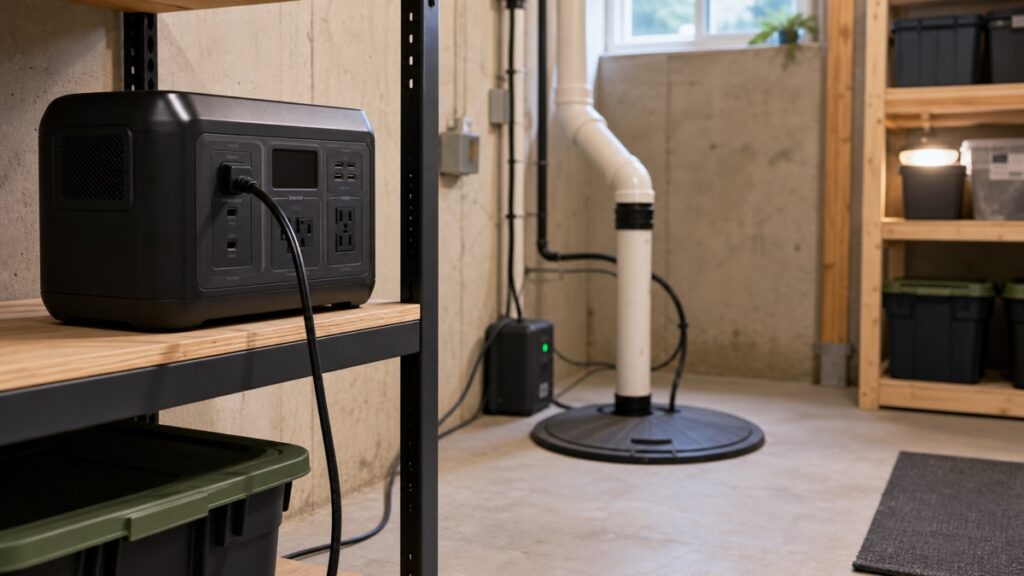
A portable power station can run some sump pumps, but a running-watt estimate alone is not enough to protect a basement. The exact pump must pass three independent gates: the inverter must start it, the station must carry its running load, and the battery must cover a realistic storm duty cycle. The float switch, check valve, discharge path, alarms, charging plan, and station settings must also work as one commissioned system.
Use exact documented or properly measured startup evidence.
Voltage, continuous watts, and receptacle current must fit.
Model storm cycling, reserve, losses, and inverter idle draw.
A Dry Basement Depends on Three Independent Gates
The first gate is instantaneous: can the inverter support the pump’s starting event for the required duration? The second is continuous: once spinning, can the exact outlet and inverter carry the pump without overload or voltage fault? The third is energy: how many watt-hours will the station deliver before reaching the planned reserve while the pump cycles through the storm?
Passing one gate does not imply the others. A large battery with a small inverter may run for a long time on paper but fail at the first start. A powerful inverter with a small battery may start cleanly but provide only a short storm window. A station that passes both electrical gates can still fail the real job if eco mode turns off the outlet between cycles, the float sticks, the check valve leaks, or the discharge line is blocked.
Horsepower describes mechanical output, not the complete electrical startup event. Pumps with similar horsepower labels can publish different full-load and locked-rotor current. Use the exact pump model, voltage, nameplate, manual, and measured cycle behavior.
Build the Exact Pump-and-Station Record
The calculator below keeps unknown startup evidence visible instead of silently inserting a generic multiplier. If the manufacturer publishes locked-rotor amps for the exact model, you can use that number as a conservative documented startup-current input. If it does not, mark startup as unknown until a qualified technician obtains suitable evidence.
The ON and OFF times create an observed duty cycle. The tool includes inverter idle draw during the OFF period because a sump pump that waits for water is not the same as an inverter that consumes nothing. The runtime estimate reserves the selected battery percentage and applies the entered conversion efficiency. It does not predict rainfall, groundwater inflow, pump wear, or battery performance in every temperature.
Horsepower Is Not a Startup-Watt Specification
Published exact-model data makes the problem visible. Liberty Pumps’ April 2025 engineering specification lists its 115V Model 257 at 5.2 full-load amps and 8 locked-rotor amps. Those are distinct values supplied for an exact pump family and voltage. Zoeller lists the 115V Model M53 at 9.7A, but its public product page does not provide a locked-rotor value. It would be irresponsible to manufacture one from its 3/10-hp label.
| Exact pump | Published electrical data | What remains unknown from that source |
|---|---|---|
| Liberty 257, 115V | 1/3 hp; 5.2 full-load amps; 8 locked-rotor amps | How a particular station responds to the event in the installed system |
| Zoeller M53, 115V | 3/10 hp; 9.7A; 60Hz | Startup amps on the cited product page |
Even when locked-rotor amps are published, compare duration and inverter behavior rather than watts alone. Some station “surge” modes reduce voltage or use conditions unsuitable for a motor. A peak wattage with no useful duration or waveform information is incomplete evidence. If the pump or station maker cannot confirm compatibility, a controlled test by qualified personnel is more informative than a category multiplier.
The existing running versus starting watts guide explains the general distinction. This page stays narrower: it turns exact pump data and storm cycles into a backup decision.
Storm Duty Cycle Changes the Runtime Answer
A sump pump is normally intermittent. During a mild event it may run for 15 seconds every few minutes. During saturated-ground or power-outage conditions it may run much more often. A single “pump watts” runtime number hides that variation.
Long OFF periods dominate. Inverter idle draw and eco-mode behavior become important.
Running energy rises, start events repeat, and a leaking check valve can waste capacity.
Plan close to continuous running demand and investigate whether the pump/discharge system is adequately sized.
Collect cycle observations during rain and maintain a conservative reserve plus a second backup path.
Record ON and OFF times over several cycles without reaching into the basin or bypassing controls. Repeat during different rain intensities. If the duty cycle rises sharply or the pump short-cycles, inspect the plumbing and switch system rather than buying battery capacity as the only response.
If the conservative scenario produces eight hours, the useful conclusion is not simply “eight hours of backup.” It means someone must restore grid power, recharge from an approved source, deploy a second independent pump path, or move to the flood-response plan before the reserve is reached. Assign that action and contact before the storm; do not wait for the battery display to become the emergency plan.
Separate battery runtime from basin protection time. The pump may stop sooner because of an inverter fault, sleeping outlet, high temperature, obstructed discharge, or failed float. Conversely, rainfall may ease and extend the calendar window. This is why the worksheet reports an electrical scenario rather than promising that a basement will stay dry for a stated number of hours.
Commission the Backup While the Weather Is Calm
The test must include the silent interval between cycles. Some stations shut down AC output under low load. If that happens, the pump may never receive power when the float calls for it. Disable such a feature only through documented settings and confirm the station remains within its safe operating instructions.
Also verify recovery. After the station reaches its reserve or grid power returns, does the required AC output come back automatically? Does the charger compete with the pump for a bypass limit? If automatic backup behavior matters, apply the separate UPS/EPS transfer and bypass check.
Battery Capacity Cannot Fix These Failure Modes
| Failure | Why more Wh does not solve it | Action |
|---|---|---|
| Pump will not start | The inverter, outlet, voltage, or startup duration fails. | Resolve exact startup compatibility. |
| Outlet sleeps between cycles | The float can call for power while AC is disabled. | Verify documented always-on settings. |
| Check valve leaks | Water returns and creates extra cycles. | Service the pump system. |
| Discharge freezes or blocks | The pump cannot remove water regardless of energy. | Correct the discharge path. |
| Station sits near water | Shock and equipment-damage risk increases. | Keep it dry and follow both manuals. |
| No recharge path | A longer outage eventually consumes any finite battery. | Plan safe charging and a second backup. |
A high-water alarm on an independent power source can warn that the primary path failed. For serious flood exposure, consider a purpose-built secondary pump or other engineered redundancy instead of relying on one pump, one float, one inverter, and one battery.
Published Pump Data Shows Why Exact Models Matter
The Liberty and Zoeller examples do not establish which station anyone should buy. They demonstrate why the shopping process must begin with the installed pump. A seller’s generic “1/3-hp pump” chart could understate or overstate demand because electrical designs differ. Use the serial/model plate on the pump you own, not a visually similar listing.
- Photograph the pump data plate and plug.
- Download the exact current manual and electrical table.
- Record full-load/rated current and any exact locked-rotor or startup data.
- Record the station’s outlet-level continuous and surge limits, including duration.
- Observe realistic cycle timing and include idle draw.
- Keep a reserve and a second flood-response plan.
When the exact startup event remains unavailable, choose “unknown” in the tool. That result is useful: it tells you what evidence is missing before an outage. It is safer than pretending the system passed.
Bottom Line: Treat Backup Power as a Pump System
A portable power station is a candidate when voltage and receptacle match, documented startup demand fits the inverter and duration, running demand fits continuous output, the observed storm-cycle runtime meets the planned window with reserve, and normal float-controlled starts work after idle periods.
For broader battery sizing after the pump record is complete, use what size portable power station do I need? Then retain the pump-specific cycle model here, because a basement storm is not a generic constant-watt load.
Leave a Reply