
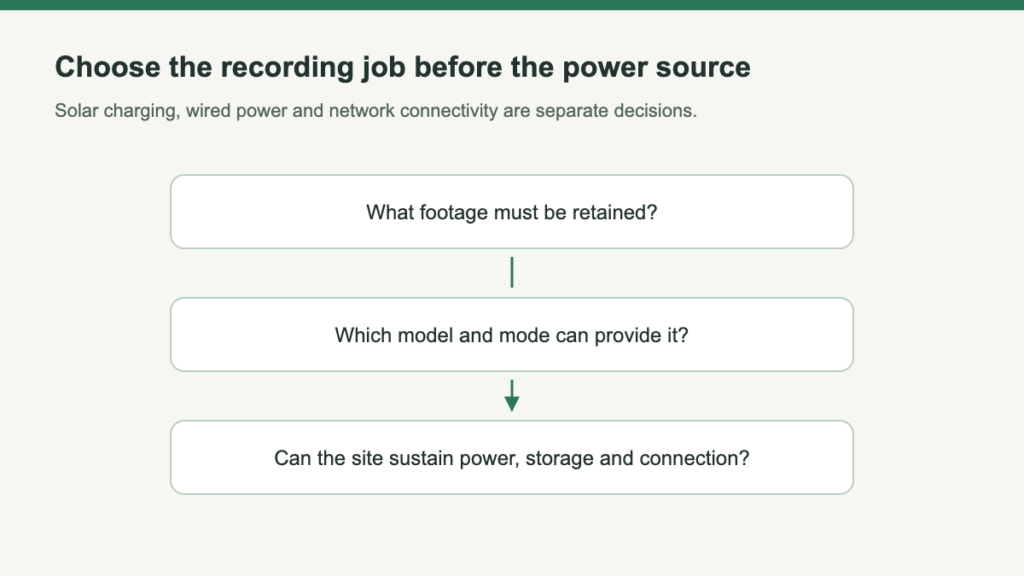
“Wireless” can describe the network connection, the power arrangement or both. A camera can use Wi-Fi while still needing a power cable. A solar camera can avoid permanent power wiring yet still depend on a router or cellular service. Start by unpacking the labels before comparing convenience.
Put power, communication and recording in separate columns
| Decision | What to establish |
|---|---|
| Energy | How the camera is powered and what maintenance it needs |
| Communication | How footage and alerts reach the intended viewer |
| Recording | What is saved, where it is kept and how it is retrieved |
This prevents a common mismatch: choosing a charging arrangement and assuming it also establishes a recording capability. The solar panel is not proof of continuous video, just as a cable is not proof that a recorder is included or correctly configured.
A nearby entrance and a distant gate are different purchases
If an approved power route is practical, compare installation work with battery access over time. Avoiding a cable does not eliminate panel, recording or maintenance tasks.
Solve communications alongside power. Sunlight cannot extend Wi-Fi coverage; a cellular choice adds compatibility and ongoing service requirements.
Battery-only can be a legitimate third option
A reachable battery-only camera can fit when its supported charging routine is acceptable. Solar is not automatically necessary.
Buying a battery camera does not prove that any panel can later be attached. Verify approved accessories before relying on an upgrade.
Do not improvise permanent electrical connections to change product classes. Follow exact equipment and site requirements, using qualified help where needed.
Choose for the hardest requirement—not the fewest cables
- Unbroken recorded evidence: establish the supported capture mode and a sustainable power path before comparing installation convenience.
- No convenient camera outlet: assess a supported battery-and-solar arrangement, including panel exposure and access for service.
- No usable home network: solve communications separately; sunlight does not turn Wi-Fi hardware into a cellular camera.
A reachable battery-only camera may also be sufficient if its approved charging routine fits the job. Do not buy a solar accessory merely to avoid considering that third option, or improvise electrical work to change one product class into another.
Use the complete installation and operating cost to compare only configurations that meet the evidence requirement. Visible cable count is a convenience detail; recording, communication and maintainability decide whether the system works for the site.
Leave a Reply