Solar Power Picks logo with sun, solar panel, and green energy icon

  • Home
  • Reviews
  • Best
    • Best portable power stations
    • Best Solar Panels
    • Best Solar Generators
    • Best Solar Charge Controllers
    • Best Solar Batteries
  • Guides
    • Portable Power Stations Guides
    • Solar Panels Guides
    • Solar Generators Guides
    • Solar Charge Controllers Guides
    • Solar Batteries Guides
  • Comparisons
    • Portable Power Stations Comparisons
    • Solar Panels Comparisons
    • Solar Generators Comparisons
    • Solar Charge Controllers Comparisons
    • Solar Batteries Comparisons
  • Calculator
Home / Solar Charge Controllers / Best / Best Solar Charge Controllers for RVs: 5 Sized Picks

Best Solar Charge Controllers for RVs: 5 Sized Picks

OUR PICKS

Victron SmartSolar 75/15 Review: A Strong Fit for Small Arrays

Best for Compact RV Arrays

Victron SmartSolar 75/15 Review: A Strong Fit for Small Arrays

Check price at Amazon Jump to details
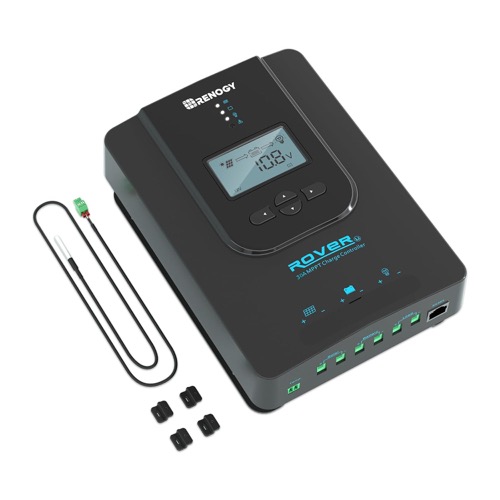
Renogy Rover 30A Review: The Useful Middle Size—with Mounting Friction

Best 30A MPPT for RVs

Renogy Rover 30A Review: The Useful Middle Size—with Mounting Friction

Check price at Amazon Jump to details
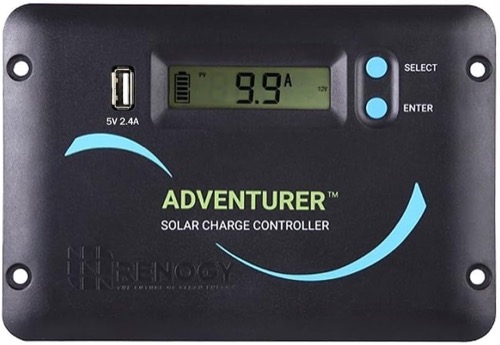
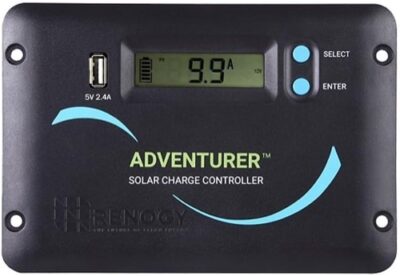
Renogy Adventurer Li 30A Review: The Flush-Mount RV Specialist

Best Flush-Mount PWM

Renogy Adventurer Li 30A Review: The Flush-Mount RV Specialist

Check price at Amazon Jump to details
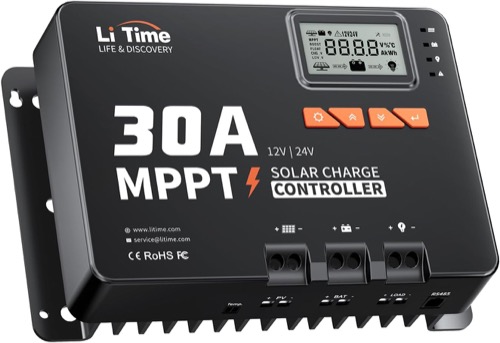
LiTime 30A MPPT Review: A Practical Bluetooth LiFePO4 Controller

Best Lithium-Focused Value

LiTime 30A MPPT Review: A Practical Bluetooth LiFePO4 Controller

Check price at Amazon Jump to details
BougeRV Sunflow 40A MPPT Review: Capable Hardware, Uneven Controls

Best Built-In Bluetooth

BougeRV Sunflow 40A MPPT Review: Capable Hardware, Uneven Controls

Check price at Amazon Jump to details

The best solar charge controllers for RV use must fit the roof array and the compartment behind it. Cold-corrected panel voltage and battery charge current set the electrical boundary; mounting depth, cable access, ventilation, display location, and Bluetooth range determine whether the controller remains practical after the coach starts moving.

An RV owner can therefore buy the wrong product in two directions. A compact 15A controller may leave no expansion room, while a 40A model can add weight, heat, and expense to a fixed 200W roof that will never use the capacity.

Our rankings use exact-model documentation and captured Amazon owner evidence, including long road trips, truck-camper mounting friction, app behavior, and lithium setups. Solar Power Picks did not physically test these controllers, so the article distinguishes published limits from owner anecdotes.

RV sizing rule — Design around the final realistic roof plan, not today’s single panel or a hypothetical unlimited expansion. Every unused amp still occupies space and budget.

The RV Shortlist at a Glance

These five models cover a compact app-first system, a balanced 30A controller with local controls, a flush-mounted PWM panel, a lithium-oriented LCD/Bluetooth unit, and an integrated 40A upgrade. Their overlap is intentional only at the system level; each earns its place through a different installation argument.

Product RV-Specific Badge Type / Output Max PV Voc Battery System RV Advantage
Victron SmartSolar 75/15 Best Compact RV MPPT MPPT / 15A 75V 12V / 24V Small passive enclosure; built-in Bluetooth
Renogy Rover 30A Best Balanced 30A RV Pick MPPT / 30A 100V 12V / 24V LCD, 20A load output, optional app
Renogy Adventurer Li 30A Best Flush-Mount Interior Display PWM / 30A 50V 12V / 24V Purpose-built wall installation
LiTime 30A MPPT Best LCD + Bluetooth LiFePO4 Fit MPPT / 30A 100V 12V / 24V Both monitoring paths included
BougeRV Sunflow 40A Best Integrated 40A Upgrade MPPT / 40A 100V absolute; protection described near 95V 12V / 24V Screen, Bluetooth, and 20A load output

No row settles array design. Victron publishes 15A maximum PV Isc; Rover, LiTime, and BougeRV lack an Isc value in the reviewed evidence; Adventurer is PWM and needs voltage-matched panels even when string Voc stays below 50V.

How We Ranked the Best Solar Charge Controllers for RV Use

We weighted hard compatibility before convenience. Every candidate was compared by PV voltage, power at 12V/24V, output current, battery profiles, conductor access, environmental protection, and monitoring. Then its distinctive RV use was checked against the owner record rather than inferred from brand reputation.

The evidence changes the rankings in concrete ways. Victron’s small enclosure and documented input current are valuable in a cramped van. Rover’s physical mounting complaints matter because a truck-camper cabinet rarely offers unlimited tool access. Adventurer’s flush face wins only after the rear cavity is measured, and BougeRV’s app/revision friction reduces the benefit of integrated controls.

That is why the best solar charge controllers for RV buyers are organized by roof and installation plan instead of one universal performance score.

Criterion RV Reason Weight
Roof-array compatibility Series Voc, parallel Isc, and battery-voltage watts are hard limits High
Battery fit LiFePO4 settings, current, BMS, and cold behavior must agree High
Compartment installation Terminals, cable bends, ventilation, and service access affect reliability High
Monitoring path A visible screen or usable app simplifies travel diagnostics Medium
Vibration/owner evidence Travel reports reveal practical mounting and connection issues Medium
Expansion economics Buying one size larger can avoid replacement, but oversizing has a cost Medium

Evidence note — A successful road trip is relevant mobile-use evidence, not a vibration certification. Published installation rules still control mounting, cable support, and environmental exposure.

Best Compact RV MPPT: Victron SmartSolar 75/15

The 75/15 is the disciplined choice for a roof that will remain small. Victron publishes 75V maximum PV Voc, 15A maximum PV Isc, 220W at 12V or 440W at 24V, 15A charge output, IP43 electronics, and a five-year warranty. Bluetooth and 30-day history are built in, while VE.Direct supports a larger ecosystem.

Its limits arrive quickly on a 12V coach. Two modern 200W modules would exceed the normal 220W allowance even if output often clips, and a future 24V/48V battery conversion changes the comparison. There is no numeric screen, so phone access is part of routine commissioning.

Choose it for a van, small trailer, or portable coach with one carefully matched array and limited cabinet space. Move to a larger voltage/current class before buying panels if meaningful expansion is likely.

Best Balanced 30A RV Pick: Renogy Rover 30A

Rover’s 400W-at-12V and 800W-at-24V allowances match many mid-size mobile arrays. The 100V PV ceiling enables series wiring, the LCD works without a phone, optional BT hardware adds app access, and a 20A programmable load circuit can manage suitable small DC loads.

The deciding concern is installation geometry. Owners described hidden bracket screw access, unclear terminal-clamp instructions, and cable-lug friction; another reported four years of service. Dry-fit the 238 × 172 × 77mm, 2kg enclosure with the final 8-AWG-or-smaller conductors, tool clearance, ventilation, and display sightline.

Rover is the strongest all-round RV starting point when 30A provides expansion room and local control matters. It loses to Victron for compact built-in Bluetooth and to LiTime when both LCD and Bluetooth must be included without a dongle.

Best Flush-Mount Interior Display: Renogy Adventurer Li 30A

Adventurer is selected for the wall, not for conversion efficiency. Its front display integrates neatly into an RV panel and controls a 30A PWM charger with 400W/800W allowances, 50V maximum PV Voc, 30A programmable load output, and optional Bluetooth.

One owner reported roughly 1.75 inches of practical rear depth after terminal and cable clearance; another wanted a cutout template. A 4,000km trip supplies meaningful mobile-use evidence, while a separate owner reported about a 0.2V controller-versus-meter difference that deserves independent verification near a lithium charge ceiling.

Choose Adventurer when voltage-matched panels make PWM reasonable and an always-visible flush display is worth the wall work. Skip it if roof area is scarce, exterior exposure is expected, or the cavity cannot remain dry, ventilated, and serviceable.

Best LCD + Bluetooth LiFePO4 Fit: LiTime 30A

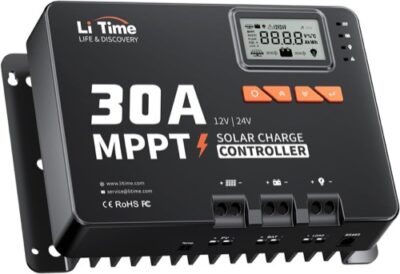
LiTime combines 30A MPPT, 100V PV input, 450W at 12V or 900W at 24V, an LCD, built-in Bluetooth, 20A load output, adjustable lithium settings, and a three-year warranty. That integrated monitoring package suits an RV owner who wants local controls at the cabinet and phone status from the living area.

The enclosure is substantial—about 9.65 × 7.09 × 3.25 inches and 4.41lb. Terminal maximum, PV Isc, ingress rating, and operating range were not published in the reviewed product page, while owners reported both strong build quality and some app/support frustration.

This is the better 30A choice when LiFePO4 and dual monitoring dominate, provided the cabinet has room and the missing current/terminal rules are obtained before wiring. No controller-managed lithium low-temperature cutoff was documented, so the battery/BMS must cover freezing conditions where required.

Best Integrated 40A Upgrade: BougeRV Sunflow

Sunflow fits RVs moving beyond the stock 10A or 20A controller. It publishes 600W at 12V and 1,200W at 24V, provides up to 40A output, and includes both a local screen and Bluetooth rather than charging extra for a module. Captured owners describe travel-trailer, van, and 640W lithium installations.

The exact voltage behavior needs attention: technical material describes a 100V absolute ceiling, protection near 95V, and recovery near 90V. App experiences range from useful history to short range, pairing failure, and revision-specific software confusion. IP34 still means protected mounting, not an exposed trailer tongue.

Choose it when 30A would constrain the final roof and integrated controls matter. Confirm PV Isc, exact low-temperature sensing, app revision, terminal fit, and the shorter 18-month support period before committing the compartment.

Match the Controller to the Coach, Not the Badge

Product Suitable RV Context Best For Skip If First Limit to Verify
Victron 75/15 Fixed small array, short output need, app-first owner Vans and compact trailers More than 220W at 12V is planned 75V cold Voc and 15A Isc
Rover 30A 300–400W 12V roof with possible series wiring Balanced expansion and local LCD Mounting/terminal access is poor PV Isc and cable geometry
Adventurer 30A Voltage-matched PWM roof and permanent control wall Integrated interior display MPPT harvest or exposed mounting is needed Rear depth and actual charge voltage
LiTime 30A 12V/24V LiFePO4 coach with spacious dry cabinet LCD plus included Bluetooth Missing terminal/Isc data cannot be resolved PV Isc, conductor fit, BMS cold cutoff
Sunflow 40A 500–600W 12V or larger 24V plan Stock-controller upgrade App polish and long warranty dominate Protection voltage, PV Isc, airflow

Build the RV Electrical Plan in the Right Order

Freeze the Realistic Roof Layout

Start with usable roof rectangles after vents, air conditioners, antennas, shading, walking paths, and service clearance. Record each exact panel’s Voc, Vmp, Isc, and Imp. Only then choose series, parallel, or series-parallel wiring and a controller.

Series wiring raises voltage and can reduce cable current over the roof-to-controller run. Parallel wiring raises current and may preserve output differently under partial shade. The right choice depends on cold Voc, hot Vmp, total Isc, connector/fuse rules, and recurring shade—not a universal “series is better” slogan.

Size for 12V or 24V Battery Charging

The same controller generally accepts more PV watts on a 24V bank because equivalent output current represents more power. Rover moves from 400W to 800W; LiTime from 450W to 900W; Sunflow from 600W to 1,200W. That does not mean a 24V controller setting converts a 12V coach automatically—battery bank, inverter, DC loads, charging sources, and distribution all need a coordinated voltage architecture.

At 12V, cable drop becomes especially important at 30A–40A. Keep the controller close enough to the battery for a designed low-loss run, while respecting ventilation and battery-compartment restrictions. Measure actual controller-terminal and battery-post voltage under charge.

Voltage-drop check — A controller can display the intended voltage while the battery sees less because of cable and connection resistance. Commission at both ends of the conductor.

Decide Between Local Display and Phone Monitoring

Adventurer puts the screen where occupants can see it. Rover and LiTime show values on the controller, which works only if the cabinet is accessible. Victron assumes a phone for numeric detail, while Sunflow offers both paths but has more variable app evidence.

Bluetooth range through metal, insulation, plumbing, and cabinetry should be tested before final mounting. If travel decisions depend on daily energy history, confirm that the exact app/controller combination stores the required data; “Bluetooth” can mean only live nearby values.

Treat Mobile Connections as a Service Item

Support cables against vibration, preserve bend radius, torque terminals according to the manual, and keep disconnects/fuses accessible. Never trim strands to fit a controller. If calculated conductor size exceeds the terminal, redesign the run or use approved distribution hardware.

After the first trip, safely de-energize and inspect for movement, abrasion, discoloration, heat, or loosening according to manufacturer instructions. A clean initial installation is not the end of mobile maintenance.

Coordinate Lithium Charging Across Every Source

An RV may charge from solar, shore power, alternator/DC-DC hardware, and a generator. All sources must respect the exact battery’s current, voltage, balance, and temperature rules. A lithium menu on the solar controller does not correct an incompatible converter or alternator charger.

None of these rankings grants automatic cold-charge protection. Identify whether the battery BMS, heater, controller sensor, or another approved device blocks charging below the battery maker’s threshold, and understand how charging resumes.

Preliminary RV Array Examples

The output-demand estimates below divide array watts by a representative target charging voltage. They are planning examples, not final designs, and do not include panel-specific cold correction.

Hypothetical Coach Array Watts Series Voc at STC Battery Approx. Output Demand Limits Still Open
Compact van, one module 200W 24V 12V 200 ÷ 14.4 = 13.9A Cold Voc, Isc, 15A clipping, battery current
Travel trailer, 2S roof 400W 48V 12V 400 ÷ 14.4 = 27.8A Winter Voc, PV Isc, cable drop, 30A margin
Larger fifth wheel, 2S2P 600W 48V 12V 600 ÷ 14.4 = 41.7A 40A clipping/overpanel policy, total Isc, heat
24V expedition coach 800W 80V 24V 800 ÷ 28.8 = 27.8A Cold 100V headroom, parallel current, DC architecture

RV Controller Mistakes to Avoid

  • Selecting the controller before measuring usable roof area and the cable route.
  • Comparing panel Vmp with the controller’s maximum Voc.
  • Ignoring parallel-string Isc because the controller name says 30A or 40A.
  • Buying Bluetooth without checking whether it includes historical data or works through the cabinet.
  • Cutting a flush opening from case dimensions without terminals and cable bends.
  • Connecting an inverter to a controller load output.
  • Assuming an IP32/IP34 enclosure is suitable for exterior spray.
  • Treating one lithium source setting as a complete multi-source charging plan.

Bottom Line — Best Solar Charge Controllers for RVs

The Victron SmartSolar 75/15 leads small fixed arrays because its compact hardware, built-in Bluetooth, published Isc, and five-year warranty reduce uncertainty. For a mainstream 300–400W 12V roof, the Renogy Rover 30A is the more expandable local-control choice. Adventurer wins only when flush installation is the defining requirement, while LiTime provides the cleanest included LCD-plus-Bluetooth package for a roomy LiFePO4 compartment. Sunflow is the deliberate step to 40A.

Before buying any of these best solar charge controllers for RV use, calculate cold-corrected string Voc and total Isc, confirm battery-voltage PV watts and charge current, and plan conductor size, terminal access, fusing, ventilation, monitoring range, and lithium temperature protection. The correct winner is the smallest model that supports the finished roof and battery with reasonable—not imaginary—expansion room.

Best for Compact RV Arrays

Victron SmartSolar 75/15 Review: A Strong Fit for Small Arrays

Victron SmartSolar 75/15 Review: A Strong Fit for Small Arrays

Get it now:

Check latest price

What to know

  • Excellent documentation
  • Bluetooth included
  • Compact passive design
  • Flexible charging

Best if

  • Excellent documentation
  • Bluetooth included
  • Compact passive design
  • Flexible charging

Skip if

  • 15A output ceiling
  • 75V PV ceiling
  • No numeric display
  • AWG 10 terminal maximum

The Victron SmartSolar 75/15 is a compact, thoroughly documented controller for arrays up to 220W on 12V or 440W on 24V battery systems. Built-in Bluetooth and flexible charge configuration give it more control than most entry-level units. Its 15A ceiling and AWG 10 terminals make sizing discipline important, but the captured owner sample is consistently positive about installation, monitoring, and real-world charging. Best fit: The Victron SmartSolar 75/15 is a compact, thoroughly documented controller for arrays up to 220W on 12V or 440W on 24V battery systems.

BrandVictron Energy
Model / SKUSmartSolar MPPT 75/15 (ASIN B075NQQRPD)
Controller typeMPPT
Rated charge current15A
Battery-system voltage12V / 24V automatic selection
Battery compatibilityLead-acid and lithium via presets or a user-defined algorithm
Max PV open-circuit voltage (Voc)75V
Max PV input current (Isc)15A
Max PV power by battery voltage220W @ 12V; 440W @ 24V; 48V not supported
Load output15A programmable output with BatteryLife control
Charging profilesAdaptive multi-stage or user-defined algorithm
Temperature sensing / low-temp protectionInternal compensation; configurable low-temperature cutoff and optional VE.Smart battery sensing
Display / local controlsStatus LEDs; detailed control through VictronConnect
App / communicationsBuilt-in Bluetooth with VictronConnect; VE.Direct port
Maximum terminal wire size6 mm² / AWG 10
Maximum efficiency98% peak
Enclosure / operating temperatureIP43 electronics / IP22 terminals; -30°C to 60°C
Dimensions / weight100 × 113 × 40 mm; 0.5 kg
Warranty5 years
Best 30A MPPT for RVs

Renogy Rover 30A Review: The Useful Middle Size—with Mounting Friction

Renogy Rover 30A Review: The Useful Middle Size—with Mounting Friction

Get it now:

Check latest price

What to know

  • 30A MPPT charging
  • 100V PV ceiling
  • LCD and programmable load output
  • Optional app monitoring

Best if

  • 30A MPPT charging
  • 100V PV ceiling
  • LCD and programmable load output
  • Optional app monitoring

Skip if

  • Bluetooth module is extra
  • IP32 protected mounting
  • No published PV Isc limit
  • Lithium system voltage must be configured carefully

A well-documented middle size in the Rover range, with useful local controls and 100V input, though app access remains optional and the enclosure is indoor-only. Best fit: Mid-size 12V/24V RV and cabin arrays needing an LCD, load control, and configurable MPPT charging.

BrandRenogy
Model / SKURover Li 30A (ASIN B07DNVW37B)
Controller typeMPPT
Rated charge current30A
Battery-system voltage12V / 24V automatic for non-lithium batteries
Battery compatibilitySealed/AGM, gel, flooded, lithium, and user-defined
Max PV open-circuit voltage (Voc)100V
Max PV input current (Isc)Not published
Max PV power by battery voltage400W @ 12V; 800W @ 24V
Load output20A programmable load output
Charging profilesFour-stage lead-acid; two-stage lithium; user-defined mode
Temperature sensing / low-temp protectionRemote sensor for lead-acid; no controller-managed lithium cold cutoff published
Display / local controlsLCD and buttons
App / communicationsRS485; optional BT-2 and DC Home
Maximum terminal wire size8 AWG / 10 mm²
Maximum efficiency>99% tracking; up to 98% conversion
Enclosure / operating temperatureIP32; -35°C to 45°C
Dimensions / weight238 × 172 × 77 mm; 2.0 kg
Warranty3 years
Best Flush-Mount PWM

Renogy Adventurer Li 30A Review: The Flush-Mount RV Specialist

Renogy Adventurer Li 30A Review: The Flush-Mount RV Specialist

Get it now:

Check latest price

What to know

  • Purpose-built flush mounting
  • 30A PWM output
  • 400W/800W published PV limits
  • Optional Bluetooth and lithium support

Best if

  • Purpose-built flush mounting
  • 30A PWM output
  • 400W/800W published PV limits
  • Optional Bluetooth and lithium support

Skip if

  • PWM rather than MPPT
  • IP20 indoor enclosure
  • Bluetooth costs extra
  • No controller-managed lithium cold cutoff documented

The flush-mount form, clear LCD, and documented 30A limits work well in RV panels, but PWM conversion and an indoor enclosure constrain array placement. Best fit: RV installations that specifically need a flush-mounted local display.

BrandRenogy
Model / SKUAdventurer Li 30A (ASIN B07BBKFTNV)
Controller typePWM
Rated charge current30A
Battery-system voltage12V / 24V automatic for non-lithium batteries
Battery compatibilitySealed/AGM, gel, flooded, and lithium
Max PV open-circuit voltage (Voc)50V
Max PV input current (Isc)Not published
Max PV power by battery voltage400W @ 12V; 800W @ 24V
Load output30A programmable load output
Charging profilesFour-stage lead-acid and lithium profile
Temperature sensing / low-temp protectionOptional temperature sensor for lead-acid; no lithium low-temp cutoff published
Display / local controlsFlush-mount LCD and buttons
App / communicationsRS232; optional BT-1 module
Maximum terminal wire size8 AWG
Maximum efficiencyNot applicable as a published MPPT conversion figure
Enclosure / operating temperatureIP20; -25°C to 55°C
Dimensions / weight166.6 × 114.3 × 48.3 mm; 0.27 kg
Warranty1 year
Best Lithium-Focused Value

LiTime 30A MPPT Review: A Practical Bluetooth LiFePO4 Controller

LiTime 30A MPPT Review: A Practical Bluetooth LiFePO4 Controller

Get it now:

Check latest price

What to know

  • Bluetooth is built in
  • Strong local controls
  • LiFePO4-oriented design
  • 20A load output

Best if

  • Bluetooth is built in
  • Strong local controls
  • LiFePO4-oriented design
  • 20A load output

Skip if

  • App polish varies
  • Support evidence is mixed
  • Some limits remain unpublished
  • No documented lithium cold cutoff

The LiTime 30A MPPT is a practical middle-ground choice for 12V/24V LiFePO4 systems that want both an LCD and built-in Bluetooth. Manufacturer documentation now fills the earlier 100V and 450W/900W PV gaps. The hardware earns positive owner feedback, while the app, documentation, and support experience are less consistent. Best fit: The LiTime 30A MPPT is a practical middle-ground choice for 12V/24V LiFePO4 systems that want both an LCD and built-in Bluetooth.

BrandLiTime
Model / SKU30A Smart MPPT (ASIN B0BJ75NLRM)
Controller typeMPPT
Rated charge current30A
Battery-system voltage12V / 24V automatic selection
Battery compatibilityLiFePO4, sealed lead-acid, and gel
Max PV open-circuit voltage (Voc)100V
Max PV input current (Isc)Not published for this model
Max PV power by battery voltage450W @ 12V; 900W @ 24V; 48V not supported
Load output20A rated load output
Charging profilesChemistry presets with adjustable parameters
Temperature sensing / low-temp protectionOver-temperature protection; controller-managed lithium low-temp cutoff not published
Display / local controlsLCD, four buttons, and status LEDs
App / communicationsBuilt-in Bluetooth; LiTime Solar app
Maximum terminal wire sizeNot published for this model
Maximum efficiency≥99% tracking; up to 98% peak conversion
Enclosure / operating temperatureDie-cast aluminum; IP and operating range not published on product page
Dimensions / weight9.65 × 7.09 × 3.25 in; 4.41 lb / 2.0 kg
Warranty3 years
Best Built-In Bluetooth

BougeRV Sunflow 40A MPPT Review: Capable Hardware, Uneven Controls

BougeRV Sunflow 40A MPPT Review: Capable Hardware, Uneven Controls

Get it now:

Check latest price

What to know

  • Built-in Bluetooth
  • 40A MPPT output
  • 100V-class PV input
  • Published load and environmental limits

Best if

  • Built-in Bluetooth
  • 40A MPPT output
  • 100V-class PV input
  • Published load and environmental limits

Skip if

  • 12V/24V only
  • IP34 still requires protected mounting
  • App experience is mixed
  • 18-month warranty

Built-in Bluetooth, a 100V PV ceiling, and useful published limits make the Sunflow competitive, although app polish and the short warranty trail premium alternatives. Best fit: 12V/24V RV and cabin systems that want 40A charging with Bluetooth included.

BrandBougeRV
Model / SKUSunflow 40A MPPT / ISE218 family (ASIN B0CFKZ5Q97)
Controller typeMPPT
Rated charge current40A
Battery-system voltage12V / 24V
Battery compatibilityLiFePO4, sealed, gel, flooded, AGM, and user-defined
Max PV open-circuit voltage (Voc)100V absolute; 95V protection and 90V recovery
Max PV input current (Isc)Not published
Max PV power by battery voltage600W @ 12V; 1,200W @ 24V
Load output20A programmable load output
Charging profilesBattery presets plus user-defined settings
Temperature sensing / low-temp protectionInternal temperature behavior; external sensor and lithium low-temp cutoff not published
Display / local controlsLocal display and buttons
App / communicationsBuilt-in Bluetooth; app stores up to 200 days of data
Maximum terminal wire sizeNot published
Maximum efficiencyNot published
Enclosure / operating temperatureIP34; -35°C to 65°C
Dimensions / weight227 × 159 × 75 mm; 1.79 kg
Warranty18 months

Product Comparison

Feature Victron SmartSolar 75/15 Review: A Strong Fit for Small Arrays Renogy Rover 30A Review: The Useful Middle Size—with Mounting Friction Renogy Adventurer Li 30A Review: The Flush-Mount RV Specialist LiTime 30A MPPT Review: A Practical Bluetooth LiFePO4 Controller BougeRV Sunflow 40A MPPT Review: Capable Hardware, Uneven Controls
Product Image
Victron SmartSolar 75/15 Review: A Strong Fit for Small Arrays
Renogy Rover 30A Review: The Useful Middle Size—with Mounting Friction
Renogy Adventurer Li 30A Review: The Flush-Mount RV Specialist
LiTime 30A MPPT Review: A Practical Bluetooth LiFePO4 Controller
BougeRV Sunflow 40A MPPT Review: Capable Hardware, Uneven Controls
Price $62.00 $173.99 $68.88 $152.99 $144.99 N/A
Rating
4.7 / 5
4.2 / 5
4.4 / 5
4.2 / 5
4.2 / 5
Category Solar Charge Controllers Solar Charge Controllers Solar Charge Controllers Solar Charge Controllers Solar Charge Controllers
Brand Victron Energy Renogy Renogy LiTime BougeRV
Model / SKU SmartSolar MPPT 75/15 (ASIN B075NQQRPD) Rover Li 30A (ASIN B07DNVW37B) Adventurer Li 30A (ASIN B07BBKFTNV) 30A Smart MPPT (ASIN B0BJ75NLRM) Sunflow 40A MPPT / ISE218 family (ASIN B0CFKZ5Q97)
Controller type MPPT MPPT PWM MPPT MPPT
Rated charge current 15A 30A 30A 30A 40A
Battery-system voltage 12V / 24V automatic selection 12V / 24V automatic for non-lithium batteries 12V / 24V automatic for non-lithium batteries 12V / 24V automatic selection 12V / 24V
Battery compatibility Lead-acid and lithium via presets or a user-defined algorithm Sealed/AGM, gel, flooded, lithium, and user-defined Sealed/AGM, gel, flooded, and lithium LiFePO4, sealed lead-acid, and gel LiFePO4, sealed, gel, flooded, AGM, and user-defined
Max PV open-circuit voltage (Voc) 75V 100V 50V 100V 100V absolute; 95V protection and 90V recovery
Max PV input current (Isc) 15A Not published Not published Not published for this model Not published
Max PV power by battery voltage 220W @ 12V; 440W @ 24V; 48V not supported 400W @ 12V; 800W @ 24V 400W @ 12V; 800W @ 24V 450W @ 12V; 900W @ 24V; 48V not supported 600W @ 12V; 1,200W @ 24V
Load output 15A programmable output with BatteryLife control 20A programmable load output 30A programmable load output 20A rated load output 20A programmable load output
Charging profiles Adaptive multi-stage or user-defined algorithm Four-stage lead-acid; two-stage lithium; user-defined mode Four-stage lead-acid and lithium profile Chemistry presets with adjustable parameters Battery presets plus user-defined settings
Temperature sensing / low-temp protection Internal compensation; configurable low-temperature cutoff and optional VE.Smart battery sensing Remote sensor for lead-acid; no controller-managed lithium cold cutoff published Optional temperature sensor for lead-acid; no lithium low-temp cutoff published Over-temperature protection; controller-managed lithium low-temp cutoff not published Internal temperature behavior; external sensor and lithium low-temp cutoff not published
Display / local controls Status LEDs; detailed control through VictronConnect LCD and buttons Flush-mount LCD and buttons LCD, four buttons, and status LEDs Local display and buttons
App / communications Built-in Bluetooth with VictronConnect; VE.Direct port RS485; optional BT-2 and DC Home RS232; optional BT-1 module Built-in Bluetooth; LiTime Solar app Built-in Bluetooth; app stores up to 200 days of data
Maximum terminal wire size 6 mm² / AWG 10 8 AWG / 10 mm² 8 AWG Not published for this model Not published
Maximum efficiency 98% peak >99% tracking; up to 98% conversion Not applicable as a published MPPT conversion figure ≥99% tracking; up to 98% peak conversion Not published
Enclosure / operating temperature IP43 electronics / IP22 terminals; -30°C to 60°C IP32; -35°C to 45°C IP20; -25°C to 55°C Die-cast aluminum; IP and operating range not published on product page IP34; -35°C to 65°C
Dimensions / weight 100 × 113 × 40 mm; 0.5 kg 238 × 172 × 77 mm; 2.0 kg 166.6 × 114.3 × 48.3 mm; 0.27 kg 9.65 × 7.09 × 3.25 in; 4.41 lb / 2.0 kg 227 × 159 × 75 mm; 1.79 kg
Warranty 5 years 3 years 1 year 3 years 18 months
Buy Now View Deal View Deal View Deal View Deal View Deal

Best RV Solar Charge Controllers: The Bottom Line

An RV controller has to fit more than the panel wattage. Compartment ventilation, terminal access, battery chemistry, display location, Bluetooth range, and cold-corrected roof-array voltage can decide whether a technically capable controller is practical.

Final check: Recalculate cold Voc, PV Isc, charge current, PV watts, cable size, fusing, and battery settings against the exact current manual before ordering.

Frequently Asked Questions

What size solar charge controller does a 400W RV array need?

A preliminary 12V estimate is about 400W divided by a representative 14.4V charging voltage, or 27.8A. That does not complete sizing. Check cold-corrected string Voc, total array Isc, controller PV watts at 12V, battery charge-current limits, cable drop, and any manufacturer's oversizing policy.

Should RV solar panels be wired in series or parallel?

Series raises voltage and can reduce cable current, while parallel raises current and can respond differently to partial shade. Choose only after calculating cold series Voc, hot Vmp, total parallel Isc, connector and fuse requirements, roof shading, and the controller's input window. There is no universally best RV layout.

Is a flush-mount controller better for an RV?

A flush controller such as the Renogy Adventurer gives a clean, visible control panel, but it requires enough rear depth for the case, terminals, sensor plug, cable bends, ventilation, and future removal. A surface-mounted MPPT can be electrically stronger and easier to service if local wall integration is not essential.

Does an RV lithium battery need cold-charge protection?

If the battery may reach a temperature where its manufacturer prohibits charging, the system needs a verified cutoff. Identify whether that function comes from the battery BMS, internal heater, controller with compatible remote sensing, or another approved device. A lithium preset alone does not prove low-temperature protection.

Can I mount an RV solar charge controller in the battery compartment?

Only when the controller and battery manuals allow the location. Consider ventilation, corrosive gas for flooded batteries, moisture, ignition concerns, service access, conductor length, and enclosure rating. IP20, IP32, or IP34 hardware is not automatically suitable for an exposed or condensing compartment.

Is Bluetooth useful in an RV solar controller?

Bluetooth is useful when the controller is hidden and the app provides live values, settings, or history. Test range through metal and cabinetry before final mounting, confirm whether hardware is included, and verify data retention. Critical charging protection must continue locally if the phone, app, or pairing is unavailable.

×

About Solar Power Picks

Portable Solar Power, Backup Power, and Off-Grid Gear Guides

Your trusted source for honest, in-depth product reviews and comparisons.

Quick Links

  • Best Picks
  • Reviews
  • Guides
  • Comparisons
  • Calculator
  • Privacy policy
  • Favorites

Categories

  • Portable Power Stations
  • Solar Batteries
  • Solar Charge Controllers
  • Solar Generators
  • Solar Panels

© 2026 Solar Power Picks. All Rights Reserved.

We may earn a commission when you purchase through links on our site. Learn more