LiTime 30A MPPT Review: A Practical Bluetooth LiFePO4 Controller
At a Glance
KEY FEATURES
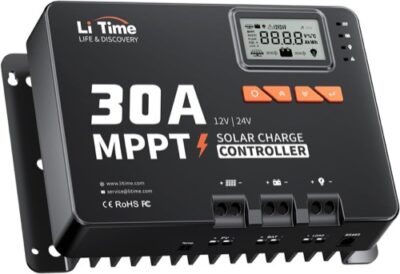
- Output: 30A MPPT controller with automatic 12V/24V selection.
- PV limits: 100V Voc; 450W @ 12V and 900W @ 24V.
- Battery support: LiFePO4, sealed lead-acid, and gel settings.
- Monitoring: LCD plus built-in Bluetooth for the LiTime Solar app.
- Best fit: LiFePO4 cabins or RVs needing local and phone monitoring.
PROS
- 30A MPPT charging, a local display, and Bluetooth cover the core mid-size use case.
- Owner material repeatedly supports straightforward installation and LiFePO4 charging.
- Physical construction earns more consistent praise than many budget alternatives.
CONS
- App reconnection and interface behavior are not consistently friction-free.
- Published terminal, ingress, and some array-limit details remain incomplete.
- Error-code documentation and technical-support access should be checked early.
Editor's Choice
Editorial assessment based on exact-model documentation and qualitative exact-ASIN owner evidence; no first-party bench test or population-rate claim
Will the LiTime 30A MPPT Fit Your Solar Array?
Estimate required charging current and check it against the documented limits for LiTime 30A MPPT.
Solar Charge Controller Size Calculator
What size charge controller do I need?
LiTime's Hardware Case Is Stronger Than Its Software Case
The larger exact-ASIN record sharpens an important distinction: this LiTime controller is often liked as a physical 30A MPPT unit even when the surrounding software or documentation causes friction. Owners describe successful LiFePO4 upgrades, cabin and RV systems, useful local readings, and Bluetooth monitoring. The critical accounts are more often about pairing behavior, forgotten connections after shutdown, unclear error codes, or getting a technical answer than about the basic idea of a 30A controller.
That pattern favors buyers who can commission from battery and array documentation instead of relying on the app to make every decision. Verify array Voc and current, choose the battery profile, compare its actual charge voltages with the battery maker’s limits, and confirm polarity before energizing the system. Treat Bluetooth as a monitoring convenience. The local display and an independent meter should still be able to tell you whether the controller is charging as expected.
There is also a useful purchasing distinction between visibility and automation. Bluetooth can save a trip to the controller and make a weak-harvest day easier to diagnose, but it does not by itself provide cloud supervision, permanent history, or a guaranteed reconnection after every power cycle. Decide which of those functions the installation actually needs. A periodically visited cabin can tolerate a manual reconnect more easily than an unattended system whose owner expects alerts from another location.
| LiTime acceptance test | What to record | Why it matters |
|---|---|---|
| Morning startup | PV voltage, battery voltage, and the time charging begins | Confirms the array reaches the controller’s operating window |
| Strong-sun charging | Displayed current, battery-terminal voltage, and enclosure temperature | Checks output, voltage drop, and ventilation together |
| Power-cycle recovery | Saved battery profile, Bluetooth reconnection, and any error code | Shows whether routine shutdown changes the intended configuration |
| Low-temperature behavior | Battery BMS state, sensor placement, and charging response | Prevents a generic lithium selection from being mistaken for cold-charge protection |
Run those checks while the installation is still easy to access. A controller can appear normal at midday yet reveal a poor connector, incorrect profile, or unreliable app workflow only after a full shutdown and restart. If the display and an independent meter disagree enough to affect the battery’s required voltage targets, stop and resolve the measurement difference before leaving the system unattended. This short commissioning log also gives support a much clearer record than a general statement that charging seems slow.
The right buyer wants a mid-size controller with local controls and Bluetooth, accepts that the app may be secondary rather than central, and has a defined 12V or 24V design. The wrong buyer needs a completely published environmental and terminal specification, seamless unattended remote telemetry, or support documentation detailed enough to replace electrical commissioning.
Quick Verdict on the LiTime 30A MPPT
This LiTime 30A MPPT review finds a useful middle ground for 12V/24V LiFePO4 systems: a 30A controller with both a local LCD and built-in Bluetooth. LiTime publishes a 100V PV ceiling, 450W and 900W array limits, a 20A load output, adjustable battery settings, and a three-year warranty. owners generally reinforce the hardware story, praising its construction, display, easy installation, and successful lithium charging.
The weak points sit around the product rather than its core feature set. One owner describes awkward app behavior, another reports poor access to error-code support, and the current product page leaves terminal size, Isc, ingress rating, and operating range unpublished. Low-temperature lithium cutoff is also not documented.
| Best For | Main Strength | Main Limitation | Evidence Confidence |
|---|---|---|---|
| 12V/24V LiFePO4 systems wanting LCD plus Bluetooth | Strong monitoring package without a dongle | App/support friction and several documentation gaps | High for headline specs; medium for owner experience |
Evidence Snapshot
Manufacturer information now resolves two gaps in the original marketplace bundle: 100V maximum PV Voc and PV-power allowances of 450W at 12V or 900W at 24V. Values still absent from the current product page remain explicitly unpublished rather than inferred.
PV Limits and 30A System Fit
LiTime specifies MPPT topology, 30A maximum battery-side output, automatic 12V/24V selection, and a 100V PV open-circuit ceiling. Those values cover many moderate RV and cabin arrays, but they remain separate constraints.
| Limit | Documented Value | What It Means | Evidence Status |
|---|---|---|---|
| Controller type | MPPT | Converts higher panel operating voltage into battery charging | LiTime documentation |
| Rated charge current | 30A | Maximum battery-side output | LiTime documentation |
| Maximum PV Voc | 100V | Cold-corrected series-string Voc must remain below this | LiTime documentation |
| Maximum PV Isc | Not published for this model | Parallel-string current needs manual confirmation | Documentation gap |
| PV power at 12V | 450W | Published array-power allowance for 12V | LiTime documentation |
| PV power at 24V | 900W | Published array-power allowance for 24V | LiTime documentation |
The 30A charge ceiling must agree with the battery’s maximum permitted current. A small 100W panel will remain far below that output under most conditions, while a larger array can approach the ceiling only when sunlight, panel temperature, battery voltage, and state of charge allow it.
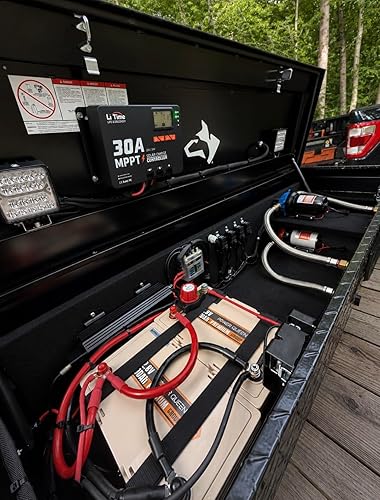
One owner reports pairing the controller with a 100W panel and LiTime lithium battery without radio-frequency interference in nearby amateur-radio equipment. Another uses it in a fifth-wheel RV. These reports demonstrate plausible uses, not maximum-output tests.
Compatibility Check — Obtain the exact PV Isc limit before finalizing parallel strings. The 100V Voc and 450W/900W figures alone do not complete array sizing.
Build, Terminals, and Installation
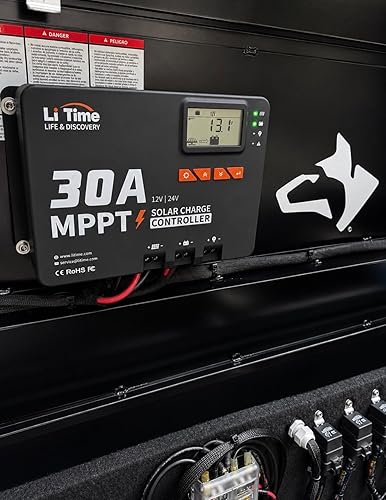
The die-cast aluminum enclosure is large for a 30A controller: 9.65 × 7.09 × 3.25 inches and 4.41 lb. Several owners call it sturdy, well made, or larger than expected. The mass and case support heat dissipation, but they also require more mounting space than compact PWM units.
LiTime includes copper wire connectors intended to increase contact area. The maximum accepted terminal conductor size is not published on the current product page, so buyers should verify the manual before selecting cable or termination hardware. Do not assume the supplied connector makes every conductor gauge acceptable.
| Installation Point | Published Detail | Practical Effect |
|---|---|---|
| Enclosure | Die-cast aluminum | Substantial passive heat-dissipation surface |
| Size | 9.65 × 7.09 × 3.25 in | Requires more cabinet space than a basic controller |
| Weight | 4.41 lb / 2.0 kg | Mount to a suitable structural surface |
| Load output | 20A | Supports suitable DC loads, not an assumed inverter feed |
| Terminal size | Not published for this model | Confirm conductor and connector limits before installation |
Installation Check — Treat the 20A load output as a documented DC circuit limit. Connect inverters and other high-current loads according to their manuals and the battery-side protection design.
LCD, Bluetooth, and the LiTime App
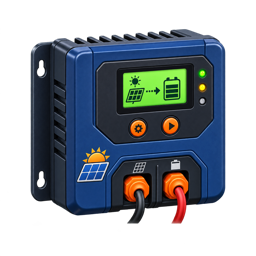
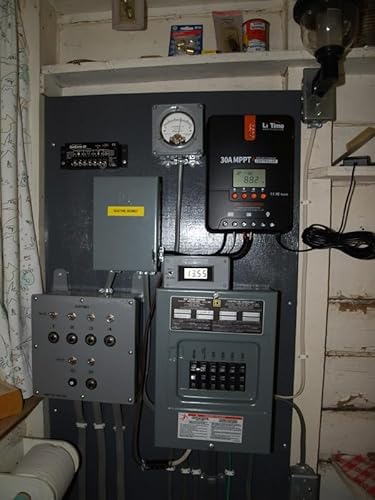
The interface package is this model’s best differentiator. A numeric LCD, four buttons, and status LEDs provide local operation, while Bluetooth is built in for LiTime Solar app access. Unlike Renogy’s optional modules, there is no separate Bluetooth accessory to buy or wire.
At least six owners praise some combination of installation, display, Bluetooth, or everyday operation. One cabin owner bought a second controller after several weeks. Another says the app works well for monitoring and remotely switching the load, although the connection requires reasonable proximity.
App connectivity should remain a monitoring convenience rather than a safety dependency. Critical protection must continue to work locally if the phone is unavailable or the app loses pairing.
Battery Profiles and Charging Behavior
LiTime documents LiFePO4, sealed lead-acid, and gel compatibility with adjustable parameters. That focus makes the product attractive to buyers pairing a controller and battery from the same brand, but brand matching does not remove the need to verify exact charge voltages and current.
Several owners specifically report successful LiFePO4 use. One replaced an older lead-acid cabin system and praises the new controller; another uses it with LiTime batteries; a third reports good charging with a 100W panel. These reports support compatibility and ease of setup, not independent proof of LiTime’s ≥99% tracking or up-to-98% conversion claims.
The product page describes over-temperature protection but does not publish a controller-managed lithium low-temperature charge cutoff. A LiFePO4 installation exposed to freezing conditions should therefore rely on documented battery/BMS protection or another approved temperature-control method.
| Battery / Use | Fit | Reason | Must Verify |
|---|---|---|---|
| 12V LiFePO4 RV | Good | Dedicated mode, LCD, and Bluetooth | BMS current and cold-charge rule |
| 24V LiFePO4 cabin | Good | Automatic voltage selection and 900W allowance | Exact charging parameters |
| Sealed or gel lead-acid | Good | Published chemistry settings | Correct profile and temperature behavior |
| Flooded lead-acid | Conditional | Not listed on the current product page | Exact manual support before use |
| Freezing lithium location | Poor without protected battery | No controller cutoff is published | Battery BMS and sensor strategy |
What owners Report
| Theme | Supporting Reviews | What the Evidence Supports | Limitation |
|---|---|---|---|
| Successful installation/operation | At least 8 | Most exact-style owners report working systems | Usage duration varies and some comments are brief |
| Solid enclosure/build | At least 5 | Hardware quality is a recurring positive pattern | Not a durability or ingress test |
| LCD/Bluetooth praised | At least 6 | Dual local/app monitoring is genuinely useful | Software and range vary by setup |
| App usability criticism | 1 detailed report | Pairing, prompts, and contrast can frustrate | Isolated and version-dependent |
| Documentation/support criticism | 1 detailed report | Error-code and battery-profile help may be weak | Does not describe every support interaction |
| Repeat purchase | 2 reports | Some satisfied owners bought a second unit | Positive self-selection |
Warranty, Documentation, and Support
LiTime publishes a three-year warranty for this controller. Save the invoice, serial information, settings, and installation photos before a problem occurs, and confirm the current regional claim process. Warranty duration does not answer every ownership question: diagnostic guidance, replacement timing, and whether connected equipment is covered can matter just as much during an off-grid failure.
Efficiency Claims and Realistic Expectations
LiTime advertises at least 99% tracking efficiency and up to 98% peak conversion efficiency. Tracking efficiency describes how effectively the algorithm finds the array’s operating point; conversion efficiency describes power lost while transferring energy to the battery. Neither percentage promises that the battery will receive panel nameplate watts in normal weather.
Real output changes with irradiance, cell temperature, shading, wire loss, battery voltage, state of charge, configured limits, and controller temperature. The supplied owners generally describe satisfactory charging, but none supplies a controlled input-versus-output test suitable for independently validating the headline percentages. Treat the figures as manufacturer maxima and size the energy system with realistic solar-hour and loss assumptions.
Buying and Commissioning Checklist
Before ordering, confirm cold-corrected string Voc below 100V, obtain the exact PV Isc limit, and match the 450W or 900W allowance to battery voltage. Confirm that the bank accepts 30A and that its BMS—not an assumed controller function—covers required low-temperature protection.
Plan enough wall or cabinet area for the enclosure and cables. Verify terminal size, protection, connection order, and airflow in the manual. Install the LiTime app before the controller becomes difficult to reach, but retain a local method for reading status and faults.
- Verify array Voc, Isc, watts, and battery-side current.
- Verify chemistry settings, BMS rules, and freezing-temperature protection.
- Verify conductor, terminal, load-output, enclosure, and ventilation limits.
- Verify app compatibility, error-code access, and warranty documentation.
Owner Pattern — LiTime’s physical controller earns more consistent praise than its surrounding app, manual, and support experience.
System-Fit Matrix
| System / Buyer | Fit | Why | Must Verify |
|---|---|---|---|
| 12V LiFePO4 cabin | Good | 450W allowance and chemistry mode | Cold cutoff and battery current |
| 24V cabin up to 900W | Good | Published voltage-specific limit | Voc, Isc, and cable design |
| Buyer wanting LCD and Bluetooth | Good | Both are included | App compatibility and range |
| Small cabinet | Conditional | Controller is relatively large | Physical dimensions and airflow |
| 20A-or-less DC load circuit | Conditional | Programmable load output | Load type, protection, and surge |
| Inverter through load terminals | Poor | 20A output is not a general inverter feed | Battery-side inverter design |
| Exposed outdoor installation | Poor | No IP rating is published | Dry enclosure and condensation control |
| Buyer requiring strong phone support | Conditional | Support evidence is mixed | Current documentation and contact options |
Alternatives Worth Comparing
Victron’s SmartSolar 100/30 offers the same output class and includes Bluetooth, but it has no built-in numeric screen. Victron publishes stronger terminal and environmental limits and supports a deeper device ecosystem.
Renogy’s Rover 40A adds 10A and a local LCD, but Bluetooth requires a separate module. It makes sense only when the array and battery can use the higher output.
LiTime is the balanced interface choice: both local numbers and phone monitoring are standard. Its appeal falls when unpublished Isc, terminal, or environmental details block the planned installation.
Who Should Buy It — and Who Should Skip It
Buy it if:
- You want both an LCD and built-in Bluetooth.
- Your 12V/24V LiFePO4 system fits a 30A output class.
- The published 450W/900W limits suit the planned array.
- You can verify the remaining Isc and terminal details before wiring.
Skip it if:
- You need a documented controller-managed lithium cold cutoff.
- The installation requires a published IP rating or terminal size before purchase.
- A polished app and extensive technical support are priorities.
- The battery and array can use substantially more than 30A.
Pros & Cons Analysis
Based on documented specifications and owner feedback
Pros
- Bluetooth is built in — No separate communication dongle is required for app monitoring.
- Strong local controls — The LCD, buttons, and status LEDs support phone-free checks and setup.
- LiFePO4-oriented design — Several owners report successful use with LiTime lithium batteries.
- 20A load output — The controller can monitor and switch appropriate DC loads within its documented limit.
- Solid construction pattern — Multiple reviewers describe a sturdy enclosure and straightforward installation.
Cons
- App polish varies — One owner reported lost pairing, intrusive prompts, and poor contrast.
- Support evidence is mixed — One reviewer said technical support and error-code guidance were unavailable.
- Some limits remain unpublished — Terminal size, Isc, IP rating, and operating range need manual confirmation.
- No documented lithium cold cutoff — Battery/BMS protection remains important in freezing conditions.
- Larger enclosure — Owners note that it is bulkier than basic controllers.
LiTime 30A MPPT: Our Verdict
Verdict: LiTime's 30A MPPT is a well-equipped LiFePO4-oriented controller whose LCD, built-in Bluetooth, and published 100V/450W/900W limits make it easy to shortlist.
Buy it if: Your 12V or 24V system fits 30A and you want local controls plus app visibility without buying a communication accessory.
Skip it if: Unpublished Isc, terminal, or ingress details block the design, or the installation depends on a documented controller-managed lithium cold cutoff.
Frequently Asked Questions
Does the LiTime 30A MPPT include Bluetooth?
Yes. Bluetooth is built into this model and connects to the LiTime Solar app without a separate module.
What is the LiTime controller's maximum PV voltage?
LiTime specifies 100V maximum PV open-circuit voltage. Cold-corrected series-string Voc must stay below that limit.
How many solar watts can it handle?
LiTime publishes 450W for a 12V battery system and 900W for 24V. Also verify PV current, battery charge current, and temperature limits.
Is it suitable for LiFePO4 batteries?
Yes, it includes a LiFePO4 mode and adjustable parameters. Confirm the exact battery's voltage, current, float, and low-temperature requirements.
Can the load terminals run an inverter?
The load output is rated at 20A and is intended for suitable DC loads. Connect inverter loads according to the inverter, controller, and battery manuals rather than assuming the load terminals are appropriate.
Does it stop lithium charging below freezing?
A controller-managed lithium low-temperature cutoff is not published for this model. Use the battery's BMS protection or another documented temperature-control design.
Is the LiTime app reliable?
Most captured comments are positive or neutral, but one detailed owner reported pairing and readability problems. Treat Bluetooth range and app behavior as conveniences rather than safety controls.
How does it compare with Victron 100/30?
LiTime provides an LCD and built-in Bluetooth at the same 30A class. Victron has stronger published terminal, environmental, networking, and ecosystem documentation.
Technical Specifications
| Brand | LiTime |
|---|---|
| Exact model / revision / ASIN | 30A Smart MPPT (ASIN B0BJ75NLRM) |
| Controller type | MPPT |
| Rated battery-side charge current | 30A |
| Supported battery-system voltage | 12V / 24V automatic selection |
| Battery chemistry and profile support | LiFePO4, sealed lead-acid, and gel |
| Maximum PV open-circuit voltage (Voc) | 100V |
| Maximum PV short-circuit/input current (Isc) | Not published for this model |
| Maximum PV power by battery voltage | 450W @ 12V; 900W @ 24V; 48V not supported |
| Minimum PV/start voltage requirement | PV operating voltage must be at least battery voltage +3V and no more than 76V |
| Load output and low-voltage disconnect | 20A rated load output |
| Grounding topology | Not published for the reviewed revision |
| Charging stages and custom voltage control | Chemistry presets with adjustable parameters |
| Temperature sensing and lithium low-temperature behavior | Over-temperature protection; controller-managed lithium low-temp cutoff not published |
| Display and local controls | LCD, four buttons, and status LEDs |
| App, communications, and data history | Built-in Bluetooth; LiTime Solar app |
| Maximum terminal conductor size | Not published for this model |
| Controller self-consumption | Not published for the reviewed revision |
| Published tracking/conversion efficiency | ≥99% tracking; up to 98% peak conversion |
| Cooling method and thermal derating | Die-cast aluminum passive heatsink; no thermal-derating curve published |
| Electrical protections | Reverse-connection, overpower, overvoltage, short-circuit, and overtemperature protection |
| Enclosure, ingress rating, and operating temperature | Die-cast aluminum; IP and operating range not published on product page |
| Certifications | Not published for the reviewed revision |
| Dimensions, weight, and included accessories | 9.65 × 7.09 × 3.25 in; 4.41 lb / 2.0 kg |
| Warranty | 3 years |