Anern 30A PWM Review: A $10-Class Controller with a USB Safety Red Flag
At a Glance
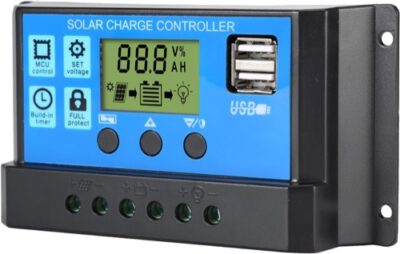
KEY FEATURES
- Controller: PWM; 30A nominal rated charge output.
- System: 12V / 24V automatic; Open, AGM, gel, and other lead-acid batteries; not lithium.
- PV boundary: Not published maximum Voc; Not published maximum PV power.
- Controls: LCD, buttons, and dual USB; No app or communications port.
- Best fit: Tiny lead-acid lighting or maintenance systems with a strict budget and protected mounting.
PROS
- Low price and local display suit supervised basic projects.
- Automatic 12V/24V recognition and load modes offer convenient functions.
- USB output can power a small accessory after careful verification.
CONS
- Any heat, odor, discoloration, or smoke requires immediate shutdown.
- PV, terminal, load, thermal, and warranty limits are poorly documented.
- Not a strong choice for unattended or high-consequence systems.
Editor's Choice
Editorial assessment based on exact-model documentation and qualitative exact-ASIN owner evidence; no first-party bench test or population-rate claim
Will the Anern 30A PWM Fit Your Solar Array?
Estimate required charging current and check it against the documented limits for Anern 30A PWM.
Solar Charge Controller Size Calculator
What size charge controller do I need?
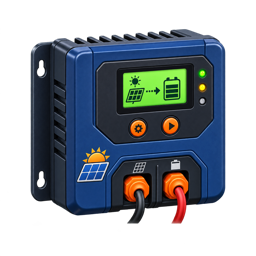
The Anern 30A PWM combines automatic 12V/24V detection, an LCD, adjustable load modes, and dual USB in a very inexpensive package. One owner used it with a nominal 20V, 100W panel and liked the battery-voltage display. Another replaced the unit after a little more than a year because the low price made disposable service acceptable.
That value argument ends at the USB failure evidence. One reviewer said two separate units became hot and emitted smoke after two or three minutes of USB use. Maximum PV voltage/current, panel power, terminal capacity, USB rating, load rating, environmental limits, and warranty are also absent from the reviewed documentation. This is not a controller to recommend for unattended or high-current service.
| Best For | Main Appeal | Disqualifying Concern for Many Buyers | Evidence Confidence |
|---|---|---|---|
| Closely supervised, tiny lead-acid experiments in a dry location | Very low price and simple local display | Two reported smoking USB incidents plus missing electrical limits | Low |
USB Heat or Odor Is a Stop Signal, Not a Troubleshooting Step
The exact-ASIN owner record reflects a familiar low-cost controller tradeoff. Some owners report useful charging, readable information, and good value for small projects. Critical accounts mention confusing instructions, charging or load problems, weak terminals, failures, and concerning heat or odor around the USB or controller. These accounts cannot quantify risk across all units, but any abnormal heat, discoloration, smoke, or electrical smell in the delivered unit requires immediate disconnection and inspection.
Do not keep cycling power to a hot controller, and do not leave it unattended to “see if it settles.” Isolate solar first and then the battery in the safe order specified for the installation, avoiding exposed energized conductors. Check polarity, cable strands, terminal torque, fuse size, connector condition, and whether the USB load itself or its cable is damaged. A unit showing visible heat damage should not return to service.
| Commissioning stage | Normal evidence | Reject or stop evidence |
|---|---|---|
| Battery-only startup | Correct 12V/24V recognition and stable display | Wrong voltage, resets, odor, or warming without load |
| Low solar input | Measured battery-voltage rise and stable terminals | Reverse polarity indication, erratic output, or hot connection |
| Small DC load | Expected switching and low-voltage disconnect | Unpublished load demand, voltage collapse, or excess heat |
| USB check | Stable output with a known small device and sound cable | Discoloration, smell, melting, or abnormal temperature |
The nominal 30A rating is not enough to size the installation because maximum PV voltage, PV current, PV power, conductor size, load-terminal rating, and operating-temperature range are unpublished in the protected record. Use a conservative low-consequence system or obtain exact-revision documentation. Never connect an inverter to the programmable load terminals.
The Anern can serve a supervised learning or maintenance project after it passes a measured acceptance test. It is difficult to justify for an unattended building, costly battery bank, or circuit where a controller fault has serious consequences. In those roles, traceable limits and a defined warranty path are functional specifications, not luxuries.
The USB Report Changes the Verdict
Do not test a suspect USB port inside a shed, RV, coop, or other combustible enclosure. A unit that heats, smells, discolors, crackles, or smokes should be safely de-energized and removed from service. Do not “see if it happens again.” Preserve order and model information for the seller.
| Warning Sign | Immediate Response | Do Not… |
|---|---|---|
| USB plug or enclosure becomes unexpectedly hot | Disconnect load and safely isolate controller | Assume cheap electronics normally run that hot |
| Odor or visible smoke | De-energize sources in a safe sequence and move away from combustibles if safe | Continue testing for a longer interval |
| Melted/discolored port | Replace/return the controller | Repair without technical qualification |
| Repeated behavior on another unit | Treat as a serious product-family signal | Blame only the cable without evidence |
Safety decision — Because two units reportedly produced smoke during the same function, Solar Power Picks cannot recommend using the Anern USB ports. The low purchase price does not reduce fire consequences.
“30A” Is Not Supported by a 30A Documentation Set
The listing describes a nominal 30A PWM controller, but the supplied evidence omits maximum PV Voc, PV Isc, panel watts, terminal wire capacity, and operating temperature. Without those values, a buyer cannot responsibly size a 30A array or confirm that the small terminals and thermal design support the label continuously.
PWM topology also changes panel selection. It switches panel current toward battery voltage rather than converting a high PV voltage into additional output current. A voltage-matched “12V-class” panel may suit a 12V battery, while a long series string can be both wasteful and electrically unsafe.
| Required Sizing Input | Anern Evidence | Consequence |
|---|---|---|
| Maximum PV Voc | Not published | No defensible cold-weather string calculation |
| Maximum array Isc | Not published | 30A faceplate cannot define safe parallel current |
| PV power at 12V/24V | Not published | No validated full-scale array recommendation |
| Terminal capacity and torque | Not published | Cable fit and connection heating cannot be designed confidently |
| Conversion efficiency | Not published | No basis for performance comparison |
The one specific positive setup used a 100W panel. That is evidence for basic operation at a modest scale, not proof at 30A. The responsible response to sparse documentation is to shrink the application or select a controller with a real manual.
Lead-Acid Profiles Only
The reviewed model supports open/flooded, AGM, gel, and similar lead-acid batteries. Lithium is not documented. The controller provides three-stage direct, boost, and float behavior aligned with lead-acid charging.
Do not infer LiFePO4 compatibility from adjustable numbers, a 12V label, or visually similar controllers sold by other names. A lithium system needs explicit charge-voltage behavior, no inappropriate equalization, battery current compatibility, and a proven low-temperature strategy.
Automatic 12V/24V selection depends on a stable battery reference. Connect and configure only according to the exact current manual. Verify the detected voltage and battery type before enabling the panel and load. An inexpensive controller can still overcharge an expensive battery if the profile is wrong.
Battery boundary — This Anern belongs only with a supported lead-acid battery. Buyers needing lithium should stop comparing price and choose documented lithium hardware.
One-Year Service Is Not the Same as Durability
This can be rational for a noncritical, accessible experiment. It is poor economics for a remote gate, battery bank, or ventilation system where travel, battery damage, livestock heat, or lost service costs more than the controller. Disposable hardware also requires repeated rewiring, which creates new connection-error opportunities.
| Failure Consequence | Cheap Replacement Strategy | Better-Delineated Controller Strategy |
|---|---|---|
| Hobby bench loses charging | Possibly acceptable | Optional |
| Coop ventilation stops in heat | Potentially serious | Strongly preferred with alarms/redundancy |
| Remote battery sulfates | Travel and battery cost dominate | Strongly preferred |
| RV USB circuit overheats | Fire exposure is unacceptable | Use certified dedicated USB hardware |
| Critical gate/access system stops | Security/access impact | Use documented, weather-rated equipment |
No customer photo was supplied, and the remaining reviews mostly say “works,” “good job,” or were written before testing. They should not be used to claim robust construction or long lifespan.
The LCD Is Useful Only If Independently Checked
The display shows battery voltage and status. One 100W-panel owner valued the reading and standardized-looking connections. An LCD can help identify whether a battery is charging, but it does not measure battery state of charge accurately from voltage under every load and chemistry.
At commissioning, compare the displayed voltage with an appropriate meter at the controller and battery. A material difference can indicate calibration, cable drop, or a connection issue. Since terminal specifications are missing, monitor for heat and voltage drop under the small intended load.
The programmable load output’s current rating is unpublished. Use it only for a modest documented load after checking startup current. An inverter or high-inrush motor belongs on a separately protected battery circuit.
“Not Weatherproof” Requires More Than a Roof
The product has no formal IP rating or operating range in the reviewed record. One owner said it worked outdoors for over a year, but exposure conditions were not described. A porch or loose cover does not necessarily prevent condensation, driven rain, insects, or overheating.
Mount it inside a dry, noncombustible, ventilated enclosure with protected cable entries. Keep it away from flooded-battery gas and materials that could ignite if electronics fail. The USB report makes enclosure material and service access particularly important.
| Installation Layer | Minimum Responsible Practice | Why This Model Needs It |
|---|---|---|
| Enclosure | Dry, ventilated, noncombustible, easy to inspect | No IP or temperature rating; smoke report |
| PV protection | Fuse/disconnect sized from verified source/cable data | Controller limits are missing |
| Battery protection | Battery-adjacent overcurrent protection | Battery fault current can be destructive |
| Load wiring | Separate protection and known surge | Load-output rating is missing |
| USB power | Do not use based on two smoke reports | Dedicated certified converter is safer |
A Small-System Evaluation Protocol
If a buyer already owns the controller and chooses to evaluate it, the process should be conservative. Use a supported lead-acid battery, a single modest voltage-matched panel, short protected conductors, and no USB load. Keep the system supervised during initial full-sun operation.
Record morning battery voltage, midday charging voltage/current using appropriate tools, and evening/resting behavior. Inspect terminals and case temperature. Stop at any unstable reading, heat, odor, reset, or loss of display. This is a screening process, not certification of the 30A rating.
Pre-Use Checklist
- Confirm exact revision and locate a matching manual.
- Use only documented lead-acid chemistry.
- Keep the array modest until Voc, Isc, and watts are verified.
- Check polarity and battery-first or other specified connection order.
- Compare LCD voltage with an independent meter.
- Do not use either USB port.
- Keep loads far below any unresolved rating and offload surge devices.
- Mount inside a dry, ventilated, noncombustible enclosure.
- Inspect temperature and connections under full sun.
- Replace the unit at the first smoke, odor, instability, or failed display.
What to Buy Instead
The Renogy Wanderer 10A has a lower current number but supplies documented PV voltage, power, terminal, and operating limits plus lithium selection. For a small lead-acid system, a lower documented rating is safer than an unsupported 30A label. The waterproof Renogy Voyager fits exposed use, while a small Victron SmartSolar adds explicit PV Isc and MPPT conversion at a higher price.
The key comparison is not $10 versus $50. It is an undocumented controller with a repeated smoke allegation versus hardware that defines how to install it.
If the Controller Is Already Installed
Existing owners should not panic solely because of one review, but they should reduce uncertainty. Stop using the USB ports, inspect the case and connectors for heat damage, verify battery profile and displayed voltage, and confirm that the panel remains modest. Never leave visibly damaged electronics energized.
Document the installation before changing anything: panel label, battery type, fuse locations, conductor sizes, and resting/charging readings. If the controller operated unattended, inspect the battery for overcharge or chronic undercharge. Replacement with documented hardware is preferable to adding improvised cooling or opening the enclosure.
Until replacement, keep charging supervised during strong sunlight and disconnect accessory loads when nobody is present. This does not certify the controller; it merely reduces exposure while the owner moves to hardware with published limits and traceable support.
Also photograph any heat discoloration before disposal or warranty contact; a dated record helps distinguish a repeat fault from later wiring damage.
Pros & Cons Analysis
Based on documented specifications and owner feedback
Pros
- Very — Very low price.
- LCD — LCD and adjustable load modes.
- Dual — Dual USB output.
- Automatic — Automatic 12V/24V detection.
Cons
- Check: Not compatible with lithium.
- Check: PV Voc and Isc limits are absent.
- Check: Not weatherproof.
- Check: Limited durability evidence.
Bottom Line: Too Little Evidence for a Recommendation
Verdict: The Anern can charge a small lead-acid battery, and one owner accepted roughly a year of service. Missing core limits already restrict its responsible use; the two smoking-USB incidents move it below our recommendation threshold.
Best reason to consider it: You already own it for a supervised, noncritical, tiny lead-acid experiment and will not use USB.
Reason to skip: Potential USB overheating, sparse documentation, no lithium support, no weather rating, and disposable durability are poor tradeoffs when safer documented controllers cost only modestly more.
Frequently Asked Questions
Is the Anern 30A PWM MPPT or PWM?
The exact model is documented as PWM. That topology does not replace checks of PV voltage, input current, output current, and battery compatibility.
What battery voltage does the Anern 30A PWM support?
12V / 24V automatic. Confirm detection and selection behavior in the current exact-model manual.
What is the maximum PV voltage?
Not published. Use cold-corrected array Voc rather than the panel's warm-day value.
How much solar can it handle?
Not published. The PV voltage, PV current, and battery-side charge-current limits must all be satisfied at the same time.
Does the Anern 30A PWM work with lithium batteries?
Open, AGM, gel, and other lead-acid batteries; not lithium. Match every charging value and low-temperature strategy to the battery documentation.
Does it include app monitoring?
No app or communications port. Verify whether any required accessory is included in the exact bundle.
Can I connect an inverter to its load terminals?
Normally no. High-current and surge loads should use a correctly fused battery-side connection unless the controller manual explicitly permits the planned load.
Who should buy the Anern 30A PWM?
Tiny lead-acid lighting or maintenance systems with a strict budget and protected mounting.
Technical Specifications
| Brand | Anern |
|---|---|
| Exact model / revision / ASIN | 30A PWM (ASIN B09HH3B2MK) |
| Controller type | PWM |
| Rated battery-side charge current | 30A nominal |
| Supported battery-system voltage | 12V / 24V automatic |
| Battery chemistry and profile support | Open, AGM, gel, and other lead-acid batteries; not lithium |
| Maximum PV open-circuit voltage (Voc) | Not published |
| Maximum PV short-circuit/input current (Isc) | Not published |
| Maximum PV power by battery voltage | Not published |
| Minimum PV/start voltage requirement | Not published for the reviewed revision |
| Load output and low-voltage disconnect | Programmable load output; exact current rating not published |
| Grounding topology | Not published for the reviewed revision |
| Charging stages and custom voltage control | Three-stage direct, boost, and float charging |
| Temperature sensing and lithium low-temperature behavior | No external sensor or low-temperature protection documented |
| Display and local controls | LCD, buttons, and dual USB |
| App, communications, and data history | No app or communications port |
| Maximum terminal conductor size | Not published |
| Controller self-consumption | Not published for the reviewed revision |
| Published tracking/conversion efficiency | Not published |
| Cooling method and thermal derating | Not published for the reviewed revision |
| Electrical protections | Overcurrent/overload, open-circuit, and reverse-polarity protection; automatic recovery is claimed |
| Enclosure, ingress rating, and operating temperature | Protected dry mounting; operating range not published |
| Certifications | Not published for the reviewed revision |
| Dimensions, weight, and included accessories | Not published |
| Warranty | Not published |