Victron SmartSolar 100/20 Review: Compact Control from 12V to 48V
At a Glance
KEY FEATURES
- Output: 20A MPPT charging for 12V, 24V, or 48V batteries.
- PV limits: 100V Voc and 20A Isc; 290W, 580W, or 1,160W by battery voltage.
- Battery support: Adaptive presets, user-defined charging, and VE.Smart sensing options.
- Monitoring: Built-in Bluetooth with VictronConnect plus a VE.Direct port.
- Best fit: Compact systems needing strong documentation and phone-based control.
PROS
- Supports documented 12V, 24V, and 48V battery systems in a compact enclosure.
- VictronConnect and VE.Direct provide strong configuration and integration options.
- The 100V/20A envelope offers meaningful growth over the 75/15.
CONS
- The 48V load output is limited to 1A and is unsuitable for inverters or surge loads.
- No local numeric screen; detailed operation depends on the app or external monitoring.
- PV watt allowance varies by battery voltage and must be checked from the exact table.
Editor's Choice
Editorial assessment based on exact-model documentation and qualitative exact-ASIN owner evidence; no first-party bench test or population-rate claim
Will the Victron SmartSolar 100/20 Fit Your Solar Array?
Estimate required charging current and check it against the documented limits for Victron SmartSolar 100/20.
Solar Charge Controller Size Calculator
What size charge controller do I need?
The exact limits matter more than the strong feature list. Its physical load output is rated 20A on 12V/24V systems but only 1A at 48V. Two owners described serious failures involving 48V load-side or battery-disconnect events, so 48V buyers should treat the load terminals as a narrow control feature and protect the battery circuit independently.
| Best For | Main Strength | Main Limitation | Evidence Confidence |
|---|---|---|---|
| Compact systems needing 20A, built-in Bluetooth, and broad battery-voltage support | Excellent documentation and VictronConnect control | 1A load limit at 48V and no numeric screen | High for specifications; medium for long-term reliability |
The 100/20 Is Versatile Until the 48V Load Output Enters the Plan
The expanded owner evidence reinforces why the SmartSolar 100/20 is a particularly flexible compact controller: users repeatedly value VictronConnect, configurable charging, the VE.Direct ecosystem, and the ability to serve several battery voltages. The same material also elevates one warning above all others. At 48V, the physical load output is limited to 1A. Serious DC loads and inverters belong on a correctly protected battery-side design, not on those terminals.
This matters because “20A controller” can be misread as a 20A load-output promise at every system voltage. It describes maximum battery charge current. Array watt guidance also changes with battery voltage, so a system that looks oversized at 12V may be entirely reasonable at 48V—provided cold Voc, PV current, and the model’s table all pass. Calculate each constraint independently.
Owner accounts also identify practical checks: verify Bluetooth through the intended cabinet, confirm whether VE.Direct integration is needed, compare displayed battery voltage with a trusted meter, and observe temperature at sustained output. The app makes these checks easier, but it cannot correct an over-voltage array or an improperly routed load.
Choose the 100/20 when its 100V PV ceiling and 20A charge output provide useful growth over the 75/15. Move to a higher-current controller when the battery bank can accept and the array can regularly deliver more than 20A. For a 48V system, buy it for compact MPPT charging and monitoring—not for the load terminals.
Electrical Limits by Battery Voltage
The model name identifies two independent ceilings: 100V maximum PV open-circuit voltage and 20A maximum battery charge current. Victron also publishes 20A maximum array short-circuit current. Series-string voltage must be corrected for cold conditions, while parallel-string Isc must remain within its own limit.
PV capacity changes with battery voltage. Victron lists 290W at 12V, 580W at 24V, and 1,160W at 48V. That last number can look surprising, but higher battery voltage allows the same 20A output to carry more power. It does not raise the controller’s 100V PV ceiling or 20A array Isc limit.
| Battery System | Nominal PV Power | Charge Ceiling | Load-Output Ceiling |
|---|---|---|---|
| 12V | 290W | 20A | 20A |
| 24V | 580W | 20A | 20A |
| 48V | 1,160W | 20A | 1A |
One owner described charging a roughly 2.1kWh NMC bank from 800W of panels at a configured 50.15V target. The account supports a plausible 48V-class use case but is not a controlled output test. Use the published table and battery charge-current limit for system design.
The 48V Load-Output Warning
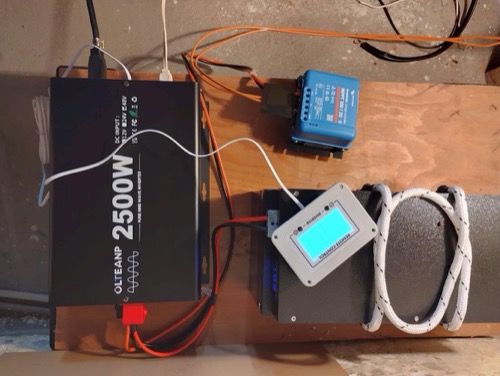
The 1A restriction at 48V is easy to miss because the same terminals carry much more current at lower battery voltages. One owner acknowledged connecting a 5A load at 48V, after which the controller’s fuse and power stage failed. A second reviewer described a separate failure after a battery-pack disconnect event and criticized the internal fuse arrangement.
Those reports do not prove that every unit has a defect, and one explicitly involved operation beyond the documented load rating. They do show why the load terminal should never be mistaken for a general 48V distribution output. High-current loads and inverters belong on a correctly fused battery-side system, with the controller’s virtual or physical output used only where its manual allows.
48V check — Keep the load output at or below 1A, use suitable DC-rated protection, and do not rely on the controller’s internal protection as the only battery fault boundary.
Bluetooth, VictronConnect, and VE.Direct
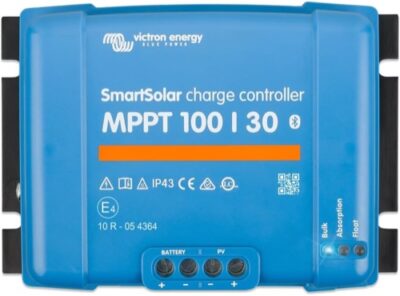
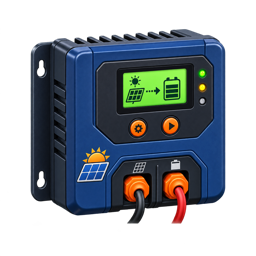
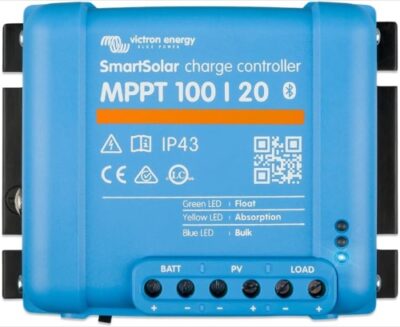
Built-in Bluetooth is the product’s strongest everyday advantage. VictronConnect provides live PV and battery data, 30-day history, charge-stage information, battery presets, user-defined values, alarms, and firmware updates. The VE.Direct port also supports integration with compatible Victron displays and system equipment.
The owner pattern is clear. Multiple users praised easy Bluetooth setup, app functions, monitoring, and reliable reconnection. One owner paired a 100/20 with a 75/15 through VE.Smart networking on a 24V LiFePO4 bank; another described Home Assistant integration through a separate Bluetooth gateway.
Bluetooth remains local-range communication. A reviewer correctly noted that internet access needs more equipment, and metal enclosures can shorten radio range. Buyers who want a numeric screen on the controller will also need an external monitor or a different product.
Battery Profiles and Temperature Behavior
Victron offers an adaptive multi-stage algorithm, presets, and user-defined charging. The controller can be configured for documented lead-acid and lithium requirements, while VE.Smart networking can share compatible battery voltage and temperature data.
Battery compatibility does not mean the controller can infer every safe value. Confirm absorption or charge voltage, float policy, maximum charge current, and low-temperature behavior with the exact battery maker. A configurable cutoff is useful only when the sensing source and threshold are suitable for the installed bank.
The manual lists 98% peak efficiency and passive cooling. Operating temperature is -30°C to 60°C, with full rated output only through the documented ambient threshold. One owner reported about 90°F operation under a particular setup; that anecdote cannot establish thermal performance across all enclosures and climates.
Compact Installation with Defined Boundaries
At 100 × 131 × 60 mm and 0.65kg, the 100/20 is easy to place in a small electrical compartment. Power terminals accept up to 6 mm² or AWG 10 conductor. Final wire sizing still depends on current, length, voltage drop, insulation rating, protection, and installation rules.
Victron specifies IP43 for the electronics and IP22 for the terminal area. That does not support exposed mounting. Follow the manual’s orientation, clearance, connection, fuse, and grounding requirements, especially where condensation or conductive debris is possible.
Using Owner Evidence Without Hiding the Outliers
| supplied Theme | Supporting Detail | What It Supports | What It Cannot Prove |
|---|---|---|---|
| Bluetooth and app control | Multiple owners praised setup, live data, graphs, and parameter access | VictronConnect is a recurring ownership strength | Perfect range through every enclosure or phone |
| Compact installation | Several owners described the unit as small, solid, or easy to mount | The published 0.65kg format is practical in tight systems | Terminal fit for every correctly sized conductor |
| 48V charging | Owners reported NMC and LiFePO4 use in 48V-class systems | The documented 48V charging mode is used in real systems | Controlled conversion efficiency or universal settings |
| Load-side failure | Two detailed reports describe destructive events with different triggers | The 48V load restriction and battery-disconnect behavior deserve attention | A product-wide defect rate |
| Long-term operation | Several reports describe months of service | Successful medium-term use is plausible | Expected lifespan across climates and installations |
The two negative accounts should not be averaged away because their failure descriptions are specific. At the same time, one owner states that a 5A load exceeded the published 1A limit at 48V. The fair interpretation is to keep the hardware within its documented role and treat any battery-disconnect scenario as a system-engineering question, not to label every 100/20 unsafe.
Owner pattern — App usability is supported by several independent reviews. The load-side failures remain important anecdotes with specific circumstances, not evidence that a known percentage of units will fail.
Where the 100/20 Fits Better Than the 75/15 or 100/30
Victron’s model numbers can tempt buyers to choose by price increments, but the useful distinction is the complete electrical envelope. The 75/15 is smaller and adequate when the array stays below 75V Voc, 15A Isc, 15A output, and 220W/440W. The 100/30 keeps the 100V ceiling while raising output and published PV power for larger 12V/24V banks; it does not support a 48V bank in the normalized comparison data used here.
| Design Situation | 100/20 Fit | Reason | Better Direction When It Fails |
|---|---|---|---|
| Compact 12V system around 200-250W | Good | Within 290W and 20A when all input checks pass | 75/15 may suffice for a smaller array |
| 24V system around 500W | Conditional | Within the 580W allowance but close enough to require accurate current math | Larger controller if battery-side demand exceeds 20A |
| 48V bank using charger output only | Good | Explicit 48V support and 1,160W published PV allowance | Preserve 100V Voc and 20A Isc limits |
| 48V system needing several amps from load terminals | Poor | Physical output is limited to 1A | Use protected battery-side distribution |
| Array whose cold Voc exceeds 75V but remains safely below 100V | Good | This is a direct reason to step above 75/15 | Reconfigure or select a higher-voltage model if 100V is tight |
| Unattended exposed outdoor installation | Poor | Terminal area is IP22 | Dry enclosure with documented ventilation and protection |
This comparison does not make the 100/20 the automatic middle choice. A 12V array that needs 25A charging has outgrown it even if voltage is comfortably below 100V. A 48V bank can use more nominal watts at 20A, but its string still cannot exceed the same PV voltage and current ceilings.
Commissioning Questions Worth Answering First
- Is the battery bank 12V, 24V, or 48V, and does the selected preset match its documentation?
- What is the array’s cold-corrected series Voc at the site’s minimum design temperature?
- Does total array Isc remain within the published 20A input limit?
- Will expected battery-side charging remain within both 20A and the battery/BMS limit?
- At 48V, are the physical load terminals unused or held below their documented 1A ceiling?
- Can AWG 10 / 6 mm² terminals support the conductor plan without excessive voltage drop?
- Is Bluetooth range acceptable at the intended mounting location, or is VE.Direct integration needed?
- Are protection, grounding, orientation, and connection order taken from the current exact manual?
Alternatives for a Different Constraint
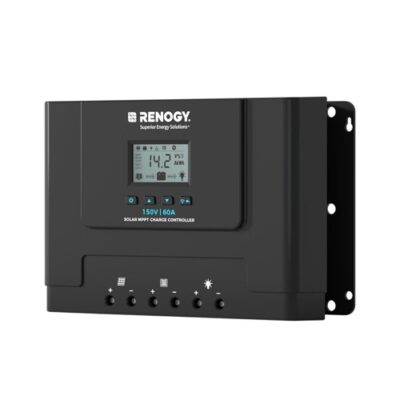
Renogy Rover 20A trades Victron’s built-in Bluetooth and 48V support for a front LCD, larger published terminal capacity, and conventional 20A load terminals on its supported 12V/24V banks. It is the more natural alternative for someone who refuses phone-first control, although its exact PV Isc limit needs confirmation and app monitoring costs extra.
SmartSolar 75/15 is the cost-and-size alternative when 75V, 15A, and its lower PV-watt allowances cover the finished design. SmartSolar 100/30 makes sense when the bank is 12V/24V and can use more than 20A. None of these choices changes the need to calculate the array and verify battery settings independently.
Victron SmartSolar 100/20 Review: Best Use Cases
Choose the 100/20 for a documented 12V, 24V, or 48V battery system that fits its PV table and benefits from VictronConnect. It is especially appealing when a 75V or 15A controller would restrict future panel configuration.
Choose a larger model if the battery can accept more than 20A and the array can supply it. Choose a controller with an integrated display if phone-based commissioning is unacceptable, and use a separate load-control design for substantial 48V loads.
Pros & Cons Analysis
Based on documented specifications and owner feedback
Pros
- Complete electrical documentation — Victron publishes Voc, Isc, PV watts by battery voltage, load limits, terminals, enclosure, and temperature range.
- Bluetooth is built in — VictronConnect supplies live readings, history, presets, custom settings, alarms, and firmware updates.
- Broad voltage support — One controller covers documented 12V, 24V, and 48V battery systems.
- Compact and passively cooled — The 0.65kg enclosure requires no fan and fits small equipment spaces when ventilation rules are followed.
- Positive setup pattern — Multiple sampled owners specifically praised the app, Bluetooth commissioning, and reliable operation.
Cons
- Severely reduced 48V load rating — The physical load output is limited to 1A on a 48V system.
- No numeric screen — A phone or external display is needed for detailed local readings.
- Two serious failure anecdotes — Two sampled owners described MOSFET or fuse failures after 48V load or battery-disconnect events.
- Protected mounting still required — IP43 electronics and IP22 terminals do not make it suitable for exposed outdoor use.
- Remote monitoring needs more hardware — Bluetooth is local; internet access requires additional Victron equipment.
Bottom Line: Excellent Charger, Narrow 48V Load Output
Verdict: The SmartSolar 100/20 is a highly capable compact charger with unusually transparent specifications and one of the better configuration apps available. Its 100V/20A design covers many small and mid-sized systems without an accessory for Bluetooth.
Best reason to buy: You value precise documentation, built-in app control, and the option to use 12V, 24V, or 48V batteries.
Reason to pause: The physical load output drops to 1A at 48V, and owner failure anecdotes reinforce the need for conservative load-side design. This Victron SmartSolar 100/20 review recommends it primarily as a charger, not as the center of high-current DC distribution.
Frequently Asked Questions
What does 100/20 mean on the Victron SmartSolar?
It means a maximum PV open-circuit voltage of 100V and a maximum battery charge current of 20A. These limits are independent and both must be checked.
What solar-array power can the SmartSolar 100/20 handle?
Victron publishes 290W at 12V, 580W at 24V, and 1,160W at 48V. The array must also stay within 100V cold-corrected Voc and 20A Isc.
Does the SmartSolar 100/20 have Bluetooth?
Yes. Bluetooth is built in for VictronConnect configuration, monitoring, history, alarms, and firmware updates.
Can it charge a 48V battery?
Yes. Victron documents 48V battery support, but the physical load output is limited to 1A at 48V and should not be treated as a general high-power output.
Can I connect an inverter to its load output?
No. Inverters and other large or high-surge loads should use a correctly protected battery-side connection. The controller's load output is for modest DC loads and control functions.
Does it support LiFePO4 batteries?
Yes, when the chosen preset or user-defined values match the battery and BMS requirements. Confirm low-temperature behavior and required sensing for the exact system.
Does it have a built-in display?
It has status LEDs but no numeric display. Detailed information is available through VictronConnect or compatible external Victron monitoring.
Is the 100/20 better than the 75/15?
It is better when the system needs a 100V PV ceiling, 20A output, more PV capacity, or a 48V battery. The 75/15 is smaller and adequate for arrays within its lower limits.
Technical Specifications
| Brand | Victron Energy |
|---|---|
| Exact model / revision / ASIN | SmartSolar MPPT 100/20 (ASIN B075NPQHQK) |
| Controller type | MPPT |
| Rated battery-side charge current | 20A |
| Supported battery-system voltage | 12V / 24V / 48V automatic selection |
| Battery chemistry and profile support | Lead-acid and lithium via presets or a user-defined algorithm |
| Maximum PV open-circuit voltage (Voc) | 100V |
| Maximum PV short-circuit/input current (Isc) | 20A |
| Maximum PV power by battery voltage | 290W @ 12V; 580W @ 24V; 1,160W @ 48V |
| Minimum PV/start voltage requirement | PV voltage must exceed battery voltage by 5V to start and by 1V to continue charging |
| Load output and low-voltage disconnect | 20A @ 12V/24V; 1A @ 48V, with BatteryLife and configurable control |
| Grounding topology | Isolated chassis; positive or negative battery grounding permitted at one point; do not ground PV positive or negative |
| Charging stages and custom voltage control | Adaptive multi-stage or user-defined algorithm |
| Temperature sensing and lithium low-temperature behavior | Internal compensation; configurable low-temperature cutoff and optional VE.Smart battery sensing |
| Display and local controls | Status LEDs; detailed control through VictronConnect |
| App, communications, and data history | Built-in Bluetooth with VictronConnect; VE.Direct port |
| Maximum terminal conductor size | 6 mm² / AWG 10 |
| Controller self-consumption | 25mA at 12V; 15mA at 24V or 48V |
| Published tracking/conversion efficiency | 98% peak |
| Cooling method and thermal derating | Natural convection / passive cooling; full rated output through 40°C, then temperature-limited |
| Electrical protections | PV reverse-polarity, output short-circuit, and overtemperature protection; no internal ground-fault protection |
| Enclosure, ingress rating, and operating temperature | IP43 electronics / IP22 terminals; -30°C to 60°C |
| Certifications | EN/IEC 62109-1, UL 1741, and CSA C22.2 No. 107.1-16 |
| Dimensions, weight, and included accessories | 100 × 131 × 60 mm; 0.65 kg |
| Warranty | 5 years |