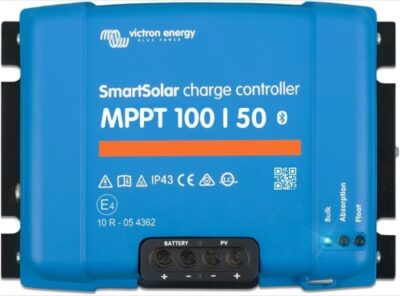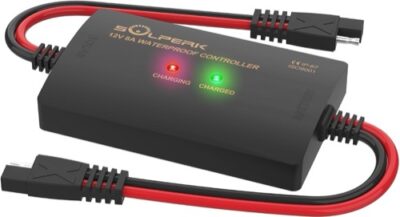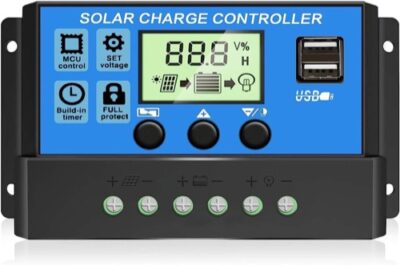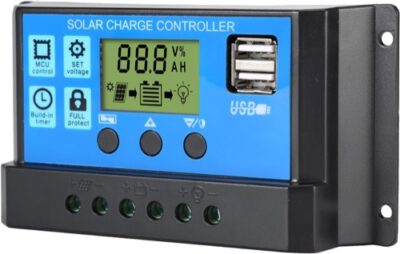
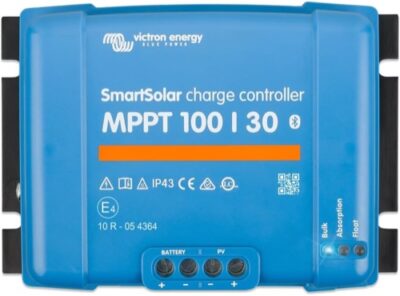
Victron SmartSolar 100/30 Review: Excellent Control for 30A Systems
At a Glance
KEY FEATURES
- Output: 30A MPPT controller with automatic 12V/24V battery selection.
- PV limits: 100V Voc and 35A Isc; 440W @ 12V or 880W @ 24V.
- Battery support: Eight presets plus user-defined charging and VE.Smart temperature sensing.
- Monitoring: Built-in Bluetooth with VictronConnect and a VE.Direct port.
- Best fit: Documented 12V/24V systems that value app control and ecosystem integration.
PROS
- VictronConnect offers strong setup, history, and firmware tools.
- VE.Smart support fits multi-device Victron systems.
- 30A output covers many serious 12V and 24V arrays.
CONS
- The absolute 100V PV ceiling limits some series strings.
- System-wide monitoring can require additional Victron hardware.
- No local numeric display for app-free diagnosis.
Editor's Choice
Editorial assessment based on exact-model documentation and qualitative exact-ASIN owner evidence; no first-party bench test or population-rate claim
Will the Victron SmartSolar 100/30 Fit Your Solar Array?
Estimate required charging current and check it against the documented limits for Victron SmartSolar 100/30.
Solar Charge Controller Size Calculator
What size charge controller do I need?
The 100/30 Is an Ecosystem Choice With a Hard String Ceiling
The expanded owner record reinforces the SmartSolar 100/30 as more than a stand-alone controller. Owners repeatedly value the app, live and historical data, configurable charging, synchronized Victron devices, and reliable service across RV, marine, cabin, and backup systems. That ecosystem is useful, but it should not distract from the two hard numbers in the model name: 100V maximum PV voltage and 30A maximum battery charge current.
Several owners describe upgrading from a 75/15 or lower-current controller as their array grew. Others mention Bluetooth delay, app limitations when viewing several devices, intermittent output, price, or a desire for broader system-level history. Those accounts help define the workflow; they cannot establish failure or satisfaction rates.
Commission the exact battery profile and compare controller voltage with the battery terminals. Test Bluetooth from the final cabinet and save a baseline of daily yield, peak power, charge stages, and any alarms. If several controllers will be networked, confirm what synchronizes through VE.Smart and what still requires a GX device or other system monitor.
The 100/30 is strongest for buyers who value transparent configuration and intend to use the Victron toolchain. A less expensive controller may meet basic charging needs; a larger Victron may avoid buying twice when array growth is already planned. Neither choice eliminates cold-corrected string calculations.
Quick Verdict on the Victron SmartSolar 100/30
| Best For | Main Strength | Main Limitation | Evidence Confidence |
|---|---|---|---|
| Documented 12V/24V systems needing no more than 30A | Built-in Bluetooth and excellent configuration | No numeric display; 30A output ceiling | High for specifications; medium for ownership patterns |
Evidence and Exact-Model Scope
One RV owner describes a full Victron system used since 2021 across different climates. Another upgraded from a 75/15 when adding panel capacity. A technically detailed reviewer discusses multiple SmartSolar controllers, VE.Smart networking, Bluetooth behavior, and system-level monitoring limitations. These accounts support use patterns; they do not replace controlled efficiency or reliability testing.
Manufacturer documentation supplies the hard limits used below. Marketplace comments are used only for installation and ownership context, not to fill specifications from adjacent Victron variants.
Electrical Limits and Array Fit
The model name summarizes two separate boundaries: up to 100V PV open-circuit voltage and up to 30A of battery-side charge current. Neither number substitutes for the other. Series panels raise voltage, parallel strings raise current, and the controller also has battery-voltage-specific PV-watt limits.
| Limit | Documented Value | What It Means | Evidence Status |
|---|---|---|---|
| Controller type | MPPT | Converts higher panel operating voltage into battery charge current | Victron documentation |
| Rated charge current | 30A | Maximum battery-side output | Victron documentation |
| Maximum PV Voc | 100V | Cold-corrected series-string Voc must remain below this | Victron documentation |
| Maximum PV Isc | 35A | Parallel-string short-circuit current must remain within this limit | Victron documentation |
| PV power at 12V | 440W | Nominal array-power limit for a 12V battery | Victron documentation |
| PV power at 24V | 880W | Nominal array-power limit for a 24V battery | Victron documentation |
The 100V ceiling gives more string flexibility than low-voltage PWM controllers, but cold weather remains critical. A string near 100V under standard conditions can exceed the controller limit as panel temperature falls. Use the panel’s Voc temperature coefficient and the site’s minimum design temperature rather than relying on normal operating voltage.
The 30A output limit matters on the battery side. A larger array may reach the controller’s ceiling earlier, and a battery with a lower permitted charge current can require an even smaller configured output. Victron’s documentation is unusually helpful here because it publishes both Isc and voltage-specific PV-watt values.
Compatibility Check — Check cold-corrected Voc, array Isc, PV watts, controller output, and the battery/BMS charge limit independently. Passing one check does not guarantee the system passes the others.
Enclosure, Terminals, and Installation
The SmartSolar 100/30 uses a compact metal enclosure measuring 130 × 186 × 70 mm and weighing 1.3 kg. Several owners call it solid, durable, compact, or heavy for its size. That is consistent with a substantial heatsink-based design, although owner impressions are not an ingress or thermal test.
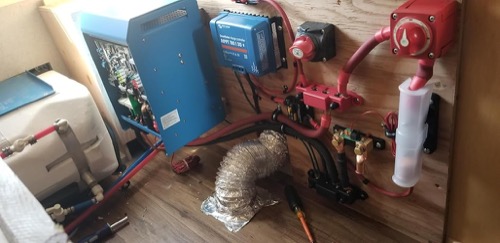
Victron lists terminals accepting up to 16 mm² or AWG 6 cable. One exact-variant owner reported that #10 AWG fit comfortably and liked the broad clamp screws. Final conductor size still depends on current, distance, voltage drop, insulation temperature, protection, and applicable installation requirements.
| Installation Point | Published Detail | Practical Effect |
|---|---|---|
| Terminal capacity | 16 mm² / AWG 6 | Supports appropriately sized conductors without improvised strand trimming |
| Electronics rating | IP43 | Limited protection only when installed in the specified orientation |
| Terminal rating | IP22 | Terminals require a protected, dry installation |
| Operating range | -30°C to 60°C | Output can derate at higher ambient temperature |
| Cooling | Passive enclosure | Avoid blocked airflow and manual-prohibited mounting positions |
There are no physical load terminals on this model. Victron supports a virtual load-output function through VE.Direct, but large DC loads and inverters normally belong on a correctly protected battery-side design. Buyers should not infer physical load terminals from generic family descriptions.
Installation Check — Follow the exact manual for mounting orientation, clearances, connection sequence, conductor preparation, torque, grounding, and overcurrent protection.
Bluetooth, VictronConnect, and Local Controls
Bluetooth is the clearest reason to choose this controller. VictronConnect presents live PV and battery data, 30-day history, battery presets, user-defined settings, alarms, trends, and firmware updates. No external Bluetooth dongle is required.
The owner pattern is unusually consistent. At least seven reviewers specifically praise Bluetooth, the app, monitoring, or connected-device coordination. Owners describe adjusting charge parameters from a phone, following solar production, and linking chargers with a SmartShunt or other Victron equipment. Several also bought additional SmartSolar units after using the first.
The app is not the same as a complete local system console. One experienced owner wanted easier switching among devices, a unified view, and longer system-level history. Another notes that the solar-energy figure reflects what the controller sends toward the battery rather than an independent measurement of every watt available at the panels. Those are useful boundaries, not reasons to dismiss the interface.
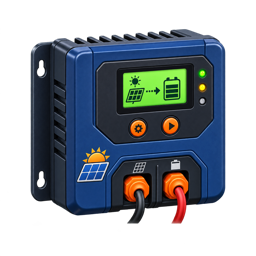
On the controller itself, status LEDs provide basic state information but no voltage or current readout. A buyer who refuses phone-dependent commissioning should budget for the optional MPPT Control display or choose a controller with an integrated LCD.
Battery Profiles, Temperature, and Charging
Victron provides eight preset charge algorithms plus a user-defined option. That flexibility supports common lead-acid batteries and lithium systems, but the selected voltages and timing still must match the exact battery maker’s requirements. A menu option cannot determine the battery’s allowed current or substitute for its BMS.
The controller has internal temperature sensing. Networked battery voltage and temperature information can be supplied through compatible VE.Smart components, enabling better compensation and configurable low-temperature behavior. This design is powerful but requires the correct sensing equipment and configuration; the controller alone cannot know the cell temperature of a remotely mounted lithium battery.
Owners report successful lithium and multi-controller systems, fast tracking, and stable day-to-day service. Those reports support usability and integration. They do not independently verify the maximum 98% conversion-efficiency figure under standardized conditions.
| Charging Decision | Fit | Reason | Verify Before Use |
|---|---|---|---|
| Flooded or sealed lead-acid | Good | Presets and adaptive multi-stage charging | Exact preset and temperature compensation |
| LiFePO4 with BMS | Good | Preset/user-defined charging and networking options | Charge voltages, current, float, and cold cutoff |
| Battery needs more than 30A | Poor | Controller output is capped at 30A | Consider a larger exact-model controller |
| Multiple Victron chargers | Good | VE.Smart synchronization is a recurring owner strength | Compatible hardware and firmware |
What The supplied owners Report
| Theme | Supporting Reviews | What the Evidence Supports | Limitation |
|---|---|---|---|
| Bluetooth/app/coordination praised | At least 7 | Monitoring and configuration are recurring strengths | Positive-only owner record limits complaint coverage |
| Solid or compact construction | At least 4 | Hardware makes a strong first impression | Not a durability or ingress test |
| Repeat purchase or multiple units | At least 5 | Experienced owners often expand their Victron setup | Brand-loyal owner record may be unusually favorable |
| Long-term RV/system use | At least 2 detailed reports | Multi-year service exists in the owner record | Different climates, loads, and installation quality |
| App/system-view limitation | 1 detailed report | Device switching and unified history can frustrate advanced users | Isolated, software-version-dependent observation |
The strongest conclusion is not that every unit will be flawless. It is that documentation and monitoring receive repeated, specific approval across different owners. The absence of low-star reviews in the owner record should prevent any claim about population-wide reliability.
SmartSolar 100/30 Warranty and Ecosystem Ownership
Victron backs the controller with a five-year limited warranty, a longer published period than the other starter products in this group. Warranty length is useful, but practical ownership also depends on correct sizing, installation records, serial-number retention, and buying through a channel that can support a claim. Review the current regional terms rather than assuming every type of damage or labor cost is covered.
The supplied long-term reports are encouraging. One RV owner describes service beginning in 2021, while another technically detailed reviewer owns several Victron chargers and has expanded the system over time. Repeat purchases and multi-year use support confidence in the platform, but they do not predict the life of an individual unit exposed to different heat, moisture, wiring quality, or electrical faults. The best ownership case combines Victron’s documentation with an installation that stays comfortably inside every published limit.
Commission the SmartSolar 100/30 in Five Checks
Before ordering, confirm that the exact panel string remains under 100V after cold correction and that total array Isc stays within 35A. Match the 440W or 880W limit to battery voltage, then check whether the battery and BMS accept 30A. These steps determine fit before Bluetooth or brand preference matters.
For installation, plan a dry mounting position that protects the IP22 terminals while preserving the manual’s airflow and orientation. Select conductors and protection from the actual circuit design, not merely the AWG 6 terminal maximum. Finally, decide how the controller will receive battery-temperature information and whether a phone is acceptable as the main detailed display.
- Confirm exact panel Voc coefficient and minimum design temperature.
- Confirm series voltage, parallel Isc, and voltage-specific PV watts.
- Confirm battery profile, current limit, BMS behavior, and cold-charge rule.
- Confirm enclosure, conductor, protection, sensing, and monitoring requirements.
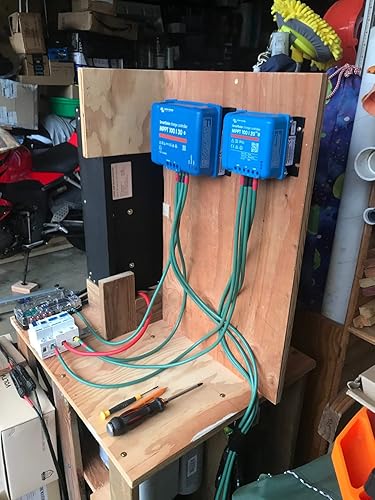
Who It Fits
| System / Buyer | Fit | Why | Must Verify |
|---|---|---|---|
| 12V RV with up to 440W PV | Good | Compact hardware and built-in monitoring | Cold Voc, Isc, battery current limit |
| 24V cabin with up to 880W PV | Good | Doubled documented PV-watt allowance | Battery profile and wire/protection design |
| Phone-first commissioning | Good | VictronConnect is included and well supported | Bluetooth range and desired history depth |
| Local-screen-only buyer | Poor | No numeric display on the controller | Optional display cost or alternative model |
| 40A battery charging target | Poor | 30A maximum output | Larger controller and array limits |
| Exposed outdoor mounting | Poor | IP22 terminal section requires protection | Enclosure, orientation, condensation control |
| Multi-controller Victron installation | Good | Synchronization and shared sensing are supported | Network design and compatible devices |
Alternatives to Consider
The Renogy Rover 40A is the direct alternative when the battery and array can genuinely use more than 30A or an included local LCD is required. It has a higher output rating but needs an optional BT-2 for app access and has more concerning terminal feedback in the owner record.
The LiTime 30A MPPT stays in the same output class while adding both an LCD and built-in Bluetooth. It is attractive for a straightforward LiFePO4 system, although its terminal, environmental, and support documentation is not as complete as Victron’s.
Choose the controller that fits the electrical design rather than the most familiar brand. A 30A SmartSolar is a poor match if the battery legitimately needs 40A; a 40A alternative adds no value if the array or BMS caps charging below 30A.
Who Gains Most From the SmartSolar 100/30
Buy it if:
- Your documented design stays within 100V Voc, 35A Isc, and 30A charge output.
- You want Bluetooth configuration and history without a separate module.
- You value published specifications and a mature connected-device ecosystem.
- A phone or optional display is acceptable for detailed local information.
Skip it if:
- You need more than 30A of battery-side output.
- A built-in numeric LCD is mandatory.
- You want a controller approved for direct exposure to weather.
- You do not want to configure battery settings or networked sensors carefully.
Pros & Cons Analysis
Based on documented specifications and owner feedback
Pros
- Excellent documentation — Victron publishes the important PV, battery, enclosure, terminal, and environmental limits.
- Bluetooth included — VictronConnect handles live data, history, settings, alarms, and firmware without a separate dongle.
- Strong owner pattern — At least seven sampled owners specifically praised monitoring or connected-system features.
- Flexible charging — Eight presets and user-defined settings cover a wider range of battery requirements.
- Compact, solid hardware — Multiple owners described the unit as substantial and suitable for tight installations.
Cons
- No numeric screen — Detailed local information requires a phone or an optional display.
- 30A ceiling — Systems that can genuinely use 31A–40A need a larger controller.
- Positive-skewed sample — All 13 captured reviews are five-star, limiting complaint visibility.
- Temperature features need planning — External battery sensing and networked cutoff behavior require compatible VE.Smart equipment.
- Ecosystem depth can add cost — Advanced unified monitoring may require other Victron components.
Victron SmartSolar 100/30: Our Verdict
Verdict: The SmartSolar 100/30 is our best-documented 30A choice, combining complete electrical limits with excellent Bluetooth control and strong owner feedback about system integration.
Buy it if: Your 12V or 24V design fits its 100V, 35A Isc, PV-watt, and 30A output boundaries and you prefer phone-based setup over a built-in screen.
Skip it if: The battery can use more than 30A, a numeric local display is essential, or the installation cannot protect the IP22 terminal area from moisture.
Frequently Asked Questions
What does 100/30 mean on the Victron SmartSolar?
The model accepts up to 100V PV open-circuit voltage and provides up to 30A of battery-side charge current. Both limits must be checked separately.
Does the Victron SmartSolar 100/30 include Bluetooth?
Yes. Bluetooth is built in and works with VictronConnect for live data, history, settings, alarms, and firmware updates.
What size solar array can the SmartSolar 100/30 handle?
Victron specifies 440W for a 12V battery system and 880W for 24V. The array must also remain within the 100V Voc and 35A Isc limits after temperature correction.
Can it charge LiFePO4 batteries?
Yes, when its charge settings match the exact battery and BMS requirements. Use a documented preset or user-defined algorithm and verify low-temperature protection separately.
Does the SmartSolar 100/30 have a display?
It has status LEDs but no numeric screen. Detailed information is available in VictronConnect, and an optional MPPT Control display can be added.
Can the controller synchronize with other Victron chargers?
Compatible Victron devices can share data and coordinate charging through VE.Smart networking. Confirm the required components and firmware for the planned system.
Can it be mounted outdoors?
Victron specifies IP43 for the electronics and IP22 for the terminals. Those ratings do not support an exposed installation; follow the manual's orientation and enclosure requirements.
Is the Victron 100/30 better than a 40A controller?
Not automatically. It is the better fit when 30A is sufficient and integrated monitoring matters; a documented 40A model can charge faster only when the array and battery can use the extra output.
Technical Specifications
| Brand | Victron Energy |
|---|---|
| Exact model / revision / ASIN | SmartSolar MPPT 100/30 (ASIN B073ZJ3L13) |
| Controller type | MPPT |
| Rated battery-side charge current | 30A |
| Supported battery-system voltage | 12V / 24V automatic selection |
| Battery chemistry and profile support | Lead-acid and lithium via eight presets or a user-defined algorithm |
| Maximum PV open-circuit voltage (Voc) | 100V |
| Maximum PV short-circuit/input current (Isc) | 35A |
| Maximum PV power by battery voltage | 440W @ 12V; 880W @ 24V; 48V not supported |
| Minimum PV/start voltage requirement | PV voltage must exceed battery voltage by 5V to start and by 1V to continue charging |
| Load output and low-voltage disconnect | No physical load terminals; virtual load output via VE.Direct |
| Grounding topology | Isolated chassis; positive or negative battery grounding permitted at one point; do not ground PV positive or negative |
| Charging stages and custom voltage control | Adaptive multi-stage; eight presets or user-defined |
| Temperature sensing and lithium low-temperature behavior | Internal sensor; external sensing and configurable low-temp cutoff via VE.Smart |
| Display and local controls | Status LEDs; optional MPPT Control display |
| App, communications, and data history | Built-in Bluetooth with VictronConnect; VE.Direct port |
| Maximum terminal conductor size | 16 mm² / AWG 6 |
| Controller self-consumption | 30mA at 12V; 20mA at 24V |
| Published tracking/conversion efficiency | 98% |
| Cooling method and thermal derating | Natural convection / passive cooling; full rated output through 40°C, then temperature-limited |
| Electrical protections | PV reverse-polarity, output short-circuit, and overtemperature protection; no internal ground-fault protection |
| Enclosure, ingress rating, and operating temperature | IP43 electronics / IP22 terminals; -30°C to 60°C |
| Certifications | EN/IEC 62109-1, UL 1741, and CSA C22.2 No. 107.1-16 |
| Dimensions, weight, and included accessories | 130 × 186 × 70 mm; 1.3 kg |
| Warranty | 5 years |