Renogy Adventurer Li 30A Review: The Flush-Mount RV Specialist
At a Glance
KEY FEATURES
- Controller: PWM; 30A rated charge output.
- System: 12V / 24V automatic for non-lithium batteries; Sealed/AGM, gel, flooded, and lithium.
- PV boundary: 50V maximum Voc; 400W @ 12V; 800W @ 24V maximum PV power.
- Controls: Flush-mount LCD and buttons; RS232; optional BT-1 module.
- Best fit: RV installations that specifically need a flush-mounted local display.
PROS
- Flush-mount format gives RV installations a clean visible control panel.
- 30A PWM charging fits modest voltage-matched arrays.
- Battery sensing and local display aid commissioning.
CONS
- Cutout, rear access, and ventilation must be planned before mounting.
- Battery-profile resolution may not fit every lithium requirement.
- Probe errors and support concerns warrant early testing.
Editor's Choice
Editorial assessment based on exact-model documentation and qualitative exact-ASIN owner evidence; no first-party bench test or population-rate claim
Will the Renogy Adventurer Li 30A Fit Your Solar Array?
Estimate required charging current and check it against the documented limits for Renogy Adventurer Li 30A.
Solar Charge Controller Size Calculator
What size charge controller do I need?
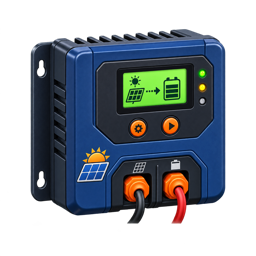
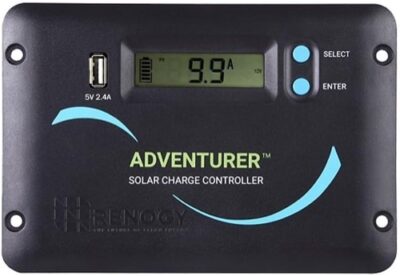
The Renogy Adventurer Li 30A is designed to look like part of an RV control panel rather than a box bolted beside it. Its front LCD and buttons sit flush in a wall, while the controller handles up to 30A, 400W at 12V or 800W at 24V, and 50V maximum PV input. It supports lead-acid and lithium profiles, programmable load control, and optional Bluetooth.
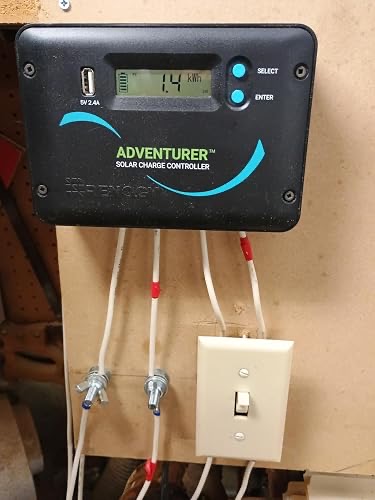
The form factor is the reason to choose it—and the source of most complaints. Owners praise the clean installation, but report missing cutout templates, nearly 1.75 inches of practical wall depth with terminals/sensor clearance, bottom-edge cable congestion, and difficult visibility from the blue backlight. One owner also measured the controller about 0.2V low and believed it overcharged by the same amount.
| Best For | Unique Strength | Main Constraint | Evidence Confidence |
|---|---|---|---|
| RVs and campers needing a permanent wall display | Purpose-built flush mounting with local controls | PWM topology, IP20, physical depth, and a calibration complaint | High for documented limits; medium for owner performance |
Flush Mounting Solves One RV Problem and Creates Three Access Checks
The expanded owner record confirms why the Adventurer Li 30A is different from most controllers in this cluster: its flush-mount format is designed for an RV wall or panel. Owners value the visible screen and clean installation. The same form factor makes pre-installation mock-up essential because rear cable access, sensor routing, heat clearance, and future removal can become harder after the opening is cut.
Positive accounts describe effective RV charging, useful display information, and a tidy replacement for factory controllers. Critical reports mention temperature-probe errors, coarse voltage increments, lithium-profile questions, weak charging, unclear support, and installations that could not satisfy the clearance requirement. Those themes define a commissioning plan rather than a failure percentage.
Battery sensing deserves special attention. A missing, misplaced, or damaged probe can trigger a fault or produce misleading compensation. Lithium batteries may prohibit charging below freezing even when the controller exposes a lithium mode; determine whether protection comes from the controller, the battery BMS, or neither.
Choose the Adventurer when flush mounting is a real requirement and the battery can be configured within its available resolution. If surface mounting, finer custom voltage control, or richer communications matter more, another 30A controller may be easier to install and service.
Measure the Wall Cavity Before Cutting
Renogy lists a body around 166.6 × 114.3 × 48.3 mm and a mass of 0.27kg. One detailed owner found that the body needed roughly 0.75 inch behind the face, the terminals added about 0.9 inch, and the temperature-sensor/cable approach benefited from still more space—about 1.75 inches total in that installation.
Another owner wished the box included an exact cutting template. Flush installation is irreversible, so create a cardboard mockup from the received controller, verify stud/wire/plumbing clearance, and plan how the terminals will be inspected later.
| Flush-Mount Question | Why It Matters | Verify Before Cutting |
|---|---|---|
| Face opening | Too large cannot be undone | Measure received bezel/body, not web image |
| Rear depth | Terminals and cable bends exceed case depth | Full conductor and sensor clearance |
| Bottom cable approach | Edge placement can create sharp bends | Bend radius, strain relief, fuse access |
| Display angle | Blue backlight may be difficult off-axis | Readability from normal standing/sitting position |
| Service removal | Hidden screws/cables complicate repair | Unit can be removed without opening whole wall |
Carpentry rule — Do not cut an RV wall from published case dimensions alone. Dry-fit the received unit, terminals, sensor plug, and final cable bends as one assembly.
PWM Is Appropriate Only for a Matched Roof or Portable Array
The Adventurer is PWM, not MPPT. It publishes a 50V PV ceiling and nominal power allowances of 400W at 12V or 800W at 24V. Maximum PV Isc was not present in the reviewed evidence.
PWM works best when panel operating voltage is suited to the battery. A high-voltage residential panel or long series string will not be converted into proportional battery current as with MPPT. Cold-corrected Voc must still stay below 50V.
| Electrical Boundary | 12V System | 24V System |
|---|---|---|
| Rated charge current | 30A | 30A |
| Published PV power | 400W | 800W |
| Maximum PV Voc | 50V | 50V |
| Maximum PV Isc | Not published in reviewed evidence | Not published in reviewed evidence |
| Terminal maximum | 8 AWG | 8 AWG |
An owner replaced an aging GoPower controller and restored charging to a 300Ah lithium bank within minutes. That demonstrates compatibility in one voltage-matched RV system, not superior energy harvest. If roof space is limited or panel voltage is much higher than battery voltage, compare the Rover MPPT line before cutting the wall.
The 0.2V Complaint Matters for Lithium
This is a detailed single-unit report, not a model-wide calibration study. Two-tenths of a volt can be meaningful near a lithium ceiling, and cable drop can also create differences between controller and battery. Commission with simultaneous measurements at both locations.
| Measurement | Purpose | Potential Finding |
|---|---|---|
| Controller battery terminals | Compare internal reading at its reference point | Calibration difference |
| Battery posts under charge | Identify cable voltage drop | Wiring/connection issue |
| Resting battery voltage | Remove charge-current drop | Meter/controller offset |
| Charge cutoff behavior | Confirm actual maximum | Profile/setpoint mismatch |
If measured battery voltage exceeds the maker’s limit, stop charging and resolve the cause. Do not simply subtract 0.2V from every setting without proving the error is stable across voltage, temperature, current, and the received unit.
Lithium commissioning — A user-adjustable maximum is useful only when the actual battery-terminal voltage is verified. Record setpoint, controller display, independent meter, and BMS reading at cutoff.
Lithium Mode Ignores the Lead-Acid Temperature Sensor
The controller supports sealed/AGM, gel, flooded, and lithium. An optional or bundle-dependent temperature sensor provides lead-acid compensation. The detailed owner said it was ignored in lithium mode and wished it could prevent cold charging.
That behavior is consistent with avoiding lead-acid-style voltage compensation on lithium, but it leaves low-temperature protection elsewhere. A LiFePO4 battery in an unheated RV must use a BMS, heated battery, or other documented control that stops charging below the battery maker’s threshold.
Non-lithium voltage detection is automatic; lithium voltage/profile requires careful configuration. One owner downloaded the manual when converting from four sealed batteries to one 200Ah lithium battery. Save the settings before changing banks and recheck after any reset.
One Polarity/Error-Code Story Raises Manual Questions
Never reverse polarity as trial-and-error troubleshooting. With all sources isolated, identify each conductor, terminal marking, and actual polarity using appropriate test equipment. If the manual and hardware disagree, stop and contact Renogy. Electronic reverse-polarity protection is not permission to experiment.
| Wiring Evidence | Responsible Treatment |
|---|---|
| Owner reports manual/polarity confusion | Flag documentation and verify exact revision |
| Controller error code identifies polarity | Use as diagnostic clue only |
| Terminals accept 8 AWG maximum | Calculate cable, do not automatically choose maximum |
| IP20 enclosure | Keep all rear connections inside protected dry wall/cabinet |
Owner Use Is Strongly RV-Centered
One installation completed a 4,000km road trip without loose wires or controller issues. Another kept four 100Ah sealed batteries topped off for a year before a lithium conversion. Owners repeatedly liked the clean appearance in campers and the ability to use the LCD without Bluetooth.
One buyer used two solar panels to support a husband’s oxygen equipment during outages. That is an owner context, not evidence that this controller or the solar system is suitable as life-safety power. Medical backup requires manufacturer-approved equipment, redundancy, runtime validation, alarms, and professional planning.
| Owner Context | Useful Evidence | Boundary |
|---|---|---|
| 4,000km trailer trip | Vibration/connection experience in one install | Not a formal mobile certification test |
| Year-round sealed-bank maintenance | Meaningful duration | Array/load details incomplete |
| GoPower replacement | Easy swap and restored charging | No controlled before/after harvest |
| Medical-device backup | Real motivation | Not approval for life-support dependence |
| Camper LiFePO4 | Successful general use | Exact cold strategy and voltage must be verified |
The LCD Is Standard; Bluetooth Is Extra
The flush LCD provides battery/solar values, profile selection, errors, and load control. The blue backlight drew one readability complaint. Test it under daylight and at night from the intended viewing angle.
RS232 supports the optional BT-1 module. App access is not included merely because the controller is “smart.” Include the correct accessory and verify current Renogy app compatibility if phone monitoring is required.
No app is necessary for normal local operation, which can be a virtue in an RV. Conversely, a hidden controller location with only app access would undermine the reason for buying the flush-mount model.
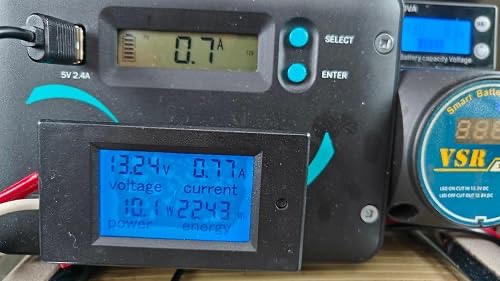
The 30A Load Output Needs Surge Analysis
The normalized specification lists a 30A programmable load output. One owner thought a protected 10A DC output was missing, which may reflect misunderstanding of the exact terminals or desired behavior. Confirm the current manual and the received hardware.
Do not connect a large inverter to the controller output. Lighting and modest DC loads may fit when continuous and startup current remain within limits. High-current distribution belongs on a fused battery bus.
IP20 Means the Attractive Face Is Still Indoor Hardware
The enclosure is IP20 and rated -25°C to 55°C. It does not belong on an exposed exterior RV wall. The rear cavity needs ventilation, wire protection, and separation from moisture and conductive debris.
The one-year warranty is shorter than Renogy’s larger Rover warranties and far shorter than Victron’s five years. Consider accessibility: replacing a flush controller after cutting a custom opening can be harder than swapping a surface-mounted unit.
Plan the opening around future service, not only initial appearance. Leave enough conductor slack to pull the controller forward without stressing terminals, but secure that slack so vibration cannot chafe it inside the wall. Keep fuse and disconnect access outside the cutout. Photograph terminal positions before the bezel is installed; a clean faceplate should not turn later voltage-drop testing into cabinet demolition.
If replacing another flush controller, compare bezel coverage as well as cavity size. A smaller replacement may expose the old cut, while a larger one may collide with framing. An adapter plate can preserve the wall and provide a noncombustible mounting surface when designed for ventilation and cable protection.
Flush-Mount Commissioning Checklist
- Confirm PWM is suitable for the selected panel voltage and array layout.
- Calculate cold Voc below 50V and obtain the PV Isc rule.
- Use the correct 400W/800W row and battery current limit.
- Build a full-depth mockup before cutting the wall.
- Verify polarity with a meter; never troubleshoot by reversal.
- Retain full conductor strands and torque 8-AWG-or-smaller cable correctly.
- Select battery profile from its manual and verify actual cutoff voltage.
- Provide lithium cold-charge protection outside the controller if required.
- Test display readability and optional Bluetooth before final fit.
- Keep IP20 electronics dry, ventilated, and serviceable.
Pros & Cons Analysis
Based on documented specifications and owner feedback
Pros
- Purpose-built — Purpose-built flush mounting.
- 30A — 30A PWM output.
- 400W/800W — 400W/800W published PV limits.
- Optional — Optional Bluetooth and lithium support.
Cons
- Check: PWM rather than MPPT.
- Check: IP20 indoor enclosure.
- Check: Bluetooth costs extra.
- Check: No controller-managed lithium cold cutoff documented.
Bottom Line: Buy It for the Wall, Not for Maximum Harvest
Verdict: The Adventurer Li 30A is a well-defined RV PWM controller whose flush display, published power limits, load control, and owner travel evidence make it practical when panel voltage is matched.
Best reason to buy: A clean permanent control-panel installation and phone-free status matter more than MPPT conversion.
Reason to pause: Wall depth, cutout/service access, a detailed 0.2V complaint, IP20 protection, optional Bluetooth, and absent lithium cold cutoff all require planning before the first cut.
Frequently Asked Questions
Is the Renogy Adventurer Li 30A MPPT or PWM?
The exact model is documented as PWM. That topology does not replace checks of PV voltage, input current, output current, and battery compatibility.
What battery voltage does the Renogy Adventurer Li 30A support?
12V / 24V automatic for non-lithium batteries. Confirm detection and selection behavior in the current exact-model manual.
What is the maximum PV voltage?
50V. Use cold-corrected array Voc rather than the panel's warm-day value.
How much solar can it handle?
400W @ 12V; 800W @ 24V. The PV voltage, PV current, and battery-side charge-current limits must all be satisfied at the same time.
Does the Renogy Adventurer Li 30A work with lithium batteries?
Sealed/AGM, gel, flooded, and lithium. Match every charging value and low-temperature strategy to the battery documentation.
Does it include app monitoring?
RS232; optional BT-1 module. Verify whether any required accessory is included in the exact bundle.
Can I connect an inverter to its load terminals?
Normally no. High-current and surge loads should use a correctly fused battery-side connection unless the controller manual explicitly permits the planned load.
Who should buy the Renogy Adventurer Li 30A?
RV installations that specifically need a flush-mounted local display.
Technical Specifications
| Brand | Renogy |
|---|---|
| Exact model / revision / ASIN | Adventurer Li 30A (ASIN B07BBKFTNV) |
| Controller type | PWM |
| Rated battery-side charge current | 30A |
| Supported battery-system voltage | 12V / 24V automatic for non-lithium batteries |
| Battery chemistry and profile support | Sealed/AGM, gel, flooded, and lithium |
| Maximum PV open-circuit voltage (Voc) | 50V |
| Maximum PV short-circuit/input current (Isc) | Not published |
| Maximum PV power by battery voltage | 400W @ 12V; 800W @ 24V |
| Minimum PV/start voltage requirement | Not published for the reviewed revision |
| Load output and low-voltage disconnect | 30A programmable load output |
| Grounding topology | Common negative / negative ground |
| Charging stages and custom voltage control | Four-stage lead-acid and lithium profile |
| Temperature sensing and lithium low-temperature behavior | Optional temperature sensor for lead-acid; no lithium low-temp cutoff published |
| Display and local controls | Flush-mount LCD and buttons |
| App, communications, and data history | RS232; optional BT-1 module |
| Maximum terminal conductor size | 8 AWG |
| Controller self-consumption | 13mA or less |
| Published tracking/conversion efficiency | Not applicable as a published MPPT conversion figure |
| Cooling method and thermal derating | Natural convection with ventilated mounting; no thermal-derating curve published |
| Electrical protections | Overcharge, overload, short-circuit, and reverse-polarity protection |
| Enclosure, ingress rating, and operating temperature | IP20; -25°C to 55°C |
| Certifications | CE |
| Dimensions, weight, and included accessories | 166.6 × 114.3 × 48.3 mm; 0.27 kg |
| Warranty | 1 year |