Renogy Rover 30A Review: The Useful Middle Size—with Mounting Friction
At a Glance
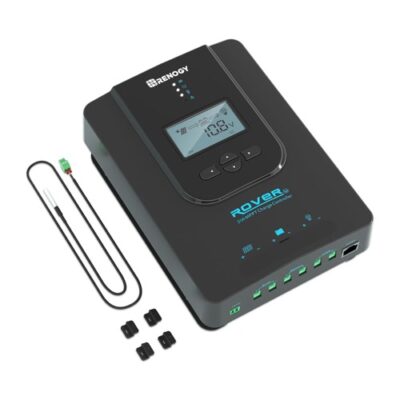
KEY FEATURES
- Controller: MPPT; 30A rated charge output.
- System: 12V / 24V automatic for non-lithium batteries; Sealed/AGM, gel, flooded, lithium, and user-defined.
- PV boundary: 100V maximum Voc; 400W @ 12V; 800W @ 24V maximum PV power.
- Controls: LCD and buttons; RS485; optional BT-2 and DC Home.
- Best fit: Mid-size 12V/24V RV and cabin arrays needing an LCD, load control, and configurable MPPT charging.
PROS
- 30A MPPT output fits many mid-size RV and shed arrays.
- Local LCD supports setup without communications accessories.
- Optional Bluetooth can add convenient live monitoring.
CONS
- Bracket and fastener access can complicate installation.
- Voltage readings and lithium targets need independent checks.
- App capabilities may require extra Renogy hardware.
Editor's Choice
Editorial assessment based on exact-model documentation and qualitative exact-ASIN owner evidence; no first-party bench test or population-rate claim
Will the Renogy Rover 30A Fit Your Solar Array?
Estimate required charging current and check it against the documented limits for Renogy Rover 30A.
Solar Charge Controller Size Calculator
What size charge controller do I need?
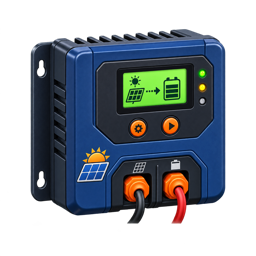
The Renogy Rover 30A sits between small 20A controllers and heavier 40A–60A hardware. It accepts up to 100V PV, supplies up to 30A to a 12V or 24V battery, provides an LCD and 20A programmable load output, and supports optional app monitoring. Its published array table—400W at 12V or 800W at 24V—fits many RV, van, truck-camper, and small-cabin systems.
owners generally describe strong charging and long service. The practical complaints are unusually physical: awkward mounting access, unclear terminal instructions, one set of poor cable lugs, and an early failure after difficult wiring. That makes the Rover 30A less about chasing theoretical efficiency and more about whether it can be mounted and terminated cleanly in the available compartment.
| Best For | Main Strength | Main Friction Point | Evidence Confidence |
|---|---|---|---|
| Mid-size 12V/24V mobile or cabin arrays needing local control | Balanced 30A capacity, LCD, and load automation | Terminal/mounting access and optional Bluetooth | High for documented limits; medium-high for recurring owner use |
Thirty Amps Is the Middle Size Only After the Array Math Works
The expanded exact-ASIN evidence supports the Rover 30A as Renogy’s practical middle size, but only when the array and battery calculations land near that middle. Owners describe improved harvest over PWM, useful local controls, successful RV and shed systems, and optional Bluetooth. Others report mounting frustration, false voltage readings, intermittent charging, app limitations, fan or noise confusion across revisions, and slow support.
First decide whether 30A is enough. Calculate the controller’s expected battery-side current from realistic array power and charge voltage, then compare that value with the battery’s accepted current and the controller’s documented limit. A panel that damaged an undersized controller does not automatically make 30A sufficient; cold Voc and input-current limits still need separate checks.
| Before mounting | During first charge | Before unattended use |
|---|---|---|
| Test bracket, screw access, cover removal, and cable radius | Compare controller voltage with battery-terminal voltage | Power-cycle and confirm the battery profile persists |
| Confirm PV polarity, cold Voc, current, and disconnects | Watch sustained output, clipping, and terminal temperature | Test optional Bluetooth and save fault screenshots |
| Record exact revision and included accessories | Verify charge targets against battery documentation | Document the support and warranty route |
Mechanical access is part of reliability. If the mounting bracket hides fasteners or forces the cable sharply, change the location or hardware before energizing. Do not trim conductor strands to fit. For lithium, treat presets as starting points and confirm every voltage. For app use, identify whether a separate module or shunt is required for the data you expect.
Choose the Rover 30A when its current envelope, local display, and system price fit a measured mid-size design. Move to 40A if regular clipping would waste meaningful harvest; move down when 30A adds cable and hardware cost without usable output.
Why 30A Is Often Enough—and Sometimes Not
Renogy publishes 400W maximum PV at 12V and 800W at 24V. The 100V Voc ceiling permits series wiring that a PWM controller cannot use in the same way. Charge output stops at 30A, so a larger array may clip or exceed the model’s permitted power even if string voltage is below 100V.
Maximum PV short-circuit current was not present in the reviewed evidence. That missing number matters when panels are paralleled. Obtain the current Renogy rule instead of using the 30A battery-output label as an input-current limit.
| Boundary | Published Value | Real Design Question |
|---|---|---|
| Maximum PV Voc | 100V | What is complete string Voc at the coldest site temperature? |
| Rated output | 30A | Can the battery accept it and can the battery cable carry it? |
| PV power on 12V | 400W | Is expansion beyond four nominal 100W panels expected? |
| PV power on 24V | 800W | Does the array stay inside both voltage and current limits? |
| Maximum PV Isc | Not published in reviewed evidence | What parallel-string current does Renogy permit? |
| Load output | 20A | What are the intended load’s continuous and startup currents? |
One owner used eight nominal 60W, 24V panels with a 600Ah lead-acid RV bank and reported results consistent with their expected conversion losses. Another saw roughly 73W from one nominal 100W panel at a stated UV index of 6.2. Neither number is a universal efficiency benchmark because irradiance, angle, temperature, wiring, charge stage, and meter behavior differ.
Capacity decision — Size from the array and battery, then add realistic expansion margin. Buying 30A because it sounds “mid-size” is not a calculation; buying 40A for a fixed 200W system may add cost without useful output.
Series Wiring Was the Upgrade for One Shaded Site
A owner replaced an older controller and rewired panels in series. In a tree-constrained location, the buyer reported charging starting earlier and more panel voltage being converted into battery current. That experience matches the reason many people select MPPT: a higher-voltage array can give the controller operating headroom and reduce current on the PV run.
It does not show that series is always superior. Partial shade can affect a series string differently from parallel branches, and cold Voc can become the controlling safety limit. The best arrangement depends on module bypass diodes, shade pattern, cable length, fusing, Vmp window, and the controller’s current rule.
| Array Choice | Possible Benefit | Rover-Specific Constraint | When to Reconsider |
|---|---|---|---|
| More panels in series | Higher PV voltage and lower cable current | 100V cold-corrected ceiling | Winter Voc or partial-shade behavior becomes unfavorable |
| More strings in parallel | Current can continue from unshaded branches | PV Isc limit must be confirmed | Conductors or string protection become complex |
| 400W on 12V | Uses the published nominal allowance | 30A output may become the active ceiling | More roof panels are planned |
| 800W on 24V | More watts at the same output-current class | Battery and inverter system must truly be 24V | Existing 12V loads dominate the project |
The Mounting Brackets Deserve a Dry Fit
Owner reports conflict on mounting ease. One buyer liked the supplied brackets and called installation simple. A truck-camper owner found the screw holes hidden under the chassis after hanging the unit and improvised with 1/4-inch hex-head screws and a small wrench. The reviewer believed slightly wider brackets would solve the access problem.
The enclosure measures approximately 238 × 172 × 77 mm and weighs 2kg. Before drilling, hold the controller and cables in the actual compartment. Confirm screwdriver or wrench access, ventilation clearance, display visibility, cable bend radius, and whether the finished mounting lets the unit be removed without dismantling adjacent equipment.
IP32 requires a protected, ventilated location. It is not an exposed sailboat, roof, or trailer-tongue controller even though owners use it in marine and mobile systems. Protect it from water, condensation, direct sunlight, and corrosive battery gases.
Physical-fit check — A controller that passes every electrical calculation can still be the wrong product if its brackets, terminals, display angle, or cable approach cannot be serviced safely in the selected compartment.
Terminal Instructions Caused Avoidable Confusion
One detailed owner said the included instructions did not clearly explain that the terminal hatch had to be lowered by turning the screw counterclockwise before inserting cable. Another returned the controller after describing cheap lugs, difficulty locking wires, and a unit that powered briefly and then stopped. Other owners installed it without terminal complaints.
Renogy publishes an 8 AWG / 10mm² terminal maximum. That number is a physical capacity, not a conductor recommendation for every run. Calculate ampacity and voltage drop, retain the full strand count, use suitable ferrules or lugs only when permitted, torque to the manual specification, and pull-test every cable.
The detailed review involving a portable power supply also described temporarily using a small A23 battery and a zener diode to wake the controller. That is a personal workaround for a device whose solar input presented 0V; it is not a general Rover installation method and should not be copied without manufacturer approval.
| Connection Step | Correct Evidence Source | Warning Sign |
|---|---|---|
| Open/position terminal clamp | Exact current Rover manual | Cable is inserted while clamp geometry is unclear |
| Select conductor | Ampacity/drop calculation plus 8 AWG maximum | Strands must be removed to fit |
| Tighten | Published torque and suitable tool | Clamp spins, strips, or fails pull test |
| Energize | Manual connection order and polarity checks | Display resets, conductor heats, or voltage drops unexpectedly |
| Register warranty | Seller invoice and current Renogy process | SKU/revision cannot be identified |
LCD or App: Decide Before Buying the Module
The LCD and four buttons expose live status, battery selection, load modes, and faults without an accessory. Owners generally found the interface usable after learning that the arrow icon functions as Enter. This local control is one of the Rover’s clearest advantages over app-only models.
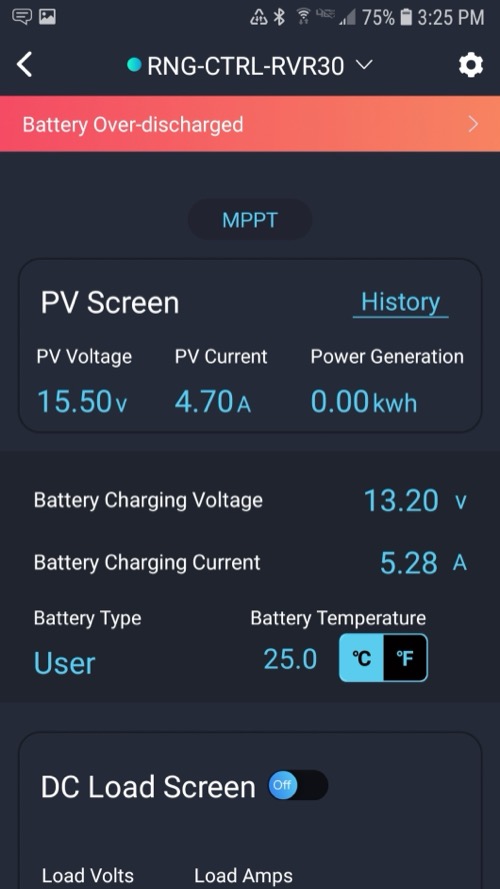
App access requires the correct optional BT-2/RS485 hardware. One owner reported that the module and app worked within a short practical range and required reconnection after leaving range. Another attached a DC Home screenshot using a BT-1 with their unit, showing why exact revision and accessory compatibility need verification rather than assumptions from old reviews.
If Bluetooth is only a convenience, buy the controller first and evaluate the screen. If history, cabinet-free parameter changes, or multi-device visibility is required, include the module price and confirm the current app’s logging behavior.
Lithium Mode Is Not Automatic in the Same Way
For non-lithium batteries, 12V/24V detection is documented as automatic. Lithium system voltage and charge parameters demand more deliberate configuration. The controller supplies sealed/AGM, gel, flooded, lithium, and user-defined modes; the exact battery manual determines the correct values.
The remote temperature sensor supports lead-acid compensation. No controller-managed lithium cold-charge cutoff was documented. A cold-weather LiFePO4 system therefore needs a BMS or other control proven to stop charging below the battery maker’s threshold.
What Long-Term Reports Add
These reports strengthen confidence beyond “worked on day two.” They still do not establish a failure percentage. The single immediate return and cable complaints remain relevant because installation quality and unit quality can interact.
| Evidence Horizon | supplied Signal | Weight in Verdict |
|---|---|---|
| Initial setup | Several easy-install and successful-charge reports | Supports usability, not longevity |
| Months/years | One four-year update and one years-long account | Meaningful positive durability evidence |
| Immediate failure | One return after wiring difficulty | Serious but isolated negative account |
| Brand history | Long Renogy ownership and other product experience | Context only, not exact-model proof |
The 20A Load Output Is for Modest DC Loads
The programmable load circuit can run lighting and control loads using timer or voltage behavior. It should not power an inverter or equipment with a large startup surge. The unusual portable-power-supply account reinforces that controller load and wake behavior can be device-specific.
For a high-current inverter, use a correctly fused battery-side connection. If the controller’s load logic is useful, it may operate an appropriately designed relay or contactor only when the exact manual permits the control arrangement.
Rover 30A Pre-Power Checklist
- Confirm the 12V or 24V battery configuration and exact chemistry profile.
- Calculate winter string Voc and obtain Renogy’s PV Isc rule.
- Check the 400W/800W row for the selected bank.
- Dry-fit brackets, tools, cables, ventilation, and display sightline.
- Open and inspect every terminal before inserting conductor.
- Torque and pull-test full-strand cables; never trim wire to fit.
- Keep the IP32 enclosure dry and ventilated.
- Verify the load’s startup current or connect it at the battery instead.
- Save settings and recheck them after a reset or battery disconnect.
- Compare displayed voltage with an appropriate independent meter.
Pros & Cons Analysis
Based on documented specifications and owner feedback
Pros
- 30A — 30A MPPT charging.
- 100V — 100V PV ceiling.
- LCD — LCD and programmable load output.
- Optional — Optional app monitoring.
Cons
- Check: Bluetooth module is extra.
- Check: IP32 protected mounting.
- Check: No published PV Isc limit.
- Check: Lithium system voltage must be configured carefully.
Bottom Line: A Well-Sized Rover Can Be the Practical Choice
Verdict: The Renogy Rover 30A is a credible middle-class MPPT controller with enough documentation, local control, and owner longevity evidence to recommend for correctly sized 12V/24V systems.
Best reason to buy: You want 30A charging, 100V PV flexibility, an onboard LCD, and programmable low-power load control without requiring an app.
Reason to pause: Mounting and terminal access caused real frustration, Bluetooth costs extra, PV Isc remains unresolved, and lithium setup needs deliberate verification. Dry-fit the hardware and finish the array calculation before ordering.
Frequently Asked Questions
Is the Renogy Rover 30A MPPT or PWM?
The exact model is documented as MPPT. That topology does not replace checks of PV voltage, input current, output current, and battery compatibility.
What battery voltage does the Renogy Rover 30A support?
12V / 24V automatic for non-lithium batteries. Confirm detection and selection behavior in the current exact-model manual.
What is the maximum PV voltage?
100V. Use cold-corrected array Voc rather than the panel's warm-day value.
How much solar can it handle?
400W @ 12V; 800W @ 24V. The PV voltage, PV current, and battery-side charge-current limits must all be satisfied at the same time.
Does the Renogy Rover 30A work with lithium batteries?
Sealed/AGM, gel, flooded, lithium, and user-defined. Match every charging value and low-temperature strategy to the battery documentation.
Does it include app monitoring?
RS485; optional BT-2 and DC Home. Verify whether any required accessory is included in the exact bundle.
Can I connect an inverter to its load terminals?
Normally no. High-current and surge loads should use a correctly fused battery-side connection unless the controller manual explicitly permits the planned load.
Who should buy the Renogy Rover 30A?
Mid-size 12V/24V RV and cabin arrays needing an LCD, load control, and configurable MPPT charging.
Technical Specifications
| Brand | Renogy |
|---|---|
| Exact model / revision / ASIN | Rover Li 30A (ASIN B07DNVW37B) |
| Controller type | MPPT |
| Rated battery-side charge current | 30A |
| Supported battery-system voltage | 12V / 24V automatic for non-lithium batteries |
| Battery chemistry and profile support | Sealed/AGM, gel, flooded, lithium, and user-defined |
| Maximum PV open-circuit voltage (Voc) | 100V |
| Maximum PV short-circuit/input current (Isc) | Not published |
| Maximum PV power by battery voltage | 400W @ 12V; 800W @ 24V |
| Minimum PV/start voltage requirement | Not published for the reviewed revision |
| Load output and low-voltage disconnect | 20A programmable load output |
| Grounding topology | Common negative / negative ground |
| Charging stages and custom voltage control | Four-stage lead-acid; two-stage lithium; user-defined mode |
| Temperature sensing and lithium low-temperature behavior | Remote sensor for lead-acid; no controller-managed lithium cold cutoff published |
| Display and local controls | LCD and buttons |
| App, communications, and data history | RS485; optional BT-2 and DC Home |
| Maximum terminal conductor size | 8 AWG / 10 mm² |
| Controller self-consumption | 100mA or less at 12V; 58mA or less at 24V |
| Published tracking/conversion efficiency | >99% tracking; up to 98% conversion |
| Cooling method and thermal derating | Passive heatsink; output derates above 65°C controller temperature and shuts down above 80°C |
| Electrical protections | PV short-circuit, PV overvoltage, PV overcurrent, load overload/short-circuit, PV/battery reverse-polarity, and overtemperature protection |
| Enclosure, ingress rating, and operating temperature | IP32; -35°C to 45°C |
| Certifications | FCC Part 15 Class B, CE, RoHS, and RCM |
| Dimensions, weight, and included accessories | 238 × 172 × 77 mm; 2.0 kg |
| Warranty | 3 years |