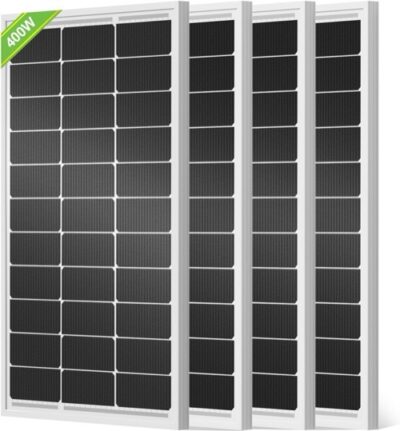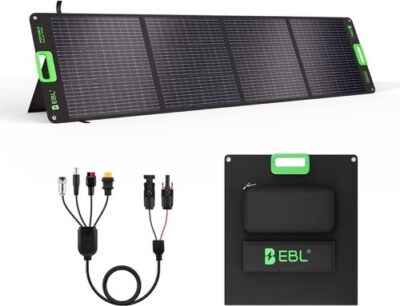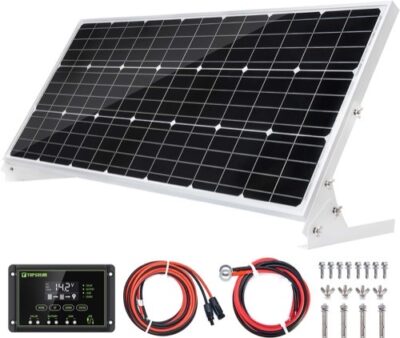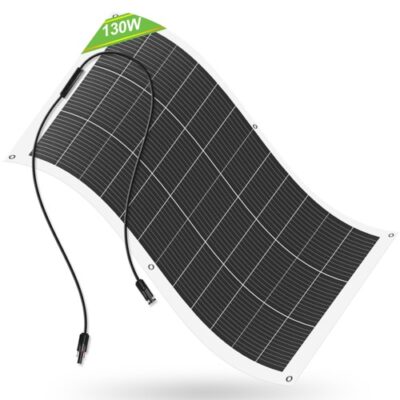
Ayahoomane 400W Review: What You Trade Off With the Cheapest Foldable 400W Suitcase
At a Glance
KEY FEATURES
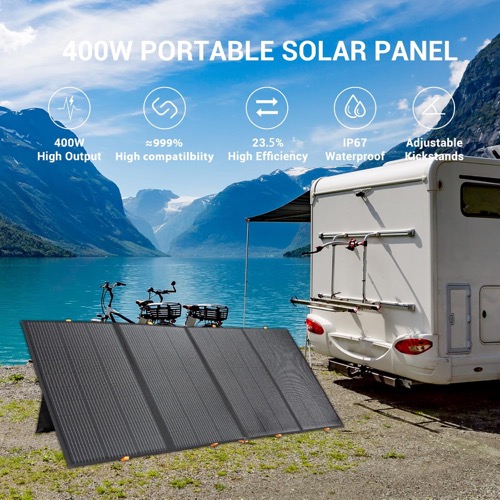
- Power output: 400 W (claimed), monocrystalline silicon
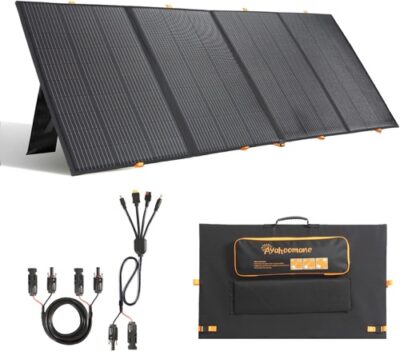
- Output: 36 V DC, 11.2 A; MC4 connector plus MC4-to-Anderson / XT60 / DC7909 / DC5525 adapter
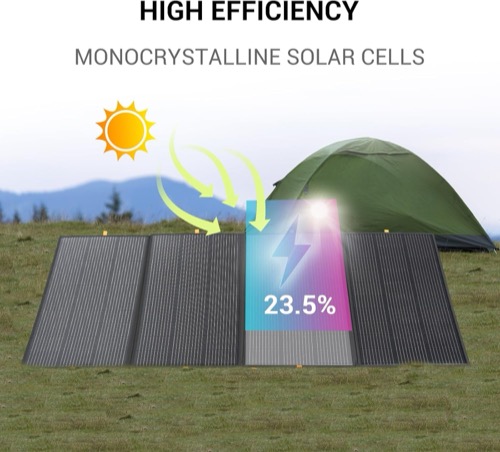
- Cell efficiency: Up to 23.5% claimed (monocrystalline — high-tier claim, not independently verified)
- Weatherproofing: IP67 surface with ETFE lamination; owners note the panel is printed "keep out of rain" — treat it as splash-resistant, not rainproof
- Charge controller: None — direct panel output; the power station's own controller does the work, or add an MPPT/PWM controller for 12V batteries
- Best for: Charging portable power stations on camping, RV, and off-grid trips where a low price matters more than a big-brand badge
PROS
- Real 315-355W into power stations in good sun
- MC4 plus XT60, Anderson, DC7909, and DC5525 tips fit most stations
- Folds into a carryable suitcase with a cable pouch
- IP67 surface with a zippered pouch to keep plugs dry
- Cheapest route into 400W foldable solar
CONS
- Some units stall at 250-280W; shade drops it fast
- Pigtail leads are short and feel thin for the current
- Heavy at 33 lb, and the legs are flimsy and fold when moved
- Printed "keep out of rain" — not for permanent wet exposure
- No-name QC variance and long-term durability question marks
Editor's Choice
Based on exact documentation and qualitative exact-ASIN Amazon owner evidence; no hands-on test or population-rate claim
A no-name 400W suitcase selling for a fraction of the branded price reads as either an obvious scam or an obvious steal, depending on who you ask. Neither snap judgment survives contact with the panel. The Ayahoomane 400W is proof that a budget foldable can pour real watts into your power station — and also proof that the savings have to come out of somewhere. Where they come out is what this review pins down.
You’ve seen the listing. Four monocrystalline panels that fold into a square, an IP67 surface, a pouch of adapters, and a price that undercuts the Jackery and EcoFlow 400W blankets by a wide margin. On paper it promises the same 400W input to your power station as panels costing a lot more. Whether that low price bites once you’re parked off-grid with a half-empty battery is the question worth answering.
Here’s the honest framing: the hardware is often genuinely good, but this is a lesser-known Amazon brand, so quality control wanders from unit to unit and no big name stands behind it if something goes wrong. For a cheap way to add serious solar to weekend and camping trips, that can be a fair trade. For a permanent, rely-on-it-for-years setup, the math changes.
This one made our best 400W solar panels shortlist — see exactly where it landed.
The expanded exact-ASIN owner record changes the buying question. This is not simply a cheap way to put “400W” beside a power station. It is a large folding array whose value depends on whether the delivered unit passes a disciplined acceptance test. Several owners describe useful direct-sun input in the low-to-mid 300-watt range, while others report substantially less under their own conditions. One technically detailed account compared panel output with measured irradiance and found the result plausible; other accounts point to shade, weak stands, or a possible underperforming unit. Those individual readings identify what to test, not a guaranteed range.
The 33.1-pound folded package is vehicle-portable, not casual hand luggage. Owners describe the unfolded panel as awkward for one person, especially when the wind is active. The integrated fabric-backed legs also divide opinion: they can make a quick campsite setup possible, but reports include shallow positioning, flex, and limited confidence in gusts. Treat the panel as a temporary ground array. Use the hanging points or independent ballast only in a way that does not load the cells, crease the folds, abrade the fabric, or pull against a connector.
| Display result | First suspect | Next controlled check |
|---|---|---|
| Zero watts | Adapter, polarity, loose solar connector, or receiver rejection | Verify Voc and the station’s PV range before reconnecting |
| Stable but capped input | Receiver current/watt ceiling or battery taper | Compare with the station manual and retest at a lower state of charge |
| Large drop from a narrow shadow | Series-connected folding sections | Remove all cell shade and compare at the same angle |
| One fold looks or behaves differently | Shipping or cell/interconnect damage | Photograph it, stop repeated flexing, and open a return case |
Compatibility needs a written check because the supplied multi-tip lead can create false confidence. Start with the station’s allowed PV voltage, maximum solar current, watt ceiling, connector, and polarity. Then compare them with the delivered panel label. Do not force a tip, improvise an unsafe polarity reversal, or assume that a station able to accept 400 watts can accept this panel’s voltage. Keep the power station and adapter junctions shaded and dry even when the panel surface has an outdoor rating.
Support evidence is mixed rather than uniformly poor. One owner describes proactive replacement of a cable issue, while other reports discuss delivery, damage, or return friction. Save the seller identity, product page, warranty wording, serial/label photos, and commissioning readings immediately. With a less-established brand, that evidence is part of the product.
Interpreting Ayahoomane Output Without a Magic Number
The nameplate describes Standard Test Conditions, while a power station displays the result of an entire chain: sunlight, angle, cell temperature, section shade, cable loss, adapter resistance, MPPT behavior, the station’s input ceiling, and battery charge stage. Exact-ASIN accounts include useful results around the low-to-mid 300-watt band in favorable sun, readings closer to the mid-200s, and units owners considered underperforming. That spread is a reason to commission, not a range to promise.
| Test | Record | Decision value |
|---|---|---|
| Cool first exposure | Voc, loaded volts/amps/watts, sky, angle | Establishes the delivered unit’s starting point |
| Warm repeat | Same fields after temperature stabilizes | Separates ordinary thermal loss from instability |
| Shade sweep | Input with a narrow shadow crossing each fold | Shows how campsite shadows affect the connected sections |
| Daily harvest | Watt-hours over the charging window | Answers whether the panel covers the actual load budget |
Do not compare a midday peak from one station with an afternoon value from another. A credible comparison holds receiver, battery state, sun, orientation, and cable path as constant as practical. If the same panel remains weak on two compatible receivers after connector and shade checks, document the measurements and use the return process.
Ayahoomane 400W Review — The Budget Suitcase Question
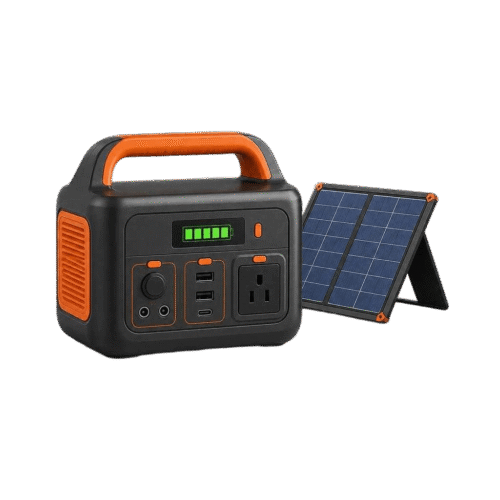
If you want a foldable 400W panel to keep a power station topped up on camping and RV trips, this Ayahoomane 400W panel does the job for a lot less than the branded suitcases. In good sun it pulls a real 315-355W into stations like the Anker C1000X and EcoFlow Delta 2, it folds into a carry-handle case, and the adapter set connects it to nearly any station you already own. Just know going in: the legs are flimsy fabric, the pigtail cable runs short, it’s not meant to sit in rain, and no-name quality control means you should test it the day it arrives — because the seller is your only safety net.
The Foldable Suitcase, Up Close
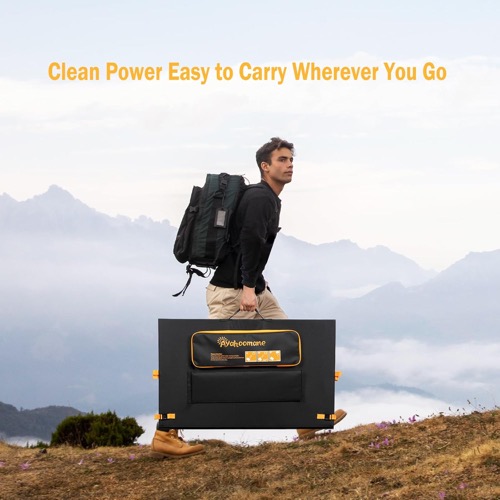
First impression for most buyers is heft, and that’s mostly a good thing. At 33 lb this is a substantial panel — one owner noted it weighs a little more than the EcoFlow Delta 2 it was charging. Folded into its square, it feels like real gear, with a carry handle and a storage spot built into the case for the cables.
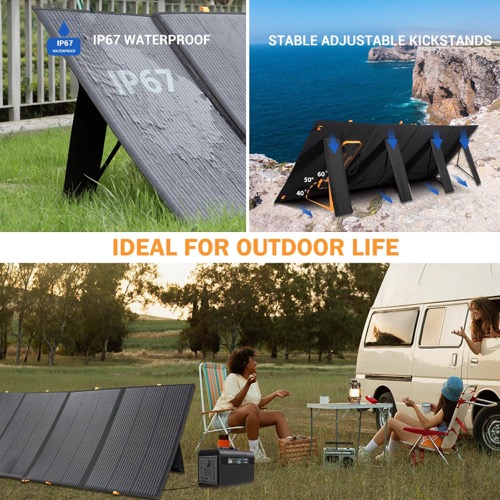
Cells themselves get decent marks. That ETFE lamination gives the surface a heat-resistant, dustproof, scratch-resistant finish, and owners describe the panels as solid when handled normally. A zippered pouch on the underside is a genuinely smart touch — you can tuck most of the connection inside and run just the insulated cord out, keeping the plugs out of light rain or splashes.
Weak spots show up in the wiring and the legs. Those MC4 pigtail leads are very short and feel thinner than you’d want for the current — one owner guessed closer to 14AWG than the 10AWG standard. And the kickstands are basically thick fabric with an elastic strap, which several buyers call far from sturdy. They fold in when you lift the panel, so setup takes a little patience.
Deploying a 33-Pound Folder Without Fighting It
The Ayahoomane occupies enough ground that setup should be planned before unfolding. Pick a level strip free of grass shadows, stones, traffic, and runoff. Open the panel with the cell face protected, set each support without twisting a fold, and route the lead so nobody can trip or pull on the junction.
Owner reports make the fabric supports the main handling compromise. They are adequate for some calm deployments but can collapse while the panel is moved and are not a wind restraint. Re-aim by controlling the full assembly rather than dragging one edge. In gusts, lower and store the panel; improvised ballast must never press on cells or create a sharp point load.
IP67 on Paper, Rain in Real Life
An IP67 surface rating plus ETFE lamination sounds like you could leave this panel out in anything. Reality is more nuanced. Owners point out the panel itself is printed with a “keep out of rain” warning, and the manual says not to leave it soaking for long. One buyer flagged that printed warning as a red flag for the always-outdoors setup he needed.
In day-to-day use, that’s less of a problem than it sounds. A passing shower or some dew won’t kill it, and the zippered underside pouch keeps the plugs dry when you run just the cord out. But this isn’t a panel you stake out through a weekend of downpours. Bring it in when the weather turns, and you’ll be fine.
Long-term durability is where the no-name reality shows. Several owners report months of trouble-free use, but a couple hit trouble — one saw panels start warping inward from daily use over two weeks, with a leg’s stitching ripping, and another had the wires overheat and melt after about a year. That’s the budget-panel lottery in a nutshell.
| Feature | This Panel | What It Means Outdoors |
|---|---|---|
| IP rating | IP67 surface | Handles splashes and brief wet; not for soaking or heavy rain |
| Frame / backing | Fabric-backed foldable | Light and packable, but panels can warp where support is thin |
| Panel surface | ETFE lamination | Wipes clean; heat-resistant and scratch-resistant |
| Junction / ports | Zippered underside pouch | Smart — keeps plugs dry when you tuck the connection inside |
| Connector weatherproofing | Not sealed at the tip | Use the pouch; treat exposed connections as not weatherproof |
| Operating temperature | Held 315W at 125°F cell temp | Good heat behavior; output stays consistent as it warms |
| Long-term owner reports | Mostly positive, some warping / wire failures | Solid for most; QC variance is the real risk |
Worth Knowing — IP67 covers the panel surface, not a promise you can leave it in rain forever. With the printed “keep out of rain” note and unsealed connector tips, this is a panel for sun and the odd light shower — use the zippered pouch, and pack it away before a storm.
Support Evidence, Certification Gaps, and Return Discipline
No exact independent safety-certification record was retained for this revision, so the review does not invent one. That does not prove the absence of every certification; it means buyers who require UL, ETL, or another specific mark must obtain documentation tied to the delivered model before purchase. A power station’s protection also does not certify the upstream panel or make an incompatible connection safe.
Support accounts run in both directions: one buyer describes proactive cable replacement, while others discuss delivery or return concerns. Preserve the order page, seller identity, warranty wording, box condition, model label, and commissioning data. Test immediately and communicate with readings and photographs rather than a bare statement that output feels low.
For ownership, inspect cable heat, connector discoloration, fabric seams, folds, white cell marks, and support attachments. Stop using the panel if a connector is loose, deformed, unusually warm, wet internally, or electrically unstable.
Ayahoomane 400W foldable panel: Decision Snapshot
| Spec | Value |
|---|---|
| Max Power Output | 400 W (monocrystalline) |
| Output Voltage | 36 V DC, 11.2 A |
| Connector | MC4 + Anderson / XT60 / DC7909 / DC5525 (no USB per spec) |
| Cell Efficiency | Up to 23.5% claimed (not verified) |
| Weatherproof Rating | IP67 surface — splash-resistant, printed “keep out of rain” |
| Charge Controller | None — direct output (station’s MPPT does the work) |
| Cable Length | 78.7 in (~6.5 ft) — runs short, extension usually needed |
| Mount Type | Fabric kickstands + 8 hanging hooks |
| Best For | Charging power stations on camping, RV, and off-grid trips |
The Ayahoomane Receiver-Matching Gate
The included adapter set covers several common physical interfaces, but it cannot change the panel’s electrical behavior. Write down the receiving station’s minimum/maximum PV voltage, maximum solar current, maximum watts, connector, and polarity. Compare those fields with the delivered Ayahoomane label before choosing a tip.
A receiver can accept the voltage yet cap current or watts, producing a stable display below the panel’s capability. A nearly full battery can taper for the same reason. Conversely, a physically matching plug does not make excessive voltage safe. Array additions demand a new calculation: series raises voltage, parallel raises current, and cold weather can raise open-circuit voltage.
Connection proof:
- No forced adapter or improvised polarity reversal
- Solar connectors fully seated, dry, and strain-relieved
- Station shaded and ventilated while the panel remains in sun
- Extension cable sized for current and distance
- Battery below taper when evaluating maximum input
Is This Budget 400W Your Panel? — Use-Case Fit Matrix
| Use Case | Fit | Why |
|---|---|---|
| Charging a power station while camping | Strong fit | Real 315-355W in sun; plugs into most stations |
| RV / off-grid supplemental solar | Strong fit | Serious watts you can reposition for the sun |
| Emergency / power-outage backup | Strong fit | Folds away; refills a station fast during outages |
| Overland / van trips | Solid fit | Portable and capable; just pack an extension |
| Getting into 400W solar cheaply | Solid fit | Cheapest route into a foldable 400W suitcase |
| 12V battery bank charging (with controller) | With caveats | Works, but you supply the MPPT/PWM controller |
| Wiring several panels in series for a big array | Borderline | Leads feel thin; owners keep it to single-panel use |
| Leaving it out through heavy rain | Skip | IP67 surface only; printed “keep out of rain” |
| Permanent always-outdoors install | Borderline | No-name QC and warping reports raise the risk |
| Hands-off setup on windy days | Borderline | Fabric legs fold and blow; needs bungees or sandbags |
| Buyer who wants certified, exact specs | With caveats | Voc, Isc, and cert details aren’t officially published |
| Direct phone / device charging | Not recommended | No confirmed USB output — needs a station or controller |
A fit if you want:
- A cheap, foldable way to put real 400W-class charging into a power station on camping and RV trips
- Broad compatibility with the Jackery, EcoFlow, Bluetti, Anker, or 4Patriots gear you already own
- Serious solar watts without paying branded-suitcase prices
- A panel you can fold into a case and carry to wherever the sun is
A miss if you need:
- A panel that survives sitting out through heavy rain
- Rock-solid, certified quality control you can count on unit to unit
- Heavy-gauge leads for a large series array
- Guaranteed specs and a strong brand warranty behind it
The Ayahoomane is a campsite-scale folding array with a narrow success condition: verified receiver compatibility, controlled deployment, and an acceptable delivered unit.
Final Decision: Value Depends on Acceptance Testing
The Ayahoomane can make sense for a price-sensitive camper or RV owner whose station accepts its electrical envelope and who wants a movable 400W-class array. Its case is strongest when storage space, two-handed deployment, weather monitoring, and a supervised arrival test are acceptable parts of the system.
It is a weak choice for an unattended permanent installation, a low-voltage station, a buyer who needs independently documented certification, or anyone unwilling to inspect a large folding assembly during the return window. Those users should pay for a product with a better-matched electrical interface, firmer documentation, or permanent-mount construction.
Bottom line: buy the delivered unit only after it proves stable on your receiver in controlled sun. The discount is meaningful only when the cable, supports, cells, and support path all pass that test.
Pros & Cons Analysis
Based on documented specifications and owner feedback
Pros
- Real output that lands close to the rating in good sun — owners regularly report 315-355W into stations like the Anker C1000X, EcoFlow Delta 2 Max, and Pecron E3600. One measured 340W and called it "exactly as expected" for the light he had.
- Wide power-station compatibility out of the box — the MC4 cable plus the XT60, Anderson, DC7909, and DC5525 tips connect to Jackery, EcoFlow, Bluetti, Anker, and 4Patriots stations. Owners consistently mention it "just worked" with the gear they already owned.
- Folds down into a carryable suitcase — four panels fold into a square with a handle, and the case has a storage spot for the cables. Buyers move it around a campsite by hand, even if it takes two arms.
- Holds output as it heats up — one owner watched the panels warm to 125°F and still put out 315W, staying consistent through the run. That's better heat behavior than a lot of budget folding panels manage.
- Still trickles on cloudy days — a grey sky knocks output down hard, but owners report it keeps going. One saw a little over 100W on an overcast day rather than nothing at all.
- Easy, plug-and-play setup — buyers describe it as super quick to set up and assemble, with everything needed in one package. The plug assortment made it painless to match a station.
- IP67 surface and ETFE lamination — the panel carries an IP67 splash rating with a heat-resistant, dustproof ETFE film, and owners describe the cells as solid and scratch-resistant when handled normally.
- Zippered pouch keeps connections dry — the underside pocket lets you zip most of the connection inside and run just the insulated cord out, keeping the plugs out of light rain or splashes.
- Cheapest way into 400W foldable solar — at its price it undercuts branded suitcases like the Jackery and EcoFlow 400W panels by a wide margin, and buyers call it a decent price point for what you get.
- Responsive seller on returns — a buyer who returned an underperforming unit praised the customer service, with replies within an hour or two and no hassle getting the return processed.
Cons
- Some units cap well below the number — not everyone hits those figures. A couple of buyers couldn't push past 250-280W even in full high-UV sun, and one returned a unit that wouldn't clear 260W in the same spot another panel hit 330W.
- Pigtail wiring is very short and thin — the most technical gripe. The MC4 leads leave little room to disconnect, and one owner pegged the wire around 14AWG rather than the 10AWG he expected, which made him too nervous to wire panels in series.
- It's heavy at 33 lb — one owner noted it weighs a little more than the EcoFlow Delta 2 it was charging. It folds and has a handle, but nobody calls it light.
- Long-term heat has burned wiring — a separate owner reported the panel started overheating after about a year and the wires "finally burned/melted." Not common in the feedback, but worth knowing for a panel you leave connected all day.
- Output drops the moment shade touches it — even a small shadow across one of the four panels pulls the numbers down noticeably, so placement and repositioning matter more than with a single rigid panel.
- Legs are flimsy and fold when you move it — the kickstands are basically thick fabric, and several owners call them far from sturdy. They fold in when you lift or reposition the panel, so setting up is fiddly.
- Not meant to sit in rain — the panel itself is printed with a "keep out of rain" warning, which one buyer flagged as a red flag for a permanent outdoor setup. The manual also says not to leave it soaking for long.
- Panels can warp with heavy daily use — one owner used it nearly every day for two weeks and the panels started bending inward where the support is thin, even with bungees and sandbags. The stitching also ripped on a leg.
- No-name brand with QC variance — this is a lesser-known Amazon brand, and the gap between the 340W units and the 260W units is the classic budget-panel lottery. There's no big brand standing behind it.
- Thin gauge limits big arrays — because the leads feel light for the current, owners keep it to single-panel, low-power station charging rather than wiring several in series for a large off-grid array.
Is the Budget 400W a Smart Buy?
Strip away the no-name badge and what's left is a foldable 400W panel that undercuts the big names on price yet still pushes a real 315-355W in good sun — enough to keep a power station alive on a trip. Broad compatibility, an ETFE surface, a zippered pouch, and a case you can actually carry round out the case for it.
The trade-offs are just as real. It's not made to sit in rain, fabric legs and a short cable are constant little annoyances, and no-name quality control means you're rolling dice on the batch. So call it two ways. A smart buy for the camper or RVer who wants affordable 400W charging on trips and will test the panel the day it arrives — for that person the Ayahoomane 400W solar panel is an easy yes. A false economy if you need a sealed, certified, warranty-backed suitcase for a permanent install you'll trust for years — there, spend more on a known brand and buy the peace of mind.
Frequently Asked Questions
How much power does the Ayahoomane 400W panel actually produce?
In good sun with a decent angle, owners commonly report 315-355W into their power stations, and one measured 340W that matched what the light conditions predicted. That said, results vary unit to unit — a couple of buyers couldn't push past 250-280W in full sun, and one returned a panel that stalled at 260W. Like any panel, the 400W figure is a lab rating, not a daily guarantee.
Is the Ayahoomane 400W solar panel waterproof?
Only up to a point. It carries an IP67 splash rating on the surface, but the panel itself is printed with a keep-out-of-rain warning and the manual says not to leave it soaking for long. Use the zippered pouch on the underside to keep the plugs dry in a passing shower, but bring it in before real weather. Treat it as splash-resistant, not a panel you stake out through a storm.
What power stations and connectors does it work with?
It ships with an MC4 cable plus a single adapter that breaks out to Anderson, XT60, DC7909, and DC5525. Owners report success with Jackery, EcoFlow, Bluetti, Anker, and 4Patriots stations — one specifically used the XT60 tip for an Anker and the Anderson tip for a 4Patriots 1800. Check your station's input port against those four tips before buying so you know which one you'll need.
Can I wire two of these panels in series for more power?
You can, but several owners advise caution. The pigtail leads are short and feel thinner than the 10AWG you'd want for the current — one buyer guessed closer to 14AWG and was too nervous to run them in series. For most people, one panel into a power station is the intended use. If you want a larger array, use heavier gauge extension cable and a proper controller rather than relying on the stock leads.
Does it charge on cloudy or overcast days?
Yes, just slowly. Owners report the panels keep producing under grey skies — one saw a little over 100W on an overcast day rather than the panel dying outright. A passing cloud knocks the number down hard and shade over any of the four panels drops it further, so expect a fraction of the full-sun figure on dull days. It trickles rather than stops.
Why does output drop when part of the panel is shaded?
This is a four-panel folding design, so a shadow across even one section pulls the whole output down noticeably. Owners specifically mention output dropping significantly when any shade — or even a prop leg's shadow — falls across a panel. Set it up in clear, unobstructed sun and reposition it through the day for the best numbers.
Is the included cable long enough?
For many setups, no. The MC4 pigtail is about 78.7 inches (roughly 6.5 ft) and owners describe it as very short, which forces the power station to sit close to the panel. Budget for an MC4 extension so you can place the panel in full sun while keeping the station in the shade. Keep the same connector type to avoid voltage drops from cheap adapters.
How sturdy are the legs and how do I set it up?
Setup is quick — unfold the four panels, prop them on the built-in kickstands, and plug into your station. The catch is the legs: they're basically thick fabric and owners call them flimsy, and they tend to fold in when you lift or reposition the panel. Once it's propped and settled it stays put, but on windy days people add bungees or sandbags, and a few build their own PVC stand.
Is a no-name 400W panel like this a safe buy?
It can be, with eyes open. The hardware is often genuinely good and the price undercuts branded suitcases, but quality control varies — some units hit 340W while others stall at 260W, one owner had wires overheat and melt after about a year, and another saw panels warp from daily use. On the plus side, a returning buyer praised fast, hassle-free customer service. Buy from a seller with a clear return window and test the panel the day it arrives.
Technical Specifications
| Brand | Ayahoomane |
|---|---|
| Model / SKU | ECB-PANEL-400W (ASIN B0D9627Y5Y) |
| Panel format | Folding portable panel |
| Rated output (Pmax) | 400W |
| Cell technology | Monocrystalline |
| Module efficiency | — |
| Voltage at maximum power (Vmp) | 36V |
| Current at maximum power (Imp) | 11.2A |
| Open-circuit voltage (Voc) | — |
| Short-circuit current (Isc) | — |
| Power tolerance | — |
| Maximum system voltage | — |
| Maximum series fuse | — |
| Output connector | MC4 with power-station adapters |
| Output cable | 78.7 in |
| Deployed dimensions | — |
| Folded dimensions | 38.3 × 24 × 1.6 in |
| Weight | 33.1 lb |
| Surface and frame | ETFE surface with fabric-backed folding body |
| Positioning / mounting | Integrated kickstands and hanging hooks |
| Environmental protection | Panel surface IP67; connections excluded |
| Wind / snow load | — |
| Operating temperature | — |
| Included accessories | Panel, output cable, adapter set, and storage bag |
| Product warranty | — |