DOKIO 100W Solar Panel Kit Review: The Complete Beginner Setup That Works Straight Out of the Box
At a Glance
KEY FEATURES
- 100W-titled offer; technical specification lists 110W.
- Two-section folding format, approximately 19 × 26 inches packed.
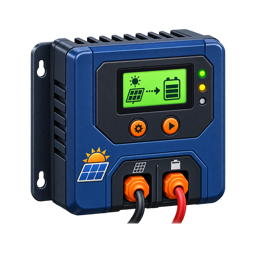
- Separate 10A PWM controller and connection accessories.
- Approximately 9.8 ft panel lead in the manufacturer package.
- Around five pounds; support and dry storage still need planning.
PROS
- Light two-section folder
- Separate controller for supported battery setups
- Several connection accessories
CONS
- 100W/110W naming inconsistency
- No integrated stand in the reviewed lightweight offer
- Battery settings and polarity need verification
Best lightweight starter kit
Based on exact documentation, retained exact-ASIN evidence, and the expanded qualitative Amazon owner-text review; no hands-on test claimed
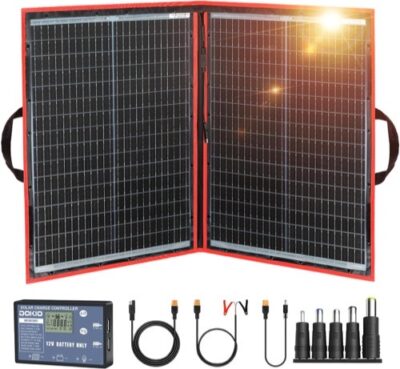
The DOKIO 100W folding kit offers a light panel, a separate PWM controller and several connection options in one package. It reduces the number of parts to source for occasional portable charging, but it does not eliminate battery-profile, cable or power-station compatibility checks.
There is a naming inconsistency to resolve first: the retained Amazon offer identifies FFSP110M and lists 110W in its specifications, while its title says 100W. DOKIO’s current 100W product page also lists 110W in the specification tab. Check the delivered label rather than treating either heading as proof of the exact revision. This review combines documentation with supplied owner accounts; we have not tested the kit ourselves.
Choose one of two charging paths
Use a controller whose settings and limits match the battery. The supplied PWM unit is part of this route, together with correctly specified wiring and protection.
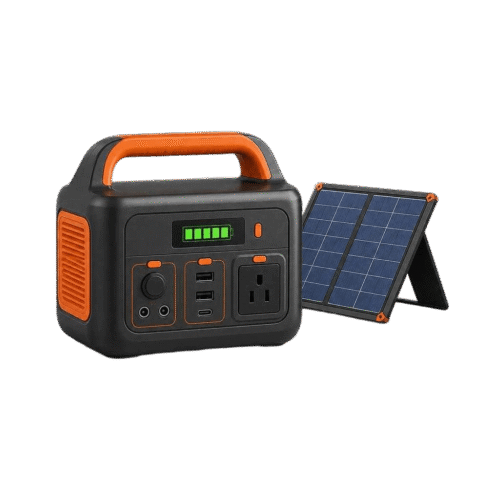
Use the station’s approved solar input and its internal controller when the panel and cable meet all input requirements. Do not insert the kit’s battery-charging controller by default.
One owner describes using the panel with an Anker SOLIX C300 without the external controller. Another explicitly identifies a 100W-range panel used with a separate battery for a Starlink Mini camping setup, but found the controller menu difficult to navigate. These are useful use cases, not proof that every shipped controller has the same menus or battery modes.
Follow the power-station compatibility guide for the first route into a station. For a separate lithium battery, verify charging voltages and temperature protection against that battery’s instructions. The word “lithium” alone does not identify a suitable profile.
The kit reduces parts shopping, not setup responsibility
DOKIO’s current product specification lists a 10A controller, approximately 9.8 ft panel cable, a battery-clip lead and DC adapters. That is useful for a buyer switching between supported applications, but an accessory list cannot certify a particular third-party socket or installation.
- Identify the panel and controller separately. Photograph both labels and keep their instructions together. Check the 100W/110W description against the hardware received.
- Lay out the intended cable route. Match polarity, connector orientation and ratings before energizing it. Do not force a reluctant plug or modify a connector to make it fit.
- Confirm the battery settings, if applicable. Follow the supplied controller’s connection order and the battery maker’s requirements; do not infer protection from a marketing bullet.
- Arrange support before leaving it in the sun. Keep the collecting sections supported without bending them, and protect the controller and connections as instructed.
A camper owner valued the storage pouch but wanted better support for the unfolded panel. The reviewed lightweight offer is not the separate “with stand” variant. Check what arrives before planning to lean it against a chair or improvise a rack.
What an 80W report does—and does not—show
An owner explicitly describing the 110W version reports about 80W in winter sun in Florida, with roughly 55W when laid flat. Their update says charging through a Bluetti AC180’s internal controller gave similar wattage to their separate PWM setup. That is a useful counterexample to the claim that an MPPT upgrade must produce a fixed gain.
| Customer account | Useful finding | Boundary |
|---|---|---|
| 110W owner: approximately 80W when aimed, 55W flat | Positioning changed this owner’s charging result. | Not a guaranteed operating range or panel-conversion efficiency. |
| 100W-range owner: 13.7V and 6.0A reported at the battery-charging setup | About 82W by the reported values, with a controller-menu complaint. | The reading does not establish safe settings for another battery. |
| Reviews explicitly describing 200W, 220W or 300W folders | May suggest questions about handling and accessories. | Their output, size and lifespan cannot be assigned to this smaller kit. |
PWM does not simply burn all unused panel voltage as heat. It operates the panel near the battery-side voltage while connected; MPPT seeks a higher-power operating point and converts voltage and current. The practical benefit depends on the panel, battery and conditions. The MPPT-versus-PWM explanation is more useful than assuming a fixed wattage increase from a replacement controller.
Soft construction needs a deliberate storage routine
The current manufacturer specification gives a folded size of about 19 × 26 × 0.5 inches and a weight around five pounds, with an ETFE surface and fabric body. It is a slim two-section folder, not the larger four-section product visible in some reviews attached to the listing.
Use the intended hinge; do not bend the collecting sections to fit a curved surface.
Choose a stable arrangement that keeps the panel from sagging or moving in wind.
Follow the drying and storage instructions, keeping cables free from crushing or strain.
Family-level feedback includes loose plugs and heat-softened connections, but a detailed long-term complaint explicitly concerns 220W panels. It is a reason to inspect connections, not an established failure rate for FFSP110M. Stop using damaged or unusually hot equipment and contact the supplier; cutting off plugs is not a routine buyer fix.
DOKIO currently advertises panel IP65 protection. That does not extend automatically to the separate controller, open connectors or the complete installation. A framed 100W panel is a different proposition if the plan is to mount an array permanently rather than pack it after use.
Buy the portability you will actually use
This kit makes most sense for modest, supervised charging where low carry weight and included connection options solve real problems. Before choosing it, compare the energy your equipment needs with the charging hours available; the 100W load-planning guide separates panel output from battery runtime.
Pros & Cons Analysis
Based on documented specifications and owner feedback
Pros
- Low carry burden — the manufacturer lists a roughly five-pound folded package, useful when a rigid glass module is inconvenient.
- Two possible charging routes — a supported battery can use an external controller, while a compatible station uses its own solar input.
- Relevant small-panel observations — explicitly identified 100W-range and 110W accounts describe useful charging, with conditions and menu limitations.
Cons
- Offer naming is inconsistent — both the retained listing and current manufacturer page mix a 100W heading with 110W technical information.
- Support is a separate consideration — the slim folder is not the stand-equipped variant and needs stable positioning without bending the collecting sections.
- Included does not mean compatible — controller profile, connector orientation and receiver limits still need checking.
- Large-panel feedback is mixed into the listing — 200W, 220W and 300W readings and longevity reports cannot substantiate this model’s performance.
A light kit, not a setup-free kit
DOKIO is a reasonable candidate for occasional small-system charging when carrying weight matters and the included controller or adapters genuinely suit your equipment. Verify the 100W/110W identity first. If you need a replacement controller, extra cabling and a substantial support stand immediately, compare that full cost with a supported portable panel. Larger DOKIO owners’ results are not a forecast for this kit.
Frequently Asked Questions
Is the DOKIO kit rated 100W or 110W?
The reviewed offer is titled 100W, but the retained FFSP110M listing and current manufacturer specification show 110W. Confirm the delivered label and matching instructions before using its electrical values.
Should the PWM controller connect to my power station?
Use the station’s approved solar-input route and internal controller when all panel and cable requirements match. Do not insert the separate battery-charging controller by default.
Can the included controller charge LiFePO4?
Only if the actual controller revision provides the settings required by your battery. Confirm charging voltage, supported chemistry and temperature protection; do not rely on the word lithium alone.
Does an MPPT upgrade guarantee more watts?
No fixed gain is established. One 110W owner reported similar wattage with the included PWM setup and a station’s internal controller. Results depend on equipment and conditions.
Does the lightweight kit have a stand?
The reviewed slim folding offer is separate from the with-stand variant. Confirm package contents and plan support that does not bend the collecting sections.
Technical Specifications
| Brand | DOKIO |
|---|---|
| Model / SKU | FFSP110M (ASIN B0748FYFSK) |
| Panel format | Folding portable panel kit |
| Rated output (Pmax) | 100W title / 110W technical table; verify delivered FFSP110M label |
| Cell technology | N-Type monocrystalline |
| Module efficiency | — |
| Voltage at maximum power (Vmp) | 18V |
| Current at maximum power (Imp) | 6.12A |
| Open-circuit voltage (Voc) | 22.5V |
| Short-circuit current (Isc) | 6.35A |
| Power tolerance | — |
| Maximum system voltage | — |
| Maximum series fuse | — |
| Output connector | SAE, XT60, DC5521, and alligator clips |
| Output cable | 9.8 ft SAE-to-XT60; 3.3 ft XT60-to-clips; DC lead |
| Deployed dimensions | 38 × 26 × 0.3 in |
| Folded dimensions | 19 × 26 × 0.5 in |
| Weight | 5 ± 0.5 lb |
| Surface and frame | ETFE surface with 1680D Oxford fabric body |
| Positioning / mounting | Two-section portable folder; no integrated stand in the reviewed lightweight offer |
| Environmental protection | IP65 panel claim on current manufacturer page; do not extend to controller or open connectors |
| Wind / snow load | — |
| Operating temperature | -49°F to 176°F (-45°C to 80°C) |
| Included accessories | Panel, 10A PWM controller, cables, five DC adapters, and instructions |
| Product warranty | Current manufacturer advertises 2 years; retained Amazon offer lists 1 year. Confirm seller coverage. |