EcoFlow 220W Solar Panel Review: The Ecosystem-Native Panel Built to Plug Straight Into Your EcoFlow
At a Glance
KEY FEATURES
- Identity: original EF-Flex-220B, not NextGen.
- Face ratings: 220W front / 155W rear under separate rated conditions.
- Voltage: 18.4V Vmp / 21.8V Voc.
- Carry: approximately 20.9 lb panel; case adds weight.
- Setup: MC4 solar output and case-based support; verify the station cable separately.
PROS
- Original-model electrical specifications remain identifiable.
- Rear face can contribute when reflected light is available.
- Folding format reduces stored footprint.
CONS
- Heavier than newer 220W versions.
- Case-based stand adds setup work.
- Receiver cable inclusion needs checking.
- Customer results are condition-specific.
Editor's Choice
Based on exact documentation and qualitative exact-ASIN Amazon owner evidence; no hands-on test or population-rate claim
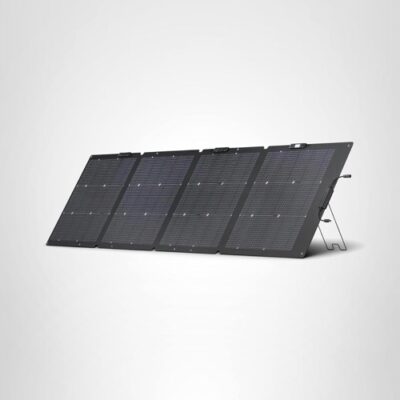
This review covers the original EcoFlow EF-Flex-220B, ASIN B09TKM8PBQ—not the lighter NextGen 220W panel. The original uses a 220W front face, a separately rated 155W rear face and a protective case that doubles as its stand. Mixing newer weight, cell technology or angle-guide claims into this review would describe a different purchase.
Recognize the original before comparing the price
18.4V Vmp, 21.8V Voc and 12A front-side operating current. Front-side Isc is 13A.
About 20.9 lb for the panel, not the later 15.4 lb claim. The protective case adds to the carried load.
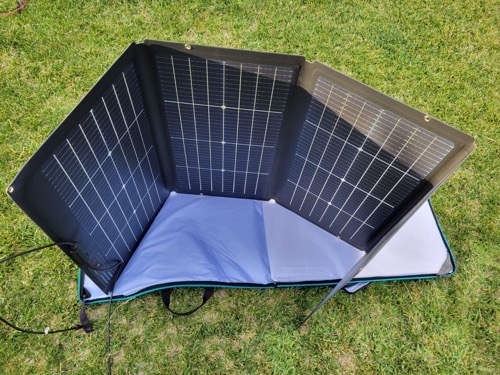
The carrying case is used as the support. Do not assume a NextGen integrated angle guide or newer stand design.
EcoFlow’s archived original-model page retains the 220W/155W, 18.4V/21.8V, 9.5kg and case-stand specifications. Its current US 220W link redirects to a NextGen product, so a current family-name page is not sufficient to authenticate an older offer.
220W plus 155W is not a 375W charging promise
The two face ratings describe different test exposures. Ordinary deployment does not illuminate both faces at their separate rating conditions. Face the primary side toward the sun and treat reflected-light contribution as conditional, not energy already included in the daily budget.
| Supplied original-model account | What it supports | What it does not prove |
|---|---|---|
| One reviewer reports 198W into a Yeti 1500x on a bright California day, and 184W into a Delta Pro shortly beforehand. | A concrete example of useful charging through suitable receiver connections. | A fair simultaneous receiver comparison or guaranteed output. |
| The same reviewer describes a smaller rear-side benefit over grass than over a bright surface. | Rear illumination and placement deserve attention. | An exact rear-side efficiency gain: the account is not a controlled isolation test. |
The retained review file also contains newer-generation accounts. Their lighter-weight and revised-stand observations are not used here as original-model evidence. The original account includes broad wiring and efficiency advice that should not be copied as installation instructions; follow the exact panel and receiver manuals instead.
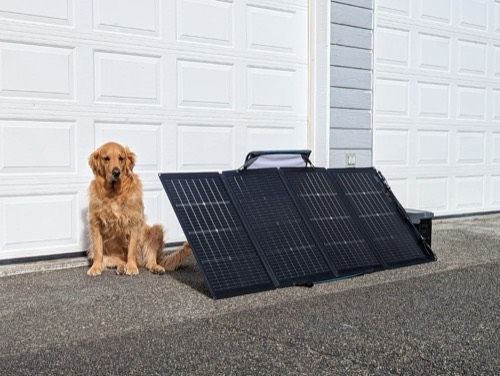
The connector is only the start of compatibility
Original documentation specifies MC4 solar connections. The station-side charging cable and its inclusion depend on the package; this review does not promise an XT60i cable in every original box. Check the exact receiving input, connector polarity and permitted voltage/current before ordering. A direct connection to an unregulated battery is not an appropriate substitute for a charge controller.
- Compare cold-corrected Voc with the receiver ceiling, not just the 18.4V operating point.
- Check the receiver’s current capability and approved cable type separately.
- For multiple panels, use an approved design; neither always-series nor always-parallel is a universal rule.
- Confirm what is in the box before travelling—do not assume a cable supplied with another station is included with the panel.
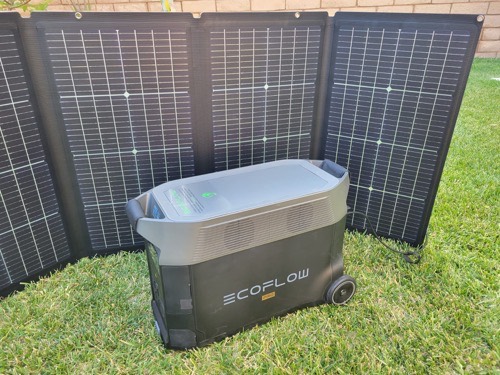
A folding glass panel needs a protected travel routine
At roughly 21 pounds before accessories, the original is more of a vehicle-camping panel than a casual hiking load. The thin glass construction and fold points deserve support when lifting, packing and unfolding. The supplied original account found setup on loose ground awkward and described sensitivity to gusts; that is a handling concern, not a measured failure rate.
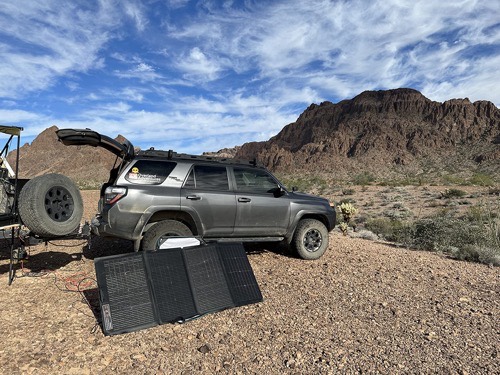
The original panel is documented as IP68. That rating is not permission to immerse the connected station or leave exposed cable ends unprotected. Inspect cells, hinge areas and connectors after transport, and stop using damaged equipment rather than trying to compensate for it with improvised supports or wiring.
Buy the original for its actual package
The original 220W can be useful when its weight, case-stand and confirmed cable fit a vehicle-based charging routine. Compare it against newer panels on total carried weight, setup effort and delivered accessories—not a mixture of the original price and NextGen features. One panel’s favorable afternoon reading is not a plan for rapidly refilling a large battery every day.
Pros & Cons Analysis
Based on documented specifications and owner feedback
Pros
- Bifacial capability has a real placement use — A bright surrounding surface can illuminate the rear, although the extra energy is not guaranteed.
- A specific original-model account is available — It describes charging and handling with named receivers, without converting one result into typical performance.
- Stored size suits a vehicle kit — The folding panel can be put away between deployments instead of permanently occupying a roof.
Cons
- Later features do not transfer backward — The original is not the 15.4-pound NextGen with its revised stand and angle guide.
- Case support needs attention — Ground and gusts can affect stability, so test the actual deployment routine.
- Glass and fold points need protection — Support the sections during transport and inspect for damage before use.
- Package claims vary — Do not count on a particular XT60i lead merely because another EcoFlow bundle includes it.
- Rear rating is not additive daily output — Separate face ratings cannot be summed into a guaranteed 375W charging figure.
Evaluate the original on carrying weight and setup
The EF-Flex-220B is a conditional vehicle-camping choice when its documented electrical limits fit the receiver and the case-stand is acceptable. Its rear face offers an opportunity, not a guaranteed recharge multiplier. Compare the delivered original package with newer alternatives without borrowing their lighter weight or accessories.
Frequently Asked Questions
Is this the 15.4-pound NextGen panel?
No. This review retains the original EF-Flex-220B offer, whose panel weight is about 20.9 pounds before the case.
Can I add 220W and 155W to budget 375W output?
No. Those are separate face ratings under specified exposure conditions. Real rear-side contribution depends on reflected light and deployment.
Is an XT60i cable guaranteed in the box?
No. Confirm the exact original package and receiver-side cable. Original MC4 panel connections do not establish that an XT60i lead is included.
Can I wire two original panels in parallel without checking?
No. The exact receiver, panel and cable limits determine the permitted connection. Check combined current or series voltage as applicable rather than using a universal wiring rule.
Technical Specifications
| Brand | EF ECOFLOW |
|---|---|
| Model / SKU | EF-Flex-220B (ASIN B09TKM8PBQ) |
| Panel format | Folding bifacial portable |
| Rated output (Pmax) | 220W front / 155W rear |
| Cell technology | Bifacial monocrystalline |
| Module efficiency | 22–23% |
| Voltage at maximum power (Vmp) | 18.4V |
| Current at maximum power (Imp) | 12.0A front / 8.4A rear |
| Open-circuit voltage (Voc) | 21.8V |
| Short-circuit current (Isc) | 13A front / 8.8A rear |
| Power tolerance | ±5W front and rear |
| Maximum system voltage | — |
| Maximum series fuse | — |
| Output connector | MC4 |
| Output cable | MC4 panel connections; receiver-side cable type and package inclusion require confirmation. |
| Deployed dimensions | 32.3 × 72.2 × 1.0 in |
| Folded dimensions | 32.3 × 19.7 × 1.3 in |
| Weight | Approximately 20.9 lb (9.5kg) for the panel; carrying case adds weight. |
| Surface and frame | Tempered-glass bifacial panel with ETFE coating |
| Positioning / mounting | Protective carry case doubles as kickstand |
| Environmental protection | Panel IP68 |
| Wind / snow load | — |
| Operating temperature | — |
| Included accessories | Original protective case/support and documents; confirm station-side charging cable inclusion for the selected offer. XT60i inclusion is not established. |
| Product warranty | Confirm current coverage for this original-model US offer and seller; do not inherit a newer model’s warranty. |