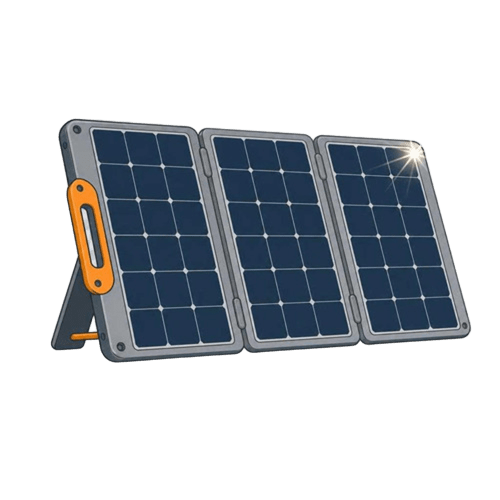
Jackery SolarSaga 200W Review: Bifacial Cells, IP68 Waterproofing, and Built for Jackery Owners
At a Glance
KEY FEATURES
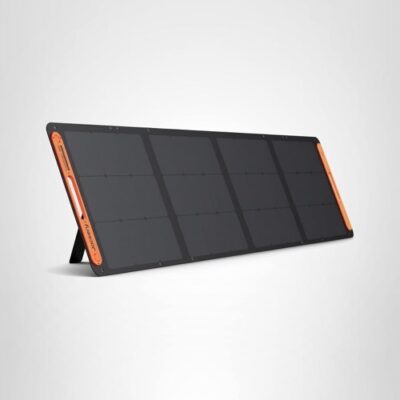
- Power output: 200 W (claimed), bifacial IBC monocrystalline silicon
- Output: 23.2 V DC — DC8020 (Jackery), DC7909, USB-A, USB-C (all on one multi-cable)
- Cell efficiency: 26.7% (IBC technology — premium tier)
- Weatherproofing: IP68 rated — full waterproof protection; tempered glass + aluminum frame + ETFE bifacial surface
- Charge controller: None included — pairs with Jackery power stations' built-in MPPT management
- Best for: Jackery Explorer power station owners, high-efficiency 200W solar charging, outdoor deployments needing genuine IP68 weather resistance
PROS
- Bifacial IBC cells at 26.7% efficiency — highest in this comparison
- IP68 waterproof rating — full submersion protection
- Native DC8020 connector — plugs directly into Jackery Explorer stations
- 5-year warranty — the longest in this product series
- Bifacial rear cells add 10-25% output over reflective surfaces
CONS
- Premium price premium over standard 200W monocrystalline panels
- Included charging cable is not weatherproof despite IP68 panel rating
- Proprietary connector limits easy use with non-Jackery power stations
- Heavy at 14.3 lbs — better suited for car camping than backpacking
- Bifacial benefit is minimal on dark or grass ground — specific to deployment
Editor's Choice
Based on exact documentation and qualitative exact-ASIN Amazon owner evidence; no hands-on test or population-rate claim
This Jackery SolarSaga 200W review focuses on the three features that separate this panel from every other 200W option in this comparison: bifacial IBC cells at 26.7% efficiency, genuine IP68 waterproof certification, and a native connection to the Jackery Explorer ecosystem. None of those are minor footnotes — each one is a real purchase reason that justifies a premium price for the right buyer.
If you own a Jackery Explorer power station and want a solar panel that connects without an adapter, survives a downpour, and gets the most out of every hour of sun available, this is the panel Jackery built for you. It’s not a universal 200W panel for any buyer — it’s a specific tool built for a specific ecosystem and specific durability expectations.
That said, the honest picture matters too. At 14.3 lbs and folding to 24×21.7 inches, this isn’t a backpacker’s panel. The included charging cable isn’t weatherproof despite the IP68 panel rating. And non-Jackery buyers will find the proprietary DC8020 connector limiting. Frame this right — this panel earns its price for the buyer it’s designed for, and falls short for everyone else.
The SolarSaga’s strongest advantage is reduced friction inside the Jackery ecosystem, but “made for Jackery” is not a complete compatibility specification. Owner accounts describe successful charging across several Explorer stations and useful direct device charging, while cable and port generations still differ. The current product page identifies a three-meter multifunction cable and a DC8020-to-DC7909 adapter. Verify the box contents and the exact station manual before assuming an older or newer Explorer will accept the same route.
The most coherent fit: known cable route, portable deployment, and station-screen feedback.
Possible only after checking electrical limits, connector, polarity, and adapter quality.
Useful for small devices, but a battery buffer handles intermittent cloud better.
A poor fit for a folding portable product that needs deployment, inspection, and protected storage.
The current JS-200D is documented as a 200W folding bifacial panel around 14.3 pounds. Bifacial contribution remains a geometry problem: the rear needs open exposure to reflected light, and the front still needs direct alignment. Raise the assembly above a pale surface, prevent the legs and cable from blocking the rear, and compare daily watt-hours against a front-dominant setup. Do not promise the sum of front and rear ratings; reflection and self-shading vary too much.
| Symptom | Likely branch | Useful evidence |
|---|---|---|
| No input | Port/adapter mismatch or incomplete connection | Panel Voc, exact station port, adapter model, polarity |
| Lower-than-expected peak | Angle, heat, shade, receiver ceiling, or battery taper | Loaded volts/amps, sky, cell temperature, state of charge |
| Good front but no visible rear gain | Dark/blocked rear surface | Same-time raised trial above a reflective surface |
| Intermittent input | Connector seating, cable strain, moving shadow | Station log and close inspection of the full lead |
The owner evidence is broadly useful for deployment rather than population-level longevity. Buyers mention easy setup, solid direct-sun charging, and the value of a long lead, while isolated shipping and condition reports reinforce the need to inspect the product immediately. Photograph the cells, hinges, cable exits, label, and accessories before first use, then establish a commissioning baseline while returns are simple.
IP68 describes the panel assembly, not every open connection or the receiving station. Jackery’s instructions for related SolarSaga models still emphasize careful cleaning and protected electrical interfaces. Dry the folder before storage, keep grit out of the folds, and avoid putting heavy equipment on top of it in a vehicle.
What Makes the Jackery SolarSaga 200W Different?
In a field of 200W portable solar panels, three technical choices make the SolarSaga stand apart.
First: IBC cell technology. Most portable solar panels in this price range use PERC monocrystalline cells, which top out around 21-23% efficiency. IBC (Interdigitated Back Contact) cells move all electrical contacts to the rear of the cell, eliminating front-side electrode shading and achieving 26.7% conversion efficiency. The practical effect is more output per square inch — meaningful when you’re comparing same-wattage panels in a footprint-limited deployment.
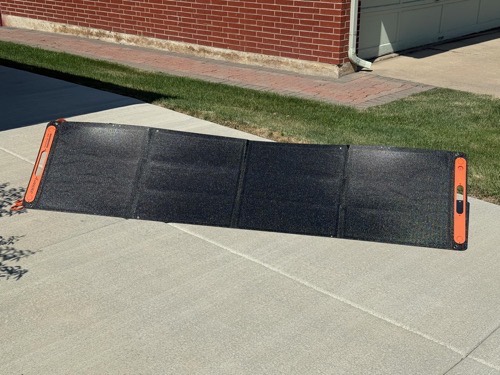
Second: the bifacial cell design. Both the front and rear surfaces are active, harvesting reflected light from below. In reflective environments — white gravel, sand, snow, light-colored concrete — the rear side can add 10-25% to effective output. It’s not magic, and it doesn’t work on grass or dark soil, but in the right conditions the bifacial advantage is real and measurable.
Third: IP68 certification. Not IP65 (spray-resistant), not a vague “waterproof” claim, but full IP68 — the highest portable panel rating in this product line. The panel body can handle rain, splashes, and brief submersion without damage. For buyers leaving panels deployed outdoors during camping trips or mounting them on RV rooftops, IP68 is the honest outdoor standard.
Who This Panel Works With
| Use case | Compatibility |
|---|---|
| Jackery Explorer 1000Plus / 2000Pro / 2000Plus / 3000Pro | Direct — native DC8020 connector |
| Earlier Jackery Explorer models (DC7909 input) | Direct — DC7909 connector included on cable |
| Non-Jackery power stations | Adapter required; verify voltage compatibility |
| 12V lead-acid / LiFePO4 batteries | Separate MPPT controller required |
| Phones, tablets (direct) | Yes — USB-A and USB-C ports |
| Bluetti, EcoFlow, Goal Zero stations | Adapter required; not officially recommended |
The SolarSaga 200W is genuinely versatile for Jackery owners and restrictive for everyone else. The USB ports add meaningful flexibility for device charging, but for power station charging, the DC8020 connector story limits the audience.
Bifacial Cells: What the Second Side Actually Does
Bifacial solar technology sounds compelling, but understanding when it delivers is important before making a purchasing decision.
Standard solar panels convert light hitting the front surface into electricity. That’s it. Bifacial panels additionally harvest albedo — reflected sunlight bouncing off surfaces around and below the panel.
The amount of that reflected light depends on the surface underneath:
| Ground surface | Approximate albedo | Rear-side output boost |
|---|---|---|
| Fresh snow | 80-90% | 15-25% |
| White sand / beach | 25-40% | 8-15% |
| Light concrete / gravel | 20-30% | 6-12% |
| Dry grass / bare soil | 10-20% | 3-7% |
| Dark soil / asphalt | 5-10% | 1-4% |
For RV campers in the Southwest desert, beachgoers, or winter sports enthusiasts deploying panels on snowy ground, bifacial output is a genuine advantage. For everyone deploying on standard green grass or soil, the rear-side benefit is real but modest.
The IBC cell construction compounds this advantage. Because the rear surface is unobstructed by front electrodes, the bifacial harvest is cleaner and more efficient than bifacial PERC designs. It’s the correct cell architecture for a bifacial panel.
Performance in the Field
Charging performance data based on product specifications and Jackery’s stated compatibility:
| Scenario | Expected output |
|---|---|
| Jackery Explorer 1000Plus (1264Wh) from 20% | ~7-8 hours (single panel, good sun) |
| Jackery Explorer 2000Pro (2160Wh) from 20% | ~13-15 hours (single panel, good sun) |
| Direct USB-C phone charging | Up to 15W direct |
| Two panels in parallel (400W) | Roughly halves charge times above |
The 26.7% IBC efficiency means this panel produces more real-world output per square inch than standard mono panels of the same rated wattage. In overcast or partially cloudy conditions, IBC cells retain more output than PERC alternatives — a meaningful practical advantage for buyers in the Pacific Northwest, UK, or other frequently overcast climates.
The 23.2V output voltage is specifically calibrated for Jackery’s charging protocol. Running this panel into a non-Jackery station works in theory (via adapter), but the charging voltage compatibility should be verified for any specific power station before purchase.
How Easy Is It to Set Up?
For a Jackery Explorer owner, setup is almost trivially easy. Unfold, extend kickstand, angle toward sun, plug in the included cable, connect to Explorer — done in under a minute. Jackery’s stated “10-second setup” claim is marketing hyperbole, but 60 seconds is realistic.
The built-in kickstand handles most angle settings adequately. For winter use at higher latitudes, a steeper angle would be ideal — the kickstand range may not fully accommodate 60°+ tilt. A secondary stand or prop can compensate, but it’s worth knowing.
The cable management on the included multi-functional cable is clean. Having DC8020, DC7909, USB-A, and USB-C on a single cable avoids the cable-swap exercise that multiple-connector setups require. The cable length of 9.8ft is enough for most camping scenarios where the power station is near the panel.
IP68 in Practice: The Best Weather Rating in This Comparison
IP68 is the highest weatherproof certification available for consumer electronics, and it’s rare in portable solar panels. To put it in context:
| Rating | Protection level | Real-world meaning |
|---|---|---|
| IP65 | Dust-tight, water jets | Handles rain and splashing |
| IP67 | Dust-tight, 30 min at 1m | Temporary submersion |
| IP68 | Dust-tight, extended submersion | Full water resistance |
| None / “waterproof claimed” | Unverified | Manufacturer says waterproof, no test standard |
The SolarSaga 200W is IP68 on the panel body — which means leaving it deployed in a rainstorm is genuinely fine. The panel won’t be damaged by overnight dew, sprinkler systems, or unexpected downpours. That certainty is meaningful for outdoor deployments where bringing the panel in every evening isn’t realistic.
The one important asterisk: the included multi-functional charging cable is not weatherproof. Jackery states this explicitly. In heavy rain use, the cable connection points where the panel cord meets the cable should be protected — a cable guard or sheltered connector position handles this easily.
Worth Knowing — The IP68 rating covers the panel body and its sealed junction box. Connectors and cables represent the weakest point in any solar panel’s weather resistance. Jackery’s honest disclosure about the cable is appreciated — but it means field rain use requires some cable protection attention.
Build Quality and Design Choices
The SolarSaga 200W feels like a premium product from the moment you unfold it. The aluminum frame is robust — comparable to fixed-mount residential panels rather than the flexible fabric construction found on budget portables. The ETFE film surface on the rear bifacial face is cleanly fitted and scratch-resistant.
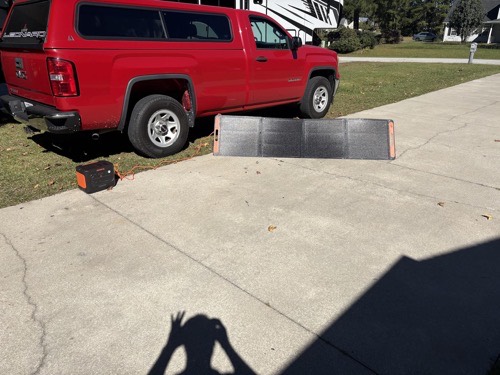
The kickstand is integrated into the panel body rather than added as an accessory, which matters for quick deployment. You unfold, position the kickstand, angle it toward the sun, and plug in. Setup takes under a minute.
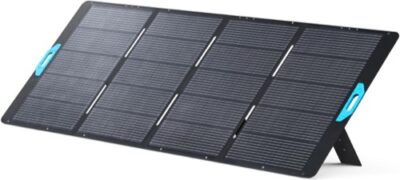
Folded dimensions of 24×21.7×1.8 inches mean it fits in most car trunks without modification. It’s not a panel you throw in a day pack — at 14.3 lbs, it’s car camping weight. The ergonomic handle Jackery mentions in the bullet points is real: the panel has a molded grip that makes one-handed carrying from storage to deployment genuinely comfortable.
The connector setup is the clearest indicator this panel is designed for Jackery users. The DC8020 port is Jackery’s proprietary input, matching the Explorer 1000Plus, 2000Pro, 2000Plus, and 3000Pro directly. If you own one of those stations, this is the cable you want — no sourcing, no compatibility research. If you don’t own a Jackery station, you’re relying on the USB-A and USB-C ports or hunting for a DC8020 to XT60 adapter.
Long-Term Ownership Considerations — Jackery SolarSaga 200W
The 5-year warranty is the longest available in this product comparison by a significant margin. Jackery’s support history suggests the warranty is honored without excessive friction, and the company maintains an accessible support channel.
IBC cell technology has a strong longevity track record in the residential solar market. The same cell architecture used in premium home panels with 25+ year performance guarantees is what this panel uses. In a portable product, that doesn’t translate directly to decades of use — physical wear, hinge stress, and connector fatigue introduce limits — but the cell degradation profile is better than entry-tier panels.
The aluminum frame resists corrosion; the ETFE rear surface is UV-stable and scratch-resistant. For a panel that gets deployed at campsites and then stored for weeks between trips, these materials hold up reliably.
Which Buyers Will Love This
| Buyer type | Fit |
|---|---|
| Jackery Explorer 1000Plus / 2000Plus / 3000Pro owner | Perfect fit — built for this exact setup |
| RV camper wanting permanent outdoor durability | Strong fit — IP68 + aluminum frame |
| Beach and desert camper | Strong fit — bifacial rear cells work well here |
| Buyer wanting the best portable efficiency in 200W | Strong fit — 26.7% IBC is the top tier |
| Casual camper who just needs a simple panel | Overkill — simpler options cost less |
| Backpacker or long-distance hiker | Poor fit — 14.3 lbs is too heavy |
| Non-Jackery power station owner | Workable with adapter — not ideal |
| 12V battery maintenance | Needs separate controller — not the right choice |
What's the Verdict?
The Jackery SolarSaga 200W is the right panel for a specific buyer: someone who owns a Jackery Explorer power station, wants genuine IP68 durability for outdoor use, and is willing to pay for IBC cell efficiency. For that buyer, it’s hard to recommend against — the native connector, the IP68 build, the 5-year warranty, and the 26.7% efficiency form a complete package that no competitor in this comparison matches.
The bifacial cell design adds real output in reflective conditions. The IP68 certification is the real outdoor standard — not a marketing claim. And the 5-year warranty signals confidence in the product’s longevity that shorter-warranted panels can’t match.
Where it falls short is everywhere else. Non-Jackery users face connector friction. The 14.3lb weight rules out backpacking. The cable isn’t weatherproof despite the IP68 panel rating. And the premium price is only justified if you’re actually using the differentiating features.
For Jackery owners who camp, RV, or spend time outdoors in conditions that include rain — this is the panel to buy. For everyone else, the value math doesn’t quite add up.
Pros & Cons Analysis
Based on documented specifications and owner feedback
Pros
- Bifacial IBC cells at 26.7% efficiency — among the highest efficiency ratings available in a portable foldable panel. IBC (Interdigitated Back Contact) construction eliminates front-side electrodes, reducing shading losses and boosting output.
- IP68 waterproof rating — the highest in this comparison — full submersion rating means rain, splashes, and outdoor exposure are a non-issue. A significant upgrade over IP65 and uncertified "waterproof" claims.
- Native Jackery ecosystem connector — the included cable has a DC8020 port that connects directly to Jackery Explorer power stations without adapters. No research, no compatibility guesswork for Jackery owners.
- 5-year warranty — the longest warranty in this product comparison by a significant margin. Jackery's support reputation is generally positive among long-term users.
- Bifacial design adds output in reflective environments — reflected light from bright surfaces (sand, snow, light-colored ground) can add 10-25% to effective output. Particularly useful for RV deployments where the ground beneath the panel reflects sunlight.
- USB-C and USB-A direct device charging — built-in USB ports allow charging phones and tablets directly from the panel without needing the power station as an intermediary.
- 9.8ft cable with multi-connector tip — the included cable provides multiple connector options (DC8020/DC7909, USB-A, USB-C) on one cable, reducing cable clutter for multi-device setups.
- Strong low-light performance — IBC cell technology handles diffuse light and overcast conditions better than standard PERC monocrystalline at similar wattage ratings.
Cons
- Premium price over standard 200W panels — the bifacial IBC and IP68 features come at a significant price premium. Buyers who don't need the Jackery ecosystem connection or premium durability can find standard 200W monocrystalline panels for considerably less.
- Charging cable is not weatherproof — Jackery notes the included multi-functional cable is not weatherproof. Buyers using the panel in heavy rain need to protect the cable connection points, which somewhat undermines the IP68 panel rating in field use.
- Heavy at 14.3 lbs — among the heavier 200W portable options. Customers planning extended hiking or frequent travel noted the weight makes it better for car camping than backpacking.
- Larger folded footprint — folds to 24×21.7×1.8 inches. Larger than many 200W competitors when folded, which affects storage in compact van builds or suitcase packing.
- Bifacial benefit requires reflective ground surface — in typical grass, dirt, or dark ground setups, the rear-side cells contribute little. The bifacial advantage is real but only matters in specific deployment conditions.
- Proprietary DC8020 connector limits non-Jackery use — while USB ports provide some versatility, the main DC output uses Jackery's proprietary connector. Non-Jackery power station users need an adapter or a different panel choice.
- 23.2V output requires compatible power station — the 23.2V output voltage is calibrated for Jackery's charging protocol. Other power stations may show compatibility issues or reduced input efficiency.
- No charge controller included — unlike the DOKIO kit in this comparison, the SolarSaga 200W doesn't include a standalone controller. It's designed to pair with Jackery stations, which have built-in MPPT management.
Our Verdict
Charging performance (4.4/5) — Bifacial IBC cells at 26.7% efficiency and Jackery's built-in MPPT integration deliver strong real-world output, with low-light performance that beats standard PERC mono. The score sits just below the top tier because the 23.2V output is calibrated for Jackery and there's no standalone controller option.
Value & compatibility (3.8/5) — Outstanding value for Jackery Explorer owners who actually use all three differentiators — bifacial harvest, IP68 durability, and the native DC8020 connector. For non-Jackery buyers or anyone who just needs a basic 200W panel, the premium price is harder to justify.
Build & weatherproofing (4.7/5) — The standout: a genuine IP68 panel body with an aluminum frame, tempered-glass front, and ETFE bifacial rear surface. The only real deduction is the included charging cable, which Jackery states is not weatherproof.
Install & usability (4.2/5) — Plug-and-play in under a minute for Jackery owners thanks to the built-in kickstand and multi-connector cable. The 14.3 lb weight and larger folded footprint pull the score down for backpackers and compact-van builds.
Bottom line — Best for Jackery Explorer owners who car camp, RV, or deploy outdoors in the rain and want top-tier efficiency with genuine IP68 durability. Skip it if you need backpack-friendly weight, a universal connector, or just a simple budget 200W panel.
Frequently Asked Questions
Is the Jackery SolarSaga 200W compatible with non-Jackery power stations?
Partially. The panel includes USB-A and USB-C ports for direct device charging. However, the main DC output uses Jackery's proprietary DC8020 connector, which requires an adapter for non-Jackery power stations. The panel charges Jackery Explorer models directly without adapters.
What does 'bifacial' mean and does it actually produce more power?
Bifacial means the panel has solar cells on both front and rear surfaces. The rear cells harvest reflected light from the ground or nearby surfaces. In reflective environments — sand, snow, light-colored gravel or concrete — the rear side can add 10-25% to effective output. On dark soil, grass, or carpet, the rear-side contribution is minimal. The benefit is real but environment-dependent.
What's the difference between IBC cells and standard monocrystalline?
IBC (Interdigitated Back Contact) cells relocate all electrical contacts to the rear of the cell, eliminating front-side electrode shading. This is why IBC cells achieve higher efficiency (26.7%) than standard PERC monocrystalline (typically 20-23%). They also perform better in diffuse and low-light conditions.
Does the IP68 rating mean I can leave the SolarSaga 200W out in the rain?
The panel itself is IP68 rated — it can withstand full submersion briefly. However, Jackery specifically states the included multi-functional charging cable is not weatherproof. In heavy rain use, protect the cable connection points. The panel surface and frame are fully weatherproof.
How long does it take to charge a Jackery Explorer 1000 Plus with this panel?
A Jackery Explorer 1000 Plus (1264Wh) paired with one SolarSaga 200W panel typically takes 8-10 hours in good sun conditions. Using two SolarSaga 200W panels simultaneously reduces that to roughly 4-5 hours. Jackery's stated pairing guide recommends multiple panels for power stations above 1000Wh.
What does the SolarSaga 200W weigh and how does it fold?
The SolarSaga 200W weighs 14.3 lbs and folds to 24x21.7x1.8 inches. It's designed for car camping, RV trips, and outdoor setups where weight is a minor concern — not for ultralight backpacking where every pound matters. The kickstand is built into the panel for easy angled placement.
Does the Jackery SolarSaga 200W come with a charge controller?
No standalone controller is included. The panel is designed to pair with Jackery Explorer power stations, which have MPPT charge management built in. If you want to use this panel with a 12V battery, you'll need a separate MPPT controller.
How does the 5-year warranty work?
Jackery offers a 5-year warranty on the SolarSaga 200W panel — the longest in this product comparison. Warranty coverage includes manufacturing defects and premature performance degradation. Jackery's support has a positive general reputation for honoring warranty claims. Keep your purchase receipt and register the product on Jackery's website for simplest warranty access.
Technical Specifications
| Brand | Jackery |
|---|---|
| Model / SKU | SolarSaga 200W / JS-200D (ASIN B0D8377KV3) |
| Panel format | Folding bifacial portable |
| Rated output (Pmax) | 200W |
| Cell technology | Bifacial IBC monocrystalline |
| Module efficiency | — |
| Voltage at maximum power (Vmp) | 23.2V |
| Current at maximum power (Imp) | 8.62A |
| Open-circuit voltage (Voc) | — |
| Short-circuit current (Isc) | — |
| Power tolerance | — |
| Maximum system voltage | — |
| Maximum series fuse | — |
| Output connector | DC8020/DC7909 with USB-A and USB-C |
| Output cable | 9.8 ft |
| Deployed dimensions | 89.72 × 23.5 × 0.98 in |
| Folded dimensions | 24 × 21.7 × 1.8 in |
| Weight | 14.3 lb |
| Surface and frame | ETFE/tempered-glass bifacial construction |
| Positioning / mounting | Integrated kickstands |
| Environmental protection | Panel IP68 |
| Wind / snow load | — |
| Operating temperature | -4°F to 149°F (-20°C to 65°C) |
| Included accessories | Panel and multifunction charging cable |
| Product warranty | 5-year product warranty |