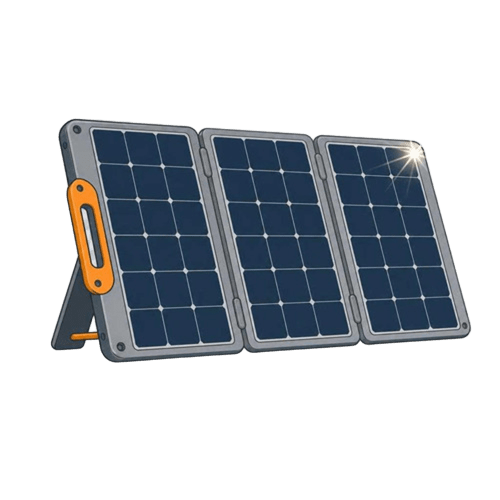
ZOUPW 100W Solar Panel Review: Five Connectors, Zero Adapter Hassle
At a Glance
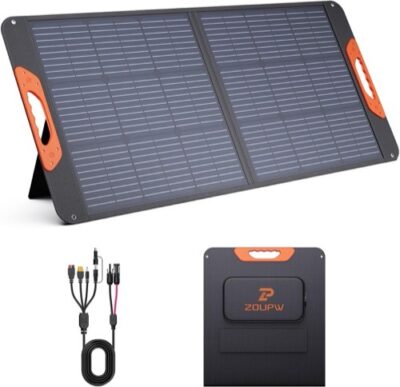
KEY FEATURES
- Power output: 100 W claimed, monocrystalline silicon cells
- Output: 20.16 V operating voltage, 24.3 V open-circuit voltage, XT60 / Anderson / DC5521 / DC7909 / DC8020 plus USB-C and USB-A device charging
- Cell efficiency: 23.5% high-efficiency monocrystalline cells
- Weatherproofing: IP67 panel body, ETFE coating, fabric-backed foldable construction
- Charge controller: Built-in intelligent controller for USB/direct device ports; MPPT/PWM type not specified
- Best for: Jackery, EcoFlow, Anker, Bluetti, Goal Zero, Predator, and similar portable power stations used for camping, outages, RV trips, and off-grid charging
PROS
- Often delivers 60W to 80W in decent sun, which is solid for a portable 100W panel.
- The 5-in-1 cable covers XT60, Anderson, DC5521, DC7909, and DC8020-style setups.
- IP67-rated ETFE panel surface handles rain and outdoor use better than many budget PET panels.
- The foldable body, magnetic handle, and zippered pouch make storage and transport easy.
- Built-in USB-A and USB-C ports are handy for direct phone and accessory charging.
- Strong value if you want a cheaper alternative to name-brand portable panels.
CONS
- Clouds, shade, poor angle, and battery input limits can pull output well below the 100W rating.
- Some USB-C-only power stations still require a separate adapter despite the broad connector kit.
- The USB hub, pocket area, and connected devices still need to be kept dry.
- At around 9.5 lb, it is more car-camping friendly than backpacking friendly.
- USB-C charging may top out below the highest advertised PD expectations with some devices.
- The 12-month warranty is adequate, but not as reassuring as longer warranties from premium brands.
Editor's Choice
Based on exact documentation and qualitative exact-ASIN Amazon owner evidence; no hands-on test or population-rate claim
This ZOUPW 100W review starts with the thing most buyers care about after their first frustrating solar setup: the connector kit. Lots of portable panels look similar on paper, but this one includes XT60, Anderson, DC5521, DC7909, DC8020, USB-A, and USB-C options, which means you’re much less likely to end up at camp with the wrong plug.
The practical problem is this: you might own a Jackery power station, an Anker battery, a laptop, and a couple of phones, and each one seems to want a different cable. That said, the wrong connector isn’t a small inconvenience when your fridge, fan, CPAP backup, or internet gear depends on the battery being charged by morning.
In practice, 100W is the sweet spot for weekend camping, patio backup, and moderate power station top-ups. This isn’t the panel you buy to refill a huge battery bank in a couple of hours, but it’s a capable mid-size option that works with far more gear than most budget panels.
Why buyers choose it
The F100W combines a long station lead, several barrel/XT60/Anderson routes, direct USB, a pouch, and a folding body.
Why compatibility still fails
A connector can fit while voltage, polarity, current limit, or a model-specific Jackery sleeve remains wrong.
The larger owner record reinforces that compatibility—not a single watt reading—is the strongest reason to consider the ZOUPW. Owners describe successful charging with several Jackery generations, Anker, Bluetti, EcoFlow, and smaller battery packs. Yet one updated account only worked after a special adapter arrived, and other buyers found that a receiving station capped input below what the panel could theoretically supply. Those are not contradictions: the panel, adapter, and receiver form one circuit.
Owner output observations span a wide range because sky, angle, cell temperature, station behavior, and battery state all change the display. The most useful reports document the receiving station and conditions: some show the F100W approaching the input ceiling of a small Jackery, while others settle lower under ordinary camping sun. An isolated high or low value cannot become a universal expectation. What can be generalized is that partial shade and a poor angle matter, and that a nearly full station may taper even when the panel is still capable of more.
A strong fit: the folded size, pouch, ten-foot lead, and adapter coverage reduce setup friction.
A weak fit: 9.48 pounds and a briefcase footprint are vehicle-portable, not trail-light.
Direct USB is convenient, but a battery buffer is steadier when sunlight changes.
Not a direct connection; add a controller with the correct chemistry profile.
The physical evidence is mostly about thoughtfulness rather than invulnerability. Owners praise the cable pouch, magnetic carry closure, included tips, and reasonably manageable weight. Complaints concentrate more on stand angle and model-specific adapters than on the cells themselves. The stands work best on level ground with calm air; low winter sun, hard pavement, or wind may require independent support and anchoring.
Finally, interpret IP67 narrowly. The panel surface may tolerate outdoor exposure, while the USB hub, adapter junctions, power station, and open connections still need shelter. A portable textile-backed panel should be dried, inspected, and stored rather than treated like a permanent framed roof module.
Compatibility: The Full Picture
Compatibility is the main reason this panel stands out. In practice, the included 5-in-1 cable solves the usual “I need another adapter” problem for many Jackery, EcoFlow, Anker, Bluetti, Goal Zero, Predator, Marbero, Forza, and Harbor Freight-style power station owners.
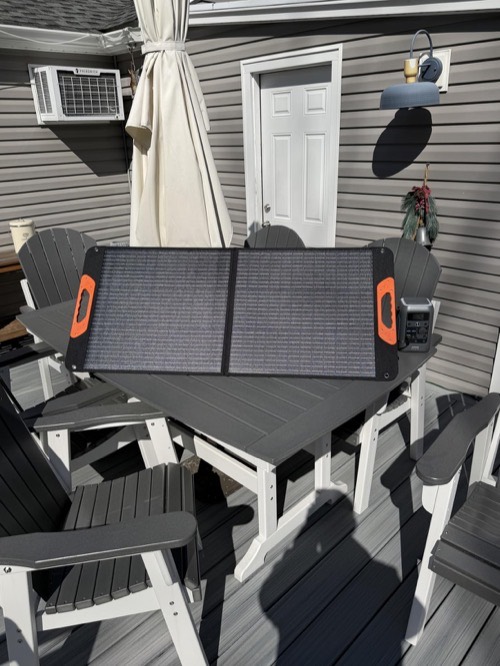
Worth knowing, though: connector shape isn’t the only thing that matters. Your power station also has a voltage range and current limit, and some stations cap solar input at 40W, 50W, 60W, or 80W even when the panel can produce more.
| Device / Power Station Type | Compatible? | Connector Usually Used | Notes |
|---|---|---|---|
| Jackery Explorer 240 / 300 / 500 | Compatible | DC7909 / 8mm | Many owners report easy plug-in charging |
| Jackery Explorer 1000 original | Compatible | Anderson | Included Anderson option helps older Jackery users |
| Jackery Plus / Pro models with DC8020 | Verify first | DC8020 | Check voltage range and exact port style |
| Jackery Explorer 300 Plus | Needs adapter in some cases | USB-C / DC8020 adapter | Some buyers needed a separate or seller-provided adapter |
| EcoFlow River / Delta series | Compatible | XT60 | Common pairing for EcoFlow solar inputs |
| Anker Solix / Anker power stations | Compatible | XT60 or DC input | Confirm model-specific solar input limit |
| Bluetti EB3A / EB70 / AC-series | Compatible | DC7909, XT60, or model-specific input | Check your Bluetti’s voltage range |
| Goal Zero Sherpa / smaller banks | Compatible if voltage and plug match | 8mm-style DC | Owners report successful use with Sherpa-style units |
| Direct phone charging | Compatible | USB-C / USB-A | Handy for camping, but output depends heavily on sun |
| Direct 12V battery charging | With caveats | Requires separate charge controller | Don’t connect directly to a lead-acid or LiFePO4 battery without proper control |
The catch is that “universal” still has limits. For example, one buyer with a newer Jackery setup needed an adapter before the panel worked with the power station, while others plugged straight into older Jackery Explorer models without fuss.
| Connector | Best Match | Included? | Practical Note |
|---|---|---|---|
| XT60 | EcoFlow, many Anker and Bluetti units | Yes | Most useful connector for newer portable power stations |
| Anderson | Older Jackery and some larger power stations | Yes | Good inclusion, but Anderson orientation can vary by brand |
| DC7909 / 8mm | Jackery 240/300/500, Bluetti EB models | Yes | One of the most common barrel-style solar inputs |
| DC8020 | Jackery Plus / Pro style inputs | Yes | Verify your station’s exact port and voltage range |
| DC5521 | Generic lithium packs and small DC gear | Yes | Useful, but not a guarantee for every small power bank |
| USB-C | Phones, tablets, some small devices | Yes | Direct charging is convenient, though not always full-power PD |
| USB-A | Phones, lights, speakers, GPS units | Yes | Best for smaller accessories |
Worth Knowing — The connector type matters, but voltage matters more. A plug that fits physically can still be wrong electrically if your power station can’t accept the panel’s 24.3V Voc.
Charging Output and Efficiency
The ZOUPW 100W is rated at 100W, which under favorable outdoor conditions translates to roughly 75W in a planning example using a 0.75 system factor. In practice, owner accounts include numbers around 60W to 80W, with some seeing around 90W or even a little higher when the sun, angle, and power station all cooperate.
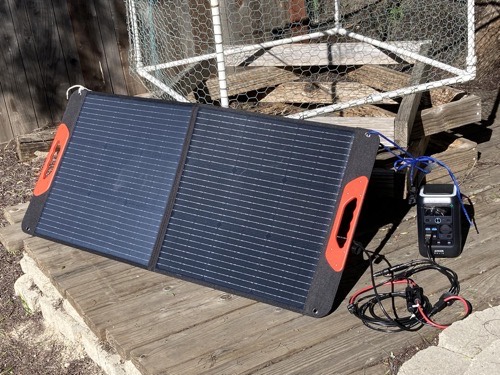
One reason is that a 100W portable panel almost never produces 100W all day in normal outdoor conditions. Battery state matters too, because many power stations taper input as they get close to full, so a “low” number on the display isn’t always the panel’s fault.
| Condition | Estimated Output | What That Means |
|---|---|---|
| Full sun, ideal angle | ~75W | Strong charging for small and midsize power stations |
| Excellent sun, cool panel, perfect match | ~85W to 95W | Possible with the right power station and alignment |
| Partly cloudy sky | ~35W to 50W | Still useful, but slower top-ups |
| Overcast / heavy clouds | ~10W to 25W | Helps slow drain; won’t refill much quickly |
| Panel angle 45 degrees off optimal | ~45W to 55W | Angle loss is noticeable, especially in winter |
| Winter sun in northern states | ~35W to 55W average | Still works, but daily Wh drops with shorter sun hours |
| Partial shade | ~5W to 30W | Shade can crush output, even if part of the panel is sunny |
Real-World Math — Using a 0.75 real-world factor, this 100W panel delivers roughly 75W in good sun. Over 4 peak sun hours, that’s about 300 Wh/day. A small 300Wh power station could gain a useful partial recharge in one sunny day, but a 1,000Wh station will still take patience.
Buyers using it with Jackery Explorer 300 units tend to be especially happy because the panel can often feed the station near its solar input limit. On the flip side, owners with larger power stations often discover that one 100W panel is useful but slow, then add a second panel or step up to a 200W model.
How Does It Look and Feel? — ZOUPW F100W
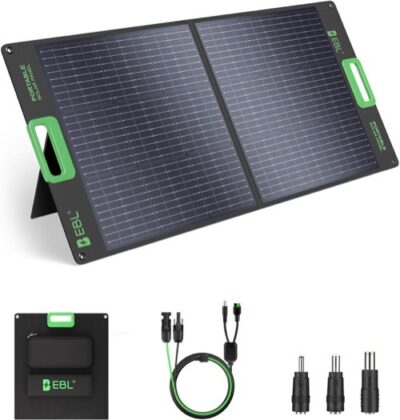
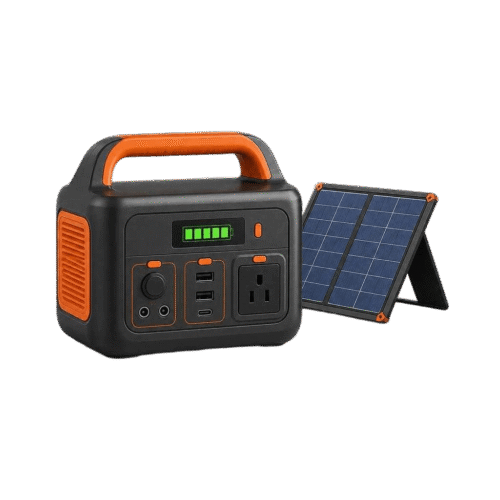
The ZOUPW 100W panel folds in half like a slim briefcase, with a magnetic handle that gives it a tidy, self-contained feel. Owners often describe the build as better than expected, and the zippered rear pouch gets a lot of praise because the cable and adapters actually stay with the panel instead of floating around your gear bin.
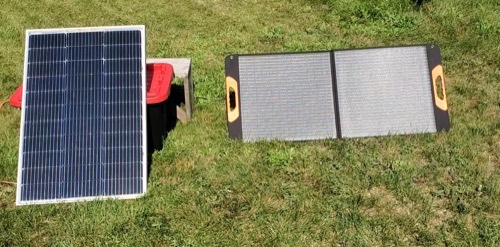
At the same time, this is still a fabric-backed portable panel, not a rigid framed glass panel. You get lighter weight and easier storage, but a few buyers say the body feels more flexible than expected, almost like stiff cardboard compared with a hard briefcase design.
In owner accounts, the 9.48 lb weight lands in the middle. It’s easy enough to carry from the car to a campsite or patio, but honestly, it’s not something most people will want to haul deep into the backcountry.
Buyer Heads-Up — If your idea of “portable” means backpacking, this panel is probably too bulky. If it means car camping, RV use, van travel, dock charging, or emergency storage, the size makes a lot more sense.
Rain, Heat, and Cold: What Owners Report
The panel body carries an IP67 rating, and the ETFE coating is a nice upgrade over cheaper PET-laminated panels. That said, ZOUPW’s own guidance makes the important distinction: the panel surface can handle rain and splashes, but the USB hub, cables, and connected devices should stay dry.
Owner accounts describe using it outdoors, camping, on patios, during storms, and even in hot desert conditions without major safety complaints. The bigger concern is less dramatic: keeping the zippered pocket and controller area from sitting in rain, and not leaving a folded fabric panel outside permanently like a rigid roof module.
| Feature | This Panel | What It Means Outdoors |
|---|---|---|
| IP rating | IP67 panel body | Better rain resistance than many budget foldables |
| Frame material | Fabric-backed foldable body | Portable and padded, but not a permanent rigid frame |
| Panel surface | ETFE laminate | More durable and heat-tolerant than basic PET surfaces |
| Junction box / controller pocket | Protected by rear zippered pocket | Keep pocket and USB area dry during rain |
| Connector weatherproofing | Not fully waterproof when connected | Avoid exposed wet connections |
| Operating temperature range | 14°F to 158°F | Covers most camping and outage conditions |
| Long-term owner reports | Positive through months to about a year in some cases | Good portable durability, with normal care |
Worth Knowing — IP67 sounds reassuring, but it doesn’t mean every part of the charging setup is waterproof. The panel body is the weather-rated part; your power station, phone, USB hub, and connector bundle still need protection.
Heat is another quiet performance factor. Solar panels lose efficiency as they get hot, so a panel baking on pavement in Arizona may show less wattage than the same panel angled in cool spring sun.
What the Controller Actually Does
The ZOUPW includes a built-in intelligent controller for its USB charging hub and safety protections. ZOUPW lists overcurrent and short-circuit protection, but it does not clearly identify the controller as MPPT or PWM for the main solar output.
In plain terms, treat this as a portable solar panel for power stations, not as a complete 12V battery-maintenance kit. If you want to charge a bare car, RV, boat, or LiFePO4 battery directly, you should add a proper solar charge controller matched to that battery chemistry.
| Feature | Available? | Why It Matters |
|---|---|---|
| Controller type | Not specified | MPPT/PWM status is not clearly listed |
| USB-C output | Yes | Useful for phones, tablets, and some small devices |
| USB-A output | Yes | Good for smaller accessories and backup charging |
| Overcurrent protection | Yes | Helps protect connected devices |
| Short-circuit protection | Yes | Helps protect the USB/direct charging circuit |
| Overcharge protection for bare 12V batteries | Not specified | Use a separate battery controller for direct battery charging |
| Reverse-current protection | Not specified | Power stations usually manage this internally |
| Battery type setting | No stated setting | LiFePO4, AGM, gel, and flooded batteries need proper profiles if charged directly |
Best Practice — Use the ZOUPW panel directly with a compatible portable power station. For bare 12V batteries, place a real solar charge controller between the panel and the battery.
What the Warranty Actually Covers
The listed warranty is 12 months from purchase, with lifetime technical support. To be fair, that’s about what you’d expect from a budget-friendly portable panel, and it’s enough for catching early defects, adapter issues, or controller problems.
The retained evidence is not suitable for estimating safety-event frequency, so electrical protection and supervised commissioning remain necessary. Worth knowing, though: the listing does not provide major safety certifications, wind load ratings, snow load ratings, or long-term degradation specs.
Long-Term Ownership — Long-term degradation for this exact portable assembly was not established by the retained evidence. On a foldable portable panel, the weak points are more likely to be cables, hinges, fabric backing, Velcro, and connectors than the solar cells themselves.
For occasional camping and emergency use, the warranty feels reasonable. For permanent marine or roof-mounted use, a rigid panel with clearer certifications and a longer warranty would be the safer long-term pick.
ZOUPW F100W: Decision Snapshot
| Spec | Value |
|---|---|
| Max Power Output | 100W monocrystalline |
| Output Voltage | 20.16V operating voltage, 24.3V open-circuit voltage |
| Connector | XT60, Anderson, DC5521, DC7909, DC8020, USB-C, 2× USB-A |
| Cell Efficiency | 23.5% |
| Weatherproof Rating | IP67 panel body |
| Charge Controller | Built-in intelligent controller for USB/direct charging; MPPT/PWM not specified |
| Cable Length | 10 ft adapter cable plus short panel lead |
| Mount Type | Fold-out kickstands |
| Best For | Campers and emergency-prep buyers using Jackery, EcoFlow, Anker, Bluetti, Goal Zero, Predator, and similar power stations |
ZOUPW 100W: What You Need to Know
If you want one foldable panel that can talk to a bunch of different power stations, the ZOUPW 100W solar panel does what you’d hope. It charges well in direct sun, feels more polished than its price suggests, and the 5-in-1 cable is genuinely useful instead of just being spec-sheet filler.
That said, this ZOUPW 100W review would be incomplete without the usual solar reality check: don’t expect 100W all day, don’t park it in shade, and don’t assume every USB-C power station is covered without checking the exact input port.
Adapter Check — Before buying any third-party solar panel, check three things on your power station: input connector, solar voltage range, and maximum solar wattage. The ZOUPW panel lists a 24.3V open-circuit voltage, so your power station needs to accept that safely.
Getting It Up and Running — ZOUPW F100W
Setup is refreshingly simple: unfold the panel, pull out the two kickstands, point it toward the sun, and connect the right adapter. Customers repeatedly mention that it starts charging quickly once plugged into a compatible power station, and the zippered pouch makes it easy to keep the 10 ft cable and tips together.
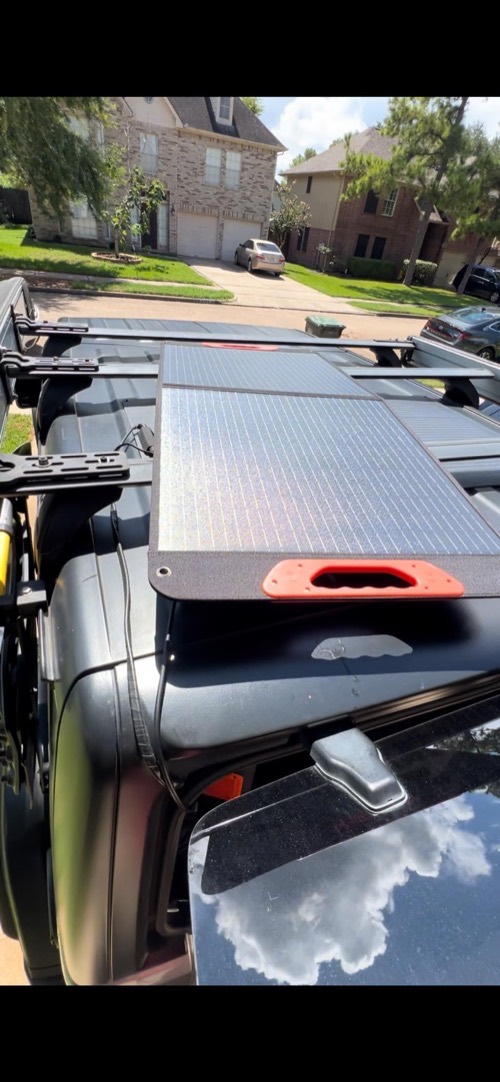
The kickstands are useful, but they’re also one of the few recurring gripes. Some owners want a higher angle, some say the fixed tilt is too low for certain seasons, and a few mention that the legs feel less stable on pavement or patios than on grass.
That said, the cable length is better than what you get with many portable panels. In practice, 10 ft lets you leave the power station in shade, inside a vehicle, or just out of direct heat while the panel sits in the sun.
Practical Tip — Don’t leave your power station baking behind the panel. Use the 10 ft cable to keep the battery in shade, then adjust the panel every hour or two if you want the best charging speed.
Our only real gripe is angle control. A more adjustable stand would make winter charging and low-sun camping easier, especially for people trying to squeeze every watt from a short daylight window.
Who Should Buy This? — Use-Case Fit Matrix — ZOUPW F100W
| Use Case | Fit | Why |
|---|---|---|
| Weekend camping with Jackery / EcoFlow / Anker | Strong fit | Great connector coverage and enough wattage for midsize top-ups |
| Emergency power station recharge | Strong fit | Useful for phones, lights, internet gear, fans, and small backup loads |
| RV travel with portable power station | Solid fit | Good for topping off stations, but not a full RV battery system by itself |
| Vanlife accessory charging | Solid fit | Works well for portable stations and small electronics in good sun |
| Off-grid shed with power station | Solid fit | Good if the panel can be placed in direct sun and brought in as needed |
| Direct 12V car battery maintenance | With caveats | Needs a separate solar charge controller |
| Boat battery charging | With caveats | Panel is IP67, but connectors and salt-air exposure need care |
| Backpacking | Skip | Too large and heavy for long carries |
| Large 1,000Wh-plus power station recharge | Borderline | Works, but one 100W panel will feel slow |
| High-draw inverter loads | Not recommended | A 100W panel can’t keep up with large AC loads |
| Shaded campsite charging | Skip | Shade cuts output hard |
| Buyer needing certified permanent install specs | With caveats | Wind, snow, and safety certifications are not specified |
You'll probably be happy if you want: — ZOUPW F100W
- A portable solar panel that works with several power station brands
- A 100W solar panel for camping, outages, and RV trips
- A foldable setup with cable storage built in
- Direct USB charging for phones and small accessories
- Better value than many name-brand portable panels
You might want to skip it if you need: — ZOUPW F100W
- A lightweight backpacking panel
- Fast charging for a large battery bank
- A permanent roof-mounted panel
- A built-in battery controller with LiFePO4 settings
- Reliable output from shaded campsites
Final Thoughts
This ZOUPW 100W review comes down to one simple point: the 5-in-1 connector kit makes this panel much easier to live with than many budget 100W foldables. Charging output is generally strong in direct sun, build quality feels solid for the money, and the rear pouch, magnetic handle, USB ports, and 10 ft cable all make it a genuinely useful campsite tool.
That said, don’t buy it expecting magic from cloudy skies or a constant 100W on the display. If you want a flexible, budget-friendly panel for Jackery, EcoFlow, Anker, Bluetti, and similar power stations, the ZOUPW 100W solar panel is an easy recommendation. If you’re trying to recharge a large power station quickly or permanently maintain a battery bank, you’ll want more wattage, a proper controller, or both.
Pros & Cons Analysis
Based on documented specifications and owner feedback
Pros
- Excellent connector coverage — Buyers consistently praise the included 5-in-1 cable because it works with common Jackery, EcoFlow, Anker, Bluetti, Goal Zero, Predator, and other portable power stations without hunting for extra adapters.
- Strong real-world output for a foldable 100W panel — Many owners report 60W to 80W in decent sun, with some seeing around 90W or higher in ideal conditions.
- Works well with Jackery power stations — Jackery Explorer 300, 500, 1000, and similar models are frequently mentioned as easy plug-in pairings using the included barrel or Anderson-style adapters.
- Useful direct USB charging — Owners like having USB-C and USB-A ports built in for phones, speakers, tablets, cameras, and smaller power banks during camping or outages.
- Good build feel for the price — Customers describe the panel as sturdy, well stitched, nicely packed, and better built than expected for a lower-cost alternative to big-name panels.
- Portable enough for car camping — The magnetic handle, folding design, and zippered accessory pouch make it easy to store cables and move the panel around camp.
- 10 ft cable is genuinely useful — Buyers appreciate that the included cable is long enough to place the panel in sun while keeping the power station shaded or inside a tent/vehicle.
- Handy kickstands for sun angle — Owners like being able to unfold the legs and tilt the panel toward the sun without building a makeshift support.
- Good value compared with name-brand 100W panels — A recurring theme is that buyers chose it over Jackery, Goal Zero, or other branded panels because performance felt close for much less money.
- Useful for outages and emergency backup — Customers report using it to recharge power stations, phones, internet gear, fans, lights, and small electronics during blackouts or storm recovery.
Cons
- Some newer USB-C-only stations may need adapters — A few Jackery Explorer 300 Plus owners mention needing a DC8020-to-USB-C adapter or seller-provided adapter before everything worked properly.
- 100W is not the everyday expectation — Customers who expected a constant 100W were sometimes disappointed, especially in haze, winter sun, clouds, shade, or when charging a nearly full power station.
- Power station input limits can cap performance — Some users see lower wattage because their battery station only accepts 40W, 50W, 60W, or tapers input as it gets full.
- USB-C PD may not always hit the advertised ceiling — Some buyers report the USB-C port topping out around 42W to 45W rather than the full claimed fast-charge level.
- Not as rigid as framed panels — A few owners describe the foldable body as thinner or slightly bendy, more like a stiff portable panel than a hard briefcase-style panel.
- Bulky for hiking or long carries — At about 9.5 lb and nearly 4 ft wide unfolded, users say it is better for vehicles, RVs, patios, and campsites than backpacking.
- Some installs still need extensions — Longer RV, roof, dock, or shed setups may need MC4-compatible extension cables to position the panel well.
- Kickstand angle and stability draw complaints — Some users wish the legs adjusted higher, felt more stable on pavement, or used something better than Velcro retention.
- Price swings affect the value story — Some owners note that it was a better bargain when purchased on sale, and the deal feels less compelling when the price rises.
- Not enough for large battery banks by itself — Owners with bigger power stations often end up adding a second panel or moving to the 200W version for faster charging.
Our Verdict
Charging performance (4.3/5) — The ZOUPW 100W delivers a real-world 60-80W in good sun from its 23.5% monocrystalline cells, with some owners seeing around 90W in ideal conditions. Using a 0.75 factor, that's roughly 75W and about 300 Wh/day over 4 peak sun hours — enough for small and midsize power stations, though clouds, shade, and input limits trim output.
Value & compatibility (4.7/5) — This is the panel's standout: the 10 ft 5-in-1 cable covers XT60, Anderson, DC5521, DC7909, and DC8020, so it plugs into Jackery, EcoFlow, Anker, Bluetti, Goal Zero, and Predator stations at a lower price than name-brand panels.
Build & weatherproofing (4.2/5) — You get an IP67 ETFE panel body, a magnetic handle, and a zippered accessory pouch, though the body feels more flexible than a rigid framed panel and major safety certifications are not listed.
Install & usability (4.4/5) — Setup is quick and the 10 ft cable lets you shade the power station, but the fold-out kickstands draw complaints for limited angle adjustment and stability on hard surfaces.
Bottom line — Best for weekend camping, RV trips, and emergency power station charging with Jackery, EcoFlow, Anker, and Bluetti. Skip it if you need a backpacking panel, fast recharge for a large battery bank, a permanent roof install, or a built-in LiFePO4 battery controller.
Frequently Asked Questions
Does the ZOUPW 100W solar panel actually produce 100 watts?
In perfect lab-style conditions, it is rated for 100W. In real use, owners commonly report about 60W to 80W in good sun, with some seeing around 90W or more under ideal conditions. Clouds, haze, winter sun, heat, shade, poor angle, and your power station's input limit can all reduce wattage.
Does it work on cloudy or overcast days?
Yes, but output drops a lot. Some users still get usable charging in haze or light clouds, while others report very low output under heavy overcast. For fastest charging, the panel needs direct, unshaded sun and regular angle adjustment.
Will it work with a Jackery Explorer 300?
Yes, many customers use it successfully with Jackery Explorer 300 power stations using the included DC7909/8mm-style connector. Some owners report charge rates around 60W to 85W depending on sun and battery state.
Is it compatible with EcoFlow River power stations?
Yes, the included XT60 connector is designed for EcoFlow River and Delta-style solar inputs. Customers mention successful use with EcoFlow River models, though your final wattage depends on the specific station's solar input limits.
Does it work with Anker power stations?
Yes, many Anker models with XT60-compatible solar input can use this panel. Owners mention good results with models such as the Anker C300 DC and Anker 548-style stations, but always confirm your power station accepts the panel's 24.3V open-circuit voltage.
Can I charge my phone directly from the panel?
Yes. The panel includes direct USB charging through one USB-C port and two USB-A ports. Buyers like this for phones, speakers, tablets, cameras, and power banks, though USB-C output may not always reach the highest claimed PD rate with every device.
Is the ZOUPW 100W panel waterproof?
The panel body is rated IP67 and uses an ETFE coating, so rain and splashes should not be a problem for the panel surface. The USB hub, cable pocket, connectors, and connected devices are not fully waterproof, so they should be kept dry during storms.
Can I leave it outside all the time?
It can handle outdoor use, but it is a portable foldable panel rather than a rigid permanent rooftop panel. For long-term exposure, protect the connector pocket and USB hub from rain, avoid standing water, and bring it in during severe wind or storms.
How long is the included cable?
The included 5-in-1 adapter cable is 10 ft long, and the panel also has its own short lead. Customers generally like the cable length for camping and patio use, but RV, dock, shed, or roof setups may still need an MC4-compatible extension.
Is the charge controller MPPT or PWM?
ZOUPW lists a built-in intelligent controller for USB and protection features, but the product data does not clearly state MPPT or PWM for the main solar output. Treat it as a portable panel with built-in USB regulation, not as a dedicated battery-maintenance controller.
Can it charge a 12V car or boat battery directly?
Not by itself as a proper battery maintainer. The panel outputs solar DC and includes device/power-station connectors, but for direct 12V lead-acid or LiFePO4 battery charging, you should use a compatible solar charge controller between the panel and battery.
Is it good for backpacking?
Not really. At about 9.5 lb and 48.5 inches wide unfolded, it is better for car camping, RVs, vans, patios, emergency kits, and base camps than long-distance hiking.
Technical Specifications
| Brand | ZOUPW |
|---|---|
| Model / SKU | ZOUPW-F100W / ZP100W-NSV1-US (ASIN B0CR42CFJ9) |
| Panel format | Folding portable panel |
| Rated output (Pmax) | 100W |
| Cell technology | PERC monocrystalline |
| Module efficiency | — |
| Voltage at maximum power (Vmp) | 20.16V |
| Current at maximum power (Imp) | 4.96A |
| Open-circuit voltage (Voc) | 24.3V |
| Short-circuit current (Isc) | 5.25A |
| Power tolerance | — |
| Maximum system voltage | — |
| Maximum series fuse | — |
| Output connector | DC8020, DC7909, DC5521, XT60, Anderson, USB-C, and USB-A |
| Output cable | 3m universal solar-output adapter cable |
| Deployed dimensions | 48.43 × 21.06 × 0.98 in |
| Folded dimensions | 24.13 × 21.06 × 1.77 in |
| Weight | 9.48 lb |
| Surface and frame | ETFE surface with fabric-backed folding construction |
| Positioning / mounting | Integrated kickstands and solar angle guide |
| Environmental protection | Panel IP67 |
| Wind / snow load | — |
| Operating temperature | 14°F to 158°F (-10°C to 70°C) |
| Included accessories | Panel, 3m adapter cable, DC adapter set, and manual |
| Product warranty | 1-year product warranty |