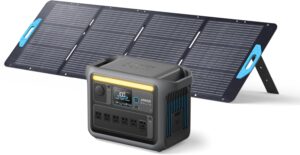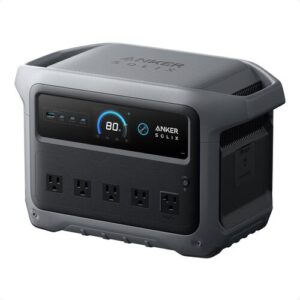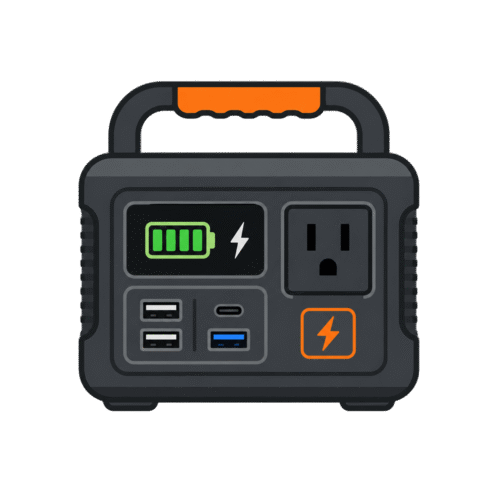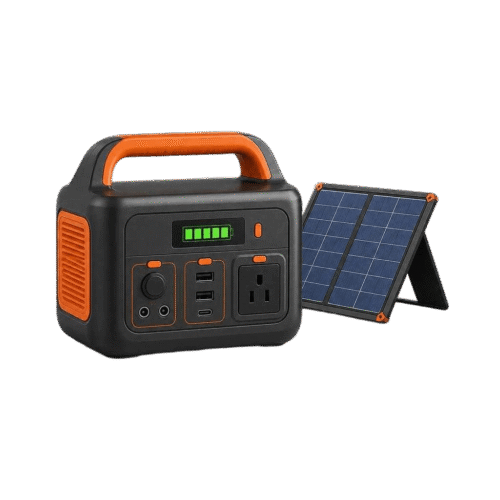
Anker SOLIX C300 Review: Compact LiFePO4 Power for Camping, Travel, and Short Outages
At a Glance
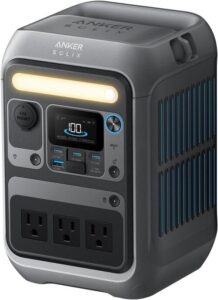
KEY FEATURES
- Battery: 288Wh, LiFePO4, rated for 3,000 cycles
- AC output: 300W continuous, 600W surge; customer testing reports clean pure-sine 120V output
- Ports: 3 AC outlets, 3 USB-C ports including 2 × 140W USB-C, 1 USB-A, 1 × 12V car socket
- Recharge: AC to 80% in about 50 minutes, solar up to 100W, car charging supported, USB-C PD input supported
- Smart features: Anker app, Bluetooth/Wi-Fi, firmware updates, output controls, pass-through / UPS-style use reported by customers
- Build: 4.1 kg / about 9 lb, 6.46" × 6.34" × 9.45", dark gray, fixed top handle
- Best for: weekend car camping, phone and laptop charging, drone batteries, routers, CPAP without heavy humidifier use, portable fridges, short blackouts
PROS
- Compact 288Wh LFP station with AC and DC output choices.
- 300W output suits electronics, networking, lighting, and tested small loads.
- USB-C, app control, and integrated lighting support travel use.
- Small battery can recharge relatively quickly from compatible sources.
CONS
- C300 AC is easily confused with the different C300 DC.
- 288Wh is a short runtime budget for moderate AC loads.
- 300W output excludes most heating and cooking appliances.
- UPS, app, fan, and restoration behavior require a real trial.
Editor's Choice
Based on exact documentation and qualitative exact-ASIN owner evidence; no hands-on test or population-rate claim
⚡ Can the Anker SOLIX C300 Run It?
Choose a common device and see the estimated runtime, whether the inverter can handle it, and how long the power station may take to recharge.
Picture this: you’re packing for a weekend camping trip, your laptop is half charged, the kids want a projector movie, and your portable fridge needs power after the car shuts off. You don’t want a gas generator. You also don’t want to drag a 30-pound battery box across the campsite.
The Anker SOLIX C300 isn’t trying to run your whole house. In practice, it works best as a quiet, compact backup for phones, laptops, routers, lights, CPAP use, drone batteries, and short fridge duty — and that’s exactly where most owners seem happiest.
The Anker SOLIX C300 is easy to confuse with the C300 DC because both use a 288Wh battery and a compact vertical body. The exact ASIN and model label matter. This review covers the AC-capable version: a small LFP station intended for electronics, lighting, networking, CPAP trials, compact coolers, and brief low-watt appliance work—not a substitute for a 1kWh outage station.
Runtime ≈ 288Wh × conservative usable factor ÷ measured average watts.
Use approved USB or DC output when it safely avoids AC inverter overhead. Keep reserve for shutdown, temperature, and battery aging.
The owner set contains many small-load, portability, runtime, port, app, UPS, noise, and solar accounts. Positive themes include compact size, integrated light, useful USB-C, and easy room-to-room movement. Cautions include output limits, fan sounds, firmware or app behavior, pass-through expectations, and isolated charging or support issues. These reports support exact-load testing and do not establish a defect rate.
| Load class | C300 AC role | Buyer check |
|---|---|---|
| Phones, cameras, laptops | Strong fit through USB-C/USB routes | Negotiated wattage, cable, and daily recharge count |
| Router, modem, CPAP | Potential backup fit | Exact power route, overnight energy, transfer, and restoration |
| Cooler or small motor | Possible within 300W | Startup, duty cycle, temperature, and reserve |
| Heat or cooking | Poor fit | Most devices exceed output or empty 288Wh quickly |
A 300W inverter can operate devices that consume the battery in less than an hour after losses. This is why the C300 works best for continuity loads rather than energy loads. A router and modem may need tens of watts; a heater or kettle needs an entirely different battery and inverter class. X-Boost-style compatibility language, where present, should never replace a measured trial.
Solar input is useful relative to the small battery, but compatibility depends on the exact C300 AC input limits, connector, polarity, and panel voltage—not on “100W” alone. The related C300 DC also has panel exclusions that should not be casually transferred between variants. Consult the exact manual and product label before buying a panel.
For CPAP or network backup, complete an overnight or full-duration drill with the same humidifier, heated hose, router traffic, and output settings planned for the outage. Portable power stations are not a universal replacement for a medically approved backup or a dedicated IT UPS.
Evidence-led verdict: the C300 AC is a focused small-load continuity and travel station. Its compactness is valuable when the buyer accepts the 288Wh and 300W boundaries and verifies the correct AC-capable variant.
C300 AC: Confirm the Variant Before Counting Outlets
If you want a small power station for weekend camping, travel, classroom use, laptop work, or short blackout backup, the C300 makes a lot of sense. For this Anker SOLIX C300 review, the clearest takeaway is simple: it punches above its weight for small electronics, charges fast from the wall, and feels more polished than many budget boxes. That said, 288Wh is still 288Wh. You’ll want something bigger for full-size appliances, long CPAP humidifier use, or multi-day outage coverage without solar.
A Compact Station Built Around Room-to-Room Movement
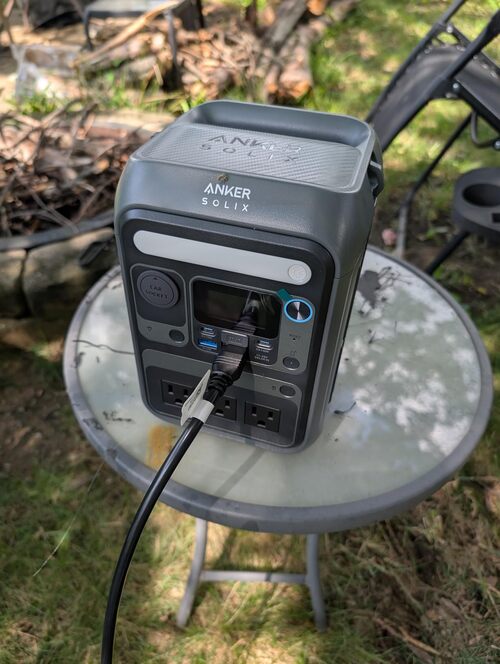
The C300 has the kind of upright, compact shape that makes more sense once you start using it. Instead of spreading wide across a table or car floor, it stands like a small tower with the handle on top. In practice, that makes it easy to grab, move, and tuck beside a desk, cooler, tent wall, or truck seat.
Customers often describe the build as solid and well put together. You get a sturdy-feeling dark gray shell, a clear front display, three AC outlets, USB ports, a car socket, and a front light bar. Honestly, the design feels more like a practical tool than a flashy gadget.
The catch is portability language. At about 9 lb, the Anker SOLIX C300 portable power station is easy to carry from the car to a campsite, but it’s not something most people will hike with for miles. Several buyers also wish the shoulder strap came in the box instead of being sold separately.
Worth Knowing — The C300 is “portable” in the car-camping sense, not the backpacking sense. Think trunk, picnic table, kayak camp, classroom, garage, or office — not ultralight trail gear.
A 288Wh Budget for Electronics and Brief Appliances
The C300 has a 288Wh battery. That’s enough for a bunch of small-device charging, a work session with a laptop, a night of router backup, or a few hours with an electric blanket. At the same time, it’s not a magic box for heaters, coffee makers, microwaves, or full-size fridges.
In real use, owners report good results with laptops, routers, portable coolers, CPAP machines, phones, lights, and drone batteries. One recurring theme is that runtime depends heavily on the load. A 15W router is easy; a 70W electric blanket or a fridge compressor changes the math fast.
| Device | Typical Power Draw | Estimated Runtime | Realistic With Margin |
|---|---|---|---|
| Smartphone charging | 10–15Wh per charge | ~18–25 charges | ~15–20 charges |
| Laptop | 50–80Wh per charge | ~3–4 charges | ~2–3 charges |
| Wi-Fi router | 10–20W | ~11–21 hours | ~9–14 hours |
| CPAP, humidifier off | 20–40W | ~5–10 hours | ~6–9 hours depending on settings |
| CPAP, humidifier on | 50–90W | ~2–4 hours | ~3–6 hours reported by some users |
| Portable fridge / cooler | 40–80W cycling | ~3–6 hours constant draw | ~5–14+ hours if cycling lightly |
| Electric blanket | 50–80W | ~3–4 hours | ~2–3 hours |
| Drone battery charging | 60–100Wh per battery | ~2–4 charges | ~2–3 charges |
| 24-inch TV | 20–30W | ~7–10 hours | ~7–9 hours |
| 1500W kettle | 1500W | Not supported | Trips inverter |
Real-World Math — At about 0.83 AC efficiency, the listed 288Wh battery gives roughly 239Wh through the AC outlets. Leave a 10% reserve, and you’re working with about 215Wh of practical AC energy.
Worth knowing, USB-C and DC loads usually stretch the battery further than AC loads because they skip inverter losses. That’s why laptop charging over USB-C can feel more efficient than plugging the laptop’s wall brick into an AC outlet.
Three Hundred Watts Is a Device Filter
A customer even tested the AC waveform and reported a clean 120V, 60Hz pure sine wave. That matters for sensitive electronics, though UPS behavior is a separate issue we’ll cover later.
| Device | Typical Draw | This Unit? |
|---|---|---|
| Phone / tablet | 10–25W | Easy |
| Laptop | 50–100W | Easy |
| LED lights | 5–15W each | Easy |
| Wi-Fi router | 10–20W | Easy |
| Portable projector | 40–100W | Easy |
| Mini fridge / car cooler | 40–80W cycling | Easy to limited |
| CPAP, humidifier off | 20–40W | Easy |
| CPAP, humidifier on | 50–90W | Runtime drops fast |
| Full-size refrigerator | 100–200W cycling, high surge | Short emergency use only |
| Drone battery charger | 60–100W | Easy |
| Small PA system | Varies, often under 300W | Easy if within limit |
| Keurig / coffee maker | 1000W+ | Trips inverter |
| Microwave | 1000W+ draw | Trips inverter |
| Hair dryer | 1500–1875W | Trips inverter |
| Large space heater | 750–1500W | Trips inverter |
| Corded power tool | Often 600W+ with surge | Usually too much |
Worth Knowing — Continuous output is the real ceiling. The 600W surge rating only lasts briefly — useful for startup spikes, not for running a 1,500W kettle.
On the flip side, the C300 does better than a normal USB power bank because it has AC outlets, high-power USB-C, and a car socket. For road trips and outages, that flexibility matters.
Fast Small-Battery Recovery Through the Correct Inputs
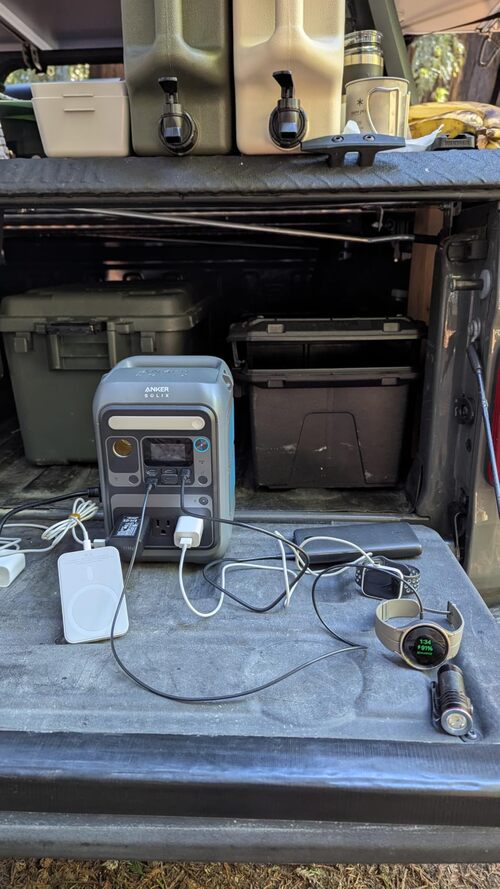
Charging speed is one of the C300’s strongest features. Anker says it can recharge to 80% in about 50 minutes from a wall outlet, and owners regularly praise how quickly it gets back to full. Shoppers on a tighter budget should also browse our budget backup station picks. In practice, that fast recharge is a big deal during outages because you can top it up during a short window of grid power, generator use, or access to an outlet.
Solar charging is useful, but the 100W input cap sets expectations. A good 100W panel in strong sun can refill the unit in a few hours, and some customers report around 70–80W in real sun from a rigid panel. That said, one owner reported a solar wake-up quirk after overnight low-light conditions, where unplugging and replugging the panel was needed to restart charging.
| Charging Mode | Estimated Time | Noise Level |
|---|---|---|
| Low-power AC mode (~100W) | ~3 hours | Very quiet |
| Standard AC charging | ~1.5–2 hours | Usually mild |
| Fast AC charging | ~1.1 hours | Fan may be more noticeable |
| Car charging (~80–100W) | ~3–4 hours | Silent from the unit |
| 60W solar panel | ~5–7 hours strong sun | Silent |
| 100W solar panel | ~3.5–4.5 hours strong sun | Silent |
| USB-C PD charging | Varies by charger | Quiet |
Adapter Check — The C300’s solar input is not the same as simply plugging in any tiny USB-C solar panel. Plan around a compatible 60W or 100W solar panel, and use the right adapter if your panel has MC4 leads.
For car charging, the C300 works best as a slow but useful road-trip top-up. Several owners keep it in a vehicle for portable fridge duty, charging while the engine runs and taking over when the car shuts off.
AC-Capable C300 Versus the DC-Only Namesake
The port lineup is generous for a small 288Wh unit. You get three AC outlets, one 12V car socket, two 140W USB-C ports, one 15W USB-C port, and one 12W USB-A port. In real use, that means you can run a laptop, charge phones, power a light, and keep a small DC accessory going without constantly swapping cables.
The high-power USB-C ports are the highlight. Most people with modern laptops will care more about those 140W ports than the AC outlets. That said, the USB-A port is basic, and a few owners wish Anker had traded one AC outlet for more USB.
Port behavior also takes a little learning. Several buyers mention that you need to press the smaller output button near the section you want to use, especially for AC. Worth knowing, a device can be plugged in and still not receive power until the correct output section is turned on.
Fan Behavior Depends on Charge Rate and Load
The C300 is quiet under light loads. Customers use it in bedrooms, classrooms, offices, cars, tents, and medical settings without describing it as distracting. Anker claims 25dB from 3.3 feet, and feedback generally lines up with the idea that this is a low-noise power station for normal small-device use.
In practice, fan noise is most likely during fast charging or heavier AC output. Even then, owners usually describe the sound as manageable rather than harsh. Heat complaints are not a major pattern in the feedback, and several users mention that it runs cool during lighter loads.
For indoor backup, the Anker 288Wh LiFePO4 power station makes the most sense for routers, lights, phones, tablets, laptops, medical accessories within spec, and small entertainment setups. It’s much nicer than a gas generator indoors because there are no fumes, no fuel, and no engine noise.
Best Practice — For bedroom or office use, run laptops and compatible devices through USB-C when possible. You’ll waste less energy, avoid AC inverter standby draw, and usually get better runtime.
Configure Auto-Off and Backup Behavior
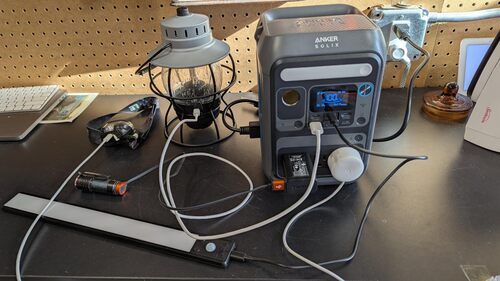
The screen gives you the basics quickly: battery percentage, charging state, output status, and remaining time estimates. Customers like that it’s easy to understand without digging through menus. The front light is also useful around campsites, outages, tents, and dark rooms.
The app is more useful than expected. You can monitor status, connect over Bluetooth or Wi-Fi, adjust settings, update firmware, and manage output behavior. To be fair, not everyone has a perfect experience — some users mention app reporting quirks, unclear input readings, or AC status not displaying the way they expected.
What the display shows?
- Battery percentage
- Output status
- Time remaining estimate
- Charging status
- Basic warning/status icons
- Easy-to-read labels in all light (Limited)
What the app lets you do?
- Monitor battery level
- Check charging and output behavior
- Adjust some charging/output settings
- Update firmware
- Use Bluetooth and Wi-Fi connection
- Accurate AC input/output reporting (Limited)
Here’s the thing: beginners should still find the C300 easy. The main learning curve is remembering that outputs have their own buttons and that low-draw ports can shut off depending on power-saving settings.
LFP for Frequent Small-Load Cycling
The C300 uses LiFePO4 battery chemistry. That’s a good fit for frequent use because LFP batteries are usually preferred for cycle life, thermal stability, and daily charging compared with older NCM lithium-ion packs. The trade-off is weight, but at 9 lb, this unit still feels manageable.
Anker lists 3,000 cycles and a 5-year warranty. In practice, that makes the C300 more appealing for buyers who want to keep a backup battery plugged in, use it weekly for camping, or cycle it often for laptops and portable devices. A few users mention defective units or battery degradation, but Anker support often appears to step in with replacements, refunds, or firmware fixes.
Long-Term Ownership — 3,000 cycles means years of regular use before major wear should show up. Daily users should still store it sensibly and avoid leaving it empty for long periods.
UPS-style use is more complicated. Some owners report excellent results with routers and network gear, especially after firmware updates that restore outlet states. On the flip side, other users warn against trusting it for sensitive computers, hard drives, or unattended firmware updates without a separate UPS.
Best Practice — For storage, leave the unit around 50–80% charge and top it off every few months. LiFePO4 is forgiving, but storing any battery at 0% or 100% for long stretches is asking for faster wear.
C300 AC Small-Load Decision Matrix
| Use Case | Fit | Why |
|---|---|---|
| Weekend car camping | Great fit | Compact, quiet, enough ports for phones, lights, fans, projectors, and small fridge duty |
| RV side-trip / van life | Good fit | Handy as a small secondary battery, not a main house battery |
| Home blackouts under 8 hours | Good fit | Great for phones, router, lamps, TV, and small electronics |
| Multi-day off-grid cabin | Limited | Needs daily solar or a larger power station |
| CPAP overnight backup | Depends | Works best with humidifier off or efficient settings |
| Portable fridge / cooler | Good fit | Works well for car coolers, though runtime depends on cycling |
| Full-size refrigerator backup | Short use only | Surge and capacity make it a limited emergency option |
| Jobsite power tools | Poor fit | 300W continuous is too low for many corded tools |
| Quiet bedroom UPS | Depends | Good for small loads, but sensitive electronics may need a true UPS |
| Hurricane / multi-day outage | Secondary role | Useful for devices, not enough for broad household backup |
| Tailgating / outdoor events | Good fit | Portable, quiet, and has three AC outlets |
| Backpacking / lightweight EDC | Poor fit | Too heavy for real backpacking |
You’ll probably be happy if you want:
- A compact power station for car camping, road trips, or short outages
- Fast wall recharge so you can top up quickly
- High-power USB-C for laptops and modern devices
- A quiet battery for phones, routers, lights, drone batteries, and small coolers
- LiFePO4 chemistry with a long warranty
You might want to skip it if you need:
- A battery for Keurigs, microwaves, hair dryers, or heaters
- Multi-day backup for a full-size refrigerator
- A serious power station for power tools
- A true computer UPS for hard drives and sensitive workstations
- Something light enough for backpacking
Different tool, different job. The C300 is a compact power station, not a replacement for a 1,000Wh or 2,000Wh backup unit.
Pros & Cons Analysis
Based on documented specifications and owner feedback
Pros
- Genuinely compact backup — The vertical form and modest weight make room-to-room, vehicle, shelf, and desk use realistic.
- AC plus strong DC options — The AC-capable model supports wall-plug devices while USB-C can avoid inverter overhead for compatible electronics.
- LFP supports frequent use — The chemistry suits regular cycling for network, travel, and small-load backup.
- Integrated lighting adds emergency utility — A built-in lamp reduces the number of separate devices in a compact kit.
- Owner scenarios align with the design — The supplied material emphasizes electronics, portability, networking, camping, and short backup rather than whole-home duty.
Cons
- Variant confusion is a material risk — C300 and C300 DC differ in outputs and charging assumptions despite similar names and capacity.
- Energy is the main constraint — A device below 300W can still consume 288Wh rapidly through the AC inverter.
- Not every small load is simple — Motor startup, CPAP settings, pass-through, and low-power auto-off need exact testing.
- Solar compatibility must be exact — Panel wattage alone does not confirm voltage, connector, polarity, or model-specific exclusions.
- Software and recovery need records — Save firmware, app settings, output state, and restoration results before unattended use.
Our Verdict
For small-device power, short outages, camping, road trips, and portable fridge support, the C300 is genuinely useful. This Anker SOLIX C300 review comes down to realistic expectations: it's fast to recharge, easy to carry, quiet in normal use, and strong for laptops, phones, routers, lights, and low-draw camping gear. The limitations are just as clear — 288Wh runs out quickly with heat, compressors, humidifiers, and anything near the 300W ceiling.
Buy it if you want a compact Anker SOLIX C300 portable power station that feels polished and practical. Skip it if your real goal is running kitchen appliances, full-size fridges for a day, or computer gear that can't tolerate power interruptions. For the right buyer, this is a smart little weekend-camping hero.
Frequently Asked Questions
How long will the Anker SOLIX C300 run a laptop?
Most laptop users should expect a few full charges or several hours of working time, depending on laptop size and whether you use USB-C or AC. Customer feedback suggests USB-C is the better option when possible because it avoids inverter losses.
Can the Anker SOLIX C300 run a CPAP machine overnight?
Yes, it can work for CPAP backup, especially with the humidifier turned off. Some owners report a full night or even longer with efficient settings, while users running heated humidification may see much shorter runtime.
Will the Anker SOLIX C300 run a refrigerator?
It can run some compact fridges, portable coolers, and car fridge/freezers for short periods. A full-size refrigerator is more borderline because compressor surge and cycling draw vary a lot.
Can the Anker SOLIX C300 power a Keurig, microwave, kettle, or hair dryer?
No for most of those appliances. The C300 has a 300W continuous inverter and 600W surge, so high-draw devices like Keurig machines, microwaves, 1500W kettles, and hair dryers are not realistic loads.
How fast does the Anker SOLIX C300 recharge from the wall?
Anker lists an 80% recharge in about 50 minutes, and many owners describe wall charging as very fast. Full recharge is usually around the one-hour range in fast AC charging conditions.
How much solar input does the Anker SOLIX C300 support?
The C300 supports up to 100W solar input. Users with 60W or 100W panels report useful camping top-ups in good sun, though solar charging is much slower than AC charging.
Does the Anker SOLIX C300 work as a UPS?
It can be used in a UPS-style setup for low-wattage equipment, and some owners report good results after firmware updates. That said, sensitive computer gear and hard drives deserve caution because some users reported AC output or firmware-update quirks.
Is the Anker SOLIX C300 pure sine wave?
The listing does not clearly highlight the waveform, but one customer tested the AC output with an oscilloscope and reported clean 120V, 60Hz pure-sine output. That makes it more suitable for sensitive electronics than modified-sine units.
Is the Anker SOLIX C300 good for backpacking?
Not really. At about 9 lb, it is portable for car camping, paddle camping, road trips, and outdoor events, but most hikers and backpackers will find it too heavy.
Does the Anker SOLIX C300 include a solar panel or shoulder strap?
No. The box includes the power station, AC charging cable, safety manual, and warranty information. Solar panels are optional, and the shoulder strap is sold separately.
Technical Specifications
| Brand | Anker |
|---|---|
| Model / SKU | Anker SOLIX C300 / A1722 (ASIN: B0D62GMQ3F) |
| Battery capacity | 288 Wh |
| Battery chemistry | LiFePO4 (LFP) |
| Cycle-life rating | 3,000 cycles |
| Expandable capacity | No |
| Continuous AC output | 300 W continuous |
| Surge / peak output | 600 W peak |
| AC voltage, frequency, and waveform | 120V, 60Hz, pure sine wave |
| AC outlets | 3 × 120V AC outlets |
| High-current, RV, or 240V output | No dedicated RV, 30A, 240V, or other high-current AC outlet published for this exact model |
| USB-C outputs | 3 × USB-C (2 × 140W two-way, 1 × 15W) |
| USB-A outputs | 1 × USB-A (12W) |
| 12V / DC outputs | 1 × 12V car socket (120W listed) |
| Maximum solar input | 100 W (11–28V, 8.2A; XT60-style solar input documented) |
| Solar input range and connector | 11–28V, 8.2A; XT60-style solar input |
| Maximum AC input | 330 W |
| AC recharge time | 80% in about 50 minutes; roughly 1.1 hours full in fast AC mode |
| Solar recharge estimate | Planning estimate: about 3.5–4.5 hours with a 100W panel in strong sun |
| UPS / EPS support and transfer time | Yes — UPS-style use reported (firmware/output-memory behavior matters for unattended restart) |
| App / connectivity | Yes — Anker app with Wi-Fi and Bluetooth |
| Operating temperature / weather rating | Not published for this exact model in the current source set |
| Dimensions | Not published for this exact model in the current source set |
| Weight | 4.1 kg / about 9 lb |
| Warranty | 5-year manufacturer warranty |