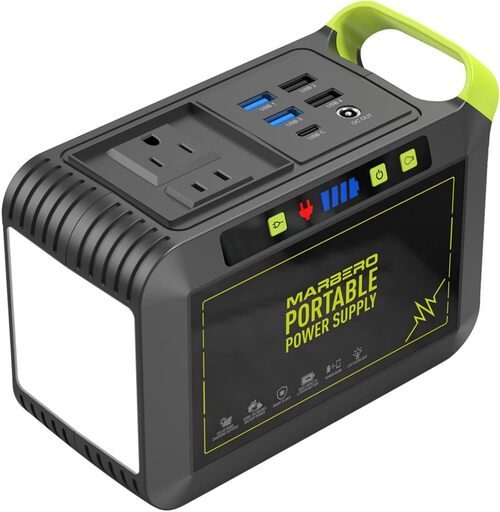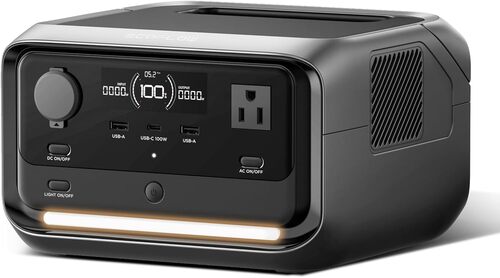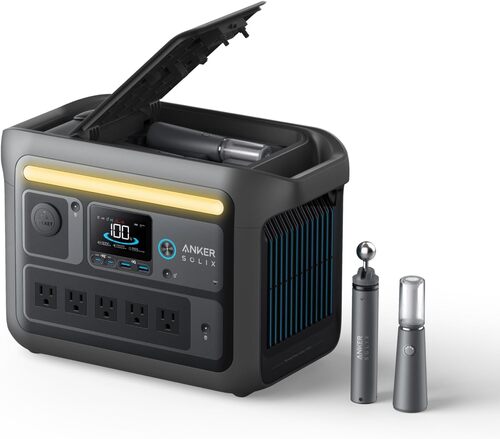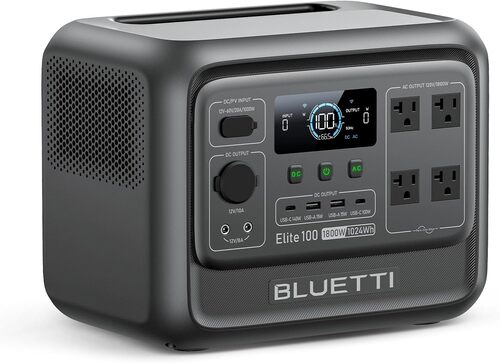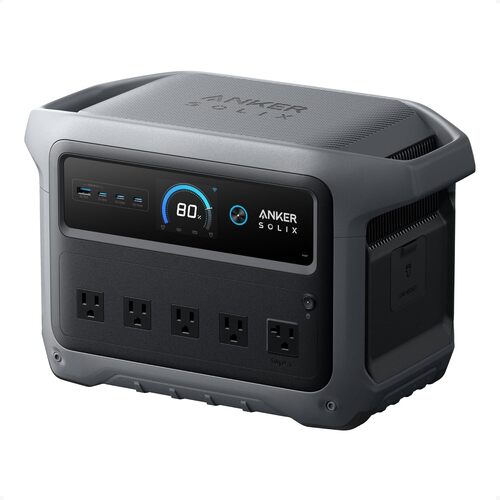
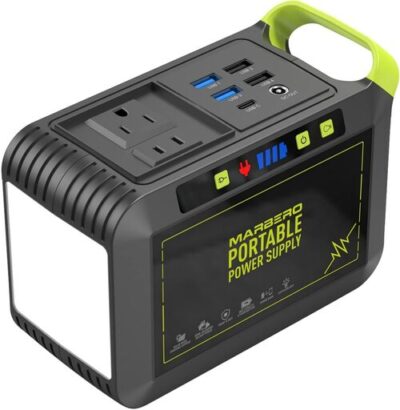
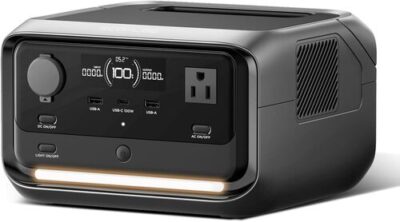
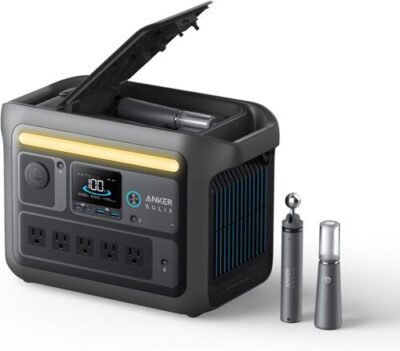
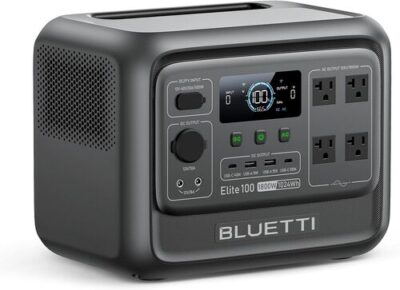
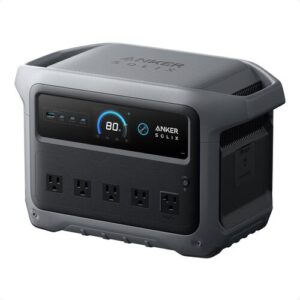
The best lightweight portable power station must earn every pound. A micro-station can be genuinely useful for phones and lights, while a roughly 25-pound 1kWh model can run substantial AC loads. Treating both as simply “portable” hides the decision.
This shortlist uses a capability frontier: how much storage, inverter output, and solar recovery each carry class provides. It also counts the cable and panel burden that product weight tables omit.
Set a Carry Ceiling Before a Capacity Target
| Carry class | What it feels like | Realistic mission |
|---|---|---|
| Under 5 lb | One-hand electronics kit | Phones, lights, camera batteries, low-watt AC |
| 7–12 lb | Easy car-to-table carry | Longer electronics duty, fans, selected compact loads |
| 20–25 lb | Short deliberate carry | 700–1,024Wh systems and meaningful AC appliances |
| Over 25 lb | Luggage or two-hand territory | Capacity becomes more important than lightweight design |
Small Batteries Have Hard AC Boundaries
An 88Wh station cannot become a kitchen-power box because it has an AC receptacle. Check continuous output before connecting any appliance, then compare energy. An 80W load can consume an 88Wh battery in roughly an hour before conversion losses; a phone charger may run for days of intermittent use.
At the 1kWh end, output can reach 1,800–2,000W without crossing 25 pounds. That is impressive density, but it does not remove the energy cost of heating appliances. Read watts versus watt-hours before using inverter size as a runtime proxy.
Count the Cable and Panel Tax
A lightweight station with a heavy power brick and rigid panel may be less convenient than a slightly heavier unit with direct AC charging. Lay out the full kit: station, wall cable, vehicle cable, solar adapter, panel, device leads, and protective case. Weigh or at least handle it as one bundle.
- Prefer integrated AC charging when repeated travel matters.
- Check whether USB-C is input, output, or both.
- Confirm the panel folds into the same luggage plan.
- Do not assume a lithium power station is allowed in airline baggage; large batteries normally exceed passenger limits.
Solar Input Can Separate Equal-Weight Stations
Two 25-pound products can have very different recovery potential. A 300W ceiling suits a slower portable-panel routine; a 1,000W ceiling can restore a 1kWh battery quickly only when compatible panels, voltage, current, adapters, and strong sun all align.
| Decision | Prefer lower weight | Prefer more input/output |
|---|---|---|
| You move it several times daily | Yes | Only if the load requires it |
| You camp beside the vehicle | Helpful | Often more valuable |
| You rely on one midday solar window | Secondary | Higher compatible PV input matters |
| You run electronics only | Usually | Extra inverter capacity may be wasted |
Choose the Carry Class, Then the Product
The lightest pick is for tiny loads, not a smaller version of a home-backup station. Compact 250–300Wh units cover mobile electronics. The 700–1,024Wh products are the better answer when “lightweight” means the most capability one person can move comfortably.
Finally, test the handle, balance, fan behavior, and charger packing during the return window. A useful lightweight station disappears into the routine; a poorly matched one becomes a box you avoid moving.
Test Portability in the Actual Routine
Move the candidate through the hardest part of its routine before committing: stairs, a vehicle threshold, a narrow cabinet, or a walk from parking to a table. Handle shape and balance can matter as much as a pound on the scale. A dense 25-pound cube with a centered handle may feel safer than a lighter, wider station that strikes your leg.
Then repeat the test with the charging kit. If the panel travels separately, count that extra trip. If the wall charger is external, confirm it has a protected storage place and enough cable reach. Portability is successful when the station and its energy source arrive together.
Commission the Lightest Viable System
- Run the priority device and all background electronics simultaneously.
- Observe remaining energy after the required operating window.
- Recharge from the exact wall, vehicle, or solar source.
- Confirm the station remains stable at low battery and under startup events.
- Remove any cable or accessory that the real routine does not use.
This process often reveals that the best lightweight portable power station is not the lightest candidate. It is the lightest complete kit that passes the job without routine overloads or a daily search for missing adapters.