VTOMAN Jump 600X Review: A Compact Camping Backup With a Jump-Start Trick
At a Glance
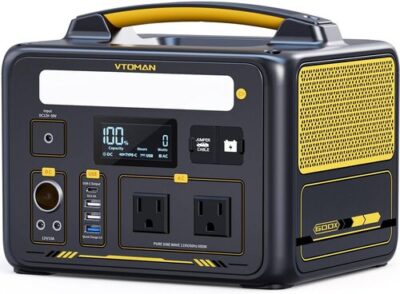
KEY FEATURES
- Battery: 299Wh LiFePO4 battery, rated for 3,000 cycles to 80% capacity.
- AC output: 600W continuous, 1200W surge; pure sine wave not specified in provided product data.
- Ports: 2 AC outlets, 1 USB-C PD 60W, 3 USB-A, 1 × 12V car port, 2 × 12V DC5521 barrel ports.
- Recharge: AC charging through supplied adapter, car charging included, solar charging supported; max solar wattage not specified in provided data.
- Smart features: Pass-through charging supported; no app or UPS mode specified.
- Best for: Camping, CPAP backup, phone and laptop charging, short blackouts, RV lights, mini fridges, road trips, and emergency car jump-starts with optional cables.
PROS
- 299Wh LFP battery and 600W pure-sine AC in a 14.8 lb body.
- Regulated 12V outputs suit coolers and vehicle accessories.
- Optional jump-start cable adds a genuine roadside role.
- Expandable to 939Wh with the matching battery.
CONS
- 100W input is slow relative to expanded capacity.
- Jump-start cable and expansion battery are separate purchases.
- 299Wh depletes quickly under high AC loads.
- 60W USB-C trails newer high-power laptop ports.
Editor's Choice
Based on exact documentation and qualitative exact-ASIN owner evidence; no hands-on test or population-rate claim
⚡ Can the VTOMAN Jump 600X Run It?
Choose a common device and see the estimated runtime, whether the inverter can handle it, and how long the power station may take to recharge.
Picture this: you’re camping, the truck battery dies, your phone is low, and the little fridge still needs power. A gas generator feels like overkill. A tiny phone bank won’t cut it either.
The Jump 600X sits in that middle lane. It’s not meant to run your whole house, but it can keep lights, phones, CPAP gear, small fridges, laptops, and camp accessories going without the noise or fuel smell.
The VTOMAN Jump 600X is differentiated less by its 600W inverter than by the combination of regulated 12V outputs, optional capacity expansion, and optional vehicle jump-start cable. That can make it a smart car-camping and roadside kit. It can also create a false sense of preparedness if the cable is not included, the battery has been left discharged, or the user has never practiced the connection sequence.
The owner set describes camping, refrigerators, CPAP, small appliances, tools, communications, solar, runtime, fan noise, UPS expectations, and roadside use. Positive and critical reports coexist around load handling, charging, and durability. They define acceptance tests, not a rate of success or failure.
| Connection | Best role | Boundary to record |
|---|---|---|
| AC outlets | Devices under the combined 600W continuous limit | Startup, V-Beyond behavior, energy use, and fan response |
| 12V car/DC5521 | Cooler, CPAP route, pumps, and vehicle electronics | Combined 120W, connector, polarity, and device approval |
| 60W USB-C | Laptop, tablet, phone, camera, and power-bank charging | Negotiated PD profile and cable rating |
| DC input | Wall, car, or compatible panel charging | 12–30V window and 100W maximum |
The 299Wh battery is a limited energy budget. A high-watt device may operate but run briefly, while a low-power 12V cooler or communications load can use the battery more effectively. The V-Beyond feature does not increase stored energy and should not be assumed to preserve normal appliance performance. Test the exact device and compare its behavior with a conventional 600W pure-sine source.
Recovery is the biggest constraint. The official specification lists a 12–30V, 100W maximum input, so a depleted battery cannot exploit a 200W panel at full nameplate power through that port. Solar conditions, cable loss, shade, and active loads stretch recharge time further. The optional 640Wh expansion battery increases total storage to 939Wh but also lengthens recovery unless daily input grows through a supported method.
Evidence-led verdict: Jump 600X is a well-targeted vehicle and camp station when its regulated DC and optional jump cable are used deliberately. Buyers prioritizing fast solar recovery or long appliance runtime should move to a larger input and battery class.
Jump 600X: Build the Roadside Kit Around the Cable
If you want a compact backup for camping, short outages, CPAP use, phones, laptops, and small 12V gear, the VTOMAN Jump 600X does a lot for its size. It’s easy to carry, has a useful port mix, uses long-life LiFePO4 chemistry, and adds a jump-start port for roadside emergencies if you buy the optional cables. Campers comparing compact EcoFlow units should read our River 3 Plus versus smaller alternatives breakdown.
That said, this VTOMAN Jump 600X review would be misleading if it treated a 299Wh battery like a full home-backup system. High-draw appliances drain it quickly, and charging speed is only average.
Fourteen Pounds and a Compact Vehicle Footprint
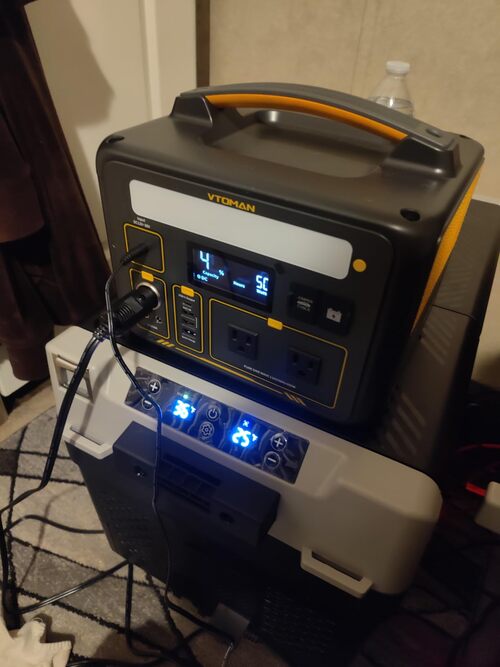
The Jump 600X has the feel of a practical utility box rather than a sleek living-room gadget. At 14.6 lb, it has enough solid heft to feel durable, but it’s still light enough to move from garage to car, tent, RV, or picnic table without much drama.
Customers often call out the handle in a positive way. In practice, that matters more than it sounds because a poorly balanced power station gets annoying fast when you’re carrying it between a campsite, vehicle, and house.
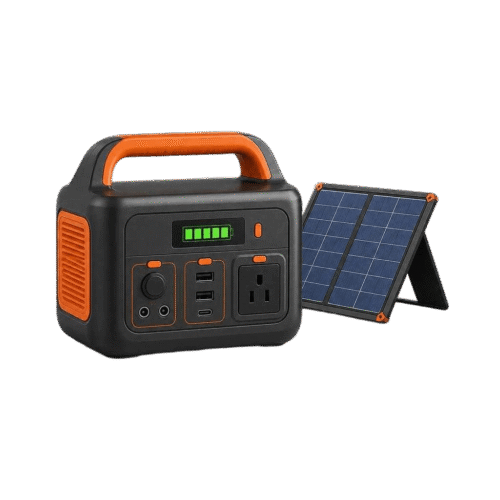
The front layout is simple: AC outlets, USB ports, DC ports, buttons, display, and the built-in light all sit where you can reach them. The bright LED light gets a surprising amount of praise, especially from owners using it during blackouts, in basements, at camp, or around vehicles after dark.
Buyer Heads-Up — The jump-start feature needs the optional jumper cable kit. The port is built in, but the cables are not included with the base package.
299Wh for Camping and Roadside Electronics
The VTOMAN Jump 600X has a 299Wh battery. Realistically, that means it’s excellent for small electronics and short appliance runs, but it is not the power station you buy if you want to run a refrigerator all night without thinking about watts.
Here’s the thing: the battery size is both the strength and the limitation. It keeps the unit portable and affordable, but it also means every high-watt appliance takes a visible chunk out of the charge.
| Device | Typical Power Draw | Estimated Runtime | Realistic with Margin |
|---|---|---|---|
| Smartphone charging | 10–15Wh per charge | 18–25 charges | Around 16–22 charges |
| Laptop | 50–80Wh per charge | 3–5 charges | Around 2–4 charges |
| Wi-Fi router | 10–20W | 12–25 hours | Around 10–22 hours |
| CPAP, no humidifier | 30–60W | 4–8 hours through AC | Better through 12V DC |
| LED camp lights | 5–15W each | 16–50 hours | Depends on number of lights |
| Mini fridge | 40–80W cycling | 3–6 hours | Around 3–5 hours |
| Full-size refrigerator | 100–200W cycling plus surge | Short emergency use | Not ideal overnight |
| Box fan | 60–135W | 2–4 hours | Around 1.5–3.5 hours |
| Drone batteries | 60–100W per charger | 2–4 charges | Around 2–3 charges |
| Small coffee maker | 500–700W | Brief use only | Large battery hit per cup |
Real-World Math — At 0.83 AC efficiency, the listed 299Wh battery delivers roughly 248Wh through the AC outlets. Subtract a 10% reserve, and you’re working with about 223Wh of practical AC energy.
Customers who use the DC ports tend to be happier with runtime. That makes sense because 12V DC avoids some inverter loss, which is useful for CPAP machines, portable coolers, astrophotography gear, and vehicle accessories.
On the flip side, feedback is mixed when people plug in larger AC loads. A fan, laptop, TV, work light, or mini fridge is fair game. A heater, microwave, or all-night full-size fridge backup is asking too much from a battery this size.
The 600W Inverter and V-Beyond Caveat
That said, watts are only half the story. A 600W device can run, but a 299Wh battery cannot run it for long.
| Device | Typical Draw | This Unit? |
|---|---|---|
| Phone / tablet | 10–25W | Easy |
| Laptop | 50–100W | Easy |
| LED lights | 5–15W each | Easy |
| Wi-Fi router | 10–20W | Easy |
| CPAP, no humidifier | 30–60W | Easy |
| CPAP, humidifier on | 50–90W | Borderline |
| Mini fridge | 40–80W cycling | Easy for short use |
| Full-size fridge | 100–200W cycling, higher surge | Borderline |
| Starlink | 50–100W | Easy for a few hours |
| Small coffee maker | 500–700W | Briefly only |
| Microwave, 700W class | Around 1100W draw | Trips inverter |
| Space heater | 750–1500W | Briefly only or trips inverter |
| Hair dryer | 1875W | Trips inverter |
| Window AC, 5000 BTU | 400–600W running, higher surge | Borderline |
| Corded power tool | Varies widely | Borderline |
Worth Knowing — Continuous output is the real ceiling. The 1200W surge rating only helps for short start-up loads, not for running a 1500W heater or kettle.
In real use, this is a better “small power when you need it” station than a “run anything” station. You’ll enjoy it more if you think in terms of phones, laptops, lights, fans, CPAP, coolers, and occasional appliance bursts.
A 100W Input Makes Recovery the Limiting Step
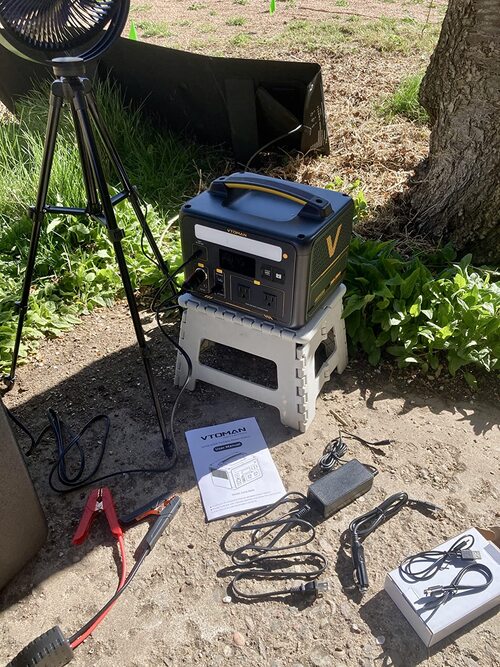
The Jump 600X can recharge from a wall outlet, a car outlet, or solar panels. Owners also like that it supports pass-through charging, though it should not be confused with a true UPS for critical equipment.
The catch is charging speed. Some customers report wall charging in a few hours, while others mention slower 5-hour or even 8-hour-plus experiences, especially with older charger bricks.
| Charging Mode | Time From Empty to Full | Noise Level |
|---|---|---|
| AC wall adapter, faster reports | Around 3.5–4 hours | Mostly quiet |
| AC wall adapter, slower reports | Around 5–8 hours | Mostly quiet |
| Older low-output AC brick | Can feel very slow | Charger may run hot |
| Car charging | Around 4 hours reported from partial charge | Silent, aside from vehicle |
| 100W solar panel | Around 5–8 hours in strong sun | Silent |
| 100W solar in weak sun | All day or more | Silent |
| Expansion battery setup | Much longer | Depends on charger |
Adapter Check — The provided data does not specify the exact solar input limit. If you plan to use third-party panels, check the manual for voltage range, connector type, and wattage before buying cables.
Solar charging works, but owners see real-world input closer to the conditions they get. In practice, a 100W panel may deliver around 60W in good sun, and less when clouds, angle, heat, or shade get involved.
For occasional camping, that’s fine. For daily off-grid living, the modest charging rate becomes one of the main reasons to consider a larger VTOMAN model.
Regulated 12V Is the Practical Standout
The port lineup is one of the better parts of the VTOMAN Jump 600X portable power station. You get two AC outlets, three USB-A ports, one 60W USB-C PD port, two DC5521 12V ports, and one 12V car socket.
That mix works well for camping and outages because you can split power between AC gear and low-voltage devices. In practice, the regulated 12V output is especially useful for CPAP machines, car fridges, air pumps, tire inflators, and DC accessories.
The limitation is USB-C. It can output up to 60W, which is enough for many laptops, but it does not work as a USB-C charging input. If you were hoping to refill the power station with a laptop charger, this is not that kind of unit.
Place the Jump 600X Where Cooling Can Work
The Jump 600X is generally quiet under light loads. Customers use it in tents, RVs, bedrooms, basements, and small rooms without describing it like a loud gas generator replacement.
At the same time, heat shows up in two places. Some owners mention the AC charging brick getting hot, and one user described a charger case hot enough to be concerning. The power station itself may also kick on fan cooling under heavier loads or warm conditions.
For indoor use, it’s still a good fit for short blackouts, CPAP backup, phones, laptops, lights, and fans. Honestly, the bigger concern is not noise — it’s choosing loads that match the small battery.
Simple Local Controls, No App Dependency
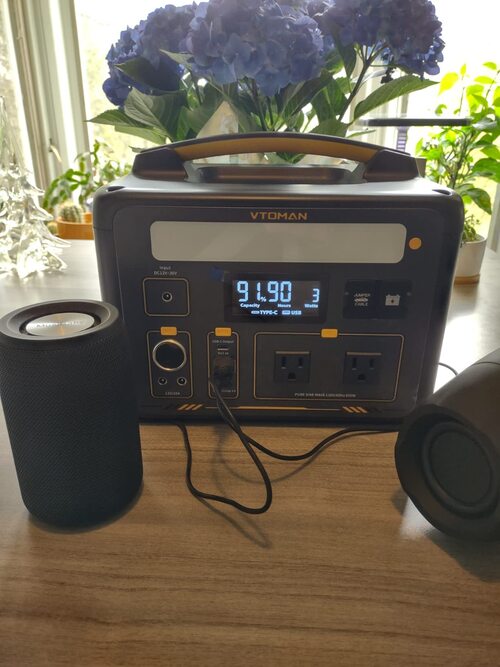
The display is simple and useful. Owners like being able to see battery percentage, input watts, output watts, and estimated remaining time, especially when testing fridges, fans, laptops, and camping gear.
That said, outdoor visibility gets mixed feedback. One owner found the screen hard to read outside, even in shade, which is worth knowing if you plan to use it with solar panels at a campsite.
For beginners, the Jump 600X feels easy to use because there isn’t much to configure. You press the output button you need, plug in your device, and watch the watts. That simplicity is part of the appeal.
LFP Helps a Kit That May Sit Between Trips
The Jump 600X uses a LiFePO4 battery, which is a real plus at this price and size. Compared with older lithium-ion chemistry, LiFePO4 is usually better for long cycle life, thermal stability, and frequent use.
VTOMAN claims 3,000 cycles to 80% capacity. To be fair, most casual campers will never cycle it that hard, but people using it for weekly outings, RV lights, CPAP backup, or outage prep should care.
Long-Term Ownership — 3,000 cycles to 80% capacity means years of regular use before major battery wear becomes the main issue. Daily users should still store and charge it properly.
Reliability feedback is mostly positive, but not spotless. Some owners report years of use, strong storage charge retention, and helpful support. Others mention DOA units, AC output failure, charging problems, or a unit that quit after months of light use.
Best Practice — For storage, leave the unit around 50–80% charge and top it off every few months. Avoid storing any power station completely full or completely empty for long stretches.
The warranty is listed as two years, and support experiences are better than expected in a bunch of owner comments. Still, the charger brick issue is worth watching, especially if your adapter gets unusually hot.
Jump 600X Roadside-and-Camp Matrix
| Use Case | Fit | Why |
|---|---|---|
| Weekend car camping | Strong fit | Portable, quiet, enough for lights, phones, fans, CPAP, and small appliances |
| RV side trips | Solid fit | Good for lights and accessories without draining house batteries |
| Home blackouts under 8 hours | Solid fit | Useful for phones, router, small TV, fan, and short fridge runs |
| CPAP overnight backup | Solid fit | Best through DC output; humidifier use reduces runtime |
| Mini fridge or cooler | Solid fit | Works well for short road trips and day use |
| Full-size refrigerator backup | Borderline | Can help in bursts, but 299Wh is limited |
| Jobsite power tools | Borderline | Some tools work, but surge loads vary widely |
| Quiet bedroom UPS | With caveats | Pass-through exists, but no true UPS mode is specified |
| Hurricane / multi-day outage | With caveats | Helpful with solar and expansion, but small by itself |
| Tailgating / vending | Solid fit | Good for lights, small electronics, and short event use |
| Backpacking | Skip | Too heavy and bulky for pack carry |
| High-draw cooking appliances | Skip | Coffee makers may work briefly; heaters and microwaves are poor matches |
The Jump 600X Fits When
- A compact LiFePO4 power station for camping and road trips
- Backup power for phones, laptops, lights, CPAP, fans, and small fridges
- A unit that can also jump-start vehicles with optional cables
- A portable station that is easier to carry than larger 1000Wh models
- Expandable capacity without buying a whole new power station right away
Choose Faster Recovery or More Energy When
- Long refrigerator backup during multi-day outages
- A true UPS for internet gear or medical equipment
- Fast AC charging like newer high-watt power stations
- USB-C input charging
- Reliable power for heaters, microwaves, kettles, or hair dryers
Pros & Cons Analysis
Based on documented specifications and owner feedback
Pros
- Roadside functions share one box — Power station, regulated 12V, lighting, and optional jump start can simplify a vehicle emergency kit.
- LFP is appropriate for repeated cycling — The published 3,000-cycle basis suits camping and backup when storage checks are maintained.
- DC outputs are practical — Two DC5521 ports and a car socket provide a direct route for compatible 12V equipment.
- Capacity can grow — The 640Wh battery offers a runtime upgrade without replacing the 600W inverter platform.
- Local operation is simple — Core use does not depend on pairing an app or cloud account.
Cons
- Recovery power is modest — The 100W input can become the bottleneck after a long night or when the expansion battery is attached.
- Preparedness requires accessories — The product name does not put a jump cable or expansion battery in every box.
- High-load capability can mislead — A 600W inverter can empty 299Wh rapidly, and V-Beyond is not extra capacity.
- All DC outputs share a limit — Multiple sockets do not each supply the full 120W DC budget.
- Acceptance testing remains necessary — Charge input, jump procedure, outlet behavior, noise, stored-battery state, and the intended loads should be proven.
Our Verdict
This VTOMAN Jump 600X review lands in a pretty clear place: it's a strong small power station for camping, emergency lighting, CPAP backup, short appliance runs, and vehicle-related backup use. The LiFePO4 battery, 600W inverter, 12V output, built-in light, and optional jump-start function make it more useful than a basic battery box.
That said, don't buy the VTOMAN Jump 600X portable power station expecting whole-home backup. Buy it because you want a quiet, portable, budget-friendly power source for the things that actually fit a 299Wh battery. Used that way, it's a genuinely practical little unit with a few charger and runtime caveats worth knowing before checkout.
Frequently Asked Questions
How long will the VTOMAN Jump 600X run a CPAP machine?
Customers report good CPAP results, especially through DC output. Expect roughly one overnight session through AC depending on pressure settings and humidifier use, and longer runtime if your CPAP can run directly from 12V DC.
Can the VTOMAN Jump 600X run a full-size refrigerator?
It can start and run some refrigerators for short periods, but it is not ideal as an all-night fridge backup. The 600W inverter and 1200W surge help with compressor start-up, but the 299Wh battery is the limiting factor.
Will it run a space heater?
Only briefly, and not as a practical heating solution. Small heaters drain the battery very fast, and larger 1500W heaters exceed the inverter rating. Use it for fans, lights, electronics, CPAP, and small appliances instead.
How long does the VTOMAN Jump 600X take to recharge from AC?
Customer experiences vary. Some owners report roughly 3.5 to 5 hours, while others with older or lower-output charging bricks mention much longer charging times. The supplied adapter is one of the more common complaints.
Can it charge from solar panels?
Yes, solar charging is supported, and owners report using 100W panels successfully. The provided product data does not specify the exact maximum solar input, so check the manual and connector requirements before buying third-party panels.
Does the VTOMAN Jump 600X support pass-through charging?
The listing says it supports pass-through charging, and some owners use it that way. That said, one owner noted the manual warned against relying on pass-through as a true UPS setup, so it should not be treated as a dedicated UPS for critical internet or medical equipment.
Is the jump-start function included?
The jump-start port is built into the power station, but the jumper cables are sold separately. Owners who bought the cables report successful vehicle jump-starts, including trucks and camping vehicles.
Is the VTOMAN Jump 600X good for camping?
Yes. Camping is one of its strongest use cases. Owners use it for lights, fans, phones, laptops, air mattresses, mini fridges, CPAP machines, small cookers, and quiet power at night.
Does it have an app?
No app support is specified in the supplied product data, and customer feedback centers on the physical display and buttons rather than app controls.
Is it easy to carry?
For a power station, yes. At 14.6 lb, it is light enough for car camping, RV use, outages, and garage projects. It is not a backpacking power bank, but it is much easier to move than larger 1000Wh-class units.
Technical Specifications
| Brand | VTOMAN |
|---|---|
| Model / SKU | Jump 600X / PB-20 (ASIN: B0BBDQ5NNN) |
| Battery capacity | 299 Wh |
| Battery chemistry | LiFePO4 (LFP) |
| Cycle-life rating | 3,000 cycles to 80% capacity |
| Expandable capacity | Yes — expandable to 939 Wh with VTOMAN Jump 600X extra battery (sold separately) |
| Continuous AC output | 600 W continuous |
| Surge / peak output | 1200 W peak |
| AC voltage, frequency, and waveform | 110V AC, pure sine wave; frequency not published for this exact model |
| AC outlets | 2 × 110V AC outlets |
| High-current, RV, or 240V output | No dedicated RV, 30A, 240V, or other high-current AC outlet published for this exact model |
| USB-C outputs | 1 × USB-C PD 60W |
| USB-A outputs | 3 × USB-A (one listed as QC 3.0 / 18W max) |
| 12V / DC outputs | 1 × 12V/10A car port |
| Maximum solar input | Not published for this exact model in the current source set |
| Solar input range and connector | Not published for this exact model in the current source set; exact PV voltage/current window and connector are unavailable |
| Maximum AC input | Not published for this exact model in the current source set; the prior value was an editorial estimate, not an exact-model rating |
| AC recharge time | About 3.5–8 hours reported (adapter version and starting charge vary) |
| Solar recharge estimate | Planning estimate: about 5–8 hours with a 100W panel in strong sun |
| UPS / EPS support and transfer time | No dedicated UPS / EPS specified (pass-through charging only) |
| App / connectivity | No app specified |
| Operating temperature / weather rating | Not published for this exact model in the current source set |
| Dimensions | 10.2" × 8.7" × 8.6" |
| Weight | 14.6 lb |
| Warranty | 2-year manufacturer warranty |